Mewsings
Archives
Tag: Asian Horror
Haze

Haze is a short (40 minute) horror film from Japanese director Shinya Tsukamoto, who also perpetrated that most harrowing of Asian horrors, Tetsuo (1989) about a man whose flesh sprouts metallic tentacles.

haze

Haze has a similarly nightmarish quality. A man wakes up to find himself incarcerated in a subterranean concrete maze in almost complete darkness. The maze he works his way through is made up of a series of tortuous (and torturous) crawlspaces, which force him to contort himself claustrophobically, often at danger of injury. In one sequence, for instance, he has to shuffle sideways through an extremely narrow corridor. Barbed wire has been laid where his heels would naturally fall, so he has to do his shuffling on tiptoes. And, as if this weren’t enough, a thick metal pipe runs along the corridor, and the only way he can fit into the space is by opening his mouth as wide as possible and grinding his teeth along the pipe as he moves.

This last detail seems a bit forced, as surely all he’d have to do is turn his head? But the best way to watch a film like Haze is discard logic and accept it, just as you’re forced to accept one of your own nightmares till you wake up. At various points the man catches glimpses, through small apertures, of a room where people are being chopped up. He finally meets a woman who’s also trying to get out and the two are forced to make their way down a corridor almost fully submerged in water and floating body parts.

As a brief nightmare, the film works, but is let down by its attempt at an ending. The man speculates on why he’s in this horrific situation, wondering if he’s being punished after some terrible war, or if a millionaire has constructed this underground dungeon for his own perverse amusement. This speculation just serves to get the viewer expecting some sort of satisfying explanation, but in the end (if I’m interpreting the very brief & tacked-on ending right) it turns out to be a sort of pain-induced semi-conscious dream as the man struggles his way back to consciousness having been injured. So it was all “just a dream”, which is hardly satisfying. But I think the best way to enjoy (if enjoy is the right word) a film like this is to forget the ending and just accept it for the Pit & Pendulum-style nightmare that it is.

Kwaidan

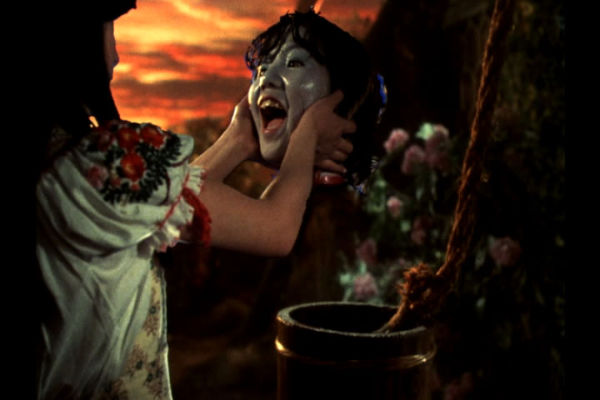
More Asian Horror, this time not part of the post-Ringu era, but a classic from 1964. Kwaidan is an anthology film, collecting four of the folk-tale-inspired ghostly horrors of ex-pat writer Lafcadio Hearn, all set in pre-modern Japan.

kwaidan

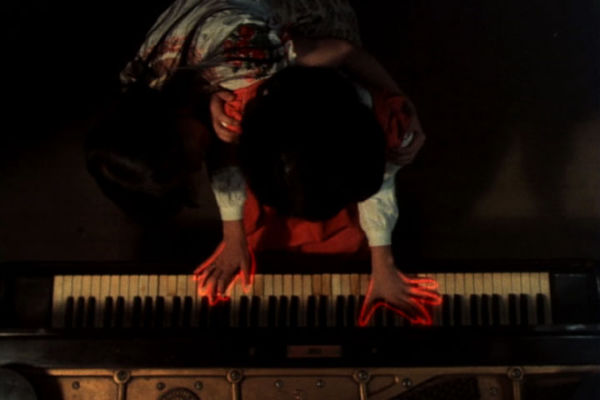
The Black Hair (from which the 2006 anthology-film, Dark Tales of Japan, got the title and idea for its Blonde Kwaidan segment) tells of a poor samurai who abandons his faithful wife for a new bride from a wealthy noble family. Later, regretting the unhappy match, he goes back to his old home to find it ruined but his wife still there, still spinning on the same old wheel. He spends the night with her but wakes to find himself lying next to a withered corpse, then goes mad as its long black hair comes to life and pursues him through the crumbling ruin.

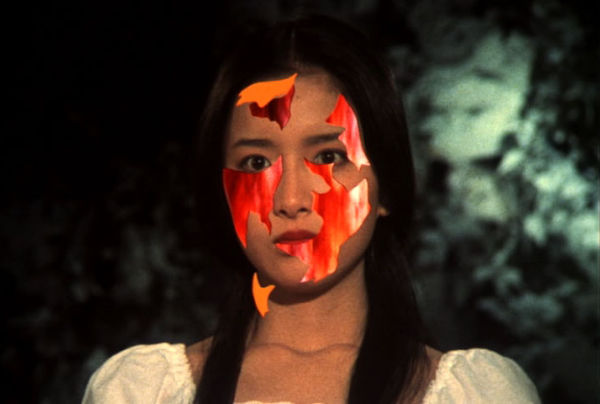
In The Woman of the Snow, an apprentice woodcutter sees his master frozen to death by the breath of a pale, demonic woman, but avoids a similar fate by promising never to speak of what he has seen. Some time later he marries, though of course doesn’t notice how remarkably similar his bride looks to that very same ice demonness. Inevitably, he breaks his promise and tells his wife what happened that night.

Hoichi the Earless is the rather bleak tale of a blind biwa-player whose skill brings him to the attention of the denizens of the underworld. To stop him from being snatched, nightly, to play before an undead court, a local priest covers Hoichi from head to foot in holy writings, missing only his ears. That night, when a ghostly messenger comes once more to summon Hoichi, all he can see is a pair of ears floating on their own in the air. The next thing we know, Hoichi is screaming, clutching where his ears once were, blood pouring from between his fingers. Lovely.

The last segment, In a Cup of Tea, is a story-within-a-story, as we learn why one writer failed to finish one particular story about a samurai who inadvertently drinks a man’s soul.

kwaidan_eyes

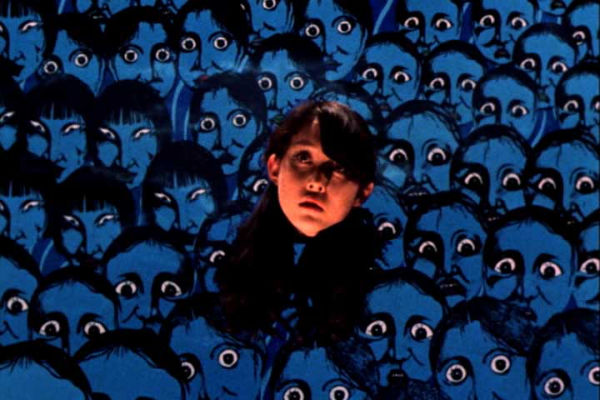
Throughout, Kwaidan makes no attempt at realism, but uses very theatrical sets, sometimes with fantasticated backgrounds, as with the Dali-esque eyes-in-the-sky of the Woman in the Snow segment, which adds to the superstitious feeling that all of nature is alive with a threatening demonic presence.

The most striking aspect of the film, though, is its soundtrack. Kwaidan uses a minimal set of traditional instruments, one of which, at times, sounds almost like an eerily extended human scream. The moments of supernatural horror are made all the more effective by the way natural sound effects drop into silence, as if the characters have fallen into another order of reality, while the sparse music twangs and grunts and screeches.

Pulse

pulsePulse (2001, Japan) is the first addition to my Rough Guide to Asian Horror, and it’s a strange one. For the first hour or so, you might think it’s a standard J-horror about a ghostly menace lurking inside The Forbidden Room, a website that causes people to become depressed, then either commit suicide or fade away into nothing but a dark stain on the nearest wall. But as the meandering storyline follows its various characters’ growing awareness of the threat, you start to realise this film isn’t going to resolve itself like your standard horror. The depression-plague spreads and begins to depopulate the world. One character asks what if there was only limited space available for the ghosts of the dead, and what if that space was now full? In an echo of the “Crevices” episode of Dark Tales of Japan, rooms sealed with red tape act as incubators in which ghosts of the dead can re-form and return to our world. It’s their touch that spreads the depression-curse.

Pulse has its share of scary moments, including that Japanese standard, the spook stalking its victim in slow, surreal, jerky steps. In one Birds-like moment, while the camera focuses on one character making a phone call, in the background a young woman casually throws herself off a tower. But in the main, Pulse is not about the sort of scary thrill-fears you expect from Asian horror. It’s a more pervasive, less focused, but far more real, fear of isolation. The graduate student who speculates on there being limited space for the souls of the dead has developed a computer program. The movement of a series of blobs on a screen are controlled by two rules: they cannot get too far apart, and they cannot get too close together. This sums up the film’s rather bleak view of its characters’ attempts to overcome their feelings of isolation in a world where, as one character says, “Words said in friendship with the best of intentions always wind up hurting your friends deeply.”

As a film, Pulse is let down by its opening, creepy J-horror gambits, because they led me to expect something quite different. (The title, of course, doesn’t help. Having watched the film, I still have no idea why it’s called Pulse.) Although marketed in a similar way, this film is less along the lines of Ringu’s pass-it-on-before-it-gets-you curse or the haunted house scenario of The Grudge and closer, by the end, to something like Day of the Triffids as the horror reaches worldwide-disaster proportions, and a truly bleak feeling at the end which even the most nihilistic of horrors (Audition, for instance) don’t manage. Not entirely successful, but certainly original.

A Rough Guide to Asian Horror

Having just watched Dark Tales of Japan, my 15th Asian horror DVD, I thought I’d provide a roundup of what’s good and what’s not in this sub-genre. I’ll start with the best:

Although obviously lower in budget than, say, the US remake (The Ring, 2002), Ring(Ringu, 1998, Japan) works because for the most part it keeps its horrors subtle, and when they aren’t subtle, they’re often surreal, thus bypassing the stock responses of a jaded genre audience by simply being so strange and new. The cursed videotape itself is a perfect example. When you get to see it, you really feel what the protagonist Reiko feels: first of all a startled, “Was that it?” Then it sinks in. “Oh my god, I’ve just watched it… But what did it mean?” There’s a real build-up to the central terror, without the usual teen-horror necessity of providing cheap jump-thrills at set intervals. It has some genuinely chilly moments. The most famous, when the terrifying Sadako comes for Ryuji, struck me as being both horrific and beautiful at the same time, something I’ve only ever experienced before when watching H R Giger’s monster uncoil out of the darkness of the escape pod at the end of Alien. My one criticism is the film’s reliance on one of its main characters having psychic powers, which distracts from the central horror, making it feel less universal, less threatening to the (presumably non-psychic) viewer. But fortunately it isn’t foregrounded enough to really impinge on the film. The sequels, Ring 2 and Ring 0, are no way near as close to the power of the original. If you’re going to watch just one Asian horror, make it Ring. (The US remake overcomplicated the plot and took all the subtlety out of the main emotional theme of neglected childhood. Avoid!)
 
ah_ringu

If you’re going to watch one more Asian horror than Ring, choose from either the South Korean A Tale of Two Sisters (2003) or Audition (1999, Japanese). Both stretch horror in the direction of the subtle and surreal; both are also shocking and bloody. Of the two, Audition is the more extreme, though anyone watching the first half may think they’re in the midst of nothing worse than a slightly odd but gentle family drama, in which a middle-aged widower is encouraged by his son to find a new wife. His best friend suggests going through the casting process of an invented film to find a mate. Then, suddenly, halfway through things just go weird. A man in a bag. A severed tongue flapping on the floor. Cheeswire and ankles… A Tale of Two Sisters, on the other hand, is a bit more human. Two sisters return to their family home after a stay in some sort of institute. But the family, including a verging-on-a-breakdown stepmother and resigned, defeated father, have obviously got secrets, and the pressure of things not said gets unbearable, till it breaks out in horrific moments and strange terrors. A Tale of Two Sisters is stylish and mysterious, where Audition is like a nice romantic dinner followed by a spiked sledgehammer to the back of the head. Take your pick.

ah_audition

Where to go from there? I’ll be briefer from here on:

The Eye (2002, Hong Kong) has some really spooky effects, as a blind girl gets a cornea transplant that allows her to see the spirits of the dead. Plotwise, so-so.

Ju-On, or The Grudge (2000, Japan) is a sort of ‘J-Horror Greatest Hits’, being basically a series of spooky moments cludged together in a haunted house. If you don’t care about plot, but want to see a few low-budget chills, it’s a good one. You could just as well see the Hollywood remake, by the same director. There’s not much to choose between them.

Inugami (2001, Japan) is a slightly more serious attempt at marrying drama with horror. It’s protagonist, Miki Bonomiya, is cursed by a violent Inugami, or dog-spirit, which is reawakened when she falls in love with a new-to-the-area teacher. The emphasis is as much on how the curse turns her into a social outcast as the horror itself.

Acacia (2003, South Korea), has a few chilly moments but loses its impact when it can’t decide whether to be a thrilly horror or supernaturally-tinged family drama.

Shikoku (1999, Japan) has a young woman returning to the village of her childhood to find her friend has been dead for several years. The friend’s mother, a sort of priestess or medium, has gone insane and is working towards bringing her daughter back from the dead. Not bad, not great.

Dark Water (2002, Japan) was directed by Ringu’s Hideo Nakata, but, although moody, doesn’t have the thematic substance to really take its chills into the sort of horror you can feel in your bones. This is another one that’s been remade in Hollywoodland, but I haven’t seen the remake yet!

Isola (2000, Japan) has the wonderful subtitle “Multiple personality girl”. One of those personalities, of course, turns out to be a vengeful spirit. Again, pretty much standard stuff.

Uzumaki (2000, Japan) is set in a village whose inhabitants start to become obsessed with spirals in all their forms (the shell of a snail, the whirling of a washing machine). More surreal than your standard Asian horror, but without a real emotional core to the horror.

Phone (2002, South Korea) again has spooky moments but nothing to really grab you, and then the plot just gets too improbable and gothic. It’s the sort of horror film you know just had to be made. Someone just had to say, “I know, let’s have a horror film featuring… A haunted mobile phone!” Yeah. Let’s.

Dark Tales of Japan (2006) is a bit different, being a compilation of short horror tales taken from, I think, a TV horror series. Standout moments are the giant demon head that suddenly appears in the corner of the room, and the final tale whose protagonist gets stuck in a lift with three very peculiar individuals.

ah_darktalesofjapan

Big Cat logo
cat
Mewsings is powered by WordPress.
Content © Murray Ewing 2009.