Life’s Morning Hour by E H Visiak

Visiak’s Life’s Morning Hour. As the original of the cover is listed among his papers, I wonder if the art isn’t by Visiak himself.

I first read E H Visiak’s Life’s Morning Hour (1968) about 15 years ago, when all I really knew of him was his essays on David Lindsay. I’d been hoping for more on Lindsay but, despite the book mentioning other literary friends Visiak had (among whom John Masefield is the only name I knew), there’s no mention of Lindsay. (Unless, that is, I take Visiak’s comment at one point, “I could no more describe it than I could describe an unknown colour had I seen one”, to be an indirect reference to the invented colours in A Voyage to Arcturus. The “it” Visiak is talking about, by the way, is a vision of God. But I’ll come to that later.) The thing is, Life’s Morning Hour is about the first half of Visiak’s life, and comes to an end as his literary career is getting started. (There’s no mention, for instance, of other writers he later knew, including Walter de la Mare and Colin Wilson.) But, having recently read Visiak’s weird novels Medusa and The Haunted Island, and having done some research on his life to flesh out my (previously very skimpy) biography of him on my Violet Apple site, I came back to his memoir, this time to learn about him, rather than Lindsay.

But first, is it a memoir? In a post at his Shiver in the Archives blog, Douglas A Anderson calls it “Visiak’s so-called autobiography”, adding it’s “actually a novel (originally titled David Treffry) Visiak tried to market in the very early 1930s”…* But, it’s frankly very bad as a novel. My impression on re-reading it is that its earlier chapters didn’t so much belong to a narrative meant to be read by others, as a man’s private mulling over his earliest impressions and fragments of memory. (Towards the end of the book, Visiak claims he wrote Life’s Morning Hour “to record my childhood, of blissful memory”.) These early chapters are more about intense sensory experiences the very young Edward Harold Physick (as he was born) had of colours, smells, glints of light, textures. They don’t even work as anecdotes, just fragments. And this is the main argument against Life’s Morning Hour being a novel — it has no story, nor even an attempt at one. Even in its later sections, when Visiak covers his miserable time at the Manchester offices of the Indo-European Telegraph Company (for which he worked before the First World War), he doesn’t cast it as a narrative. He mentions his misery but doesn’t fully explain it, then goes away and remembers a few random incidents at the office, comes back to it again, then goes away from it once more. This really is a memoir — a collection of reminiscences — more than it is even an attempt at an autobiography. And, of course, Visiak had written novels by the 1930s, so he knew how to do that, so the idea he wrote this as a novel isn’t very convincing, unless he was attempting something very new and modernistic, and, ultimately, unsuccessful. (What seems more possible is that, having written this memoir for his own amusement, he wondered what to do with it, and tried to place it with publishers as a novel. But I don’t know.)

Crimes, Creeps and Thrills (1936), edited by John Gawsworth, included Visiak’s “The Shadow”

There are a few frustratingly fictional-feeling aspects to the book, though. Some people’s names are omitted or invented. Visiak is very evasive about the names of family members. He refers to “my literary uncle” a number of times without giving his name, and only late in the book provides a telling footnote to indicate he’s quoting from the Memoirs of W H Helm (which Visiak himself edited, in 1937). Helm was the literary editor of The Morning Post, wrote several books (Jane Austen and Her Country-House Comedy, Homes of the Past: A Sketch of Domestic Buildings and Life in England from the Norman to the Georgian Age), and was married to Visiak’s paternal aunt. Visiak also provides very little information about his father or his father’s family, even though both were successful sculptors, a fact he doesn’t even allude to. (And Visiak spent a lot of time with his grandparents as a boy, it seems.)

Even more fictionalising comes about with Visiak’s changing some names. He mentions, for instance, going to “the Grammar School at Hallingford”, during which time he stayed at the house of a “Mr Blackwaters”. As far as I can tell, there is no such place as “Hallingford”, and the name “Blackwaters” doesn’t appear at all in Ancestry.co.uk. Short biographies about Visiak, though, mention his going to Hitchin Grammar School (a history of which is among his papers at Reading University), but the only definite proof of a school I can find is his and his brothers’ names in the enrolment lists of St Augustine’s School, Westminster, at the age of 10. And this school isn’t mentioned at all in Visiak’s memoir. Certainly, Life’s Morning Hour can’t be entirely relied on as a factual autobiography. But it is interesting, I think, as a means of learning a little bit more about the man — certainly the inner man.

(His brothers get only a few mentions, despite his having six of them. One who does, Noel Gilbert, died of meningitis at the age of 17, and Visiak describes him as having, at the end, ribs like a skeleton, which can’t help recalling, for me, the “Skeleton Antic Lad” of The Haunted Island.)

Visiak poem from The Graphic, 12th April 1924

Visiak edited the Nonsuch Edition of Milton (1952)

Visiak took a strong pacifist stance during World War I, registering as a conscientious objector and refusing to take even non-military war work as an alternative, as he didn’t want to have anything to do with war. (There’s a quite comprehensive stack of documents at the National Archives detailing the process he went through.) Life’s Morning Hour traces the origins of his pacifism to a story he wrote, as a Rider Haggard-obsessed boy, in which a Zulu king lays down his weapon on a battlefield rather than continue the carnage — an action which seems to have taken Visiak by surprise. (He went on to read about the treatments of the Zulus under the British, and later wrote a poem about them. When it was published, he was surprised to come home one day to find a Zulu man waiting for him, who was in turn surprised to find the writer of the poem wasn’t a Zulu, as he’d thought the rhythms of the poem could only have come from a fellow countryman.) But Visiak wasn’t a lifelong pacifist, certainly not in the personal sense, as at each of the schools he mentions going to he confronts bullies head on, fighting them as soon as they start to pick on him. But his pacifism in relation to the war was perhaps intensified by two other factors. One was his social conscience, which extended not just to his fellow human beings (and he was always writing not just to newspapers but government bodies, suggesting ways in which people’s suffering might be alleviated, or complaining when bad things were done to them — he wrote to a US newspaper after it reported the lynching and burning of an African American, and received, because of it, several nasty replies). He also became a passionate anti-vivisectionist, at one point contemplating studying physiology (despite having no aptitude in the sciences), just so he could infiltrate animal-testing laboratories and expose their atrocities. It was as a result of this, which became an obsessive idea, that the other factor in his pacifism came about. Worrying how he could achieve this aim of infiltrating vivisection laboratories, yet knowing how ill-suited he was to the task, and so being caught in a situation he couldn’t resolve, he had what he interprets as a sudden vision of God, whom he saw as:

“…an orifice of golden motes… of ethereal fire. It was irregular in shape, curved, extending about half way across the office. At either side, within it, a form was visible… They suggested lions with wings. But it was the form I knew to be, but did not see, in the centre that drew and concentrated my attention…

“It was not a human form, nor was it that of any conceivable creature. Had it been that of an angel with wings in the conventional notion of such a being, I might well doubt the authenticity of the vision, suspecting it to have been of subjective derivation; but it was, as I have said, unimaginable

“The Appearance was ineffable; it surpassed the human form as the human form surpasses the most elementary form of life. I should say, indeed, that it transcended form. It was awful, adorable, transcendental. It was also, and identically, a sound; a sound alike ineffable, incomparable in soul-enthralling harmony with any musical chord…”

The effect of his vision, oddly, was to make Visiak feel that his grand anti-vivisectionist plan mattered less in the broad scheme of things than simply continuing his day-to-day life, and this released him from his obsessive thoughts on the matter. But it also no doubt strengthened his Christianity, which was, ultimately, the reason he gave for not wanting to participate in the Great War.

Visiak’s birth name, in his own handwriting (from the 1911 census)

Life’s Morning Hour isn’t a wholly satisfying book. It only works as any kind of autobiography if you have a more factual record of his life to hand; most of its content as a memoir is impressive in terms of how he retained intense early childhood sensory experiences, but generally fails to be interesting even at the level of an anecdote, more as a series of poetic impressions. It certainly doesn’t work as a novel, it has no focus of story or conscious development of character. What it reveals about Visiak as a person is its strongest point: the things that were important to him, his formative moments, the people he met and how he interacted with them. (He petitioned on behalf of a sacked alcoholic colleague three times, each time succeeding in getting him reinstated. The third time, the Indo-European Telegraph Company actually decided to take an active hand in the poor man’s care and rehabilitation.)

Certainly not an essential read, then, even for those who’ve enjoyed Medusa and The Haunted Island (which was mostly written, he reveals, on the train to and from work, just as his early Buccaneer Ballads were written at work), but a valuable addition if you want to know more about the sort of man Visiak was.

(* Just to note, this isn’t speculation on Douglas Anderson’s part, but based on the manuscript to Visiak’s unpublished novel, David Treffry, which, it turns out, is basically the same as Life’s Morning Hour, apart from being partly in the third person.^)

^TOP

Demian by Hermann Hesse

Although Hermann Hesse had been a published author since 1902, Demian (written in 1917, published in 1919) marked a new beginning for him as a writer. He had volunteered at the start of World War I and, found unfit for duty, was put to use taking care of prisoners of war. But he didn’t buy into the relentless patriotism of the times, and wrote against it, earning himself a tirade of hate from the press and through the mail. In the midst of this, his father died, his son became seriously ill, and his then-wife Maria Bernoulli (of the mathematical Bernoullis) was suffering from schizophrenia. Hesse had a breakdown, and began receiving psychoanalytic therapy from J B Lang, a doctor on Jung’s staff. Although later he was not uncritical of psychoanalysis (particularly when it was applied to literature), Hesse remained a friend of Lang’s, who treated him again whilst Hesse was writing Steppenwolf, and Hesse even returned the favour, seeing Lang through a crisis of his own. Hesse also became friends with Jung, and Jung’s ideas are an obvious influence on Hesse’s novels from this point on, though most markedly in Demian, which Colin Wilson, in The Outsider, identifies as the first of Hesse’s “major novels”. When it first came out, Demian was presented as the memoir of its protagonist, Emil Sinclair. It was only when it was in its ninth edition, the following year, having become a hit with young men coming back from the front wondering what the fighting had all been for, that the book was published under Hesse’s own name. (I can’t help wondering if any of its earlier readers might have felt a little betrayed on learning it was fiction, not autobiography.)

The story follows the development of its narrator, Emil Sinclair, from the age of ten to eighteen. At the start of the novel, although he lives in a comfortable, well-off and loving family, he’s aware that outside the warmth and light of his home there’s a world of darkness, chaos, crime, “servant girls and workmen, ghost stories and scandalous rumours, a gay tide of monstrous, intriguing, frightful, mysterious things”. He has his first brush with this world when an older boy blackmails him into stealing money from his parents. Sinclair is saved by another older boy, Max Demian, who seems much more mature than any of the other boys in the school, and more knowledgeable than many of the teachers.

Walking home together after a lesson on the story of Cain and Abel, Demian introduces Sinclair to an alternative interpretation: Cain was feared before he did anything wicked, and the story of his murdering his brother may be a later addition, provided as a justification for the fear people felt of this man who bore a special “mark” on his face, that set him apart from his fellows. Sharing this with his father, Sinclair is warned against such heretical thinking. For a while, Sinclair avoids Demian, and retreats once more into the familial “world of light”, though it feels, more and more, a lie.

This knowledge of the darkness in the world — and within himself — continues to work on Sinclair throughout his education, leading him to, at one point, become nothing but a drinking wastrel among the worst of his fellow students. But the influence of Max Demian continues to be felt, even when the boy himself is not there, and Sinclair pulls himself through, becoming, after that low point, a much more serious-minded solitary student, pursuing his own path to self-knowledge through dreams and painting, through which he tries to realise certain symbolic images that keep recurring to him — first the face of a young woman he idolises from a distance, then an image of a bird emerging from an egg which Max Demian pointed out on a faded, worn-down coat of arms above the doorway to Sinclair’s family home. When this bird image is finished, Sinclair sends it to Demian, even though he’s not sure Demian is still at his old address. He receives, by way of an answer, a slip of paper in his school book, reading:

“The bird is struggling out of the egg. The egg is the world. Whoever wants to be born must first destroy a world. The bird is flying to God. The name of the God is called Abraxas.”

Abraxas is a name tied to Gnosticism, and may be related to the word “Abracadabra”. (It may also be a mis-transcription of the far less impressive-sounding “Abrasax”.) Hesse, though, may have encountered it in a privately printed little volume called Seven Sermons to the Dead, which was the only portion of what is now known as The Red Book: Liber Novus that Jung published during his lifetime. (A translation of Seven Sermons, by Stephan A Hoeller, can be read online, at Gnosis.org.)

In these “sermons”, which condense Jung’s explorations of the deepest aspects of the unconscious, Abraxas is presented as a forgotten deity who combines and transcends good and evil, and seems a presiding deity of the unconscious:

“He is the unlikely likely one, who is powerful in the realm of unreality… he is undefinable life itself, which is the mother of good and evil alike… Abraxas, however, speaks the venerable and also accursed word, which is life and death at once… Abraxas generates truth and falsehood, good and evil, light and darkness with the same word in the same deed. Therefore Abraxas is truly the terrible one.”

As Sinclair is trying to find a way to contain both the light and darkness within himself, he wants to know more about this mysterious god. He meets a musician, Pistorius, who seems to want to be a priest of a new religion bringing Abraxas back into worship. At first, I thought Pistorius might have been Hesse’s characterisation of Jung, but several sources I’ve read say it’s a portrait of Hesse’s analyst, Lang. This part must have been written when Hesse was coming to the end of (or after) his analysis and was getting impatient with what he perceived as its limitations. Of Pistorius, he says:

“He had wanted to be a priest, to announce the new religion… But it was beyond his power to do so… He lingered too much in the past, his knowledge of ancient days was too precise; he knew far too much about Egypt, India, Mithras and Abraxas… the New must be really new and different and must spring up from new soil and not be created from museums and libraries.”

Hesse’s novel is all about finding “the New”, and how to be a human being in a world where many people:

“…are all conscious of the fact that the laws of life they have inherited are no longer valid, that they are living according to archaic tablets of the law, that neither their religion nor customs are adapted to our present-day needs.”

This is not the nineteenth-century world in which each person’s destiny is clear — for the young Sinclair, for instance, “my destiny in life was to become like my father and mother; pure, righteous and disciplined” — but a new world, with no established guide as to how to live. Hesse, through Sinclair, puts forward the idea that each human being “is a valuable, unique experiment”, “each one… an attempt on the part of nature to create a human being.”

As Sinclair says:

“I was… a ‘throw’ into the unknown, perhaps for some new purpose, perhaps for nothing, and my only vocation was to allow this ‘throw’ to work itself out in my innermost being, feel its will within me and make it wholly mine. That or nothing!”

And doing so, uniting in himself the dark and light worlds into one, whole, new world, may mean destroying the old one, but Hesse, in 1917, already knew such a destruction was on the cards, and the novel ends with Sinclair taking part in the First World War.

Hermann Hesse, image from The Dutch National Archives, via Wikipedia.

Throughout this latest read of Demian, I found myself at times reminded of another writer I hadn’t previously associated with Hesse, Gustav Meyrink (whose Angel of the West Window I reviewed last year). Demian treads the line between a psychologically-minded Bildungsroman and a novel of occult initiation full of strange, perhaps-visionary incidents. Max Demian, for instance, proves to have mental powers that enable him to make teachers ignore him when he doesn’t want to take part in a class, and even to will people to do certain things, if he thinks strongly enough. But the most Meyrink-ian aspects are where Sinclair’s involvement with his visionary inner world spills into the outer world: is Max Demian a person at all, or is he an aspect of Sinclair, an exteriorisation of his Jungian, realised Self?

Demian’s ending has always disappointed me, because its resolution is almost entirely visionary, or symbolic. (Colin Wilson says it “ends with a whirl of Shelleyan airy-fairy…”) It seems to me that novels based on beliefs such as Hesse was presenting, about the ultimate path of human destiny rather than being based on actual experience, run a real risk of ending in unconvincing wish-fulfilment, or petering out trying to avoid it. Demian does the latter, but not before presenting a very compelling picture of the dilemma of how to live in a world where there’s no clear, God-made plan for each and every man and woman. Hesse does provide something of an answer (“There was but one duty for a grown man; it was to seek the way to himself…”); it’s just finding a way to depict the culmination of that “way to himself” (which is surely never-ending). Still, Demian is my second-favourite Hesse novel (after Steppenwolf), and worth reading.

^TOP

The World Broke in Two by Bill Goldstein

The World Broke in Two (cover)Bill Goldstein’s book looks at a single year (1922) in the life of four writers — Virginia Woolf, E M Forster, T S Eliot, and D H Lawrence — all of whom were at some sort of creative impasse at the beginning of the year, and all of whom, by the end of it, had set out in a new direction:

“Behind these four writers’ creative struggles and triumphs and private dramas—nervous breakdowns, chronic illness, intense loneliness, isolation, and depression, not to mention the difficulties of love and marriage and legal and financial troubles—lay a common spectral ghost: the cataclysm of World War I that each of them, in 1922, almost four years after the Armistice, was at last able to deal with creatively.”

None of these writers fought in the war, but all were deeply affected by it. Lawrence, for instance, had pretty much been hounded out of Britain; first being found unfit to fight, then being suspected (because he had a German wife) of being a spy. Woolf’s mental suffering during the war might have happened anyway, but it certainly can’t have helped to know that, while she was fighting her own inner battle, the world on the outside was tearing itself apart. Eliot’s breakdown — partly due to overwork, partly to his troubled marriage, partly to the effort of writing his poetry — expressed itself in The Waste Land, but chimed well enough with the post-war mood that, when it eventually came out, was taken to be expressive of the times. E M Forster, meanwhile, had been stuck on his “Indian fragment” for more than ten years. His previous novel, Howard’s End, had come out back in 1910, and some people were assuming he’d died.

The War shattered the world, and with it all the old certainties. To these writers, it was as if the very nature of human being had changed. How could anyone write in the same old way? But all four very much needed to write, and needed to find a new way of doing it, to say what they had to say:

“The techniques these writers experimented with in 1922 were an attempt to make personal and artistic sense of a dislocation in time and consciousness between the country England had been before the war and what it was now, and between the artists they had been then and the pioneers they were becoming.”

What each of them needed — or had found, but needed the confidence to see through — was a way of exploring their inner worlds, of expressing dissonant, complex inner states, where there was no established technique for doing so. It was as if, as far as the novel was concerned, human beings had ceased to be defined entirely by their position in a society bound by shared values (as they were to the Victorians), and now had to be understood, each of them, as a world of their own. Eliot’s The Waste Land is perhaps most purely about that sense of isolation and separation; Woolf’s Mrs Dalloway, with its narrative centre skipping from character to character, combines that sense of each us being our own, separate, vibrant inner world of memories, sensations, regrets, judgements, and passing notions, with the sense of constantly brushing against the equally distinctive worlds of others, all the time apart from them, but at the same time connected, by shared memories and experiences.

Eliot finished The Waste Land near the beginning of the year — during his convalescence from a breakdown — but seems to have spent most of the rest of 1922 being difficult with his potential publishers, on the one hand asking for as much money as he could get, on the other failing to type up the poem and let his publishers see what they were actually paying for. Forster returned from an official position in India, stopping in Egypt to see a man he’d fallen in love with years previously, only to find him dying. Woolf began the year in bed, recovering from illness. Lawrence, the writer who, of the four, I know least about, is the most distant from the others. While Woolf, Eliot and Forster all met up quite often in England in 1922, Lawrence was in Italy, Australia, Ceylon, and then America. (Perhaps for the best. As Goldstein says: “There was very little about Lawrence that wasn’t irritating to someone… The only possible permanent reconciliation with Lawrence was a posthumous one.”)

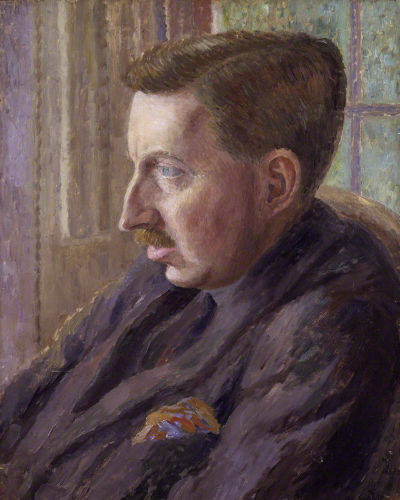
E M Forster, painted by Dora Carrington

The thing that seems to have acted as a turning point for at least the three novelists covered here was reading two books. James Joyce’s Ulysses had been serialised between 1918 and 1920, but was published in hardback in 1922, and it was in this form that Woolf, Forster and Lawrence read it. This was also the year that translations of Proust’s À la recherche du temps perdu started coming out in English. And generally, among those three novelists, the basic reaction seems to have been the same: that Ulysses was technically impressive, though something of a drag to get through, but Proust was a revelation, offering proof that there was a way to explore the new inner life in a novel.

Eliot told Woolf that Ulysses was “a landmark, because it destroyed the whole of the 19th century”, but that wasn’t what a novelist desperate to find a way to start a new novel wanted to hear. Woolf felt Ulysses was important, but found it “a mis-fire” — “Genius it has I think; but of the inferior water.” Lawrence and Forster made similar remarks. With Proust, though, the language is very different. “I plunged into Proust,” Forster wrote. Woolf longed to “sink myself in” Proust “all day”, and, Goldstein notes, although she realised she couldn’t write like Proust, soon enough, having read him, “she was writing like herself again.”

By the end of 1922, Woolf was working on Mrs Dalloway; Forster on A Passage to India; Eliot had published The Waste Land; Lawrence, in Kangaroo, had written directly of the experiences that had led him to leave wartime England.

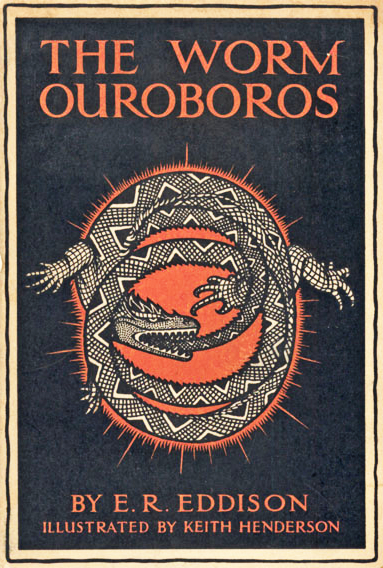
The Worm Ouroboros, cover by Keith Henderson

Inevitably, I can’t help thinking about the fantastic and supernatural fiction of the time. I’ve covered some of it on this blog: 1922, for instance, saw the publication of E R Eddison’s The Worm Ouroboros, which certainly wasn’t seeking new models of what it meant to be human, but can still be seen to be addressing the aftermath of the war, though in a very different way. Stella Benson’s Living Alone (1919), and J M Barrie’s Mary Rose (1920) are both post-World War I works, and Tolkien’s experiences in the war certainly shaped The Lord of the Rings. But it was the supernatural fiction of the 1890s that seemed to have already been writing about a new way of understanding what it meant to be human. The Strange Case of Doctor Jekyll and Mister Hyde and The Portrait of Dorian Gray both addressed the idea that the old model, of people being a single, distinct personality both within and without, no longer worked. Modernist works like Mrs Dalloway and The Waste Land seemed to be trying to work out how to write about what it meant to be human when you threw away this idea of being a single person altogether. The Waste Land takes fragmentation as its central metaphor. Hesse looked at the same idea — of one person being multiple — in his 1927 book, Steppenwolf. His idea was that that inner multiplicity could only be fully accommodated by indulging every part of it to the full. (Which reminds me of what Krag says to Maskull as the reason for his having to make such a violent, disturbing, and personality-changing journey across Tormance in A Voyage to Arcturus: to “run through the gamut”.)

Mrs Dalloway, first edition, cover by Vanessa Bell

But it seems to be Woolf, in Mrs Dalloway, who accepts and finds a way to work with the idea that we are not of “fixed and enduring form” (as Hesse puts it), by presenting her protagonists less as characters in the Dickens manner (with fixed external traits and not much else besides) than as constantly-changing centres of experience, whose personalities alter depending on whom they are with, and what memories or sensations come foremost to their mind. It feels like the most healing of the ideas made in response to this “world broke in two”.

But, of course, it has its dark side, in Septimus Smith, the most explicit victim of the World War presented in any of the four works Goldstein discusses. Smith is an example of what can go wrong with this new idea of human beings, when they lose their delicate centre and become trapped by violent memories and unfaceable emotions overpowering their present reality. Smith’s “writings” — his obsessive and often nonsensical ideas — are his way to try to fix some sort of centre in his wildly-decentred inner world, but they are unworkable (“there is no death”, “there is no crime”, “trees are alive”). Where Mrs Dalloway herself slips nostalgically into the past and drifts back to the present, all the time making new, minor adjustments to her understanding of herself, Smith flounders in a storm of experiences that no idea of what it means to be human can ever help him with. For him, the world is The Waste Land, but it’s debatable whether reading Eliot’s poem would have helped him. Perhaps reading Woolf’s novel might?

^TOP