 Muriel Spark’s 1970 novel The Driver’s Seat is one of those books I kept coming across intriguing mentions of, giving an air of inevitability to my finally caving in and reading it. (Helped no end by the fact it’s been published in one of those natty little Penguin Archive mini-editions.) And such a term as “inevitability” is apt for a novel about a woman who not only rushes headlong into what she has evidently decided is her certain fate, but takes charge of arranging it at every step. (And is it still fate when you arrange it yourself with such determination? Or is it like taking the diver’s seat on an already one-way road?)
The novel follows the last day in the life of 34-year-old Lise, who has spent the 16 years of her working life in an accountants’, achieving an exactly middling position in the office hierarchy. As we join her, she is off on holiday (to an unnamed southern destination, from an unnamed northern one). Throughout, she acts strangely, and often inconsistently, though some of her actions prove to have an ultimate aim behind them. Early on, for instance, she seems to have settled on a new (garish) dress, only to react suddenly against it when the sales assistant tells her it’s made of a new stain-proof material. Lise acts as though this were an insult—the implication that she’s likely to stain her dress—and storms out of the shop. By the end of the novel, we know that staining the dress is, in a way, part of the plan.
 In very Muriel Spark fashion, after having us follow this oddly-behaved woman for a short while, wondering why she’s acting this way and where this is going, Spark breaks the narrative tension in her usual throwaway manner at the start of chapter 3, by telling us Lise will be found the next day, violently stabbed to death. (Any other author would either tell us this straightaway, or leave it to a twist at the end. Spark tells us as though we should have known anyway.) What Spark doesn’t tell us, but which emerges as we follow Lise, is that it is Lise’s intent that this is exactly what should happen. Death is inevitable; Lise has taken over the driver’s seat, and is arranging her own death as she wants it to occur.
Her random, attention-grabbing antics start to make sense as we’re told, while Lise is interacting with a series of hapless bystanders, that these people will recall this strange woman the next day, when they hear of her death, and in many cases report their interaction to the police. If so, Lise is evidently not intending that the police will be able to build up any sort of picture that makes sense. She tells one person she’s a teacher from Iowa and a widow, when she’s neither; to another she says she’s here to meet a certain young man, but it’s evident she doesn’t know who he is or what he looks like, only that he has to be of a certain type. (That type, it turns out, being a murderer of women, which Lise can evidently detect.) It’s as though she wants to create around herself an air of mystery, perhaps (I can’t help thinking) because she detects, within herself, none of that natural core of mystery we know as the self. In the same way that Wolfgang Pauli once declared another scientist’s idea to be “not even wrong”, Lise is, in my opinion, as a character, not even shallow—she is entirely a fictional performance, with no human depth (unless that depth can be found in her desire to be murdered in a very specific way). Try fitting her to EM Forster’s definition of flatness as opposed to three-dimensionality in a fictional character, and she’s neither.
As a novel, it’s full of possible readings. I have a few, but they’re by no means meant to be final. It’s one of those books that grows into multiple interpretations.
 For instance, Lise as a feminist statement about taking control of one’s life in a world where women have so few avenues for doing so. Lise seems to have calculated that, as a woman, her fate, as an unmarried early-middle-aged woman, is to be the victim of a violent death at the hands of a man, so she gets in the driver’s seat and sets about arranging it. The death itself is not her choice, but the manner of it is: “Well you won’t have sex with me,” she tells her murderer, then goes on to provide him with the materials to tie her up and stab her, as well as precise instructions on how to do these things. To add to this feminist reading, a lot of the novel is taken up with shopping—another area where women are, culturally, allowed some limited range of self-determination (what to buy, or at least which brand to buy). Lise, then, makes her purchases, or rejects potential purchases, with no seeming sense of reason, this being the maximal way to defy the fate of being a consumer when being a consumer itself can’t be escaped.
Looking at some contemporary reviews for the novel, I wondered if another reading of it is that, here, Spark is goading her critics. A Scotsman review (by Derek Stanford, from 26 Sep 1970) is headed “Back to the Batty Woman”—this referring to a character-type Spark was perceived to have focused on, though it comes with the implication that it’s Spark herself who’s the “Batty Woman”:
“Muriel Spark, in her time, has performed some impressively giddy gyrations, leaving us to wonder, as we watched her cut these capers, just how long she could keep it up. Myself, I thought, from The Mandelbaum Gate, that a downward spiral was setting in… and I am accordingly glad to see that with her latest fiction The Driver’s Seat her capricious levitations have started anew.”
 If Spark, then, saw herself as being pigeonholed as “the Batty Woman”, The Driver’s Seat could be seen as her deliberately taking it on. Lise is the batty woman and acts battily, but it’s the batty woman novelist who’s clearly perceptible behind this depthless character: Lise is just a plastic game-piece Spark is pushing around this particular board, so the author must be as batty as her protagonist. The death that this Lise-as-Spark invites isn’t physical death, but a critical writing off as finally being batty beyond the pale. “Do your worst,” Spark seems to be saying to her potential critics, “after all, it’s what I’m goading you into doing.” (She’s certainly taking a gibe at critics when she has Lise describe the paperback she keeps brandishing—and hasn’t read—as “a whydunnit in q-sharp minor”, knowing they—like me—will surely try and fail to categorise her latest novel as being in some sort of genre. My own categorisation is coming up, not in the next paragraph but the one after that. But, no—Sparkian flash-forward—it’s an absurdist comedy.)
Stanford, in that Scotsman review, suggests that, in The Driver’s Seat, “Mrs Spark almost gives the impression of seeking to nail down—and destroy—her batty woman once and for all.” So here’s another reading still, in which Spark takes a clear character type from her fiction and drives it to the limit, just to see what it wants, what it does. Like laying a ghost by keeping on telling it that it isn’t yet frightening enough.
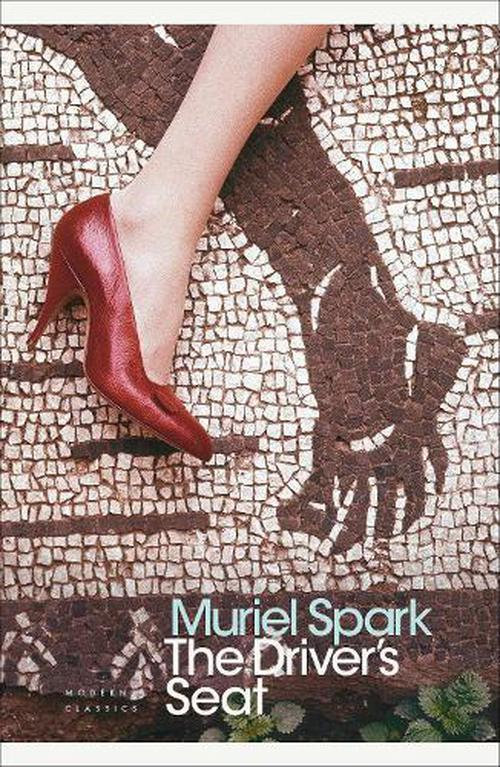 I’ve seen The Driver’s Seat described as a psychological thriller. If so, it’s one without either psychology (Lise is clearly a literary character, not an attempt at a human being), or thrills (we know what’s going to happen, we never find out why). Both Stanford and Alexander Walker (in another review I’ll be coming to soon) mention the book’s humour, and I’d say, if it’s anything, The Driver’s Seat is a comedy, but an absurdist one, a comedy of extremes, and of unease. Lise acts strangely, but with a squirm-inducing in-your-faceness—that face being both of the characters she interacts with, and the reader’s.
Stanford, in his review, says, “The humour in the book is the humour of the Void, and back of the giggles and sniggers, one detects the acrid presence of near-nihilism and deep misanthropy.” Alexander Walker, writing in The Birmingham Daily Post (also 26 Sep 1970), tells us that he read the book in 82 minutes, “but it takes a lot longer to puzzle out the undeclared intentions” of the author. He continues:
“Beneath the narrative comedy—and it is often a very funny story—lurks the equivocal sense of religious convictions being worked out…”
(Is it “very funny”? Are there ”giggles and sniggers”? What book are they reading?)
The key, for Walker, is how Lise will recognise the man of her “type” that she says she’s looking for. She’ll know him because she’ll detect “Not really a presence,” but more “The lack of an absence…” Is this, then, the quest for, not the presence of God in a seemingly Godless world, but at least the lack of Godlessness…? I’m not so convinced the novel is dealing with such questions, but perhaps it takes more knowledge of Spark’s work as a whole to see it. But perhaps Lise is trying to create, through seeding her final day with moments meant to be memorable (because bizarre, and ending in her death), an element of mystery in a world that has no mystery—and a world that has no mystery is a world that has no God. But the mystery Lise injects is random, scattered, disjointed; it’s a Dada-ist reality, with Cubist leanings.
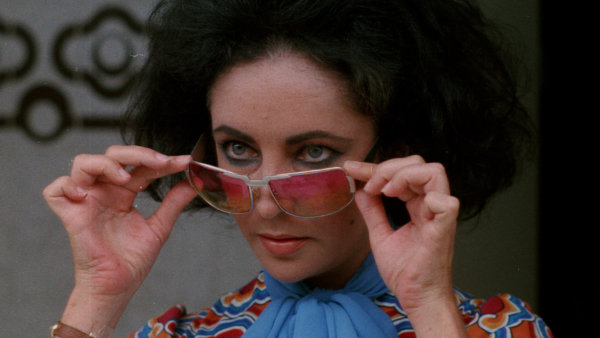
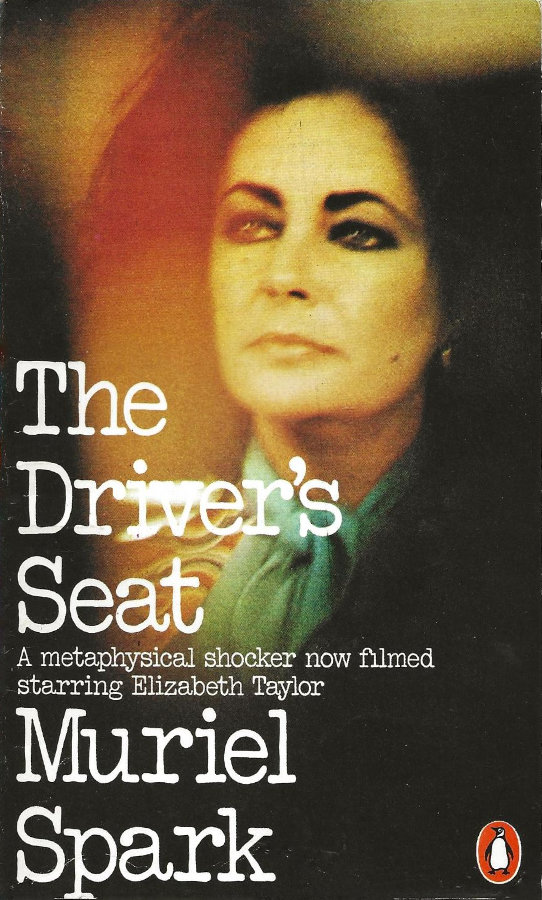
Elizabeth Taylor in The Driver’s Seat / Identikit
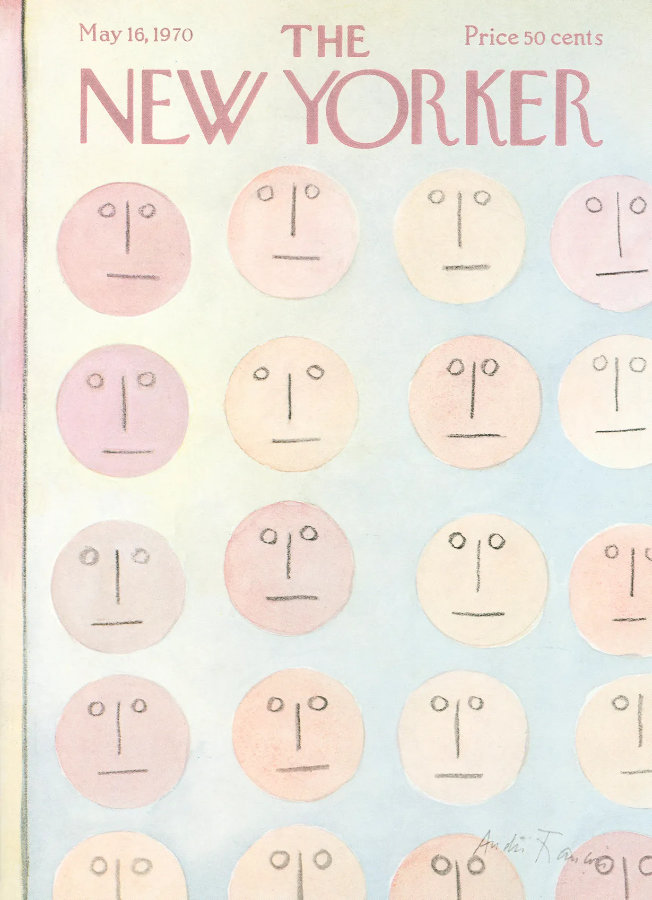
The New Yorker, 16 May 1970, featuring The Driver’s Seat, art by André Francois
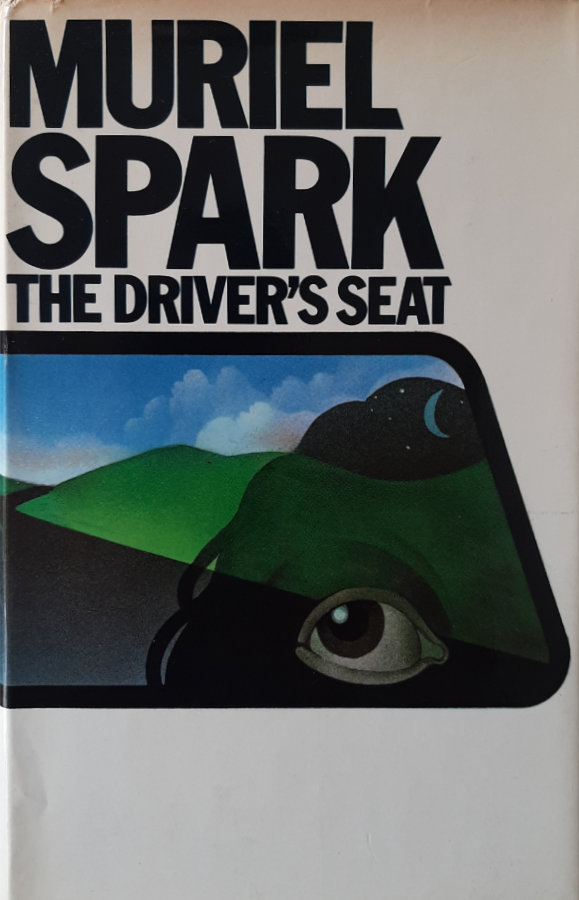
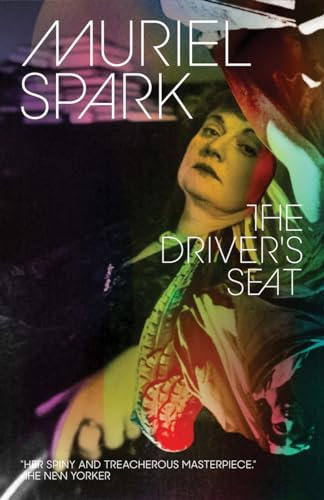
Before it was published in hardback (in September 1970), The Driver’s Seat appeared, in its entirety, in a special issue of The New Yorker (only the second time this had ever been done, apparently). It was also filmed, in 1974 (sometimes known as Identikit), starring Elizabeth Taylor. The film reveals the cinematic nature of the book: we only know the characters through what they say and do, the book’s narrative jumps-forward translate easily into filmic flash-forwards, and if you read as fast as Alexander Walker, it takes about the same time to read as to watch. The major difference is that, like Cronenberg’s adaptation of Crash, actors can’t help bring a different slant to every moment, simply by the empathy a human face evokes in the viewer. (Though the redubbing customary to Italian films of the time—and this is an Italian production—does add an element of dehumanisation, in my opinion. Particularly to the male actors, so many of whom look the same. Plus, there’s Andy Warhol, who makes two appearances, and has a natural coating of whatever the emotional equivalent of teflon is.) Novels can get by presenting us with absurdist non-characters like Lise, but as soon as Lise is portrayed by a human being (and late-career Elizabeth Taylor can’t help but come with a certain faded-superstar, on-her-fifth-divorce, not-quite-right-for-arthouse fragility), the necessary distance of absurdism is lost, and it all becomes much more uncomfortable and tragic. (But wait—a film in which Elizabeth Taylor steals a car, all the while heading towards her own violent death… Get JG Ballard on the line!)
The Driver’s Seat was, apparently, Spark’s favourite of her own novels. Of the three of hers I’ve read, I think I still prefer The Prime of Miss Jean Brodie, which is much more the portrait of a believable, even recognisable, personality type, but this one certainly comes close, with its thought-provoking worrying quality you just know is going to keep you returning to ponder it.