
I thought I’d take a side-step from re-reading Barker’s novels to look at some of his plays, written in the days prior to the publication of (but in some cases alongside the writing of) the first Books of Blood stories and The Damnation Game. A good selection are currently published in individual editions from the Clive Barker Archive, complete with Barker cover art, photos, and informative afterwords.
 Barker had been creating plays since his days as a teenager at Quarry Bank School in Liverpool, which from the start were both horrific and fantastic in nature. According to Douglas E Winter in his Barker biography The Dark Fantastic, Voodoo (1967) was “a living horror film”, Inferno (1967) a “weird reinvention of Dante” complete with “Hell and Nazis and God knows”, and the title of Neongonebony (1968) refers to our current neon-lit age descending into a bone-choked post-apocalypse. The Holly and the Ivy (1970, when Barker would have been eighteen), was a three-hour take on the King Arthur story, ending with the revelation of a homosexual relationship between two of its main characters, which caused some consternation among the school staff—not for the first time, with Barker. These early works were collaborative and partly improvised (an approach Barker would encourage even in his later works, as he says in his introductions to the published editions: “These plays are not finished things, they’re invitations to collective work.”). Nevertheless, he was the one who assigned parts and determined the purpose of each scene within an overall narrative. Playwriting, acting and production continued for Barker throughout his time at university (where he switched from philosophy to English Literature), in first the Hydra Theatre Company, then the Theatre of the Imagination, and for a short while the Mute Pantomime Theatre. These all seem to have been small groups, mostly of the same people (Pinhead actor Doug Bradley, and Hellraiser II scriptwriter Pete Atkins, for instance). They all moved to London around 1977, and formed the Dog Company, where Barker, now out of university, concentrated entirely on the stage. He continued to act in his own plays for a while, but gave that up in 1980 to concentrate on writing and directing, and in 1982 gave up directing too.
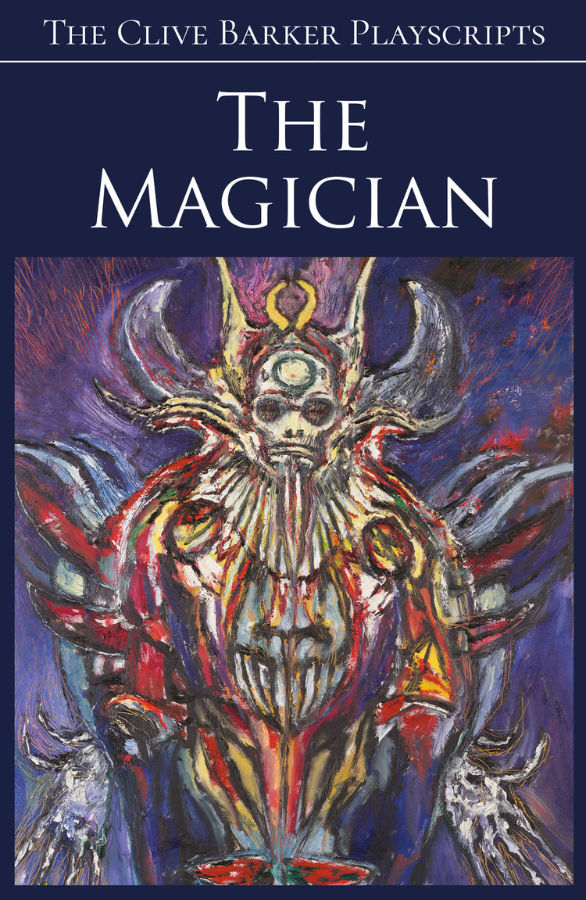 The three plays I chose to read (and I’ve seen none of these performed, so I’m sure I’m missing a lot of how they’d actually be experienced) all had the more obviously fantastical titles. First among them was The Magician: A Farce in the Style of the Commedia dell’Arte, which was first performed from November to December 1978. As the title says, this is a take on the traditional comedy form the Harlequinade, with its set character-types (Pantalone, Columbine, Pierrot, and so on). Here, Pantalone is the governor of an unnamed European city-state, where rumours arrive that the great magician Cagliostro is on his way. But is he a real magician or “all reputation, no power”? It turns out he did perform one genuine act of magic many years ago, the creation of an homunculus, which he proceeded to drown, in horror at what he’d made. But the creature survived, and was raised in ignorance of what it really was, to become the governor of this city-state. The play ends with a reconciliation between the father/creator Cagliostro and his fantastical “son”.
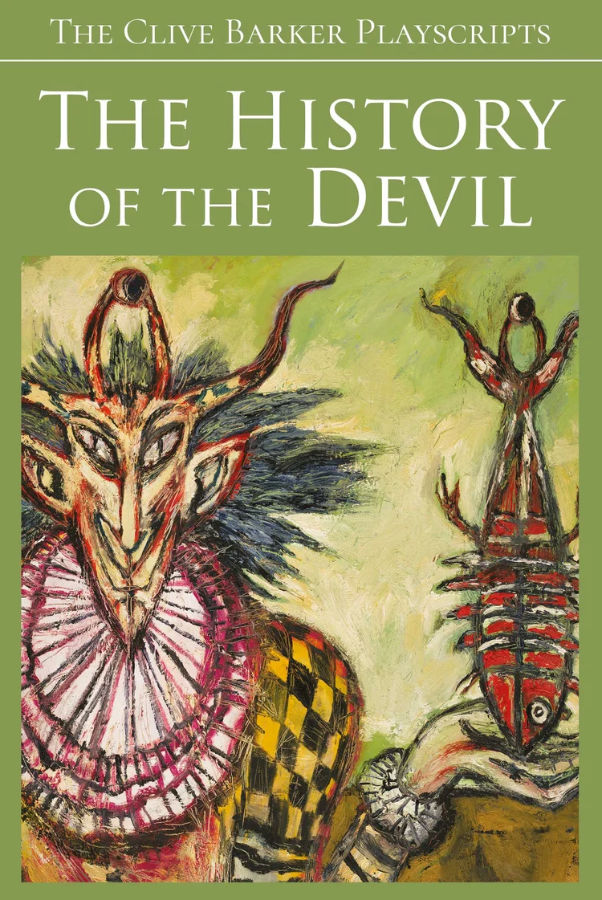 The History of the Devil was first performed in September 1980, and went on to have a run at the Edinburgh Fringe, where it was listed among the twelve best plays of the festival. It would be the Dog Company’s most performed play. In it, the Devil has himself put on trial in the hope that, if found innocent, he’ll be allowed back into Heaven. Witnesses (most of them summoned from the grave) appear, and their testimonies turn into on-stage enactments, including the story of the Devil’s first arrival on Earth (in what seems to be medieval Russia), his encounter with Christ in the desert, his attempt to get a Renaissance architect to build him a palace (if not on Earth, then in Hell), and his freeing some women accused of being witches in Puritan America. For me, although these episodes provide plenty of variety, they don’t really add up to an argument for or against the Devil as a source of evil, and it’s the court scenes that are the best parts of the play. The Devil’s ultimate justification is that none of this would be any different if he weren’t here:
“Is there a moral sky over me? No. Does this dirt suffer morality? No. In all the natural world there’s no moral thing. You ask why you are unhappy. Why, why? Morality. You go against nature.”
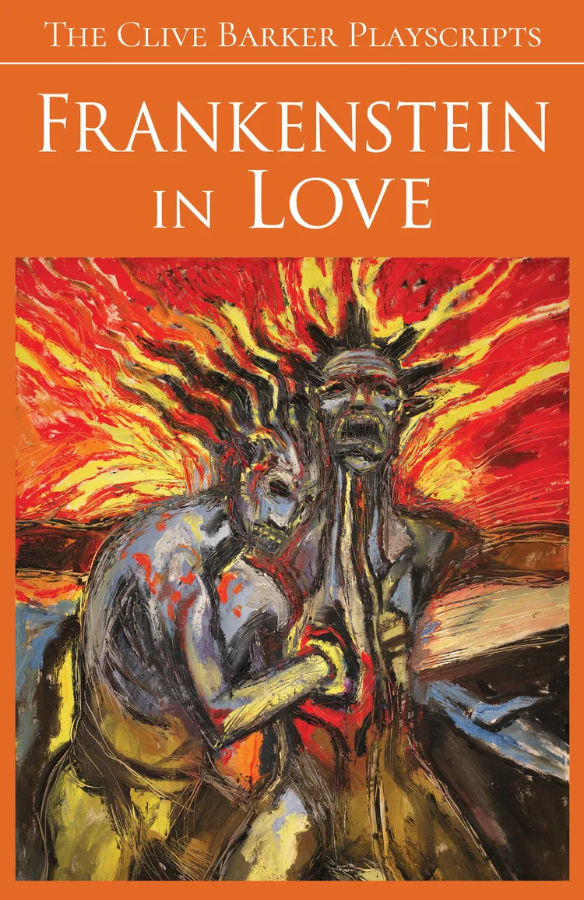 Frankenstein in Love was first performed from April to May 1982, after which it was taken to Holland, Belgium, and again to the Edinburgh Fringe. It’s set in an unnamed South American country at the point where its current dictator, Perez, is being overthrown by the revolutionary forces led by El Coco. Perez’s chief executioner, it turns out, is Doctor Frankenstein (who has been allowed to experiment to his heart’s content on the regime’s political criminals), while El Coco is actually his first creation, the famed “monster”. After the revolution, El Coco is assassinated, but, being dead already, cannot die, and returns to revenge himself on Doctor Frankenstein, arriving on his wedding day (where the doctor is marrying one of his experimental subjects). Of the three plays, this is the most out-and-out horrific, dripping in gore, death, shock and transgression, including a man’s heart being ripped out on stage, another having his head trapped in a box of knives, and another having a new face sewn on, all wrapped up in an air of political oppression, medical experimentation, plague, cannibalism, and the misuse of corpses (“hardly the standard ingredients of British theatre” as the reviewer for The Scotsman put it).
Despite the political background, Frankenstein in Love doesn’t feel like a political statement (unless it’s in the overall tone of misused power and constant backstabbing), but rather presents a vision of a world in which all is merely flesh and death, but in which flesh is not ended by, but transformed by, death. As Veronique, one of Frankenstein’s experiments, says:
“Yes, I’ve learned that lesson. Flesh is trash. Its natural state is meat. Everybody is just meat. The rest is the will to be more than meat.”
Or, Frankenstein himself:
“We look at our bodies and we see them putrefying around our living minds and we know, finally, that the enemy is our flesh. The body is a prison and must be escaped by metaphysics, or changed by wit and knife and courage.”
Far more relentlessly grim than anything Barker put into his fiction—perhaps doubly so because it was being put on live, on stage, where the horror is unrelenting—it was actually written shortly after the most powerful of Barker’s initial Books of Blood stories, “In the Hills, the Cities”.
Aside from the general air of horror, these plays are speckled with hints of what was to come in Barker’s more well-known works. For instance Christ, in The History of the Devil, when planning his means of martyrdom, asks “Isn’t there something they do in the East with hooks in the skin?”, which recalls the hooks in the skin in Hellraiser. In Frankenstein in Love, after El Coco’s assassination (by fire), he becomes a skinless walking corpse, “A walking anatomy lesson”—which recalls Frank from Hellraiser, as well as the “anatomy lesson, raw and wet” of Gentle’s homunculus in Imajica.
More generally, I think it’s possible to see how Barker’s approach to writing fiction has been informed by his background as a playwright. All three of these plays feature a narrator who speaks to the audience and interacts with the characters, and who talks knowingly of the events being played out as a drama (somewhat like Puck when he addresses the audience at the end of A Midsummer Night’s Dream, only in this case throughout the play), and there’s certainly a similar tone in Barker’s fiction, where he’s always highlighting archetypal aspects like character roles and story-types (it’s so ingrained in Barker’s prose style it’s hard to isolate in a good quote, but here he’s describing Gentle and Judith’s love affair in Imajica: “one death short of tragedy, and one marriage short of farce”). In addition, I think his penchant for making his monsters such eloquent, often philosophical beasts, is rooted in writing them as characters for the stage.

Sphere 1988 PB, art by Steve Crisp
The theme that kept standing out for me, even if it wasn’t the main one of each play, was that of monstrous sons and their fathers/creators. I’ve already mention the reunion of the homunculus and his creator in The Magician, but there’s also the Devil seeking reconciliation with his father/creator God in The History of the Devil, and El Coco/Frankenstein’s monster seeking revenge on his father/creator (he calls him his father, but it’s pointed out a couple of times that, no, he’s his creator) in Frankenstein in Love. In the latter two plays, these attempts at reconciliation (if the last one can even be called that) end in failure, if not tragedy. This is a theme I thought popped up in some of the early Books of Blood stories, too, such as “Skins of the Fathers” and “Rawhead Rex”, and now I think about it can also be found in The Damnation Game (most explicitly in the character Breer, who’s resurrected by Mamoulian, and so in a sense becomes his “monster”, though the Faustian pact-that-isn’t-a-pact between Whitehead and Mamoulian perhaps makes more sense if read as a father/creator-son relationship) and in Gentle’s created double in Imajica.
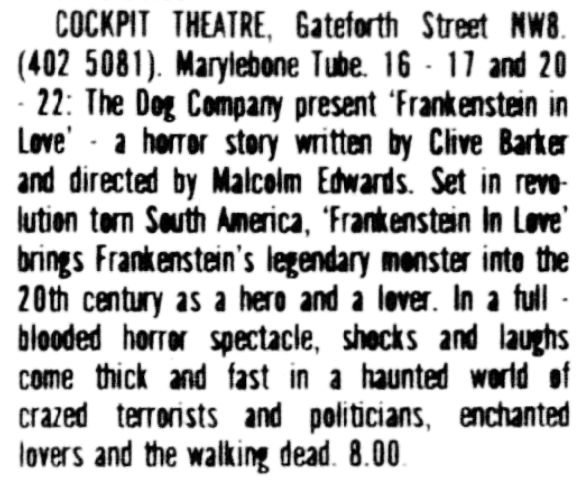
Notice of a performance of Frankenstein in Love, from the Marylebone Mercury, 16 April 1982
The end of the Dog Company came, ironically, not through failure but success. As well as Frankenstein in Love (the first of Barker’s plays to be directed by someone else, which was partly done to ensure the Arts Council took the company more seriously), they put on another Barker play at the Edinburgh Fringe, The Secret Life of Cartoons. This was enough of a hit that the troupe recognised they’d need to bring in other people to give it its full due if they were to take it further (which they did), and this meant leaving the days of a six-actor, one-playwright fringe group behind. Barker continued to write plays (for the Cockpit Youth Theatre), but was already working on The Books of Blood and The Damnation Game, with Hellraiser and international bestsellerdom looming fast.
