
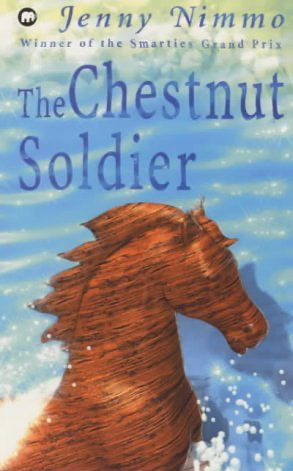
Egmont 2001 edition
Four years have passed since the events of the previous two books in Jenny Nimmo’s Snow Spider trilogy, and The Chestnut Soldier (first published in 1989) feels a bit more grown-up, with boy magician Gwyn nearly thirteen and starting to notice girls in a different way (he thinks Nia Lloyd’s sixteen-year-old sister Catrin the most beautiful girl in Wales, but “Lately he had found it difficult to talk to her”). The narrative is divided between Gwyn and the now eleven-year-old Nia (the main character in Emlyn’s Moon), with Gwyn no longer feeling like the distant and wise boy-magician from the second book: he’s trying not to use his “power” (as he’s come to call it, thinking the word “magic” childish), partly because he keeps getting it wrong and making mistakes, but also because he feels he should be taller by now and is worried magic is stunting his growth.
One day, the Lloyds learn that their mother’s cousin, Evan Llŷr, is coming to stay. It has been ten years since they last saw him, and he’s now a major in the British Army. He has, though, been wounded somehow, and is seeking a place to convalesce. In his thirties, handsome and mysterious, he comes across instantly as something of a romantic figure. Nia thinks him “the prince from every fairy tale; he was fierce and kind—and immensely troubled”, and every woman in the narrative from Nia to Gwyn’s grandmother Nain are under his spell. Particularly so is Catrin, who neglects her boyfriend, an Irish lad called Patrick McGoohan, who likes to ride by on his horse to be admired, but now finds himself ignored.
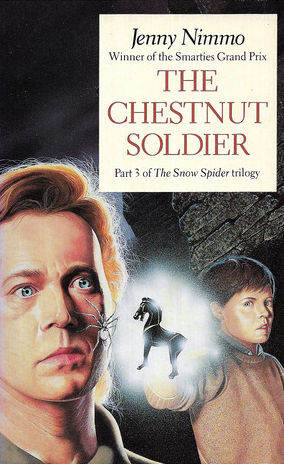
1990 edition, art by Bruce Hogarth
The mystery of Evan’s “wound” takes a while to come out. It’s not physical. He went into a burning building while posted in Belfast, to rescue some of his men who were trapped inside, but he was the only one to escape alive. These elements—his being a soldier, an association with fire, and a potential friction with the Irish—act as a sort of mythic-magnetic pull between him and a story that has already appeared in the first volume of the series, the legend of Efnisien, who maimed the King of Ireland’s horses when the King came over to marry Efnisien’s sister, and whose angry spirit became trapped in the broken wooden horse that was among Nain’s gifts to the young Gwyn. Now, this wooden horse uses Nia’s younger brother Iolo to get itself free of Gwyn’s control, and the spirit of Efnisien enters, or blends with, Evan.
After this, Evan becomes increasingly dark and cruel. Poltergeist activity begins to surround him, breaking young Iolo’s toy horses and Idris Llewelyn’s carved unicorn, and driving Patrick McGoohan’s horse, Glory, to madness. Books fall off shelves, plates break, storms descend on the town, and the Lloyd home looks like it’s been hit by an earthquake. Catrin is hopelessly drawn to Evan, even when his kiss is rough and not at all to her liking. He becomes a sort of Heathcliff figure, romantic and dangerous in a way that skews into the supernatural.
Gwyn realises he has to do something, and after another few failed attempts which increasingly convince him he was never meant to be a magician at all, travels back in time to speak with his ancestor, Gwydion Gwyn, to work out how to deal with this demonic force. (Gwydion, who anachronistically asks “You’re not blaming your genes, are you?”, assures him that he, too, made plenty of mistakes.)
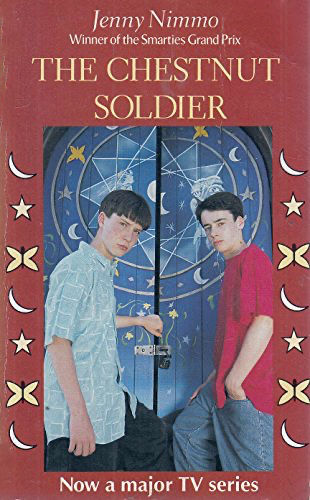
TV tie-in cover, 1991
Like the preceding book in the trilogy, the supernatural element in The Chestnut Soldier enters gradually, at first being indistinguishable from the story of a troubled but handsome man suddenly entering the lives of the Lloyds. But unlike with Emlyn’s Moon, there’s not so much of an alternative story to be going on with while the supernatural builds. (In addition, although there’s just as much light comedy as in the previous book, it doesn’t feel as light, couched as it is amongst much more serious-seeming darkness.) In both books, everything is resolved in a brief but confusing showdown involving magic and mythical figures, but whereas in Emlyn’s Moon this released all the tension in the mundane narrative in a way that made sense, here it’s unclear how—or if—Evan’s real-life troubledness is fixed along with his supernatural possession. Things are resolved, but they don’t really feel resolved—though this could be taken as part of the series’ growing up along with its characters, having them face messier situations and messier resolutions.

The “It’s another Harry Potter” style cover from 2009, art by Brandon Dorman
I was disappointed to find no return of the faerie-like “White People” from the first two books, particularly as they were the most intriguing element, for me. Here, Gwyn only thinks of them briefly, to note that his sister is surely happy with them, so he feels no need to try and bring her back, and besides, he’s grown up and she is now a perpetual child, so what would the two have to talk about? It seems rather dismissive and cold, particularly as I can’t help thinking that Bethan’s supposed happiness with the fairy folk is the sort of happiness a cult member has with their cult—it may require deprogramming to reveal it’s not happiness at all. (I think The Snow Spider could do with a Boneland-style sequel, where an adult Gwyn has to either rescue his sister properly, or at least face up to the reality of what happened to her.)
Like Alan Garner’s The Owl Service (which Nimmo hadn’t read, at least before writing the first book in the series), myth, here, is a thing that threatens to take over modern generations, replaying its tragedies and re-inflicting its suffering. But unlike in The Owl Service, Gwyn’s approach is to fight myth with myth: just as Evan becomes infected with the mythic presence of Efnisian, Gwyn allows himself to become, in part, his ancestor Gwydion Gwyn. (Which leads to some comic moments, as this Welsh ancient’s presence in Gwyn leads to him suddenly finding all sorts of aspects of modern life hard to deal with. Only, as this happens in the final chapters, with the darkness around Evan building, it’s hard to really feel the comedy.)
The series ends with Gwyn saying “I’m grateful for the adventure but I don’t believe I’ll need magic for a while.” Which leaves things somewhat unresolved—he’s still evidently living in a world where myth leaks through into reality, so how does he know he’s not going to need it?
For me, this may be the least successful of three books. The Snow Spider worked as an introduction to the difficulties and wonders of this world of myth and magic; Emlyn’s Moon was the most satisfying as a novel, with its nicely-balanced magical and mundane storylines; The Chestnut Soldier seems almost consciously messier, reflecting the main characters’ entry into adolescence and an awareness of greater moral ambiguity, but ultimately ending in a mood where the characters just felt they’d outgrown magic, as though it were their choice to make, in a world that seems dangerously fraught with myths and faerie.
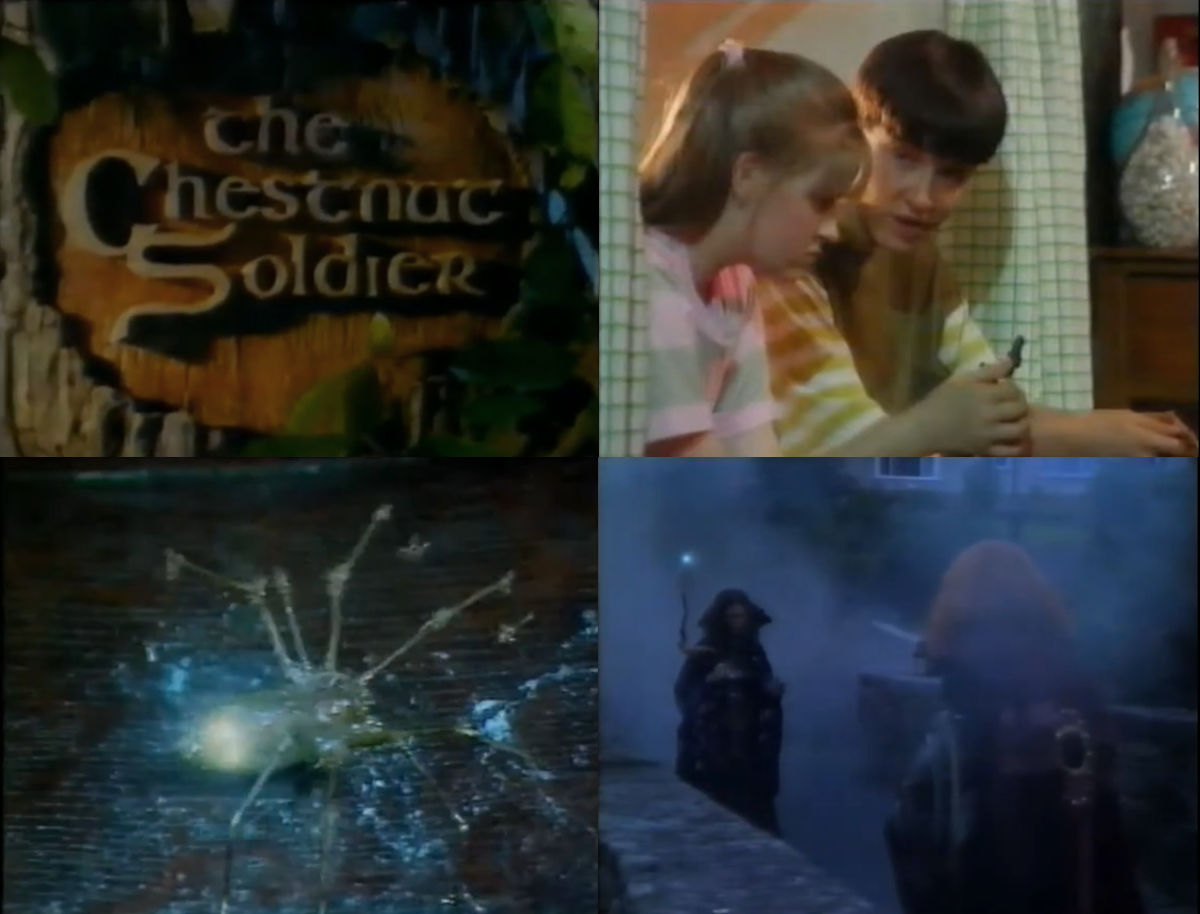
The 1991 adaptation of The Chestnut Soldier
Like its predecessors, The Chestnut Soldier was adapted for television, being broadcast in four parts in 1991 (produced by HTV Cymru/Wales), running from Wednesday 20th November to 11th December, and retaining all the same actors for the main roles. Interestingly, in McGown and Docherty’s encyclopaedic look at children’s TV drama, The Hill and Beyond, they say: “The Chestnut Soldier loses the subtlety of its predecessors, opting instead for a more teen angst approach”—but as I’ve said, this feels true of the book, too. I can’t help wondering how this third instalment would have been dealt with had the 2020 BBC adaptation got this far. On the one hand, that series clearly implied that there was going to be more of a showdown with the faerie-like people who’d taken Gwyn’s sister, and their by no means friendly intentions; on the other, how would a 2020s adaptation have dealt with the romantic relationship between sixteen-year-old Catrin and thirty-something Evan? It’s accepted without comment in the book (even from Catrin’s mother), but I can’t imagine how it would have been treated in the style of the more careful 2020 version of The Snow Spider.
