
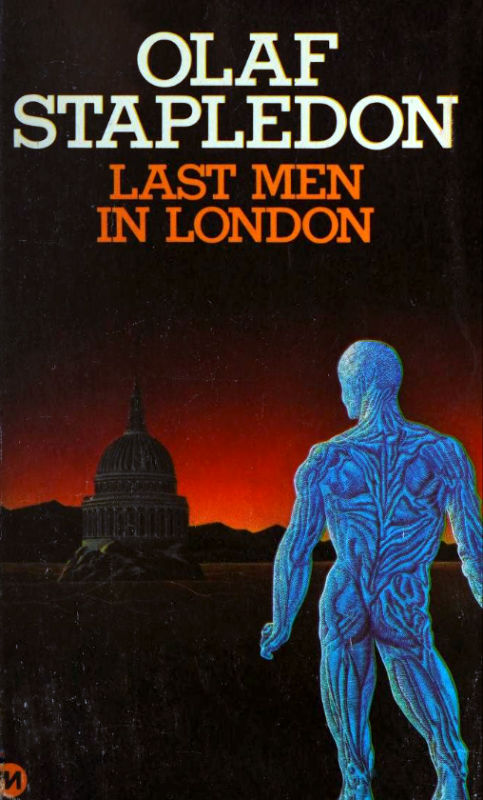
1978 paperback, art by Peter Goodfellow
Olaf Stapledon’s second novel, published in 1932, is not so much a sequel to Last and First Men (1930) as a sort of pendant to it (as his next novel, Odd John, started out as an appendix to this one). Like that first book, it’s dictated by a Neptunian from the far-future final race of humankind, who have developed the ability to project their consciousnesses into minds of the distant past, and not just witness events, but influence them to a certain extent, too. (Stapledon gets over the difficulty of the future being able to influence the past with a little handwaving: “Thus when I am observing your mental processes, my activity of observing is, in one sense, located in the past.” Or, for a little more detail: “though future events have indeed no temporal being until their predecessors have ceased to exist with temporal being, all events have also eternal being. This does not mean that time is unreal, but that evanescence is not the whole truth about the passing of events.”)
Instead of the vast, thousands-of-millions-of-years sweep of Last and First Men, Last Men in London concentrates on one comparatively tiny sliver of time, but one that is nevertheless “a crucial incident in the long-drawn-out spiritual drama of your species”: the First World War and its immediate aftermath. And the Neptunian chooses to approach this period through the consciousness of one individual, a relatively ordinary man called Paul. His intent is to present a deeper understanding of the causes of what was then known as the Great War, but also, by introducing Paul to glimpses of the more cosmic worldview of the Eighteenth Race of humankind, to see how this affects a man of our age. “It is my task,” he says, “to tell you of your own race as it appears through the eyes of the far future…”
Methuen hardback, 1932
After the immensely compressed tale of multiple human species in his first novel, focusing on a single individual might make it sound as though Last Men in London would read like a more straightforward narrative. In fact, it’s even less of a traditional novel (in terms of character, plot, and so on) than Last and First Men. After an initial chapter which details life on far future Neptune, we get a brief glimpse of Paul as he hesitates before an army recruitment centre in London, wavering between social pressure to join up and his more deeply held belief in pacifism. But this is one of the few conventional scenes in a book that has only about three or four named characters, and almost no scenes with dialogue, action, and so on. Following the introduction of Paul, the narrator digresses for two long chapters on the causes of the Great War (whose roots are not in the messiness of Imperial European politics as you might think, but in the very nature of our simian ancestry), before returning to Paul and his personal experiences in the war, and then onto his life in the years that followed.
This is only partly a criticism—you come to Stapledon for ideas, not realism—but I have to say I still find Stapledon at his most readable when he’s following a narrative, whether it be of the human race as a whole as in Last and First Men, or the life of an intelligent dog in Sirius. (To be fair, Stapledon declares early on: “Though this is a work of fiction, it does not pretend to be a novel. It has no hero but Man.”) Here, he has his exposition dials turned up to eleven—which isn’t a criticism as such, but I have to say I did find these sections, though interesting, a bit of a slog.
 But Last Men in London could also be a kind of autobiographical novel. Like Paul, Stapledon refused the call-up into the army, but elected to serve in the Friends Ambulance Unit as an expression of his pacifism—and, like Paul, he won the Croix de Guerre, and was intensely aware of the irony of a pacifist winning a war medal. Also like Paul he spent time as a teacher. All this leads me to suspect you can probably read Paul’s education in a wider worldview as Stapledon’s own philosophical awakening, with the Neptunian narrator/educator a sort of fictional stand-in for Stapledon’s inner, guiding, slightly alienated deepest self. (It might even be better to read this novel as Stapledon’s attempt to write about the causes of the First World War being derailed by an inner need to tell the story of his own philosophical development.)
As to the causes of the Great War, from the Neptunian perspective it comes down to humankind’s “practical intelligence” getting ahead of its deeper self-understanding, plus a tendency in the First Men (as the Neptunians call us) towards “the importance of personal triumph over others in the great game of life”—the tendency to value heroic individuals over humankind itself, with a corresponding belief in nations as a sort of communal hero-self, with one nation necessarily triumphing over others being the accepted state of things. From the Neptunian point of view, the Great War was on the cards from the moment we came down from the trees (we have “a will that is still in essence simian, though equipped with dangerous powers”), but awaited the technological breakthroughs of the nineteenth century for its fruition:
“…your ‘modern’ world came too soon. In the century before the war it developed with increasing acceleration. You had neither the intelligence nor the moral integrity to cope with your brave new world.”
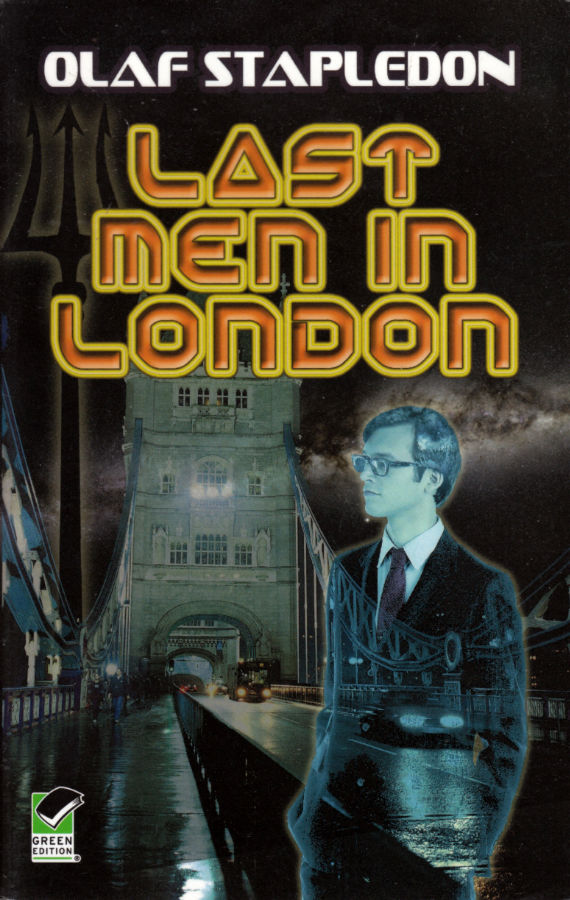
Dover Books edition
More interesting from a present day perspective, perhaps, is Stapledon’s insight into the mood during and after the Great War. There was, he says, a “suspicion in all the combatants that human nature had failed”, its ultimate effect being to “undermine man’s confidence in his own nature”. He goes on, in perhaps his most passionate and forthrightly critical section of the book, to detail how various sectors of society—politicians, religious leaders, teachers, artists and writers, common people—contributed to the war by turning a blind eye or justifying it to themselves. Perhaps the most useful passage to read today, as it still has such relevance, is this:
“Many people seemed to Paul to unearth a new self to cope with [the war], a simpler, less doubting, more emotional self, a self that concealed under righteous indignation a terrible glee in the breakdown of old taboos.”
Post-war, Stapledon describes the mood as one of:
“…a deep and deadly self-disgust, a numbing and unacknowledged shame, a sense of huge opportunities missed, of a unique trust betrayed, and therewith a vast resentment against earlier generations, against human nature, against fate, against the universe.”
Though Paul, in moments of particularly Stapledonian insight, still finds himself thinking:
“How can things be so wrong, so meaningless, so filthy; and yet also so right, so overwhelmingly significant, so exquisite?”
Which is perhaps one of the things that led John Kinniard to write, in Starmont Reader’s Guide 21: Olaf Stapledon, that “Stapledon’s philosophy is best approached as a challenge and a corrective to the disillusionment that became the dominant attitude of the Nineteen-twenties.”
So, what is Stapledon’s answer to all of this? It can be summed up in ideas that were already present in Last and First Men: “loyalty to man and worship of fate”. Or, as the Neptunian narrator puts it in a way that perfectly sums up Stapledon’s mix of the acceptance of cosmic doom with a defiantly joyous optimism:
“The story of your species is indeed a tragic story, for it closes with desolation. Your part in that story is both to strive and to fail in a unique opportunity, and so to set the current of history toward disaster. But think not therefore that your species has occurred in vain, or that your own individual lives are futile. Whatever any of you has achieved of good is an excellence in itself and a bright thread woven into the texture of the cosmos. In spite of your failure it shall be said of you, had they not striven as they did, the Whole would have been less fair.”
Does this help us at all, though, in the prevention of future wars? Stapledon’s notion of “loyalty to man and worship of fate” is a little too vague to be practically useful (unless one were to be faced with a catastrophe that really did threaten the species as a whole like, say, an increasingly unstable climate). Who is to say what best serves “man” or what should be regarded as “fate”? Elsewhere, Stapledon criticises the pursuit of happiness for this very reason:
“For if happiness alone is the goal, one man’s happiness is as good as another’s, and no one will feel obligation to make the supreme sacrifice. But if the true goal is of another order, those who recognise it may gladly die for it.”
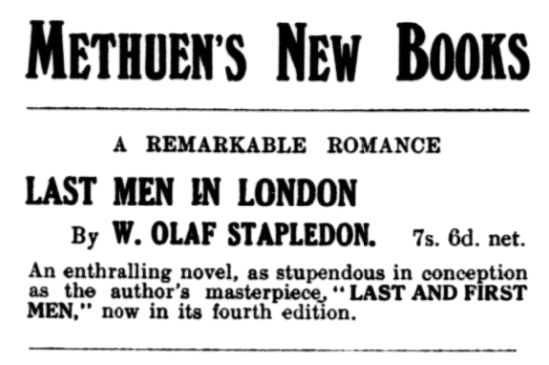
Reviews at the time, though fewer than for Stapledon’s first novel, were mostly positive: “one of the most impressive things I have read” (The Birmingham Weekly Mercury), “engrossing and equally stimulating to the imagination and the reflective capacity” (The Aberdeen Press and Journal), “approached seriously, it will be found a rich, stimulating book” (The Daily News). Hugh I’Anson Fausset, in the Yorkshire Post and Leeds Intelligencer, though, offered up a criticism of the Neptunian narrator:
“He may personify ‘the mature individual who has wholly escaped the snares of private egoism,’ and whose will is for the racial good, but only by ceasing to be a person with a real unity of being and a spiritual centre.”
Around the same time, Fausset reviewed (positively) David Lindsay’s Devil’s Tor, a novel which has a few similarities with Last Men in London: both are books in which events and characters are manipulated by science-fictional beings (one from the future, one from space); both touch on the early evolution of humanity and talk of a coming, better race; both make use of sometimes quite intense examination of characters’ inner motives; and both ultimately move towards the metaphor of music made up of many individual instruments as a way of apprehending the cosmic story (and Stapledon’s declaration that “There is no music without the torture of the strings” might have interested Lindsay).
John Wyndham’s Chocky (1963) is a much more readable take on the theme of the alien/futuristic visitor inside one’s own head. I’m sure Wyndham must have read at least some of Stapledon’s works, and wouldn’t be surprised if he’d read them all. Whether he remembered it while writing Chocky is debatable, but there’s a hint of Stapledon’s cosmic vision in Chocky’s parting statement about intelligent life being “the rarest thing in creation, but the most precious. It is the only thing that gives meaning to the universe. Without it, nothing begins, nothing ends…”
Last Men in London is not one of Stapledon’s essential works, but it does make interesting reading as a historical document (its insights into the postwar mood), and as a transition point in Stapledon’s own creative direction: here, he’s working out how to take the themes of Last and First Men and apply them to his evident interest in the philosophical development of an individual. His treatment of Paul’s life is rather distant and unengaging, but he ends the novel with a short episode in which Paul, as a teacher, encounters a weird-looking child prodigy who proves to be, like the next novel’s “Odd John”, a throw-forward to the next step in human evolution. Writing Last Men in London, then, perhaps showed Stapledon the way he should be going, and which he’d do more successfully in both Odd John and Sirius.

As someone who has gotten up to find that my country has just gone to war…this hits a little close. I have the book but haven’t reread it in some while. I always found the bit about the future species having its young members recap the primitive past rather disconcerting, not quite adding up somehow–I’d prefer to get thru adolescence without javelin wounds–but otherwise the far future civ appeals. With my luck I’d be the 97th sex, but anyway. It’s good to read a smart analysis of things not often reviewed.
I don’t know if it’s consolation that “we’ve been through this kind of thing before”, or it’s depressingly “we never learn”!