
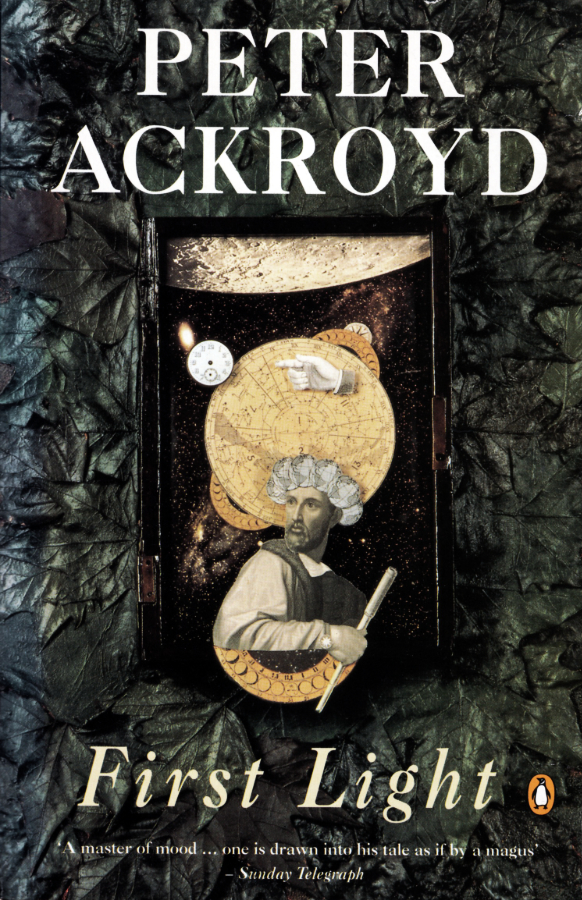
Cover art by Paula Silcox
I came to this novel because a brief description I read somewhere reminded me of David Lindsay’s Devil’s Tor. Like it, First Light (1989) is set in the southwest of England (on the Devon/Dorset border), and deals with the uncovering of an ancient tomb somehow linked to the stars. The only other Ackroyd novel I’ve read is his first, Hawksmoor (1985), which I remember as being nightmarish (in the full dream-like sense), with a lot of impressionistic writing as it slips between two times. First Light is different. Its prose is clear, its tone often comic (or at least satirical), and it has a far larger cast of characters. Having read it, the comparison I’d make is not with Devil’s Tor, but another novel from that same decade and also set in the southwest, weaving mysticism with the misty English landscape: John Cowper Powys’s A Glastonbury Romance.
First Light starts with the discovery of a seemingly unspoiled stone-age tumulus, surrounded by a wide stone circle in Pilgrin Valley, near the village of Colcorum. But although the gradual excavation of the tumulus over a period of several months provides a spine to the novel, its main focus is on a range of characters whose lives touch sometimes only slightly on the dig itself. At the same time as the dig is going on, for instance, astronomer Damian Fall (living in a cottage in Pilgrin Valley) is dealing with the realisation that he has long since ceased to feel the “exaltation” that drew him into the profession—he “once thought of the night sky as my home”, but now feels “like a priest who had lost his belief in God”. Meanwhile, a retired TV and music hall comedian, Joey Hanover, has come to the area, driven by the distant memory of a cottage where he spent his earliest years. Joey wants to find this cottage so he can learn who his parents were—a different and parallel sort of excavation of the past. And while the lead archaeologist, Mark Clare, deals with the dig, his wife, a “brooding, melancholy” young woman who wears a permanent brace on her leg, convinces her husband they should try to adopt a child, only to find that, as she’s registered disabled, it’s most likely she’ll be refused.
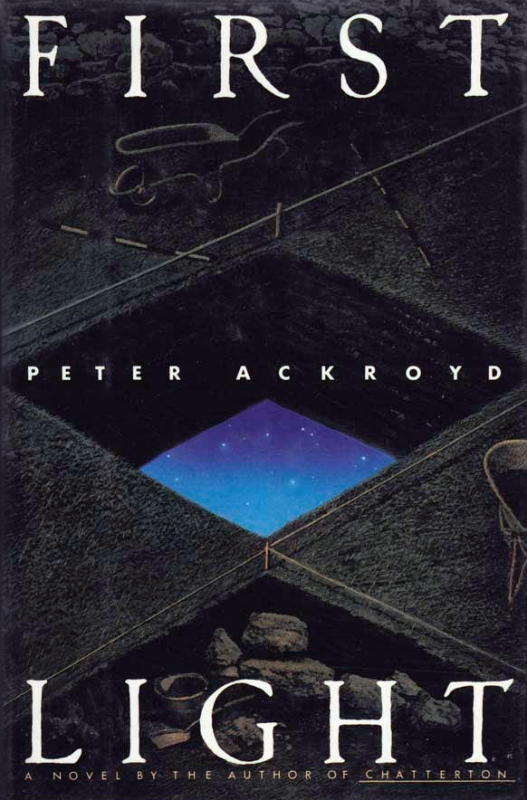
covert art by Fred Marcellino
And there’s a range of characters who don’t have stories so much as a series of interactions, and form the more comic side of the novel. Foremost among these is Evangeline Tupper, whose position in the Department of the Environment has led to her being associated with the dig, despite her having no real feel for archaeology or, really, the environment. Outwardly overly enthusiastic about everything and everyone, she’s immediately viperish the moment anyone’s back is turned. She’s always commenting on how feminine her partner (always introduced as her “assistant”) Hermione is, but laconic Hermione is clearly not interested in being “feminine” at all. (It’s hard to tell if this is a joke the two share, or some barely-concealed sarcasm on Evangeline’s part.) Then there’s Julian Hill, the site’s environmentalist, full of theories about the significance of what they’re going to find at the dig (he has already written an article on how astronomers were “the leaders or at least the magi of late neolithic society”), and when this doesn’t prove immediately true, says his theory is right, it’s just the evidence that’s wrong.
Locals include Farmer Mint and his adult son, only ever called Boy. The Mints are the main local family, and Farmer Mint lives and works in Pilgrin Valley. Almost a caricature of the closemouthed but knowing local, he and his family turn out to have a knowledge of the tumulus and what it contains that they are not about to share. Then we have Brenda, secretary at the local observatory, who takes everything said to her as a suggestive remark; antiques shop owner and amateur actor Augustine Fraicheur, who camply proclaims the village to be utterly decadent compared to the “innocence” of London, and hints at dark goings-on; Lola Trout, an old woman whose dialogue is almost entirely comprised of profanity; and Michael, known as the Woodlander, a homeless man, intensely shy, who has taken it upon himself to be the guardian of the region’s flora and fauna.
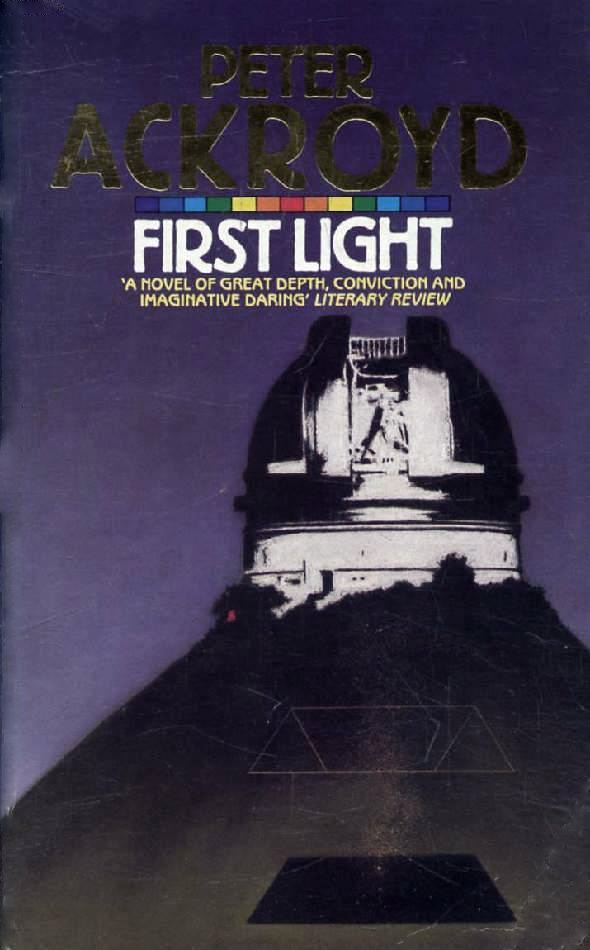
Covert art by Nick Bantock
While Powys’s tone and style in A Glastonbury Romance embrace every character and story, and pass effortlessly into his characters’ deepest thoughts and feelings, Ackroyd’s style in First Light seems to have two starkly different modes. He has a light, distant, satirical tone when dealing with this more comical characters, such as Evangeline, the Mints, Augustine and Brenda. But three of his characters—Mark, Kathleen, and Damian—are loaded with melancholy, and when we’re with them, it’s a heavy, elegiac tone that takes over. It’s as though the one genuine feeling of any depth Ackroyd is presenting us with is sadness; anything else is light and flighty and ironic. (Oddly, both tones work. The melancholy chapters can be genuinely moving, and the comic chapters can be amusing—I’d never say laugh-out-loud funny, but certainly amusing. It’s just odd to find these two tones, and nothing between, existing together in the same novel.)
There aren’t many moments when the two modes interact. When Brenda attempts her “Oh, you are awful!” style on deeply depressed Damian, it’s like water on an oilskin. The one exception, the character who seems able to exist in both worlds, is Joey Hanover. While he never plumbs the ultimately distressing depths of Damian and Kathleen, he at least has an inner need, presumably driven by some sort of unhappiness, to uncover the mystery of his birth. But, while Damian and Kathleen have no happy ending, Joey at least achieves his, and finds himself a new family in the process. He always has a song and a joke, whatever the situation, and I can’t help wondering if he’s Ackroyd’s example of a “survivor” character: just as ultra-cynical McReady is the perfect survivor for the environment of John Carpenter’s The Thing, so an ex-music hall comedian, armed with a stock of popular songs, is, somehow, the perfect survivor for the strange emotional environment of First Light, with its odd mix of human disconnection and distant yearning.

Covert art by Craig Dodd
Mark, on the other hand, has the most hard-won story. At first craving some vision that will unveil the secrets of Pilgrin Valley’s ancient past, he’s later more desperately driven by the need to find some meaning in it all—not just the dig, but the tragedy that hits his life. Damian’s assistant Alec provides him with a clue, when talking about time and the patterns it makes: “I suppose that we could only see the pattern if we were outside it. And in that case we would have ceased to exist…” But Mark nevertheless manages to find some meaning in it all with the notion that we contain within ourselves the stuff of dead stars, linking each of us to the distant heavens, just as the dead within the tomb seem to be linked to distant Aldebaran. (The novel is all about striving to find meaningful, preferably human, connections: to other people, to the past, to the stars. It’s just that the failures to do so feel more profoundly felt than the few successes.)
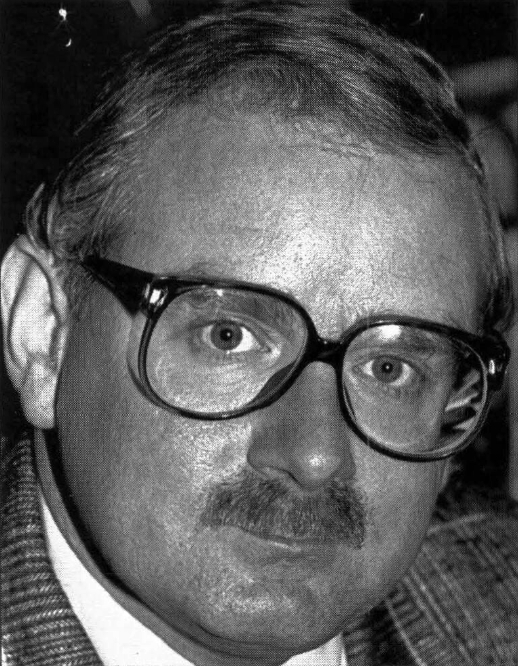
Peter Ackroyd
It’s not as big or all-embracing a novel as A Glastonbury Romance, and I think there are hints that Ackroyd would never write such a book as Powys’s. While Powys brings in so many different characters, viewpoints, experiences and outlooks, and seems genuinely capable of grasping the whole of life in all its many facets, First Light is limited to those two tones, the satirical and the melancholy, and shows some repetition in its band of characters. Evangeline, as I’ve said, is overly enthusiastic but catty the moment anyone’s back is turned; so is the dig’s “finds” supervisor, Martha Wells, and so is Augustine Fraicheur. Either Ackroyd is trying to tell us something about how he believes people are, or he’s found a limit to his comic range.
Nevertheless, it’s an interesting novel, perhaps as much for its flaws as its many little moments of insight. It’s certainly not trying to say something as grand as either Devil’s Tor or A Glastonbury Romance, but is, I think, paddling in the shallows of the same great body of water those two plunge into: the matter of mystical Britain, and the broader, deeper stuff of human life.
