
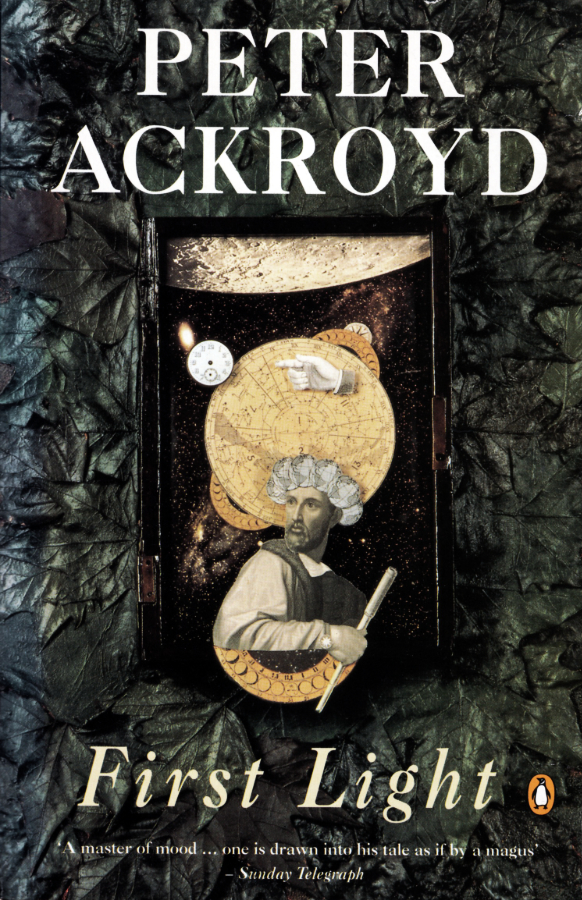
First Light by Peter Ackroyd

Cover art by Paula Silcox

I came to this novel because a brief description I read somewhere reminded me of David Lindsay’s Devil’s Tor. Like it, First Light (1989) is set in the southwest of England (on the Devon/Dorset border), and deals with the uncovering of an ancient tomb somehow linked to the stars. The only other Ackroyd novel I’ve read is his first, Hawksmoor (1985), which I remember as being nightmarish (in the full dream-like sense), with a lot of impressionistic writing as it slips between two times. First Light is different. Its prose is clear, its tone often comic (or at least satirical), and it has a far larger cast of characters. Having read it, the comparison I’d make is not with Devil’s Tor, but another novel from that same decade and also set in the southwest, weaving mysticism with the misty English landscape: John Cowper Powys’s A Glastonbury Romance.

First Light starts with the discovery of a seemingly unspoiled stone-age tumulus, surrounded by a wide stone circle in Pilgrin Valley, near the village of Colcorum. But although the gradual excavation of the tumulus over a period of several months provides a spine to the novel, its main focus is on a range of characters whose lives touch sometimes only slightly on the dig itself. At the same time as the dig is going on, for instance, astronomer Damian Fall (living in a cottage in Pilgrin Valley) is dealing with the realisation that he has long since ceased to feel the “exaltation” that drew him into the profession—he “once thought of the night sky as my home”, but now feels “like a priest who had lost his belief in God”. Meanwhile, a retired TV and music hall comedian, Joey Hanover, has come to the area, driven by the distant memory of a cottage where he spent his earliest years. Joey wants to find this cottage so he can learn who his parents were—a different and parallel sort of excavation of the past. And while the lead archaeologist, Mark Clare, deals with the dig, his wife, a “brooding, melancholy” young woman who wears a permanent brace on her leg, convinces her husband they should try to adopt a child, only to find that, as she’s registered disabled, it’s most likely she’ll be refused.
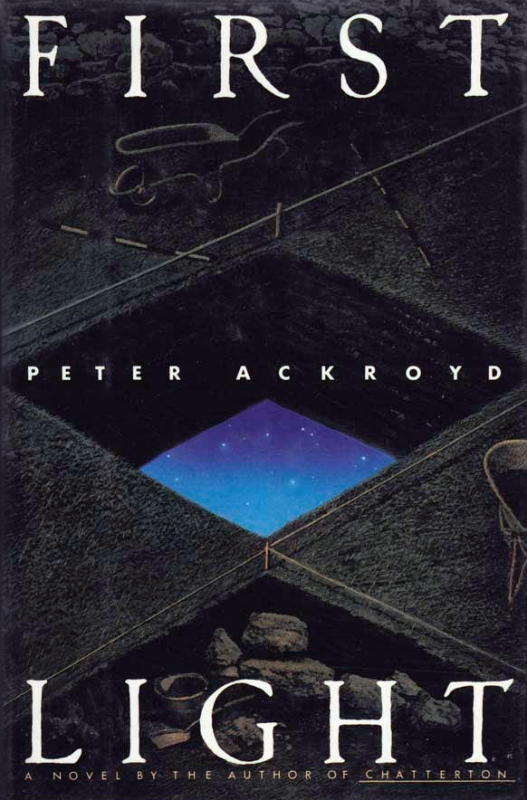
covert art by Fred Marcellino

And there’s a range of characters who don’t have stories so much as a series of interactions, and form the more comic side of the novel. Foremost among these is Evangeline Tupper, whose position in the Department of the Environment has led to her being associated with the dig, despite her having no real feel for archaeology or, really, the environment. Outwardly overly enthusiastic about everything and everyone, she’s immediately viperish the moment anyone’s back is turned. She’s always commenting on how feminine her partner (always introduced as her “assistant”) Hermione is, but laconic Hermione is clearly not interested in being “feminine” at all. (It’s hard to tell if this is a joke the two share, or some barely-concealed sarcasm on Evangeline’s part.) Then there’s Julian Hill, the site’s environmentalist, full of theories about the significance of what they’re going to find at the dig (he has already written an article on how astronomers were “the leaders or at least the magi of late neolithic society”), and when this doesn’t prove immediately true, says his theory is right, it’s just the evidence that’s wrong.

Locals include Farmer Mint and his adult son, only ever called Boy. The Mints are the main local family, and Farmer Mint lives and works in Pilgrin Valley. Almost a caricature of the closemouthed but knowing local, he and his family turn out to have a knowledge of the tumulus and what it contains that they are not about to share. Then we have Brenda, secretary at the local observatory, who takes everything said to her as a suggestive remark; antiques shop owner and amateur actor Augustine Fraicheur, who camply proclaims the village to be utterly decadent compared to the “innocence” of London, and hints at dark goings-on; Lola Trout, an old woman whose dialogue is almost entirely comprised of profanity; and Michael, known as the Woodlander, a homeless man, intensely shy, who has taken it upon himself to be the guardian of the region’s flora and fauna.
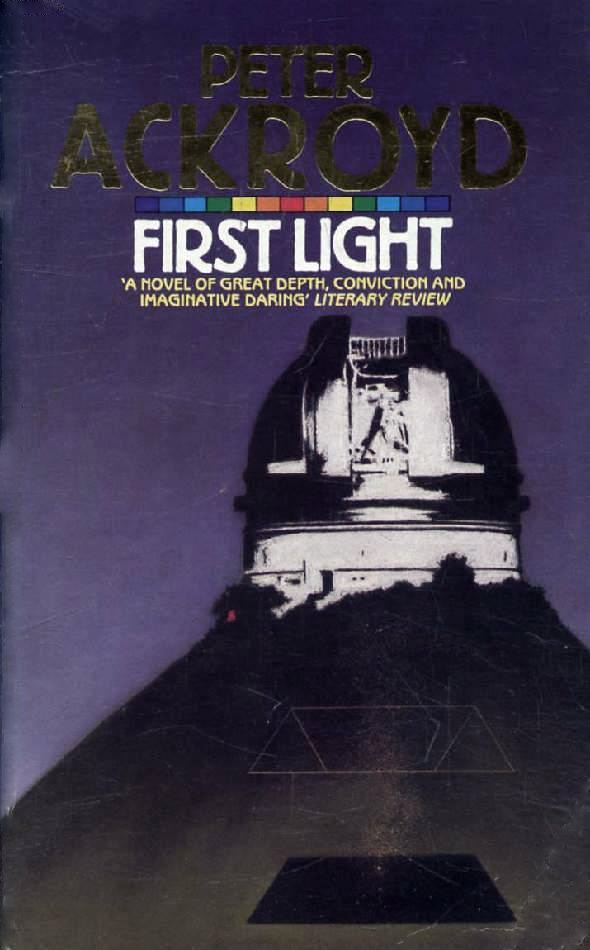
Covert art by Nick Bantock

While Powys’s tone and style in A Glastonbury Romance embrace every character and story, and pass effortlessly into his characters’ deepest thoughts and feelings, Ackroyd’s style in First Light seems to have two starkly different modes. He has a light, distant, satirical tone when dealing with this more comical characters, such as Evangeline, the Mints, Augustine and Brenda. But three of his characters—Mark, Kathleen, and Damian—are loaded with melancholy, and when we’re with them, it’s a heavy, elegiac tone that takes over. It’s as though the one genuine feeling of any depth Ackroyd is presenting us with is sadness; anything else is light and flighty and ironic. (Oddly, both tones work. The melancholy chapters can be genuinely moving, and the comic chapters can be amusing—I’d never say laugh-out-loud funny, but certainly amusing. It’s just odd to find these two tones, and nothing between, existing together in the same novel.)

There aren’t many moments when the two modes interact. When Brenda attempts her “Oh, you are awful!” style on deeply depressed Damian, it’s like water on an oilskin. The one exception, the character who seems able to exist in both worlds, is Joey Hanover. While he never plumbs the ultimately distressing depths of Damian and Kathleen, he at least has an inner need, presumably driven by some sort of unhappiness, to uncover the mystery of his birth. But, while Damian and Kathleen have no happy ending, Joey at least achieves his, and finds himself a new family in the process. He always has a song and a joke, whatever the situation, and I can’t help wondering if he’s Ackroyd’s example of a “survivor” character: just as ultra-cynical McReady is the perfect survivor for the environment of John Carpenter’s The Thing, so an ex-music hall comedian, armed with a stock of popular songs, is, somehow, the perfect survivor for the strange emotional environment of First Light, with its odd mix of human disconnection and distant yearning.

Covert art by Craig Dodd

Mark, on the other hand, has the most hard-won story. At first craving some vision that will unveil the secrets of Pilgrin Valley’s ancient past, he’s later more desperately driven by the need to find some meaning in it all—not just the dig, but the tragedy that hits his life. Damian’s assistant Alec provides him with a clue, when talking about time and the patterns it makes: “I suppose that we could only see the pattern if we were outside it. And in that case we would have ceased to exist…” But Mark nevertheless manages to find some meaning in it all with the notion that we contain within ourselves the stuff of dead stars, linking each of us to the distant heavens, just as the dead within the tomb seem to be linked to distant Aldebaran. (The novel is all about striving to find meaningful, preferably human, connections: to other people, to the past, to the stars. It’s just that the failures to do so feel more profoundly felt than the few successes.)
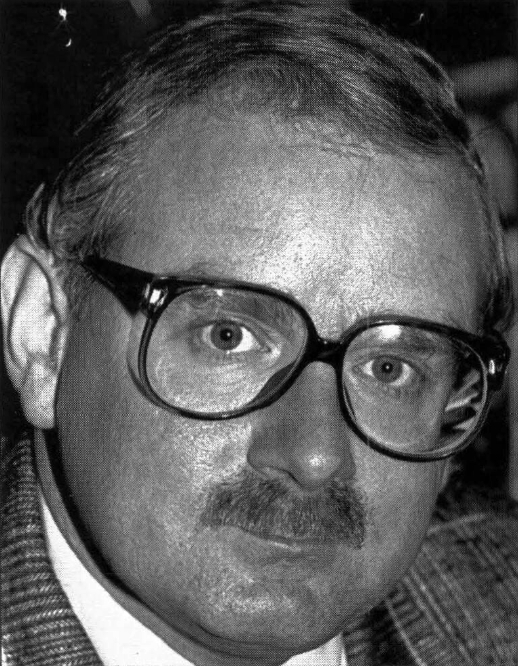
Peter Ackroyd

It’s not as big or all-embracing a novel as A Glastonbury Romance, and I think there are hints that Ackroyd would never write such a book as Powys’s. While Powys brings in so many different characters, viewpoints, experiences and outlooks, and seems genuinely capable of grasping the whole of life in all its many facets, First Light is limited to those two tones, the satirical and the melancholy, and shows some repetition in its band of characters. Evangeline, as I’ve said, is overly enthusiastic but catty the moment anyone’s back is turned; so is the dig’s “finds” supervisor, Martha Wells, and so is Augustine Fraicheur. Either Ackroyd is trying to tell us something about how he believes people are, or he’s found a limit to his comic range.

Nevertheless, it’s an interesting novel, perhaps as much for its flaws as its many little moments of insight. It’s certainly not trying to say something as grand as either Devil’s Tor or A Glastonbury Romance, but is, I think, paddling in the shallows of the same great body of water those two plunge into: the matter of mystical Britain, and the broader, deeper stuff of human life.

^TOP

A Glastonbury Romance by John Cowper Powys

1975 Picador PB, art by Mark Harrison

In some ways, John Cowper Powys’s massive 1933 novel A Glastonbury Romance bears comparison with David Lindsay’s massive 1932 novel Devil’s Tor. Both are set in rural South West England, where mystical visions seem to presage a worldwide spiritual or religious revival; both spend a lot of time examining, in intense detail, the inner lives of their characters; and both are, as already said, massive (A Glastonbury Romance being more than twice the length of David Lindsay’s 200,000-word “monster”). And this massiveness is part of their point — they want to come across as major statements, their physical heft a corollary to the weight of what they’re trying to say. But Lindsay’s and Powys’s intents are poles apart. Lindsay’s fundamental urge was world-rejection; his need was for a radical re-understanding of the universe’s troubling core mystery. Powys, on the other hand, was all about acceptance of life. To him:

“There is no ultimate mystery! Such a phrase is meaningless, because the reality of Being is forever changing under the primal and arbitrary will of the First Cause. The mystery of mysteries is Personality, a living Person; and there is that in Personality which is indetermined, unaccountable, changing at every second.”

But Powys isn’t the sunny-minded optimist you’d imagine as Lindsay’s opposite. He doesn’t turn away from (Lindsay’s touchstone) pain. He believed in accepting all of life, from the sublime and mystical to the crude and rude, and not merely with a stoic shrug, but by seizing it with an almost pagan ferocity. As one of the central characters of A Glastonbury Romance, the unconventional preacher, faith-healer, and (for most of the novel) Mayor of Glastonbury, “Bloody Johnny” Geard, says of his (very personal and idiosyncratic) beliefs:

“It matters not at all from what cups, from what goblets, we drink, so long as without being cruel, we drink up Life. The sole meaning, purpose, intention, and secret of Christ, my dears, is not to understand Life, or mould it, or change it, or even to love it, but to drink of its undying essence!”

The novel starts with the reading of a will. Canon Crow has died, and his family, with members ranging from the trampish rogue John Crow to the opportunistic industrialist Philip Crow, gather to learn that none of them has inherited anything. The whole £40,000 has been left to “Bloody Johnny” Geard of Glastonbury. Geard, though, does not see this as a personal bequest. He believes it’s his mission to turn his home town of Glastonbury — resting place of the Holy Grail and the Blood of Christ — into a world-class site of spiritual pilgrimage, “a mystical rival to Rome and Jerusalem”, and sets about doing just that. His first act is to announce a Passion Play, with mixed-in Arthurian elements, and he hires John Crow to organise it and advertise it to the world.

But really, Powys is almost wilfully uninterested in plot. His intent, as stated in a 1953 preface to a later edition, was to examine:

“Nothing more and nothing less than the effect of a particular legend, a special myth, a unique tradition, from the remotest past in human history, upon a particular spot on the surface of this planet together with its crowd of inhabitants of every age and of every type of character.”

Which reminds me of Alan Moore’s intent with From Hell, to take the Jack the Ripper murders and examine them as a “human event” that touches the lives of many different people in many different ways. Powys is doing the same with the myth of the Holy Grail. But even this is to imply A Glastonbury Romance has more focus than it has, and I’d say a better guide to the sort of thing this novel is doing is a quote from the critic George Santayana, who said of Dickens (in a 1921 essay called “Dickens”):

“…what he had was a vast sympathetic participation in the daily life of mankind.”

And that seems more like what Powys is doing. With the excuse of following the events (very loosely, and often only as background or rumours) surrounding the putting-on of Geard’s Passion Play (in the first half of the novel) and, in the second half, the conversion of Glastonbury to a Socialistic commune, and Geard’s use of the healing powers of its “Grail Fountain” to turn the town into a British Lourdes, Powys dips into the inner lives of his many and varied characters, some of whom have nothing to do with the Play or those later events, or who only touch them lightly. Even major-seeming plot events are brushed aside offhand. In one chapter, Geard takes Tittie Petherton, who has been suffering awful pains from cancer, to the Grail Fountain, to cure her and provide his Glastonbury with its first miracle. We leave them there, mid-cure, and hear nothing for several chapters, then all-too-briefly glimpse Tittie Petherton, apparently fully cured, enjoying scones at a tea. It’s never stated that she’s cured, though she’s obviously better, and we don’t get the sort of disbelieving or believing reactions you want to hear. It’s almost as if the actual relation of plot is an embarrassment to Powys, and best brushed under the carpet. (Though it has to be said that in four of the book’s longest chapters — that dealing with the Pageant itself, and the final three which round off the book — Powys resolves his major plot strands with the same sort of dramatic brio as Peake displays in his Gormenghast novels’ major set-pieces.)

Powys is interested, most of all, in inhabiting the lives of his multitude of characters, in sampling their peculiar ways of experiencing the world, of thinking about it, of feeling about it, of relating to it. And he isn’t only interested in human characters. His is “a universe so thrilling and so aching with teeming consciousness” that, in wandering from one character to another, he occasionally brings in a non-human consciousness, including at one point a tree, or the sun (which takes a particular dislike to the Vicar of Glastonbury, though this only results in his feeling the heat a little more than others if he goes outside without a hat), the dead Canon Crow freshly laid in his grave (who has an ethereal though down-to-earth conversation with his wife, who’s buried in another country), and the “First Cause” — the God of Powys’s universe, a being whose nature generates all the good and all the evil in our world. (For Powys, it’s only human beings who can actually “produce good out of evil” as “this they do of their absolute free-will”; the First Cause just pours both good and evil out, constantly.)

In this way, Powys seems to stand in an odd relation to the modernist writers of his time. On the one hand, he employs the stream-of-consciousness technique of dipping into his characters’ minds, to relate both their consequential and their inconsequential thoughts, just as Virginia Woolf does in Mrs Dalloway. (Also her technique of shifting from one character to another as they pass in the street, or glance one another across a field.) On the other hand, he has no interest in the concept of the unreliable narrator, or of giving up any of the authorial authority the likes of Dickens took for granted. Which isn’t to say he comes across as dictatorial. Rather, he’s convincing through the sheer novelty and strangeness of the inner worlds he presents us with. In a way, Powys, as narrator, is like one of the “invisible anthropologists” he sometimes mentions as witnessing the events of his novel — the disembodied inhuman entities he tells us are lingering around his many characters, watching what they do with mild, dispassionate interest. Powys actually gets a mention in Colin Wilson’s monumental study The Occult for his having “deliberately set out to cultivate ‘multi-mindedness’, to pass out of his own identity into that of people or even objects”, and not just in his novels, but in his daily life.

There’s a quote from Wilson on the back of my 1975 paperback edition of the novel, calling it “Possibly the greatest novel of the twentieth century, and one of the great mystical masterpieces of all time”. Powys’s mysticism, though, isn’t anything like Lindsay’s. With Lindsay, visions give his characters a glimpse of another reality, and when they return to this world it’s with a feeling they’re sinking back into a second-rate or false reality. With Powys, visionary experiences are just one part of the vastness of the one, single reality — a rare part, yes, but still a part of this world, not a glimpse of another. And his characters’ visionary experiences don’t, in the end, turn out to be that important. Three of his main characters, the roguish John Crow, the would-be-saint Sam Dekker, and the would-be-sinner Owen Evans, have visions. Evans, who thinks playing the part of Christ on the Cross in the Pageant will cure him of his obsessive sadistic fantasies, does have a vision of Christ, but the effect of that vision wears off, and what actually saves him, in the end, is the love of his wife. Sam sees the Holy Grail, and feels the need to rush around telling everyone, but where he expects to have to overcome disbelief, he’s instead faced with indifference. John Crow has a vision of Excalibur, but this has even less effect; chapters later he’s disgusted with Geard’s peddling the reality of the Arthurian myths as “lies”. Geard, the most mystically-minded character in the book, is more childlike than saint-like, and in place of Lindsay’s need, in Devil’s Tor, for his characters to give themselves up to serve that book’s demanding, tragic Goddess, Geard sees Christ more as “a Power to be exploited”:

“He [Christ] was the Mayor’s great magician, his super-Merlin… Never once had it crossed the threshold of Mr Geard’s consciousness that it was his duty to live a life of self-sacrifice.”

(I like that fact that, ultimately, the source of Geard’s force of personality is “the man’s complete freedom from self-consciousness”.)

Powys’s mysticism is not about glimpses of other worlds, but more an awed appreciation of this one. Every moment, for him, however quotidian, is imbrued with a sort of mystical light, and he loves to let us into the mind of a minor character and reveal that, in some quiet way, they have the secret of life’s true meaning, and have had it, quite naturally, since they were born:

“When not in acute physical pain, or in the presence of acute physical pain, Nancy Stickles enjoyed every moment of life. She liked to touch life, hear life, smell life, taste life, see life…”

US 1st edition

It’s an odd thing, though, that for a book published in 1933, and ostensibly set in “the present” — and which features an aeroplane, and cars, and I think at one point someone suggests using a telephone, though nobody has a radio, but evidently it is the 1930s — it makes absolutely no mention of the First World War. None of the characters thinks of it, or recalls having served in it, or has lost anyone to it, or been wounded in it. If Powys is a modernistic writer in the techniques he employs, he seems utterly indifferent to the driving force behind such works as The Waste Land or Mrs Dalloway (with its shell-shocked Septimus Smith). Powys doesn’t even present his life-acceptance as an answer to the worldwide trauma of the Great War, and the widespread loss of belief of the 20th century; it’s as though it just doesn’t affect him, so he doesn’t mention it. (Which is doubly odd, because Powys obviously has a real hatred of cruelty. He apparently had a belief that, early in life, his thinking ill of others caused them actual ill, so he practised a sort of generalised benevolence, so as not to magically cause anyone harm.)

It could be that, as I said with Peake’s Gormenghast, the war makes itself felt in the way both that book and this one ends with a flood. In A Glastonbury Romance, the army even turns out to help, but there’s just not the same feeling, as with Peake, of this being a terrible disaster thrust upon all its characters in the same way the war was thrust upon the real world. With Powys, it feels more as though he just needed to find a way to end his massive book, so came up with a flood, as a sort of watery full-stop.

Reading A Glastonbury Romance is like taking a holiday, not just in another place, but in a timeless time. It’s a glimpse into Powys’s own worldview, one obviously nurtured in a rural upbringing, free of the modern world’s onslaught of communication and networking, a world in which one could really develop an eccentric inner life, an individualistic and even mystic way of experiencing one’s own existence and the quiet, slow-paced, characterful worlds of nature, and other people. That, more than anything, is what lingers, having read this book. It’s less about getting from page 1 to page 1,120, than it is about switching to a different mode of existence whilst being nestled between its capacious pages — a subtler, stranger, and perhaps now-lost mode of existence, but certainly one I’m glad to find preserved in Powys’s novel.

^TOP
