
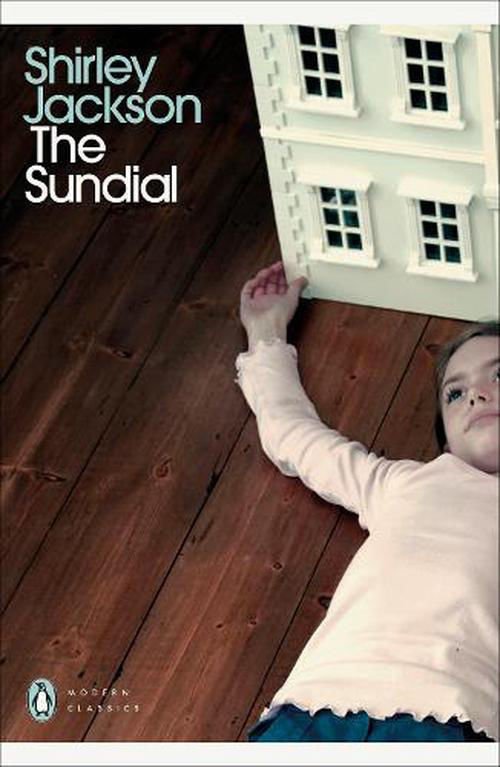
 The Sundial is Shirley Jackson’s fourth novel, begun in 1956 (following a couple of years of creative block, according to her biographer Ruth Franklin) and finished in July 1957. It was published to mixed reviews the following year.
The setting, like the two masterpieces that would follow it (The Haunting of Hill House and We Have Always Lived in the Castle), is a large country house, surrounded by a walled-in estate. This is the home of the Halloran family, who, as the novel begins, have just buried their only son, Lionel. Lionel’s wife, Maryjane, is convinced her mother-in-law pushed Lionel down the stairs. She shares her suspicions with her ten-year-old daughter Fancy, and soon the little girl is asking “Shall I push her? … Like she pushed my daddy?”
Whether she pushed him or not, Mrs Halloran now owns the house (her husband is still alive but feeble in mind and body), and says she’s going to eject as many of its inhabitants as she can: Maryjane will be given a small allowance and sent to live in an apartment in the city, though Fancy (who stands to inherit after Mrs Halloran) will stay; Fancy’s governess Miss Ogilvie, and young Essex, who came to catalogue the library, will simply have to leave. Meanwhile, Aunt Fanny—the aged Mr Halloran’s sister—will be moved into the house’s tower, with the implication that she’ll be expected to stay there.

US first edition
They’re saved, though, when Aunt Fanny, after getting lost in the house’s extensive gardens and having some sort of agoraphobic attack (perhaps egged on by Fancy, though the girl denies being there), seems to receive a communication from her dead father, saying the world is going to end (“Fire and floods and sidewalks melting away and the earth running with boiling lava”), though everyone in the house will be saved, the lone inheritors of a new world, into which they will emerge “safe and pure”.
Mrs Halloran—as well as pretty much everyone else in the novel—accepts this, and allows everyone to stay after all: if she sends them away from the house now, they’ll be killed in the coming apocalypse, and she doesn’t want that on her conscience. It’s agreed not to tell anyone on the outside (and it’s perhaps notable of this misanthropic bunch that not one of them has someone they want to warn or save), but a number of people turn up by chance and are allowed to stay. There’s an old acquaintance of Mrs Halloran’s, Mrs Willow, now a widow and in search of some means of providing for her late-twenties daughters Arabella and Julia, who come along too. Seventeen-year-old Gloria Desmond, daughter of Mrs Halloran’s cousin, also turns up, having been sent for a holiday while her father is away. And Aunt Fanny decides to adopt a random man she finds in the local village—perhaps realising they have only Essex and the feeble Mr Halloran in the house, now—a man she pretends to recognise as (a name clearly made-up on the spot) Captain Scarabombardon.
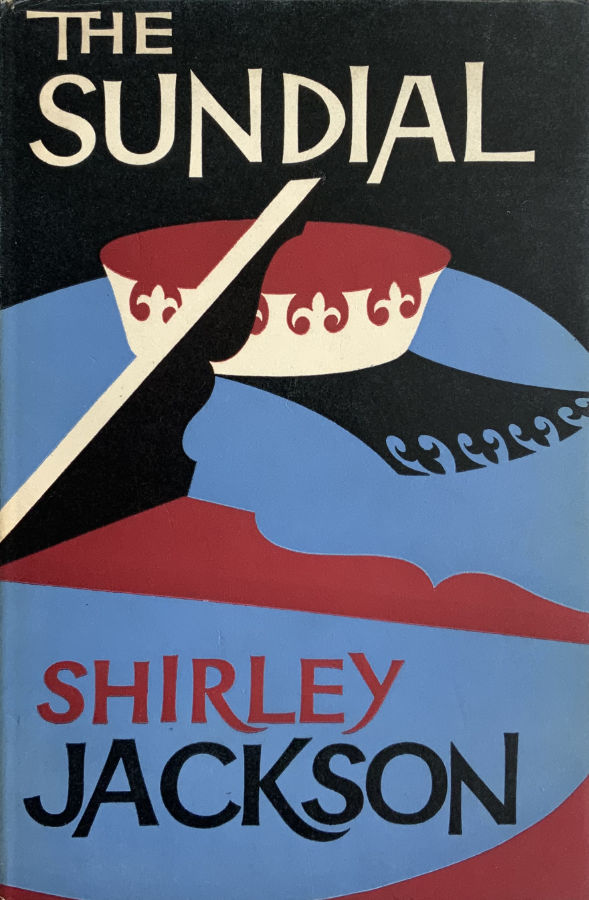
UK first edition
They start making their plans. Aunt Fanny buys bulk supplies at random—food, medicines, umbrellas. Mrs Halloran issues a page of rules everyone will be expected to follow on the night before the apocalypse and that first new morning, including the need to look presentable: “I want to know that I am bringing with me into that clean world a family neat, prepossessing, and well-groomed.” She talks about “the good impressions we must create”, even though that new world will, supposedly, be devoid of people. The servants will be sent away the day before (to die with everyone else), and the villagers will be given an (unknown to them) farewell party.
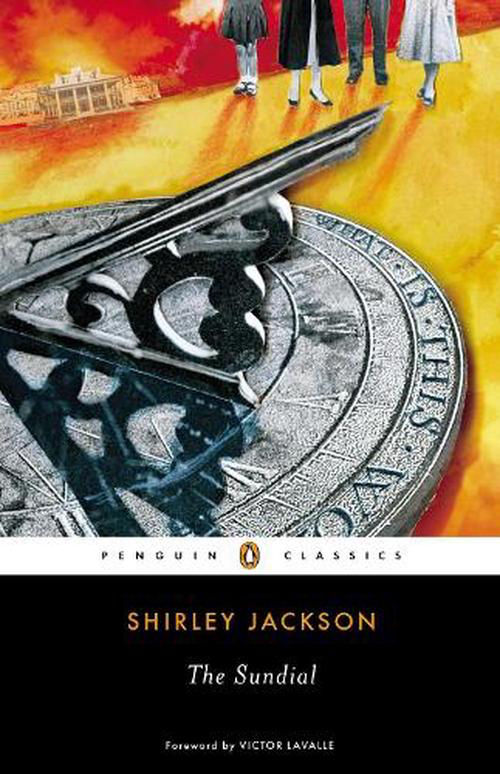
The sundial of the novel’s title is the one part of the house that, because it has been placed off-centre, defies the otherwise perfect architectural symmetry. The dial bears an inscription, “What is this world?”, a quote from Chaucer’s Knight’s Tale:
What is this world? What asketh man to have?
Now with his love, now in his colde grave,
Allone, with-outen any companye.
If Jackson is asking “What is this world?” of the world she’s created in The Sundial, then it’s a world of casual backbiting, social power-play, and a constant, outwardly civil cruelty between the characters. And it’s one in which the “love” referred to by Chaucer is already absent, well before the “colde grave” comes to call.
All of the characters are here not because they love one another, but because they’re dependent on Mrs Halloran’s riches. And Mrs Halloran, whose one and only aim seems to be to own the house (“It is my house now, and it will be my house then. I will not relinquish one stone of it in this world or any other.”) presumably lets them stay not only for her conscience’s sake (she barely has one), but because she knows, if she ousted them and they thought they were going to die, they’d most likely force themselves back inside, and maybe get rid of her in the process. Rich she may be, but her riches are her only power, and they’ll surely mean nothing in the new world.
 One of the things that means The Sundial doesn’t work as well as Jackson’s subsequent two novels, for me, is that it has no main character, no side to take amongst all these rather icy folk. Hill House has Eleanor, and Castle has Merricat. Neither is necessarily admirable (Eleanor is weak, Merricat a murderer), but both are very clearly, and relatably, human. There’s no one like that here. And not just because none of the characters is exactly sympathetic—that doesn’t matter—it’s because none of them is fleshed out enough. Mrs Halloran gets the closest, though largely because she’s the one in charge. But whereas at the start I felt that her believing in the prophecy was more by way of acknowledging a sort of social chess-move on Aunt Fanny’s part (to force her to allow everyone to stay), by the end of the novel it’s apparent she fully believes it, leaving me unable to work her out, as a character. She declares she’ll be queen of the new world when it comes, and buys herself a gold crown. Perhaps she, too, went insane, just more quietly? The rest of the characters (all but one) are too shallow to be much differentiated. When Jackson began bringing in new people—Arabella, Julia, Gloria, the captain—I couldn’t work out why, because none of them brought anything different to the story. Granted, Julia makes a break for it and tries to leave the house for the city, but it might as easily have been Arabella, or Gloria, or Maryjane.
The one exception to all this is Fancy, the ten year old girl whose self-absorption and lack of sentimentality made me think of her as a proto-Merricat (the narrator of Jackson’s last novel, We Have Always Lived in the Castle, with whom she shares a certain witchyness). Fancy is the one character with any life to her, and the one character to see through the ridiculousness of the prophecy, and the household’s belief that the world ending would be a good thing. What, she asks at one point, “makes anyone think you’re going to be more happy or peaceful just because you’re the only ones left?” And: “you all want the whole world to be changed so you will be different”, with the clear implication this isn’t going to be the case. Fancy herself, meanwhile, is the only one to actually want the world outside to continue to exist, even to go out into it:
“Who wants to be safe, for heaven’s sake? … I’d rather live in a world full of other people, even dangerous people. I’ve been safe all my life…”
Early on, I suspected the events of the novel were, really, driven by some witchy plot by Fancy. We know she has a very detailed doll-house, and at one point one of its dolls is found on the sundial, pierced by pins, voodoo-style—is she, then, actually manipulating all these events? If she really was present when Aunt Fanny had her anxiety-driven visions, did she in fact create them, as part of her aim of getting her own back on Mrs Halloran for pushing Lionel down the stairs? (I couldn’t help picturing Fancy, with her very detailed doll-house, as a stand-in for the author, who is herself playing with her own little fictional doll-house, with the Hallorans and co. as dolls—and just as lifeless as dolls, too.)
 The thing is, Fancy appears in the first chapter, and briefly (and disappearingly) in the second, then is absent for most of the rest of the novel till the finale. And I suspect the reason for this is that Jackson might have sensed how quickly Fancy would have demolished all the other characters, and quite rightly taken over the narrative, making it into a very different novel (a better one, but evidently not the one Jackson wanted to write at that point). Fancy is the one living character among a host of the dead and the dull, and the basic notion of The Sundial just wouldn’t have withstood her little-girl pertinacity and self-interest. So, she’s left to reappear at the end, where she promptly assumes the dominance due to her, as though marking her place at the centre of a future novel (Castle).
Without her, the rest of the novel is episodic and patchy. It’s funny, yes, in a very dark, deadpan, Charles Addams kind of way, but the humour can never be anything more than witty, snipy lines, because none of the characters has enough character to support anything deeper. (You can’t joke about Julia, or Arabella, or Gloria, because what is there to joke about?) Elsewhere, chapters, or even incidents in chapters, feel like they might be better as standalone stories. A number actually suggest existing Jackson stories, such as Julia’s nightmare journey through the absurdly-named Fog Pass in the company of a sadistic and lecherous taxi driver (which could sit alongside a story like “The Bus” or “Paranoia” from Dark Tales). Jackson’s portrait of the nearby village as striving for an outward gentility while knowing its one and only attraction is a house where a child murdered all her family but one aunt (another detail that points to We Have Always Lived in the Castle), captures something of Jackson’s satire on late 50s America, and could easily have been a novel on its own. Incidents such as the Hallorans having to start burning books when Aunt Fanny’s supply-buying requires the library shelves for storage, or Aunt Fanny creating a duplicate of her mother’s house in the attic, or her getting lost in the garden maze, or the visit of a rival apocalyptic cult who are expecting to be taken to Saturn one day, and have had to renounce all metal ornaments—all these could be Jackson stories, and might have worked better standalone than here, in a novel, where they don’t really gel with anything else.
 Jack Sullivan in The Penguin Encyclopedia of Horror and the Supernatural is much more positive about The Sundial, calling it “a quirky, brilliant tale of apocalyptic terror”. In it, he says, “Jackson pulled out all the stops… and was not afraid to switch tones abruptly.” (I’d say the tones don’t so much switch as wander.) And while I’d certainly agree “these are some of Jackson’s most intensely neurotic and unpleasant characters” (though without the “intensely”), and that the humour is “more sardonic and pungent than in any of her work to this point”, I don’t know if I can agree that this humour, as Sullivan says, “is irresistible”.
Perhaps if I’d read The Sundial before Hill House and Castle, I might have appreciated its dark humour more—but only because it provides a taster of what, in those final two books, is so well developed. It’s a further examination of her intense ambivalence about the idea of home. A quote from a talk she gave about the writing of Sundial is revealing about this theme in her fiction. Saying that her fiction, up to that point, had mainly been about people trying to get into some walled-off paradise they never attain (those nightmare journeys home), she decided to try writing something that starts within the walled-off paradise, only to find:
“I had set myself up nicely within the wall inside a big strange house I found there, locked the gates behind me, and discovered the only way to stay with any degree of security was to destroy, utterly, everything outside.”
In her creation of ten-year-old Fancy, who welcomes danger so long as it brings her people, Jackson had perhaps allowed a little kernel of herself to defy that sense of apocalyptic, agoraphobic dread which powers her final two novels. Fancy/Merricat—the wilful and witchy girl who lacks sentimentality and can push a grandmother down the stairs, or poison her family—is, perhaps, Jackson’s version of a survivor-character, her perfect embodiment of vitality in the otherwise dark and cruel world she creates in her fiction. The trouble was, the rather low-tension atmosphere of social backbiting and petty power games she created in The Sundial wasn’t challenge enough for the likes of Fancy/Merricat, and the girl had to be left offstage for too long.

To each his own. My favorite Jackson novel. It gets funnier and darker every time I read it. But why is it necessary to give such a detailed description of the plot? You seem to presuppose your readers have not read the novel. There is a pleasure in reading a work for the first time without already knowing the details. Although it does seem to be a lost art, it is possible to a review a work without spoilers.
Yes, maybe the humour just didn’t click with me. As to discussing the plot, my main aim in these blog posts is to work out what the book meant to me, rather than provide a review (selfish, I know!) and that tends to involve going into the plot a bit more than just teasing it. I don’t tend to mind reading about the plot beforehand, so perhaps that’s just another personal difference. (I try to avoid it with new books, but it always feels like a limitation on what I can say.) I tend to seek out longer critiques of books once I’ve read them, rather than reading reviews beforehand, so I suppose I’m aiming what I write more at that sort of reader. (Again—myself!)
I am actually quite okay with the detailed description of the plot for, I guess, two reasons — one personal and one observational. The personal reason is that I rarely read a book specifically for the plot — unless perhaps a mystery book where I do not want a spoiler for the ending. If I did simply read for the plot, I would have stopped reading a long time ago because there are really only — per Christopher Booker — Seven Basic Plots. It’s the writing quality, the nuances, the characters, the prose, etc., etc., etc. that make me pick up and choose (and continue to read once chosen) any particular book. The second reason is that the title of this blog is Mewsings — not intrinsically Book Reviews. Many blogs I subscribe to ARE book review websites / blogs and these folks are being given advance copies by publishers to read / review / promote book releases. This is clearly not the case with this blog as the majority of books discussed here are not current releases — many of the books are actually quite hard to find or to purchase online unless a used copy and sometimes not even then. So, I am quite content with the format and approach. Thank you, Murray Ewing — don’t know why I keep picturing you in my head as a woman — I guess the cat logo and title of website is forcing me into this stereotype!
Thanks, Marcia! The cat was meant to be a pun on mewing/meowing for mewsings. (I’m not a woman, by the way, but I don’t mind how you picture me!)
I’m not trying to pass legislation. I just remember all the times over the years I have stumbled upon wonders literary and cinematic unmediated and without preconceptions. There is a power in walking into an artistic ambush with all your defenses down. Of course I’ve also learned over the years to trust my own tastes enough to read the essays and reviews afterwards!
Sounds like the story might have worked better if there’d been some real, existential threat to the group (ie, some real jeopardy) if only so as to make the characters’ behaviour more credible…