The Palace of Morgana by John Sterling

cover art by Richard Dadd

I first heard of the early-19th century writer John Sterling through Brian Stableford’s Dedalus Book of British Fantasy: The 19th Century, which included one of his tales, “A Chronicle of England”. Introducing it, Stableford said:

“Sterling would surely have become one of the leading writers of his day had he not died so young, and he might well have become the most important nineteenth century fantasy writer; his prose fantasies are more various and more adventurous than any other contemporary work.”

“A Chronicle of England” paints a delightful, fairy-haunted picture of England in the days before it received its first human inhabitants. The constant battles between the semi-substantial, light-loving fairies, and their brothers, the thunderous, brutal giants, often feels like a poetic allegory of England’s changeable weather — sunny one moment, cloudy the next — particularly when, at one point, the giants open a great cave to unleash a mist upon the land. The story certainly felt different in the richness and poetry of its fantasy elements compared to the other writers in the anthology, and I wanted to find out more.

Sterling was born in 1806 and died of tuberculosis in 1844. During his short life he’d been co-proprietor of the literary magazine The Atheneum, a disciple of the elderly Coleridge, and a friend of Thomas Carlyle. He wrote novels (Arthur Coningsby, published in 1833; The Onyx Ring, serialised from 1838 to 1839), poetry, and numerous essays, plus enough short fantasy stories to fill a slim volume. His shorter writings were mostly collected in a two-volume, posthumous Essays and Tales in 1848 (which you can find at archive.org), and these contain almost all of his fantasy output. (His novel Arthur Coningsby also contains some easily-separable stories, as told by its characters, some of which are published on their own in Essays and Tales, but I found two more of a fantastical nature that merited being collected as tales in their own right.)
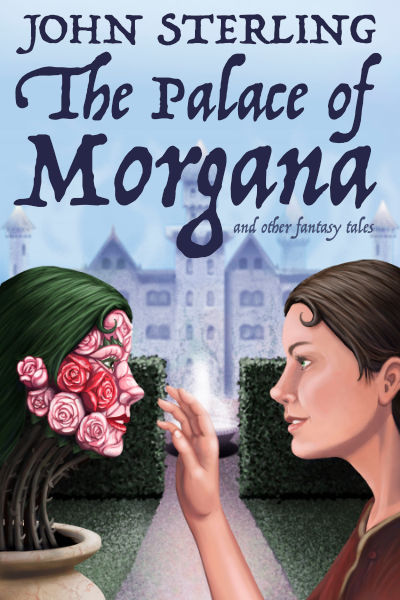
cover by Murray Ewing

Once I’d sought these out, cleaned up the text, and assembled them together for my own reading, I thought I’d put them out as a book, because, although the Essays and Tales are freely available as a PDF, I think the fantasy tales are worth issuing on their own, and in a more readable form.

Are they worthy, though, of Stableford’s high praise? It’s impossible, of course, to tell if Sterling really would have become one of his age’s most important writers, but his fantasy stories certainly show signs of developing in a unique direction. Aside from an attempt at Orientalism (“The Caterpillar”), which at least has the virtue of ending with a humorous moral to its tale of what happens to a young woman who thoughtlessly flicks a caterpillar off her arm, Sterling’s early tales published in The Atheneum were mostly set in or around the world of Ancient Greek myth. “Zamor”, for instance, is a sort of Vathek-in-miniature, providing three glimpses into the life of Alexander the Great, first as a carefree but ambitious boy, then as a world-conqueror granted a glimpse of the afterlife horrors awaiting all world-conquerors, and finally as a broken man haunted by that terrible vision. Perhaps the best tale of this period is the poignant “The Last of the Giants”, in which a fifteenth-century man, wandering among wild mountains after a shipwreck, gets a privileged but mournful glimpse of the titular creature.

The Arthur Coningsby tales are slighter but see an opening out in the sort of fantasy Sterling wrote. “The Crystal Prison”, for instance, is about a man punished by being imprisoned in a crystal sphere, in which, wherever he looks, he sees only his own face (an idea also used, if I recall rightly, in “The Hell of Mirrors” by Japanese writer Edogawa Rampo in 1926), and “The Sons of Iron” is a sort of early robot fable, about men made of metal who spend their lives making more men out of metal.
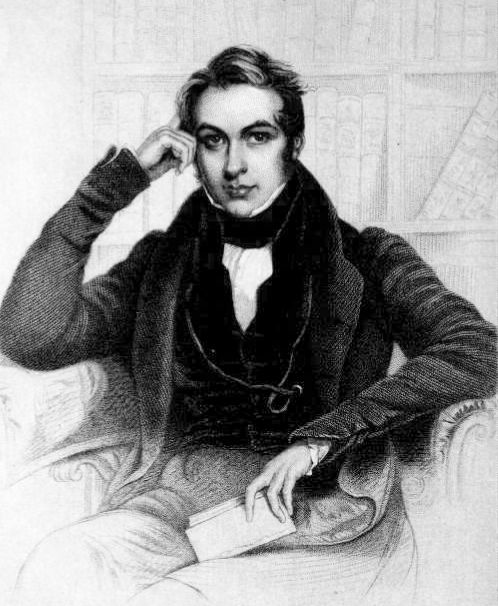
Portrait of John Sterling, by J Brown

Near the end of his life, Sterling began publishing a series of stories under the shared title “Legendary Lore” in Blackwood’s Magazine, and it’s here his writing really shows the promise Stableford alluded to. “A Chronicle of England” and “The Palace of Morgana” (a virtually conflict-free idyll about bright young things flitting around the grounds of a paradisal palace, amusing themselves with displays of magic — Stableford calls it “a uniquely delicate prose poem”) have left the world of Classical Greece for a fantasy that seems to owe more to the Shakespeare of A Midsummer Night’s Dream and The Tempest. The fantasy in these two tales is poetic and playful, strange and wondrous. Also published in Blackwood’s was “The Suit of Armour and the Skeleton”, a dialogue between two relics in an old church, one of whom (the suit of armour), despite being hollow, is rather full of himself, for having once been worn by a somewhat brutal duke, while the skeleton, of humbler origins, proves to have a more down-to-earth and inclusive outlook, as well as a greater claim to be on display in the church. The title and form both reminded me of Clark Ashton Smith’s prose-poem dialogue, “The Corpse and the Skeleton”, which has a similarly satirical (though more darkly cynical) flavour.

If these three, the best of Sterling’s tales, point the way to how his work might have progressed had he lived, he’d certainly have deserved Stableford’s praise. Ralph Waldo Emerson wanted to get Sterling’s works published in the US, and Carlyle, Sterling’s friend and literary executor, wrote a book on his life, but today he’s mostly forgotten. I’d like to imagine though, that, had the Ballantine Adult Fantasy line continued, it might one day have had a Sterling volume such as this. (I was aiming for something of that feel with my cover.) His language is often poetic and archaic (and I like it all the more for that), and he may rely, on occasion, on certain Romantic clichés (most of his heroines are unworldly, innocent types devoted to their ageing, widowed fathers, but have a longing to witness strange and sublime sights), but if you like classic fantasy, I think there’s something to enjoy in them.

The Palace of Morgana and Other Fantasy Tales is now available on Kindle, ePub and in paperback (and, of course, you can read most of the tales in Essays and Tales at archive.org).

^TOP

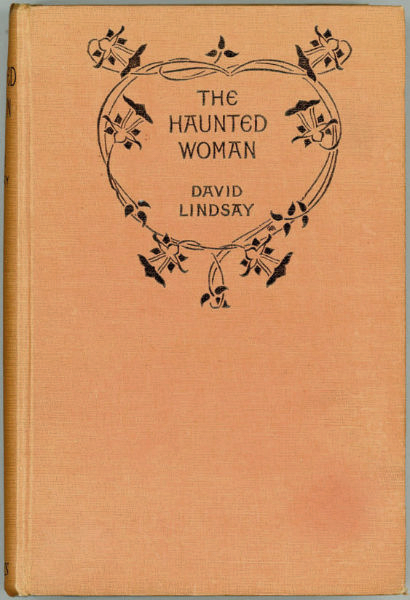
The Haunted Woman by David Lindsay

first edition, from Methuen

What is the haunted woman in David Lindsay’s The Haunted Woman haunted by? The novel starts with Isbel Loment (whose name is a wonderfully Lindsayan mix of music and tragedy), engaged to a Lloyd’s underwriter, Marshall Stokes, but in the meantime living an itinerant existence in a series of hotels with her aunt, Mrs Moor. Before her marriage, Isbel knows she must find a place for her aunt to settle, and Marshall, coming back from a trip to the United States, hears of a possibility, Runhill Court, near Steyning, in Sussex. As Isbel and her aunt are at present staying in Brighton, it’s only a short car-ride away, so an afternoon excursion is planned.

As well as showing the two women round this mostly Elizabethan mansion, Marshall has an additional assignment given to him by the house’s current owner, the 58-year-old widower Henry Judge. Judge, not presently living at the house, had some unusual experiences in the East Room, and wants Marshall’s opinion of the place. (Presumably he asked Marshall because, as Marshall himself admits, “I’m not gifted with a great deal of imagination”, and so might be expected to be down-to-earth in such matters.) But it’s Isbel who senses something strange about the place, hearing a sound in the passage leading to the East Room which the others can’t hear, and which she compares to both an orchestra tuning up, and “a telephone wire while you’re waiting for a connection”.

It’s already been revealed that Isbel has unfulfilled depths to her character. Sherrup, an artist and musician they meet briefly at Runhill Court, later tells her she’s “an artist without a profession… a lightning-rod without an outlet”, and she herself has already intimated that the rather shallow Marshall might not be the best match for her:

“I don’t know. . . . Love must be stronger than that. . . . I mean, one girl might be content with mere placid affection, and another might ask for nothing better than a thick sentimental syrup. It depends on character. My character is tragic, I fancy.”

Isbel, then, is all potential; the house, with its supernatural orchestra tuning up, is also all potential. Isbel says Runhill Court’s “atmosphere seems tragical”, so it’s obvious in which general direction all this potential is going. And when she meets the house’s owner, Henry Judge, and he says to her:

“There are deep, and possibly painful, transactions of the heart to which the term ‘romance’ would be quite inadequate…”

— she perhaps ought to know Marshall is not the man to fulfil her deeper nature, and Henry Judge is. But, already engaged as she is, society will not allow her to even think of the possibility. So constricting are the social rules by which Isbel and Judge live, it affects even their ability to feel when their deeper selves begin to suggest a route towards fulfilment.

Japanese edition

(The social world, in The Haunted Woman, is staid and placid on the surface, but vicious immediately beneath, as exemplified by Isbel’s exchanges with the widow Mrs Richborough, who also has her sights set on Judge. Judge, like all the men in the novel, except perhaps for the artist Sherrup, is oblivious to the barely-veiled subtext of what Isbel and Mrs Richborough are saying, but beneath their civilities, the two women are spitting venom and all but tearing at each other with their teeth.)

So, it’s her tragical, passionate nature that makes Isbel a haunted woman, and it requires a haunted house to bring the haunting out. Runhill Court doesn’t offer the traditional kind of haunting; its ghost is architectural. As Sherrup says of the structure that first stood where Runhill Court stands now:

“It was called Ulf’s Tower. The story is that Ulf was the original builder of the house. He lived about a hundred years after the first landing of the South Saxons… When Ulf built his house, Miss Loment, it was on haunted land. Run Hill was a waste elevation, inhabited by trolls—which, I figure, were a variety of malevolent land-sprites. Ulf didn’t care, though he was a pagan. He built his house. I gather he was a tough fellow, away above the superstitions of his time and country. And—well, one day Ulf disappears and a part of his house with him. Some of the top rooms of the Tower were clean carried off by the trolls; it happened to be the east end of the house, the nearest to their happy hunting-grounds. That was the very last that was heard of Ulf, but all through the centuries folks have been jumping up to announce that they’ve caught sight of the lost rooms. . . . ”

These rooms, accessible by a staircase that appears only to certain people at certain times, are where the story of Isbel and Judge’s true selves play out. The idea that it’s only in a place supernaturally removed from the day-to-day world that we can even start to make contact with our deeper feelings, our truer instincts, is typically uncompromising of David Lindsay. What’s worse, as soon as Isbel and Judge leave the rooms, they return to their everyday mindsets and forget everything that has just happened, even their most heartfelt vows and life-changing decisions.

Unlike A Voyage to Arcturus, The Haunted Woman offers no explicit, final explanation. Isbel has no Krag to tell her what it all means. This is one of the characteristics of Lindsay’s novels between Arcturus and Devil’s Tor — the human characters get mind-blasting visions, but no clue or guidance as to what they mean or how to fit this new strata of experience into the everyday world of twenties England.

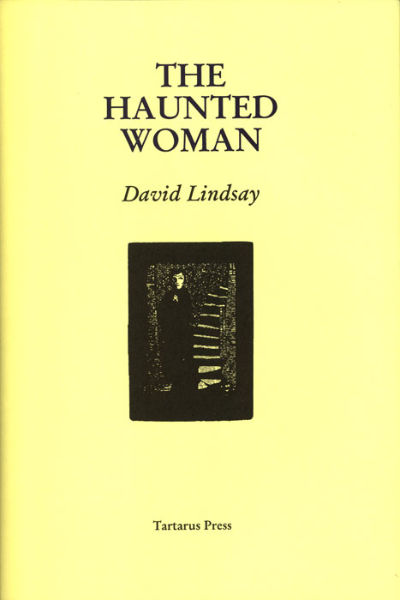
Tartarus Press edition, artwork by R B Russell

For most of The Haunted Woman, though, the meaning of the supernatural elements seems clear. Up the phantom staircase, Isbel is confronted by three doorways, and in her first three trips, she explores a different room each time. In the first room, furnished only with a mirror, she receives a vision of herself as she truly is, with all her tragical and passionate potentialities written clearly on her face. In the second room, furnished only with a couch, she meets Judge and the two can “drop the mask of convention, and talk to each other more humanly and truthfully” than in the outside world. But what of the third room? Here, there’s a window, looking out on a Spring-like, fresh world, unspoilt by man. No roads, no hedgerows. A musician plays his archaic instrument and his music awakens the pair’s passionate nature, until they’re overwhelmed, and can’t sustain the “worldly prudence on his side, angry pride on hers” that keeps them apart in the normal world. But what Lindsay does next takes it all one step further than a mere allegory of love in the face of straitening social bounds. Looking into the musician’s face kills two of the novel’s characters. The musician is not, then, the embodiment of human love or passion, but of the essentially tragic nature of the passion that’s so much a part (though submerged throughout her normal, waking life) of Isbel’s character.

David Lindsay, grainy newspaper photo, from the time of the publication of Devil’s Tor

So, passion, or love, is lifted to the level of Muspel (our true spiritual home) from A Voyage to Arcturus, as though Lindsay is saying that what Pain was in that first novel, Tragical Passion is in this one — the way out of a deceptive, ensnaring world, and the way home. (Lindsay several times in the novel links passion with pain — and music — as when he describes the sound of the musician’s bowed instrument as “low, fierce, passionate, exactly resembling a deep, forced human cry of love-pain.”)

This feeling that the coming together of a man and woman in a deeply meaningful, but deeply tragical and troubled manner, is the closest the living can come to a sort of reconnection with their deeper, truer selves, is reiterated in The Violet Apple, and intensified in Devil’s Tor. (I’d say it also has a hint of fairy-tale fulfilment at the end of The Adventures of Monsieur de Mailly.) It obviously had great meaning for David Lindsay, and is certainly an argument for regarding his post-Arcturus novels not as commercial compromises (as they’re often seen), but as genuine attempts to further his understanding of his own ideas.

^TOP

Tolkien: Maker of Middle-Earth Exhibition

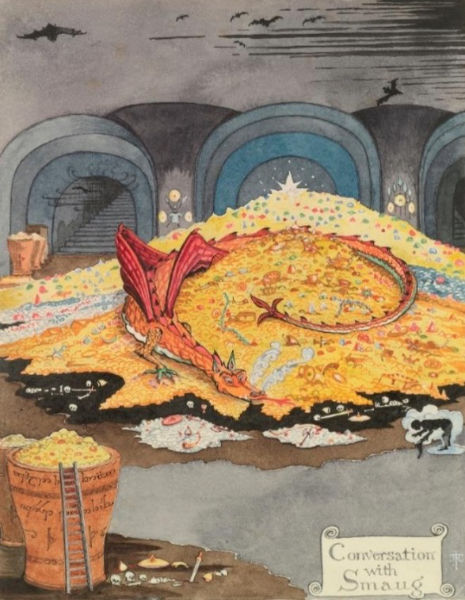
The Bodleian Library in Oxford is currently (1st June to 28th October) running an exhibition of items from the Tolkien archives. I’ve never been one to bask in, for instance, the particular chair an author wrote in (the chair from Tolkien’s study, and his little writing desk, are both on display), nor to get much from standing in the presence of an original manuscript, unless it’s been made more interesting with doodles (as with Mervyn Peake) or interesting corrections. I was, though, genuinely thrilled to see some of Tolkien’s original artwork, including two I must have known since first reading The Hobbit around the age of 10 or 11 — “A Conversation with Smaug”, which was used as the cover to my copy of The Hobbit, and his illustration of the trolls.

“A Conversation with Smaug” by Tolkien

What struck me about both was how small they were. Neither seemed appreciably bigger than the state in which I’d first seen them, i.e. the page-size of a 1970s paperback (they were probably more hardback size). And this smallness — tinyness, even — became something of a theme throughout the exhibition. For someone who created the first modern epic-sized fantasy, Tolkien, when he wrote, and when he drew, wrote and drew very small. The thing that really brought this home was seeing a letter written by Tolkien’s mother. Her handwriting was extremely neat, quite stylistic, but extremely tiny. I can’t find an example to reproduce, but I particularly remember her letter “p”, which had a strongly angled upright, with a little curlicue at the end, joined onto a perfect little circle. The whole thing looked as regular as typewritten text, but also, of course, being handwritten, entirely unique. And also tiny. Tiny, tiny, tiny.

Moving from that to some examples of Tolkien’s own writing, in his invented scripts, seemed more of a logical step than a leap of invention — with his invented letters being based around tiny circles with lines and curlicues attached, all so neat and tiny. Not quite as tiny as Mrs Tolkien’s, but tiny nevertheless. The tinyness of Mrs Tolkien’s handwriting could, of course, be put down to her writing on small letter-paper to keep down on postage costs, but to me, the tinyness of Tolkien’s runes and handwriting makes me think more of the privacy of imaginative creation, as though, in a way, he was making his “sub-created” world out of deliberately smaller elements, to contain it within our world, not make it stand on a par with it.

And I’ve no doubt that so much practice with tiny, neat calligraphy would have given Tolkien the control of his pen (and paintbrush) needed to produce his very neat drawings and paintings. There was a quote from Tolkien reproduced alongside one of his drawings, saying that he didn’t have the patience to be an illustrator and didn’t think he could draw, but I’m always impressed by how much the more successful of his artworks work because of the sort of sparseness and control you don’t expect to find in an amateur, who’d be more given to over-drawing, filling up the page with detail to compensate for lack of skill. Tolkien seemed to know what he wanted to draw, did it to the best of his ability, then stopped. And his use of colour on occasion makes successful use of quite restrained pastel shades, another thing I don’t associate with someone who “can’t draw”.

I have to add, though, that the last thing I looked at in the exhibition was Pauline Baynes’ watercolour map of Middle-earth, and there you could definitely see the subtle touches that showed a professional was at work. Despite being the original piece, I could only detect the barest hint of supporting pencil work — a very faint line running through the centre of the curves of text naming regions of the map was about it. (The colours were also a lot subtler and brighter than the image I’ve linked to.) Pauline Bayne’s illustrations (for the Narnia books) are something I’ve known for about as long as Tolkien’s Hobbit illustrations, so that was another thrill, seeing some of her original work.

One of Tolkien’s pages from The Book of Mazarbul”

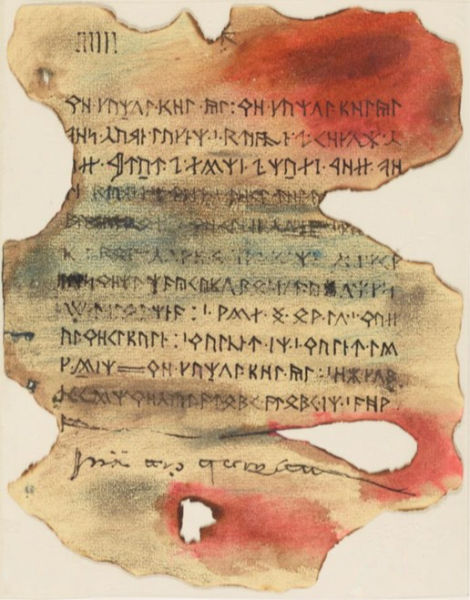
Elsewhere, there were Tolkien’s maps — not just finished versions, but some work-in-progress versions, one of which had a second layer of paper stuck onto it, where frequent rubbings-out and corrections led to his needing to redraw a section. Role-playing gamers of a certain generation will no doubt be thrilled to see one map of Middle-earth drawn on green-lined graph paper, which was, for me, the go-to stationery for your serious fantasy role-play mapping (having smaller squares than standard squared paper, it seemed you were being that much more serious). Role-players will also be happy to see Tolkien’s artistic attempts to recreate pages from the Book of Mazarbul that the Fellowship find in Moria, recording the last days of the dwarves’ attempt to reclaim their old domain. Tolkien has artistically burned the edges and added suggestive smudges of blood-like red. It could be a prop from a particularly well-made dungeon crawl.

There were also letters. On display was a reader’s report from a young Rayner Unwin on The Lord of the Rings, and a few fan letters, one in runes, one from a young Terry Pratchett (praising Smith of Wootton Major), and some illustrations to The Lord of the Rings done by Princess Margrethe, two years before she became Queen of Denmark.

All in all, a good exhibition. Not many physical objects (a chair, a collection of pipes, an old — and, again, tiny — notebook), nor many photos, but the things I got the most out of, anyway, were the originals of the illustrations and book-cover designs (those for The Lord of the Rings and the first hardback of The Hobbit were all there). The exhibition was held in one reasonably-sized room, but it didn’t feel small, thanks in part to that intriguing Tolkienian tinyness.

^TOP