 I first came across Oliver Onions through his most famous ghost story, “The Beckoning Fair One”, in a book called 4 Classic Ghostly Tales. A story of artistic obsession, it’s about a writer, Oleron, locking himself away in an unfortunately-chosen house to finish his latest novel, and there becoming distracted by a spectral woman who taunts him with her barely-perceptible presence. Detectable at first only by a faint static crackle as she brushes her hair, once she knows she’s captured her victim’s interest, she does the very un-ghostly thing of withdrawing, rather than intensifying, her manifestations, leaving Oleron, desperate and addicted, doing nothing for hours but standing there watching & listening for the slightest sign of her. As much as it works as a ghost story, “The Beckoning Fair One” is the tale of a writer cutting himself off from the real world to pursue an impossible, all-too-idealistic beauty that can never be captured.
 The Dead of Night collects all of Onions’ ghostly and near-ghostly tales, some slight, some disappointing, but a good few coming close to “The Beckoning Fair One” in power, subtlety, and depth. Many share the same basic theme, of the artist caught in a choice between an impossible ideal and a compromise with what reality has to offer, often contrasting the pursuit of an ideal muse with a failing connection to a real woman, less ideal and less inspiring, who often comes off the worse. (Elsie Bengough, in “The Beckoning Fair One”, is a very real, and practical, woman — “the mere thought of Elsie was fatal to anything abstract” — who’s attacked in subtle ways whenever she tries to get between the Fair One and her latest victim.)
“Resurrection in Bronze” is the most powerful such tale. John Brydon, an artist on the verge of wider success, locks himself away in his studio to finish his latest commission, a sculpture than may earn him thousands, rather than his usual hundreds, of guineas. But while doing so, he neglects his family, his health and his sanity. It’s a taut psychological study with no supernatural element. Nevertheless, it feels at home between the same covers as “The Beckoning Fair One”. The haunting is real, even if there is no ghost.
“The Smile of Karen” adds a twist to Onion’s tales of obsessive artists: this time it’s the muse who’s the focus of the story. Walther Blum is an illiterate woodsman with a powerful, natural artistic talent in sculpting wood — powerful to the point of torturing him with the need to capture the “anguishing and untranslatable beauty” he sees in his seventeen-year-old wife. Karen, though, finds the atmosphere at home unbearable: “I had married a man who growled over pieces of wood. I was something to turn into a piece of wood.” As much as the artist of “The Beckoning Fair One” is torn between two muses, one real, one ghostly, Karen is torn between being the beautiful statuette her husband would make of her, and her own, real, normal woman. To escape him, she flirts with a local womaniser, galvanising her husband’s violent jealousy.
In his introduction, originally for a 1935 compilation of his ghostly stories, Onions writes of how too many hackneyed ghost stories have stripped the ghost itself of much of its power:
“the spectre is apt to be swamped by the traditional apparatus that makes the stock illustration for the Christmas Number, and there is little to be said about this region except that here the ghostly texture is at its coarsest…”
And so he decided to explore the “surrounding” territory — “no less haunted… and with far subtler terrors”. And though The Dead of Night does contain a few rather mechanical attempts at doing something new with the traditional tale of ghostly haunting (“Rooum”, with its engineer pursued by an insubstantial thing that runs through him, taking more and more out of him each time; “The Rocker”, in which a gypsy sees what an old woman rocks in her arms as she sits each night by the fire; or the very traditional “and when I came back the next day, it was all gone” style of “The Cigarette Case”), there are some that transcend the genre so much as to be barely related to it, but nevertheless make excellent stories. Two of these, “The Honey in the Wall” and “The Rope in the Rafters” (long tales both), provide an excellent variant on the ghostly tale. As much psychological studies as anything else, these stories lead you into feeling that their protagonists are becoming ghosts themselves, though metaphorically, rather than in any Sixth Sense kind of way.
“The Honey in the Wall” is about a young woman trying to decide how to keep hold of her home in the face of dwindling family finances. She spends the story separated from her young and frivolous house-guests, haunting her home’s lesser-known rooms and passages. Particularly affected by the portrait of one of her ancestors, whom she imagines as so much more capable of facing such a crisis, young Gervaise at one point dresses up as “Lady Jane” and is mistaken for a ghost. The title of the story refers to a stash of twenty-two pounds of honey, long-abandoned by the bees that made it, found in a hollow wall, which Gervaise likens to the warmth and sweetness she feels she has to offer, but which is stifled in its expression by her withdrawn, introspective temperament. The supernatural element to this tale is so slight as to be maybe no more than a dream or a delusion, but it caps the feeling that Gervaise is a ghost in all but that she isn’t dead.
The protagonist of “The Rope in the Rafters” is another such living ghost. James Hopley, disfigured by a bomb in WWI, goes to a remote chateau to recover from a recent mental breakdown. His scarring causes several people to react to him as if he were a ghost, so he keeps himself hidden, haunting his own little part of the chateau and increasingly becoming detached from reality. The suggestion that there’s a genuine spectre at the chateau — “Jean the Smuggler”, who likes to drive people to take their own lives — is blurred with Hopley’s own feverish flashbacks to the week he spent in a wounded daze following the explosion that ruined his face. The identification between haunter and haunted feels similar, at the end, to that between the unbalanced Eleanor Vance and Hill House in Shirley Jackson’s The Haunting of Hill House (the scariest book I’ve ever read, if you’re interested), in that its conclusion also feels like a final coming home, however horrific.
There’s a third strand that recurs throughout Onions’ ghostly tales, in which people are not haunted by ghosts, but by influences from the distant past — past lives or long-buried race memories, often going as far back as the myth-tinged times of Ancient Greece. The most successful of these, and the longest piece in The Dead of Night, is “The Painted Face”, in which Xena Francovilla, the devout daughter of a rich hotelier, is placed by her father in the company of an American, Mrs Van Necker, and her small gaggle of more worldly young charges. Coming to Africa, Xena’s religious devotion to Saint Rosalia slips and she finds herself becoming increasingly pagan, at the same time falling in love with a young man and feeling the first stirrings of womanhood. But the influence isn’t only biological — she seems to have, in some past incarnation, been promised to Poseidon, who cursed her for her faithlessness to forever be enchanting men, only to lose them after the first kiss. Xena embarks on a plan to rid herself of this curse. The final mechanics of the story, though, are less important than the extended psychological portrait of a young girl caught between two distinctly different but powerful influences — that of the chaste Saint Rosalia and the pagan Dionysus.
 In general, I’d say, it’s in the longer stories, where Onions can spend time with his characters and build up the strangenesses and subtleties, that he’s more successful, whether there are ghosts, ghostly influences, or no supernatural goings-on at all. The one exception to this longer-the-better rule is “The Real People”, an attempt to turn the artistic quandary of “The Beckoning Fair One” to comic ends, as a popular but uninspired writer creates a seemingly “living” character for once, and has her first take over his novel, then his real life. Apart from the humour being a little underwhelming, this long tale didn’t work for me because the supposedly “living” character (an initially meek and lowly shop-girl who starts social climbing) seems as clichéd as the protagonist’s other literary creations.
There are few conventional ghost stories, here, then. The best, and most ghostly, is “The Beckoning Fair One”, but there are plenty of good tales situated at what Onions calls “the ultra-violet and the infra-red of the ghostly spectrum”, where the haunting is as much metaphoric as actual: “The Honey in the Wall”, “The Painted Face”, “The Rope in the Rafters”, and “Resurrection in Bronze” being my favourites.

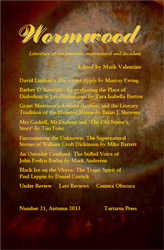 I have an essay in the latest issue of Wormwood, on David Lindsay’s posthumously-published novel, The Violet Apple. Of all Lindsay’s novels, it’s the one I most wanted to write about, perhaps because it’s one of his lesser-known and rarely-read works, but also because, although his first novel, A Voyage to Arcturus, is undoubtedly the most impressive in terms of sheer ambition, The Violet Apple is his most muted, and human — the novel of a writer with some experience and craft — as well as perhaps being his most artistically unified. I even named my website dedicated to David Lindsay after it. (I’ve always thought it the most filmable of his novels, too, and would love to see it as a sort of Merchant Ivory style period piece!)


