The House on the Borderland by William Hope Hodgson

Sphere PB, art by Terry Oakes

The title alone is enough to earn Hodgson’s 1908 novel a place at the heart of any weird fiction canon. And the book’s first quarter, with its nameless narrator (known as “the Recluse” to this found-manuscript’s editor) holing himself up in a remote country house and fending off nightly attacks from noxious swine-things like a classic Doctor Who base-under-siege story, feels like the perfect set up for a weird adventure story. But then things take a ninety-degree swerve into the cosmic, visionary, and psychedelic, with a long trip through accelerated time. We see the death of our Earth and the Sun, then follow a slow, abstract path to the heart of the universe, to glimpse the truth behind “the scheme of material creation”: a pair of massive central suns, one a giant, weird green (“the abode of some vast Intelligence?”), the other utterly dark. Then back to the present and the house under siege, though not, now, by a host of fleshy-white swine-things, but one giant green glowing one, whose touch leaves a fungous infection that recalls, to my mind, the bleak and inexplicable creeping death in Lovecraft’s most coldly cosmic tale, “The Colour Out of Space”.

Ian Miller art for Panther PB

To be wrenched out of what seems like such a brilliant set up for a weird adventure novel into that rather abstract, visionary journey to the heart of the cosmos always leaves me wondering if The House on the Borderland has a single, unifying idea behind its various, brilliantly weird episodes, or is just a collection of Hodgson’s wilder imaginings. As well as the swine-things and the time journey, there’s a curtailed afterlife love story, as the Recluse has a perhaps visionary, perhaps extra-dimensional, meeting with his lost, dead love — and this is another jarring moment, because at this point it’s revealed that most of this section of the manuscript is missing. It’s almost modernistic in effect, as we experience the Recluse’s feelings of loss through having the relevant portion of the story itself missing, apart from hints and echoes.

Lovecraft loved the book (though he couldn’t help squirming at its “few touches of commonplace sentimentality”), but came to it too late for it to really be an influence. And I feel that Hodgson is far more of a gut writer than one like Lovecraft, who had a definite outlook and philosophy. (I almost wonder if the book didn’t kick off after a fevered reading of Wells’s The Time Machine, which has the same mix of beast-men (the Morlocks) and a trip to the end of time. Only, Hodgson takes things to far weirder extremes.) Still, it seems, from his author’s note at the start, that The House on the Borderland has some unifying meaning:

“The inner story must be uncovered, personally, by each reader, according to ability and desire. And even should any fail to see, as now I see, the shadowed picture and conception of that to which one may well give the accepted titles of Heaven and Hell; yet can I promise certain thrills, merely taking the story as a story.”

The start of the novel, with its nightly assaults by semi-human swine-things, is chock full of classic Gothic imagery of the dark subconscious: a bottomless Pit, an unexplored cellar, a trapdoor opening onto unimaginable depths, an overpowering rush of water, the swine-things themselves, and the fact that they don’t seem to be seen by the Recluse’s sister, the one person with whom he lives. Plus there’s the lure of the shadow-self, and that need to stare into one’s personal Nietzschean Abyss:

“Sometimes, I have an inexplicable desire to go down to the great cellar, open the trap, and gaze into the impenetrable, spray-damp darkness. At times, the desire becomes almost overpowering, in its intensity.”

The novel feels like a wholesale reaction to all the nineteenth century’s upendings of religious certainties: Darwin’s linking of man to the animals (the swine-things), the realisation that the sun must one day die, even the germ theory of disease (in the way the dog’s eerily glowing wound infects a cut on the Recluse’s arm), plus the gradual replacement of a Christian Heaven by an astronomical cosmos of suns, planets, and nebulae.

Ace Books (1962) edition, art by Ed Emshwiller

But I think the thing that unifies Hodgson’s novel is clear in its title. This house stands on a borderland, and so it is the house, by being where it is, that unites the various weird realities it touches. Living in it, the Recluse is living between the bestial (attacks by the swine-things) and the spiritual (his visions of his dead love in her seashore afterlife); also between life and death (the gods that surround the house’s visionary twin in the Arena seem to represent “a state of life-in-death”); and between Heaven and Hell (the house has “Little curved towers and pinnacles, with outlines suggestive of leaping flames”), or hope and despair, in the way the narrator’s connection with his lost love at the Sea of Sleep, and his apprehension of the Green Sun as some sort of ultimate intelligence, are set against the swine-things, the beast-headed gods of the Plain of Silence, the Dark Sun that twins the Green Sun, and the Dark Nebula (“a very hell-fog”), which seems to contain souls trapped in agony (“A face, human in its outline; but so tortured with woe, that I stared, aghast. I had not thought there was such sorrow, as I saw there.”)

These extremes of Heaven and Hell, hope and despair, are part of a package. You can’t have one without at least risking the other. Or so the Recluse’s dead love tells him, at one point:

“Strangely, she warned me; warned me passionately against this house; begged me to leave it; but admitted, when I questioned her, that she could not have come to me, had I been elsewhere.”

William Hope Hodgson

And if it’s the house that unifies the various elements in Hodgson’s weird novel, then it’s not much of a leap to taking that house as a metaphor for the human condition. Its cellars are the outermost regions of the unconscious, whose key the narrator keeps with him at all times (though he only, at first, goes down there to store and retrieve wine, inebriation being one way into the realms of the unconscious). Below these are far vaster, perhaps limitless depths. The Recluse spends most of his time, though, in his study, a room which symbolises the intellect. It’s this room that has the weakest external door, and where the swine-things get closest to breaking in. As a final indicator that the house and the man who lives in it are one, it’s only when the Recluse’s body is invaded by the giant green swine-beast’s infection that the swine-thing(s) manage to get inside the house.

It seems to me that, though The House on the Borderland’s depiction of humankind as standing on the edge of all sorts of weird realms is undoubtedly cosmic, it’s not as despairing as Lovecraft’s cosmicism. Hodgson isn’t saying, as Lovecraft did, that humankind is utterly insignificant compared to the vastness of the cosmos, but he is saying that it’s possible, in such enormous and strange spaces, to be infinitely lonely:

“…I realised, despairingly, that the world might wander forever, through that enormous night. For a while, the unwholesome idea filled me, with a sensation of overbearing desolation; so that I could have cried like a child.”

But this could just be a depiction of the Recluse’s own particular type of Hell. He seems to have become locked in loss since the death of his loved one. He still, for instance, lives with a woman (his sister), but appears to have absolutely no emotional or intellectual connection with her (“I have made a rule never to speak to her about the strange things that happen in this great, old house”). Similarly, after his dog dies, he acquires another one, but can’t bring himself to take it into the house, even when it’s being attacked at night by the massive green swine-thing. His one physical contact with it results in his own infection.

The House on the Borderland is undoubtedly a classic of weird fiction. I still find the central time-travel section too slow-moving and abstract, and the Doctor Who fan in me would love to read a version that was only about the swine-things assailing the house at night, but perhaps it’s the unforgiving strangeness of the book’s jarring shifts in narrative direction that really encapsulate its meaning and power: we’re all of us living in houses on many strange and disquieting borderlands, and had better watch out.

The House on the Borderland is available at Project Gutenberg. The William Hope Hodgson blog contains a lot of information about the writer and his works.

^TOP

Goblin Market by Christina Rossetti

Christina Rossetti by her brother Dante Gabriel Rossetti

Christina Rossetti’s fairy-tale poem Goblin Market was completed in April 1859 (when she would have been 28), and was first published in 1862, in Goblin Market and Other Poems, her first non-privately-printed collection. The poem’s initial title was “A Peep at the Goblins”, but her brother, the Pre-Raphaelite poet and painter Dante Gabriel Rossetti, convinced her to change it. (He also provided the illustrations for its first appearance.) It was, appropriately enough for a poem about a redemptive bond between sisters, dedicated to Christina’s sister Maria Francesca Rossetti (a Dante scholar who would later become a nun). And at this point it seems best to bring in the rest of the family: Christina’s other brother William was a critic, biographer and Pre-Raphaelite (and a civil servant); her father Gabriele was an Italian Dante scholar now living in London; her mother was the sister of John Polidori, author of The Vampyre (1819), which was based on Lord Byron’s offering on that infamous night in 1816 when Mary Shelley presented the story of Frankenstein at the Villa Diodati.

Illustration by Arthur Rackham

Goblin Market tells the story of golden-haired sisters Laura and Lizzie, whose country-maiden idyll is interrupted at the start and end of each day by the cries of goblins hawking their wares, a mouthwatering list of ever-ripe, ever-juicy fruits. These goblin-grown (or, in at least one case, imported) fruits are dangerous, though, as the sisters know from the tale of Jeanie:

Do you not remember Jeanie,
How she met them in the moonlight,
Took their gifts both choice and many,
Ate their fruits and wore their flowers
Plucked from bowers
Where summer ripens at all hours?

Having eaten the fruits, Jeanie “Fell sick and died”, and is now to be found in her grave, above which no grass or flowers grow. Laura, though, can’t resist the goblins’ cries. She has no money to buy the fruit, but the goblins are only too happy to give her as much as she can eat for a lock of her hair. The next day, all she can think of is tasting the fruit again, but when the evening comes, she’s devastated to find her sister can hear the goblins’ cries but she no longer can. She pines away, till Lizzie sacrifices herself for her, going to the goblin men and trying to buy their fruits with a penny. When the goblins realise she isn’t going to gobble their fruit up straight away, they assault her with it, pelting her, and smearing it into her face. Lizzie goes home covered in fruit pulp and juice, and offers herself to Laura:

Hug me, kiss me, suck my juices
Squeezed from goblin fruits for you,
Goblin pulp and goblin dew.
Eat me, drink me, love me;
Laura, make much of me;
For your sake I have braved the glen
And had to do with goblin merchant men.

Finding the fruit now tastes of a “bitterness without a name”, Laura is saved, and we get a brief, trite moral about there being “no friend like a sister”, then the poem ends. The moral in no way satisfies, but isn’t that always the way with fairy tale morals? They’re like the “Once upon a time” at the beginning — part of the formula, a way to get things started or get them stopped, a frame for the wonders contained within, and, like most frames, not to be examined too closely.

Illustration by Arthur Rackham

Goblin Market was well-received at the time (though Ruskin didn’t like its irregular rhyme scheme and line lengths), and has since, like eat-me Alice, only grown in stature, and is now perhaps Christina Rossetti’s second most well-known poem (the first being “In the Bleak Midwinter”).

There’s something startling, even shocking, about the poem, that begs for explanation. Those lines I quoted just above are perhaps the key to this feeling, arriving as they do in the midst of a poem by a woman Victorian writer who never married (though was several times engaged), and who held strong religious views. She herself (according to an 1895 biography by her friend Mackenzie Bell) said the poem had no specific meaning, and was just a fairy-story. Brian Stableford, in The Dedalus Book of British Fantasy, calls it “one of the most vividly erotic pieces of writing to have surfaced in England during the entirety of Victoria’s reign”, and Kinuko Y Craft’s illustrations for the poem, published in Playboy in 1970, make it clear that, to her, the goblins’ fruits were sexual in nature. At the time she wrote it, Christina Rossetti was working at the St Mary Magdalene Penitentiary for fallen women in Highgate, an institution “remarkable in the period for its conviction that women who had transgressed sexually could be redeemed” (“An introduction to ‘Goblin Market’” by Dinah Roe), and the tale-within-a-tale of Jeanie:

Who should have been a bride;
But who for joys brides hope to have
Fell sick and died

…combined with the fact that only “maids” hear the goblins’ cries, and Laura ceases to hear them after she’s tasted their fruit, makes it sound that the poem is about Victorian ideas of sexual purity and young women having to act “as modest maidens should” — that is, until it comes to Laura’s redemption through Lizzie putting herself through the same ordeal, which doesn’t fit.

Nevertheless, the poem is undeniably, well, fruity.

Other critics go for a more religious interpretation, and fruit is laden with religious significance, from the fruit of the Garden of Eden, to “You will know them by their fruits” (Matthew 7:16):

“…it is easy to see the produce of the goblins as the corruptible, temporal rewards of earthly life that should be passed over, not because they are necessarily bad, but because there is something better to seek, something that will satisfy where the goblin fruit cannot: the eternal, incorruptible rewards of heaven.” (“Fallen or Forbidden: Rosetti’s ‘Goblin Market’” by Lesa Scholl)

Also, there’s the poem’s feminism:

“The goblin merchants are men… who dominate women; they consume their prey like the fruit they sell, tossing the rinds and pits away once they have found temporary satiety…” (“Can I know it? — Nay: An Alternative Interpretation of Christina Rossetti’s ‘Goblin Market’” by Matt Christensen)

Laura’s pining away for another taste of the fruit sounds like addiction (and fits in with Christina’s brother Dante’s wife’s death from a laudanum overdose, though this was in 1862, after the poem was written), but if so, the goblins aren’t exactly your classic drug pushers, as they make themselves scarce as soon as they’ve created a new addict; they’re only interested in corrupting innocent souls, not leeching off them.

One of Dante Gabriel Rossetti’s illustrations to his sister’s poem

(The goblins are one of the most interesting parts of the poem, from a fantasy-reader’s perspective. They’re not your traditional goblins, but a ragtag mix of animalistic little men:

One had a cat’s face,
One whisked a tail,
One tramped at a rat’s pace,
One crawled like a snail,
One like a wombat prowled obtuse and furry,
One like a ratel tumbled hurry skurry.

And I can’t help thinking of Dante Gabriel Rossetti whenever I read this, as he had his own little private menagerie, which gained a wombat in 1869. It was, apparently, allowed to sleep on the dinner table during meals. Hopefully Dante didn’t also gain his own ratel — another name for one of nature’s most aggressive small animals, the frumious honey badger.)

Goblin Market is obviously a tale of fall and redemption, but one in which redemption can be purchased through the same means as the fall. It’s the glamour the goblins spin about their fruit that makes it taste so good, which is why they don’t want to simply sell it to Lizzie so she can take it to the ailing Laura — they know that, without their sales spiel, the fruit will taste like “wormwood”. Likewise, it seems to be what the fruit is purchased with that gives it its evil or its good effect: Laura purchases hers with a lock of her golden hair, which is usually a gift for lovers (or, in Victorian times, the memento of a dead loved one); Lizzie purchases hers not so much with a penny as her willingness to sacrifice herself for her sister.

Perhaps, with Goblin Market, it’s not the details that give the poem its meaning, but the underlying sentiment, that it’s not what you do but why you do it that matters.

You can read the poem online here.

^TOP

The Hollowing by Robert Holdstock

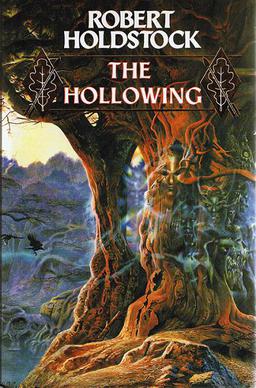
UK cover by Geoff Taylor

The Hollowing (first published in 1993) begins a year after the previous Ryhope Wood book, Lavondyss, and has a brief, baton-passing connection with that book’s characters. Early on, James Keeton, the father of Lavondyss’s protagonist Tallis Keeton, emerges from Ryhope Wood, ragged and wild-looking, a year and fifteen days since he disappeared in search of his still-missing daughter. Obviously broken by this loss (and, no doubt, by his time in the mythic depths of Ryhope), Keeton is taken to a sanatorium, where he’s visited by this book’s main character, Richard Bradley, and Richard’s son Alex, who had something of a connection with Tallis. But Keeton came back clutching one of Tallis’s masks, and when Alex picks it up and looks into it, he opens a “Hollowing” to the heart of Ryhope — a sort of wormhole shortcut by which you can leap from one distant location to another, even one world to another. Alex falls unconscious, and when he recovers, he’s not fully there, only capable of mumbling a few strange words, like “chapel” and “giggler”. Some time later, he disappears, and when his somewhat woody-seeming and highly decomposed body is found at the edge of the wood, Richard and his wife Alice can only mourn for his death. A few years later, though, Richard (now separated from Alice) receives a message from a group of scientists camped in Ryhope Wood, saying they’re in contact with his son and need his help to reach the boy. Alex is not dead, just lost deep in Mythago Wood.

Reluctantly but inevitably, Richard enters the wood, acclimatises to its peculiarities, and arrives at the scientists’ station at Old Stone Hollow to meet its bunch of investigators:

When the Station at Old Stone Hollow had been established, three years ago by the time-standard of the world outside of Ryhope Wood, there had been twenty assorted scientists and anthropologists, all gathered in by Alexander Lytton, all with a specialist field, all made privy to the secrets and oddities of the realm of the wildwood. They had been divided into ten teams of two, but only five of these duets remained extant. Three had disappeared more than two years ago and were presumed dead…

The backstory of the first Ryhope Wood book, Mythago Wood, has a pair of scientists, George Huxley and Edward Wynne-Jones, attempting to use early-20th century instruments to understand the wood’s mythogenic powers, but now we get a whole campful of them. These are not, though, quite the same as The Stone Tape’s band of experts trying to crack the secrets of a haunted room; they’re a bunch of jaded, irritable, and emotionally scarred men and women as far from understanding their object of study as ever, except that they’ve come to know, and be wary of, its many dangers. The station is surrounded by an electronic barrier that repels most mythagos, but also by more traditional warding methods: scarecrows, masks, shields and weapons hung from trees, totem poles. Anything that works. The scientists of Old Stone Hollow are prone to wander into the wood on their own private quests, driven as much by personal stories of loss or need (“Everybody’s looking. Everybody’s seeking. Everybody’s dreaming”) as the desire for scientific understanding. Many have had the experience of going “bosky” — entering so deep into the wood and its mythic world, they lose touch with their modern selves and start to behave like the very myths they’re living among. And they accept this as part of the deal.

One of the leaders of the expedition, a Scot named Alexander Lytton, has read George Huxley’s journal and has an obsessive need to somehow make contact with the man himself (even though he knows he’s long dead). He believes the wood was woken to its present active state by George Huxley, and is annoyed that Alex’s destabilising presence is overwriting Huxley’s traces. Alex, Lytton believes, was damaged mentally when he was snatched into the wood. The boy was stripped of the many inner aspects of himself, each becoming a separate mythago, many of them created from his enthusiasm for various myths and legends (he had a particular interest in the tale of Gawain and the Green Knight, but even his interest in dinosaurs has its effect on the wood). Somewhere, though, there’s what Lytton calls the boy’s “protogenomorph”, the “first form of the dreaming mind of the boy”, “the part of him that has waited for you, the part that has been fighting the battle”. Richard, then, has to find his son in the depths of Ryhope Wood and somehow bring him back to wholeness.

One of the new things Holdstock does in The Hollowing is show us the mythically-entangled stories of characters from other parts of the world. There’s Arnauld Lacan, whose entanglement with mythagos began in Brittany where, like the first book’s Stephen Huxley, he fell in love with, and lost, a woman who seems to have been a mythago. More interesting, though, is Helen Silverlock, a Lakota Sioux (Richard is reminded of “Cher from the pop duo Sonny and Cher” — one of the book’s few references to the pop music of its time, it mostly being set in 1967). Her family has been “regularly attacked, abused and destroyed by Coyote”, and she has come to Ryhope in the hope of meeting this particular form of trickster and sorting things out.

The most interesting section of the book, for me, was a longish chapter where Richard, living alone for a while in Old Stone Hollow, encounters a whole ship-load of mythagos, a grizzled crew of cynical Ancient-world warriors with a hold full of plundered wonders and treasures — some of which are living, including a pair of centaurs, a cyclops blacksmith, and the still-singing severed head of Orpheus. This is a gritty, aged version of Jason and his Argonauts, a Jason interested in nothing but gaining and owning treasures, pillaging them wherever his ship lands, and caring nothing for their value except as trophies. In a way, he could be the embodiment of the worst direction the scientists of Old Stone Hollow could go, if they thought of the wood simply as a thing to classify, dissect, and extract exploitable knowledge from. Jason, in this purely possessive aspect, can be seen as the worst possible attitude to take towards the “treasures” of the mythic and imaginative inner worlds. (In many ways, he and his band recall the dark, plundering “Outsider” Christian from the first book.)

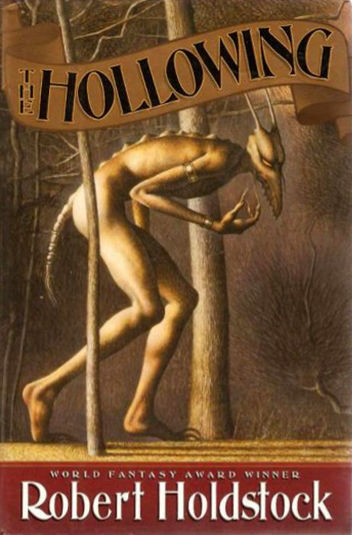
US edition, cover by John Jude Palencar, from ISFDB.

In contrast to Jason is Sarin, a woman Jason keeps as one of his items of living plunder in the hold of his ship. She comes from a time when everyone could speak a single language, known as the “Tall Grass language”, as well as each having their own private language (“which they spoke alone, to the moon, or to hidden forces, or to God”). In her time, a great tower was built, stretching high into the sky, before being struck down by the gods as a warning against overreaching arrogance, after which people forgot the Tall Grass language, and could only speak a confusion of their own, secret tongues. Sarin, however, emerged from the fall of the Tower of Babel with her memory of the original language intact, and using it, she can understand and speak all languages, given a little time to work them out. She, in a way, provides a different way of seeing the inner worlds of myth and imagination: as ways to access the one “language” of myth and symbol we all, at some deep level, share, before it’s distorted by individuality and isolation. As Lytton later says of the many mythago-selves Alex was stripped of when he was brought into the wood:

“This is an encyclopaedia of what we have all inherited!”

It’s been a while since I reviewed Mythago Wood and Lavondyss, though I intended to read through the entire series at the time. Lavondyss was just too rich and harrowing an experience to leap straight into another book in the same vein. I’d say The Hollowing is no way near as powerful or focused as Lavondyss, though it’s hard to imagine any author producing another book as powerful as that one. In fact, I found it hard to imagine how Holdstock could ever follow that book, so having his next novel in the Ryhope Wood sequence feel somewhat half-powered is forgivable, even if I would have preferred a more focused story, to make the reading flow a bit better. (I was never drawn back to this book to see what happened next, only to get a bit more reading done.)

The Hollowing’s mythagos are much more fantastic, its world much more plastic, bending and warping far more than Mythago Wood’s did, and so it lacks the first book’s ability to make you feel you were being confronted by living, breathing, often stinking, emanations from a real historical past. It also feels much less connected than Lavondyss did to its main character’s personal darkness, much less singularly focused. Rather, The Hollowing feels like a slice of life in Ryhope Wood — eventful, certainly, but rather scattered and fragmentary. It’s not really clear what Richard Bradley has to do to bring his son back from being lost in the heart of the wood, so for most of the book it feels we’re just sitting around waiting for things to happen. And yes, things happen, but it all feels somewhat disconnected, until, finally, Richard too goes “bosky”, and has his period of living wild in the wood, casting off the shell of his daily self and accessing something more primal. And perhaps this was the necessary step he had to take in order to reach his son, but it still felt that it was something that just happened, rather than something he had any active part in initiating. Still, The Hollowing left me feeling Holdstock has more to say, so I’ll hopefully be reading the next book in the Ryhope Wood sequence soon.

^TOP