Titus Groan by Mervyn Peake

Titus GroanIf you imagine a sliding scale of fantasy from the Epic to the Gothic, the defining works at either end must surely be Tolkien’s Lord of the Rings and Peake’s Gormenghast books. Both Tolkien and Peake were illustrators (Tolkien on a much more amateur level), and both used (initially private) drawing as a means of immersing themselves in their created worlds. A quick glance through J R R Tolkien: Artist & Illustrator shows that Tolkien was mostly interested in, and accomplished at, landscapes. His humans and humanoids, when present, are often stiff, and usually take second place to the scenery, but his landscapes, though conjured with a decorative rather than a realistic style (and very much under the influence of the Golden Age of Illustrators), are much more convincing. Peake, on the other hand, was a professional illustrator, and his manuscripts for Titus Groan were peppered with evocative little sketches, mostly of his characters, in an attempt to capture their personalities and test the authenticity of the dialogue he wrote for them. Tolkien’s characters are people in a landscape, and you know that, should the people depart, the landscape would remain, just as magnificent, just as laden with myth and history. Middle Earth is a place you can imagine visiting for a while. But you can’t imagine visiting Gormenghast castle without the fear of it bringing out your Gormenghastian side, your urge to find your own lonely niche in its spidery attics and dusty, junk-filled side-rooms, and there stew in your eccentricities till cooked into a weird and ornery self-caricature. Peake’s characters and landscape are one — his cast of oddities are not so much in the shadow of the great castle, as it is the shadow of them, and they the shadow of it. So much do its limits make an entire world for them that when one of their number, crack-kneed Flay, is banished to the wilderness, he’s astonished to find that:

“Nature, it seemed, was huge as Gormenghast.”

Peake's own dustjacket design for Titus Groan

Peake’s own dustjacket design for Titus Groan

Knowing Peake is an illustrator, it’s tempting to say that the incredible vividness in which his world and characters are described must be the result of an artist’s eye and a well-honed visual imagination, right down to the details:

“a sweep of old cobwebs, like a fly-filled hammock…”

“a thin beam of light threaded the warm brooding dusk and was filled with slowly moving motes like an attenuate firmament of stars…”

“His face was very lined, as though it had been made of brown paper that had been crunched by some savage hand before being hastily smoothed out and spread over the tissues…”

or, one of the most evocative lines from the second book, Gormenghast:

“…a streak of lightning, like an outrider, lit up the terrain so that for a moment the world was made of nothing but wet steel.”

But read his descriptions closely, and you find that Peake feels his world as much as he sees it — both the physical weight of it, and the unseen tensions and moods that haunt it — though this of course may be what explains his ability as an illustrator as much as it explains his ability as a writer: both are translations of a keen inner sense of the is-ness of things, and the being-ness of people, rather than merely what they look like. And Gormenghast is a world as much shadowed with dark emotion as it is by lack of light. Here is doomed Sepulchrave in his doomed library, dwelling on doom:

“The library appeared to spread outwards from him as from a core. His dejection infected the air about him and diffused its illness upon every side. All things in the long room absorbed his melancholia. The shadowing galleries brooded with slow anguish; the books receding into the deep corners, tier upon tier, seemed each a separate tragic note in a monumental fugue of volumes.”

Fuchsia, by Mervyn Peake

Fuchsia, by Mervyn Peake

I first read Titus Groan when I was about 17. I read it again a year later, then once more just recently, and was amazed to find how vividly every incident and character had remained in my memory throughout the 24 year gap. Each character, though grotesquely fantastic, is also utterly, realistically human, a product of what Peake called “extreme individualism”, both infinitely strange and infinitely right, a perfect example of a type of person I’m sure I’ve met, but know I can’t have. That shark-eyed look of cold calculation you get from Steerpike (who was originally called Smuggerly in Peake’s earliest drafts) makes him the original of all Machiavellian social climbers and arch-manipulators; Fuchsia’s tempests of love and hate, resentment and forgiveness, (always full on, one then the other), make her the most awkwardly adolescent of adolescents; Prunesquallor so rightly accused (by his snapping sister) of being “drunk with [his] own levity” is perhaps the only character with the potential of seeing beyond the Gormenghastness of Gormenghast, if only he weren’t so Gormenghastian himself; the Twins as emotionally dead as marionettes; the drear solemn weight of mournful Sepulchrave; the stateliness and indifference of Countess Gertrude; the insignificant whining of Nanny Slagg — all so real, so human, so exaggerated, so true.

In a radio broadcast at the time of the book’s publication, Peake said:

“I enjoy the fantastic and the sheer excitement of having a sheet of white paper and a pen in one’s hand and no dictator on earth can say what word I put down…”

And, in a later essay (“How a Romantic Novel Was Evolved”), he talks of just what sort of words he found himself putting down as he began Titus Groan:

“A mixture of serious as well as nonsensical fantasy began to pour itself out, without object, sentences growing out of their precursors involuntarily.”

Growing out of their precursors — like the mass of Gormenghast grows from its own tortuous foundations. Has a novel ever so resembled its own subject? Titus Groan is a monumental fugue of words.

^TOP

Peter Pan and Wendy

Inventing Wonderland by Jackie WullschlagerClassic children’s authors tend to acquire a mythic reputation, often a sort of shadow image of their most famous creation. Lewis Carroll and his desperate need for the friendship of little girls is the most obvious example, but J M Barrie comes a close second, being depicted as a man who couldn’t grow up, who turned his back on his own failed marriage to inveigle himself into a household already equipped with a gang of boys, thus allowing himself to both be, and not be, a sort of father without responsibilities and boys’ gang-leader — a view backed up by such books as Jackie Wullschlager’s (mostly disapproving) Inventing Wonderland, Humphrey Carpenter’s Secret Gardens, and the film Finding Neverland.

Loaded with these preconceptions, I expected Peter Pan and Wendy, Barrie’s 1928 novelisation of his 1904 stage play, to be a sort of manifesto of eternal boyhood, but it turned out to be a slightly more honest and self-aware examination of that inability/unwillingness to grow up. Peter Pan, though a hero at times, is also seen as a distant, strange figure, more like a fairy changeling than a human boy, several times being described as heartless, and quite capable of forgetting Wendy (and Tinker Bell) as soon as they’re out of his sight. But as Barrie doesn’t seem to have sufficient sympathy or understanding of the other character in his book’s title (the only other really interesting character is Hook), we don’t get a proper examination of the alternative to Peter Pan-ism, i.e., growing up. Wendy, though she does grow up in the book, is made to feel guilty for the fact, even though (I’d say) she gets the better part of the deal.

Peter Pan and Wendy - Penguin Classics

Peter Pan and Wendy is a strange reading experience (to me as an adult, anyway). There’s a feeling that this isn’t supposed to be your introduction to the story — at the time it was written, Barrie could be pretty sure of your having seen the hugely successful play first — and we’re not really introduced to the characters (Wendy and the other Darling children have already heard of Peter Pan at the start, and aren’t surprised when he flies into their bedroom looking for his shadow), nor are we at any point being convinced of the logic (or illogic) of the story. It all just happens, and it’s the fun in telling it that is the main point. The story itself doesn’t have much weight — it’s so full of playful make-believe, there’s no sense of it going anywhere, nor of its having any logic to adhere to — but Barrie keeps things alive by the occasional bit of storytelling brio, such as when, after introducing the pirates and Captain Hook’s way of keeping them in check, Barrie says, “Let us now kill a pirate, to show Hook’s method,” making the story seem a much more live, active experience than most books. Barrie also has his moments in dramatising what’s going on in his character’s heads — the scene where Hook, thinking Peter Pan to be dead, is unable to feel triumph because of hangups from his schooldays, really adds an unexpected dimension of character.

The bizarre thing about Wendy being made to feel guilty for having grown up, at the end of the novel, is that, while she was in Never Never Land, she did nothing but play at being a mother to the Lost Boys. Peter Pan, on the other hand, has no need to grow up, as he lives constantly in a make-believe world of instant gratification, with adventures (in which he always wins) in constant supply. He is not so much the image of eternal boyhood as an ideal of a non-existent sort of boyhood (though one that boys may wish they had) which doesn’t have any emotional attachments. No mothers, no fathers, and no need of friends. (The Lost Boys are a constantly renewing bunch; Tinker Bell, devoted to Peter Pan, dies of old age after a couple of years and Peter forgets she ever existed.) The Darling children, including Wendy, take on this heartlessness while they’re in Never Never Land, not caring how miserable they’ve made their parents by disappearing suddenly in the night. On returning, they’re instantly forgiven, and herein lies the book’s main need for its fantasy element. The best fantasies, though they start out as escapes, end up having to face the thing they escaped from. Never Never Land is an escape from emotional consequences, but this continues into the real world after the children return, making you feel you haven’t really returned, and that this isn’t a truly satisfying ending.

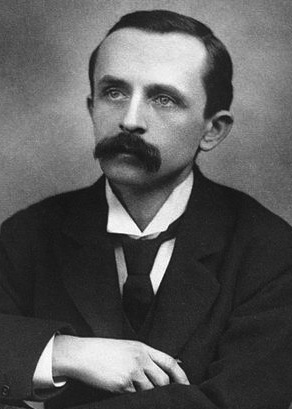
J M BarrieBut although Peter Pan and Wendy only works because it ignores its own emotional implications, it can’t be because Barrie himself was unaware of them. His 1920 play Mary Rose could be seen as Wendy’s story with a more realistic twist, told from the point of view of those she left behind. In the play, Mary Rose is a woman who is twice in her life lost to a faraway fairyland, disappearing for years then returning having not aged, while those around her have. The second time, she disappears shortly after having given birth; when she returns, she pines for the baby she hadn’t finished nursing, but the boy is now a grown-up man, his mother all but forgotten. Here, then, the lack of emotional connection between a child and its parent which was, in Peter Pan, a result of a quite natural boyish retreat into imagination, is seen as the result of bereavement and loss, and so is perhaps that much more an honest expression of whatever it was that caused Barrie’s retreat from his own adulthood.

^TOP

DC Comics’ Sword of Sorcery

coverI’ve read somewhere that DC’s Sword of Sorcery was conceived as an answer to Marvel’s runaway success in bringing Robert E Howard’s most famous creation to the world of comics, with Conan the Barbarian issue 1 appearing in August 1970. DC dipped its toe by having Fritz Leiber’s Fafhrd and Gray Mouser guest in Wonder Woman #202, in Oct 1972. I haven’t read this, so I don’t know how the two (to my mind, wholly separate) universes would have been brought together. I’d like to imagine a story featuring Fafhrd & the Mouser’s rivalrous attempts to woo the Amazonian Princess, while perhaps simultaneously trying to relieve her of her lovely gold wristbands and glowing lasso (which I can see the Mouser finding irresistible), probably only to be soundly and solidly put in their place — but I think, to judge from the cover, they just get into a fight.

Sword of Sorcery, a standalone title featuring Fafhrd & the Gray Mouser in their proper environment, the fantasy world of Nehwon, debuted in March 1973. In the first editorial, writer/adapter Denny O’Neil issues a pledge: “We’ll change Fritz’s work as little as possible, because we love it, because it would be silly to imagine we can improve on greatness, and because, for the first time in our comics careers, we’re approaching a project with genuine reverence.” But by the third issue (which mentions, in its editorial, that both Leiber and Harlan Ellison have complimented them on their adaptation) they’re presenting an original, non-Leiber story. I do have to say it sticks quite well to the feel of the F&GM stories, including in its cast a bird-woman (which fits in with the pair’s many dalliances with exotic, semi-human females), but this same bird-woman brings out an uncharacteristic note of sexism from Fafhrd (usually the more chivalrous of the two). Thinking themselves abandoned by the half-woman half-bird Lissa, Fafhrd says: “She could be of no help… and besides, what do you expect of a woman… even a woman half a nobler creature?”

panel from Sword of Sorcery issue 1, Ningauble and Sheelba

The wizards Sheelba and Ningauble, minus the clash of terse/loquacious personalities Leiber gave them

In general, though, seen as a comics-of-the-time take on Leiber’s tales, Sword of Sorcery manages an okay series of adaptations. The stories have mostly been boiled down to centre on one big fight, but do include a smattering of the sort of wordplay & archaicism so characteristic of Leiber’s writing. One thing I forgot about this sort of comic (not having read any in ages) is just how much the characters love to talk during fights, and mostly about themselves. As soon as they whip out their swords, Fafhrd & the Mouser turn into a pair of gangsta rappers — “Hey, I’m great at this, I’m great at that, look at me, how good I am in a fight.” Fafhrd calls himself a barbarian rather a lot (and is “Fafhrd the Barbarian” in the titles); Leiber’s character wouldn’t do that — not as a boast, anyway, as he was more interesting in being civilised. It’s basically a shorthand way of getting readers to grasp his status as a Conan analogue. And I have to mention one truly awful thought bubble from a non-Leiber back-up strip in issue 4, about Fafhrd in his youth. Seeing his girlfriend snatched by a snow-dragon, the young Fafhrd thinks: “So… my blooming manhood is put to the test!” A letter from issue 4 says it all: “A splendid adaptation of ‘Thieves House’ this month. I wonder, though, why you retitled it ‘Revenge of the Skull of Jewels’. That’s laying it on a bit thick, isn’t it?” Laying it on a bit thick is what this sort of comic does.

from Sword of Sorcery issue 3, a fight scene

Another thing I forgot from US comics of this era is just how crude the colouring technology was. In most cases, the splotchy, all-too-basic colouring detracts from the artwork far more than it adds. I would have preferred to have seen it in black & white just to get a better look at the linework. And I wasn’t 100% taken by the depictions of Fafhrd & the Mouser — mostly the Mouser, who, though properly short, still had the usual superhero proportions, making him seem like a 7 foot tall man shrunk in size, rather than a short man with a short man’s proper proportions. But, again, I suspect this is just one of the conventions of the time. One thing I would like to say about the art, though — and this isn’t at all intended as faint praise — is I liked the backgrounds. They really brought out the feel of Leiber’s Nehwon, particularly the city of Lankhmar, a lush mix of opulent Orientalism and Renaissance Europe:

panel from Sword of Sorcery issue 2

And this panel is simply beautiful:

panel from Sword of Sorcery, ship at sea

Sword of Sorcery died without an announcement after five bimonthly issues. It was an interesting run, but more for how Leiber’s work could be fitted into a medium or market that couldn’t properly deal with his attempts to rethink & out-think the clichés of a genre he’d helped define (even, to name).

Fafhrd & the Mouser would appear in comics again in 1990, this time from the Marvel-owned Epic Comics, where they distinctly benefit from being directed at a more adult market, and in a generally more mature (post-Watchmen) comics milieu. In a neat link, although it was drawn by Mike Mignola, this later series was written by Howard Chaykin, penciller for Sword of Sorcery. I’ll maybe cover it in a future Mewsings.

^TOP