Dark Companions by Ramsey Campbell

Fontana PB

When his previous two collections, Demons by Daylight (1973) and The Height of the Scream (1976), came out, those books were the definitive statements of who Campbell was, as a writer, at that time. But with Dark Companions (published in 1982), things are slightly different. Campbell is now publishing novels, having four out under his own name (including The Doll Who Ate His Mother, and The Nameless, which I’ve reviewed here on Mewsings), and three novelisations of Universal horror films under the pen-name Carl Dreadstone. All but one of the stories in Dark Companions were written after Campbell became a full-time writer. Three won awards (two World Fantasy, one British Fantasy), and one (“The Companion”) was praised by Stephen King (“one of the three finest horror stories I have ever read”) in his 1981 book about horror, Danse Macabre. It feels Campbell has come a long way from the author of Demons by Daylight who was grateful for T E D Klein’s review that proved that one person out there, at least, got what he was trying to do.

Looking at his development as a writer, it’s obvious that by this point Campbell has found his voice and is comfortable enough with it to, for instance, branch out in directions he perhaps wouldn’t have tried in those earlier two collections. For example, he groups six of the tales collected in Dark Companions as “a kind of tribute to the old EC horror comics” — very short stories, often told in the second person, these are macabre twist tales, often using traditional horror elements such as vampires, witches and the creations of mad scientists, with part of the point of each tale being for the reader to work out exactly who the “you” being addressed in the narrative is. They’re not exactly jokes, but they certainly employ a sort of dark humour and a lightness of intent you don’t find in those earlier two collections.

Cover to Demons by Daylight (Arkham House)

Eddie Jones art to Arkham House edition of Demons by Daylight

The stories in Demons by Daylight and The Height of the Scream often felt like almost raw slices of the author’s own experience (in his introduction to Dark Companions, Campbell says his second collection was “sometimes so personal as to be wilfully incomprehensible”), redolent of the times they were written in — the years following the 1960s social revolutions — and the stage of life Campbell presumably was in at the time, with most of the protagonists being in the early stages of adulthood, often students, forming their first adult relationships, starting new jobs, discovering themselves (and often, this being Campbell, losing their sense of self in the process). With most of the stories in Dark Companions, the experience feels less raw. And while it means that something of that feeling of immediacy is lost, the stories gain, often, by feeling they are rooted a bit deeper in a more considered, or digested, experience.

One example of this is that a lot more of the stories in this collection are about childhood fears, or children’s encounters with horrors, as though Campbell could now take the time to trace the roots of fear to a deeper level. (Though my favourite story from Demons by Daylight, “The Guy”, from 1968, also fits this description, which goes to show how perilous it is to make sweeping generalisations about an artist’s development.) “The Companion”, for instance, is about a grown man, closer to retirement than childhood, who thinks himself well past the fears that kept him awake when he was young. Something of a tourist of childhood nostalgia, he spends his holidays visiting old fairgrounds. A trip on a ghost train he keeps trying to persuade himself is disappointing rather than redolent of his own, very personal, childhood fears, of course ends with him discovering that there’s no way of running from fears if they’re intent on coming after you. “In the Bag”, about a hypocrite headmaster, is another tale along similar lines. “The Chimney” — which Campbell calls, in the introduction to a “best of” collection, Dark Feasts, “disguised autobiography — disguised from me at the time of writing, that is” — is another tale about childhood fears and its protagonist’s attempts to overcome them. Like “The Guy”, it’s focused on a particular holiday (something that’s true of another tale of childhood horror, here, “The Trick”), and, like “In the Bag”, it’s a horror that’s only fully realised when the young boy narrator is grown up, though in a poignant, rather than simply horrific, way.

Mark Watts cover

As well as these tales of childhood horrors catching up with adults, there are stories that take place entirely during childhood/young adolescence. “Mackintosh Willy” is perhaps my favourite example of the latter, being centred around a shelter in a park where a particularly scary tramp was to be found, until he died there. But although the narrator of the tale is the one who finds the body and reports it to the police, someone else, in the meantime, has snuck in and put a pair of Coca-Cola bottle caps on his eyes — an act of mocking the dead that will have consequences. “The Man in the Underpass” (a story I always want to rename “The Man Without Underpants”) is narrated in a sort of what-we-did-in-our-holidays way by 11-year-old Lynn. When she and her friends see a pagan-looking figure scrawled on the wall in an underpass, they find it worthy of a snigger or two, but one girl, the religious-minded Tonia, is more deeply affected. The thing that doesn’t quite work for me, in this tale, is how Tonia identifies this figure with an Aztec deity, one she calls Popocatepetl, having found the name in a library book. It’s never explained what an Aztec figure should be doing in an underpass in England, or why Tonia should insist it have this particular name, even when she’s told it’s of a volcano rather than a god. Perhaps Tonia has just got it wrong, or perhaps there’s an aspect of Aztec mythology I can’t find out about, but it seems to me the figure is more like the home-grown Cerne Abbas Giant, who would at least have more of an excuse for being there.

Every so often (as with “Cold Print” and “The Franklyn Paragraphs”, which I spoke about in a review of Campbell’s Visions from Brichester), it feels that Campbell writes a story that is as much about horror as it is a tale of horror, and in Dark Companions there’s “The Depths” which, though not my favourite tale in the book, feels like it’s perhaps the most important, in terms of Campbell trying to say something about his particular field of endeavour. The protagonist, Miles, is a crime writer who has decided to spend some time in a house where a particularly horrific murder occurred, so as to better write about it. But when he finds his head being flooded by visions of other crimes, full of details even he finds horrific, he leaves. He soon discovers, though, that the crimes he imagined have subsequently occurred, and that only by writing these visions down can he stop more from occurring. Like The Nameless, this is a story about the most horrific crimes being inspired by some extra-human force outside their perpetrators. Or, perhaps, something deep inside:

“No wonder they were so terrible, or that they were growing worse. If material repressed into the unconscious was bound to erupt in some less manageable form, how much more powerful that must be when the unconscious was collective! Precisely because people were unable to come to terms with the crimes, repudiated them as utterly inhuman or simply unimaginable, the horrors would reappear in a worse form and possess whoever they pleased…”

Miles sees images of horror all around him, and notices the way people are simultaneously fascinated and disgusted, prurient one minute, disowning them the next. He even feels disgust at some of his own stories, published in one of the more lurid magazines under a pseudonym. Finally, though, he comes to understand something of his role as a writer about horror: freighted with so many violent images, he starts to realise he’s something of a scapegoat, loaded with humanity’s darker impulses. And you know what happens to scapegoats…

^TOP

The House on the Borderland by William Hope Hodgson

Sphere PB, art by Terry Oakes

The title alone is enough to earn Hodgson’s 1908 novel a place at the heart of any weird fiction canon. And the book’s first quarter, with its nameless narrator (known as “the Recluse” to this found-manuscript’s editor) holing himself up in a remote country house and fending off nightly attacks from noxious swine-things like a classic Doctor Who base-under-siege story, feels like the perfect set up for a weird adventure story. But then things take a ninety-degree swerve into the cosmic, visionary, and psychedelic, with a long trip through accelerated time. We see the death of our Earth and the Sun, then follow a slow, abstract path to the heart of the universe, to glimpse the truth behind “the scheme of material creation”: a pair of massive central suns, one a giant, weird green (“the abode of some vast Intelligence?”), the other utterly dark. Then back to the present and the house under siege, though not, now, by a host of fleshy-white swine-things, but one giant green glowing one, whose touch leaves a fungous infection that recalls, to my mind, the bleak and inexplicable creeping death in Lovecraft’s most coldly cosmic tale, “The Colour Out of Space”.

Ian Miller art for Panther PB

To be wrenched out of what seems like such a brilliant set up for a weird adventure novel into that rather abstract, visionary journey to the heart of the cosmos always leaves me wondering if The House on the Borderland has a single, unifying idea behind its various, brilliantly weird episodes, or is just a collection of Hodgson’s wilder imaginings. As well as the swine-things and the time journey, there’s a curtailed afterlife love story, as the Recluse has a perhaps visionary, perhaps extra-dimensional, meeting with his lost, dead love — and this is another jarring moment, because at this point it’s revealed that most of this section of the manuscript is missing. It’s almost modernistic in effect, as we experience the Recluse’s feelings of loss through having the relevant portion of the story itself missing, apart from hints and echoes.

Lovecraft loved the book (though he couldn’t help squirming at its “few touches of commonplace sentimentality”), but came to it too late for it to really be an influence. And I feel that Hodgson is far more of a gut writer than one like Lovecraft, who had a definite outlook and philosophy. (I almost wonder if the book didn’t kick off after a fevered reading of Wells’s The Time Machine, which has the same mix of beast-men (the Morlocks) and a trip to the end of time. Only, Hodgson takes things to far weirder extremes.) Still, it seems, from his author’s note at the start, that The House on the Borderland has some unifying meaning:

“The inner story must be uncovered, personally, by each reader, according to ability and desire. And even should any fail to see, as now I see, the shadowed picture and conception of that to which one may well give the accepted titles of Heaven and Hell; yet can I promise certain thrills, merely taking the story as a story.”

The start of the novel, with its nightly assaults by semi-human swine-things, is chock full of classic Gothic imagery of the dark subconscious: a bottomless Pit, an unexplored cellar, a trapdoor opening onto unimaginable depths, an overpowering rush of water, the swine-things themselves, and the fact that they don’t seem to be seen by the Recluse’s sister, the one person with whom he lives. Plus there’s the lure of the shadow-self, and that need to stare into one’s personal Nietzschean Abyss:

“Sometimes, I have an inexplicable desire to go down to the great cellar, open the trap, and gaze into the impenetrable, spray-damp darkness. At times, the desire becomes almost overpowering, in its intensity.”

The novel feels like a wholesale reaction to all the nineteenth century’s upendings of religious certainties: Darwin’s linking of man to the animals (the swine-things), the realisation that the sun must one day die, even the germ theory of disease (in the way the dog’s eerily glowing wound infects a cut on the Recluse’s arm), plus the gradual replacement of a Christian Heaven by an astronomical cosmos of suns, planets, and nebulae.

Ace Books (1962) edition, art by Ed Emshwiller

But I think the thing that unifies Hodgson’s novel is clear in its title. This house stands on a borderland, and so it is the house, by being where it is, that unites the various weird realities it touches. Living in it, the Recluse is living between the bestial (attacks by the swine-things) and the spiritual (his visions of his dead love in her seashore afterlife); also between life and death (the gods that surround the house’s visionary twin in the Arena seem to represent “a state of life-in-death”); and between Heaven and Hell (the house has “Little curved towers and pinnacles, with outlines suggestive of leaping flames”), or hope and despair, in the way the narrator’s connection with his lost love at the Sea of Sleep, and his apprehension of the Green Sun as some sort of ultimate intelligence, are set against the swine-things, the beast-headed gods of the Plain of Silence, the Dark Sun that twins the Green Sun, and the Dark Nebula (“a very hell-fog”), which seems to contain souls trapped in agony (“A face, human in its outline; but so tortured with woe, that I stared, aghast. I had not thought there was such sorrow, as I saw there.”)

These extremes of Heaven and Hell, hope and despair, are part of a package. You can’t have one without at least risking the other. Or so the Recluse’s dead love tells him, at one point:

“Strangely, she warned me; warned me passionately against this house; begged me to leave it; but admitted, when I questioned her, that she could not have come to me, had I been elsewhere.”

William Hope Hodgson

And if it’s the house that unifies the various elements in Hodgson’s weird novel, then it’s not much of a leap to taking that house as a metaphor for the human condition. Its cellars are the outermost regions of the unconscious, whose key the narrator keeps with him at all times (though he only, at first, goes down there to store and retrieve wine, inebriation being one way into the realms of the unconscious). Below these are far vaster, perhaps limitless depths. The Recluse spends most of his time, though, in his study, a room which symbolises the intellect. It’s this room that has the weakest external door, and where the swine-things get closest to breaking in. As a final indicator that the house and the man who lives in it are one, it’s only when the Recluse’s body is invaded by the giant green swine-beast’s infection that the swine-thing(s) manage to get inside the house.

It seems to me that, though The House on the Borderland’s depiction of humankind as standing on the edge of all sorts of weird realms is undoubtedly cosmic, it’s not as despairing as Lovecraft’s cosmicism. Hodgson isn’t saying, as Lovecraft did, that humankind is utterly insignificant compared to the vastness of the cosmos, but he is saying that it’s possible, in such enormous and strange spaces, to be infinitely lonely:

“…I realised, despairingly, that the world might wander forever, through that enormous night. For a while, the unwholesome idea filled me, with a sensation of overbearing desolation; so that I could have cried like a child.”

But this could just be a depiction of the Recluse’s own particular type of Hell. He seems to have become locked in loss since the death of his loved one. He still, for instance, lives with a woman (his sister), but appears to have absolutely no emotional or intellectual connection with her (“I have made a rule never to speak to her about the strange things that happen in this great, old house”). Similarly, after his dog dies, he acquires another one, but can’t bring himself to take it into the house, even when it’s being attacked at night by the massive green swine-thing. His one physical contact with it results in his own infection.

The House on the Borderland is undoubtedly a classic of weird fiction. I still find the central time-travel section too slow-moving and abstract, and the Doctor Who fan in me would love to read a version that was only about the swine-things assailing the house at night, but perhaps it’s the unforgiving strangeness of the book’s jarring shifts in narrative direction that really encapsulate its meaning and power: we’re all of us living in houses on many strange and disquieting borderlands, and had better watch out.

The House on the Borderland is available at Project Gutenberg. The William Hope Hodgson blog contains a lot of information about the writer and his works.

^TOP

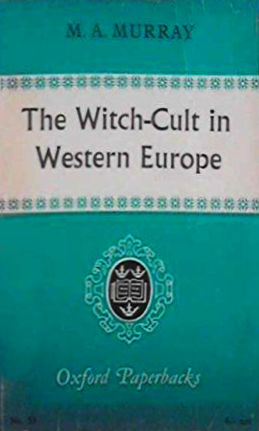
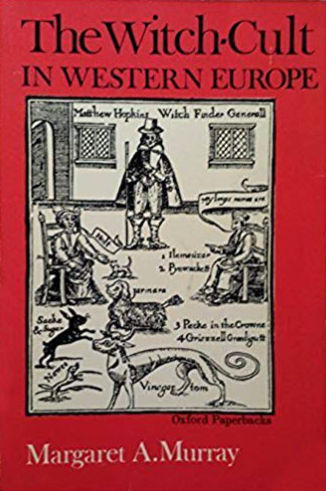
The Witch-Cult in Western Europe by Margaret Murray

Like Jessie Weston’s From Ritual to Romance, Margaret Murray’s The Witch-Cult in Western Europe (1921) is an academic book in part inspired by Frazer’s Golden Bough, and more notable today for its cultural influence than its now-dismissed scholarship. Weston’s book is largely remembered for being mentioned by T S Eliot in connection with The Waste Land, but Murray’s has had a more pervasive and widespread influence (among other things, feeding into the formation of Wicca, but also, I think, providing a key ingredient for a lot of 1960s and 1970s folk horror). I first came across it thanks to H P Lovecraft, who refers to it in “The Horror of Red Hook” and “The Call of Cthulhu”, and whose key idea — that the witches persecuted in the 15th-, 16th- and 17th-century trials in Europe and New England weren’t Satan-worshippers, madwomen, or victims of a mass delusion, but members of an ancient, if decadent, fertility cult, misinterpreted and demonised by their Christian persecutors — is referred to in “The Dreams in the Witch House”, “The Haunter of the Dark”, and his essay “Supernatural Horror in Literature”, where he associates it with Machen’s “The White People”. (Murray subscribed to the idea, which informs a lot of Machen’s weird fiction, that a “dwarf race” once inhabited Europe and “has survived in innumerable stories of fairies and elves”.)

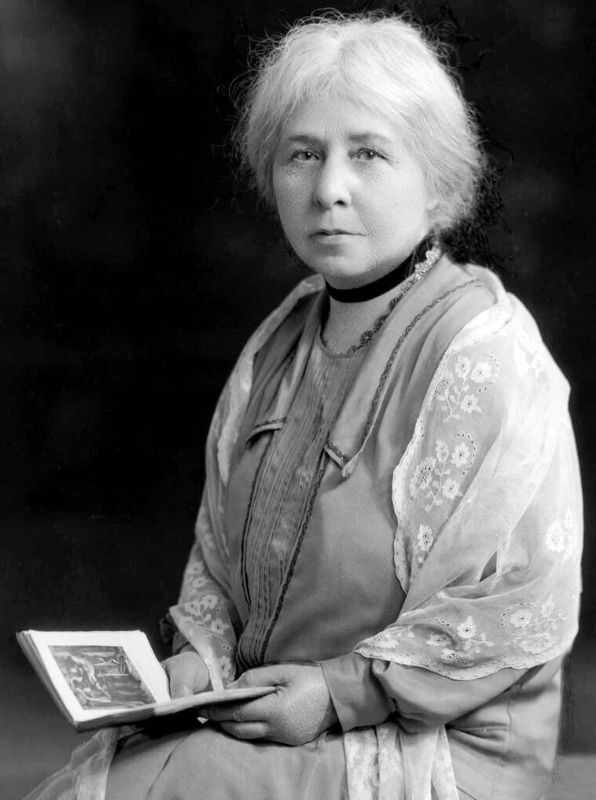
Margaret Murray

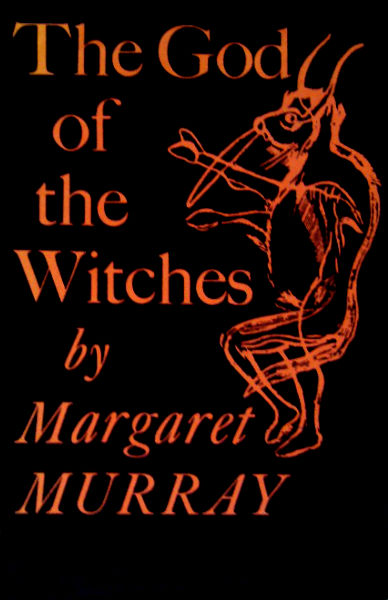
Born in 1863 (and dying 100 years later), Margaret Murray made her initial academic reputation as an Egyptologist, working alongside Flinders Petrie. When the First World War made archeological fieldwork in Egypt impossible, Murray branched out. She at first strayed into Jessie Weston territory, writing a paper on “Egyptian Elements in the Grail Romance” (which Weston criticised), before settling on witchcraft in 1917. The Witch-Cult in Western Europe was her definitive statement, and because of it she was asked to write the entry on the subject for the 1929 edition of the Encyclopedia Britannica (which was still there in the 1968 edition). As Jacqueline Simpson, in an essay entitled “Margaret Murray: Who Believed Her, and Why?” (published in Folklore in 1994, and readable online here), says, in the encyclopedia entry Murray “set out her own interpretation of the topic as if it were the universally accepted one”. Her book had been read by academics, and some accepted it, but others — largely those whose specialities she touched on, it seems — dismissed it; but the encyclopedia article lent authority to her theories and reached a much wider, non-specialist public. Murray wrote a more populist take on the book, The God of the Witches (1931), playing down some elements (the sexual and baby-eating ones) and introducing others, such as the phrases “the Old Religion” and “the Horned God”, which would go on to become folk horror staples. By the 1950s and 1960s, her books had become bestsellers.

Much to the horror, it has to be said, of some of those working in the same field. Jacqueline Simpson says that:

“Precisely because [Murray’s] material is so diverse, the links so tenuous and the tone so dogmatic, untrained readers are naturally mystified, and assume that their own limited knowledge is at fault; overawed, they feel themselves to be in the presence of great scholarship…”

Compounding this, most academics in the same field:

“…deliberately ignored her… Normally this is an effective technique for ensuring the oblivion of bad books, but in this case it backfired, since it left her theory free to spread, seemingly unchallenged, among an eager public.”

Part of this is down to Murray’s approach, which is obvious from a statement she makes early in her book:

“The evidence which I now bring forward is taken entirely from contemporary sources, i.e. the legal records of the trials, pamphlets giving accounts of individual witches, and the works of Inquisitors and other writers. I have omitted the opinions of the authors, and have examined only the recorded facts, without however including the stories of ghosts and other ‘occult’ phenomena with which all the commentators confuse the subject. I have also, for the reason given below, omitted all reference to charms and spells when performed by one witch alone, and have confined myself to those statements only which show the beliefs, organization, and ritual of a hitherto unrecognized cult.”

Which even to me, an untrained reader, sounded like she was ignoring what didn’t support her theory (“the opinions of the authors”), and quoting only what did (“the recorded facts”). (Apparently what she left out, even by the use of a brief “…”, could, at times, turn out to completely undermine what she was using a quote to prove.)

But what’s interesting is the effect her book had. People — particularly novelists, film-makers, poets and 20th century witches — took to it not because it was academically convincing, but because there was a need for the idea it was putting across. There was, as Jacqueline Simpson says above, an “eager public”.

Part of this is down to the ideas held about witches at the start of the 20th century. Murray wasn’t the first to suggest witches were part of a single pre-Christian cult — that idea had been around in Germany and France a hundred years before — but coming at the time it did, her book seemed to provide a third way into a subject otherwise split between two increasingly unrealistic alternatives. As Jacqueline Simpson puts it, on the one hand there was the likes of Montague Summers, “maintaining that [witches] really had worshipped Satan, and that by his help they really had been able to fly, change shape, do magic and so forth.” On the other, there was a more widespread but frankly less interesting idea held by “sceptics who said that all so-called witches were totally innocent victims of hysterical panics whipped up by the Churches for devious political or financial reasons”.

Murray asserted that the witch-cult was a real thing, but explained away the supernatural elements. The Devil, she said, was present before the witches because he was a man (or sometimes a woman) in a mask and costume. This also explained why so many witches claimed the Devil was cold to the touch. (And, Murray says, “when the woman admitted having had sexual intercourse with the Devil, in a large proportion of cases she added, ‘The Devil was cold and his seed likewise’”, which Murray explains in part through use of an “artificial phallus”, a necessary requirement, she adds, because a mortal man playing the part of the Devil couldn’t be expected to perform without one for a whole coven of witches.)

(…And a note on covens: Margaret Murray is, apparently, the sole source of the idea that a coven of witches must have thirteen members, something she admitted getting from a single quotation from one Scottish witch trial.)

Another aspect of the witch-cult were witches’ marks which, she says, were of two types, either an artificial mark given to the witch when she or he was initiated (and which Murray suggests was most likely a tattoo, as it was caused by pricking of the skin and was often coloured), the other type being a “little teat”, which Murray says was probably a pre-existing supernumerary nipple, something she takes pains to prove occurs more commonly than is generally thought.

Meanwhile, of a witch’s ability to transform herself into an animal, she says:

“In many cases it is very certain that the transformation was ritual and not actual; that is to say the witches did not attempt to change their actual forms but called themselves cats, hares, or other animals.”

What struck me, on reading the book, and considering the way it aggravated some academics (the Wikipedia article on “the Witch-cult hypothesis” is full of quotes from reviewers pouring scorn on just about every aspect of Murray’s scholarship) yet was accepted by artists and writers, was that Murray’s ideas may not have been historically true, but they certainly met an imaginative need. The way witches were presented, through Murray’s extracts from the trials, seems to me to be painting a picture that’s very much the shadow image of the more intolerant side of Christianity that would have prevailed at the time. All the key characteristics of the “witch-cult” as Murray presents it — a mostly female priesthood, folk-style magic and fertility rituals, close ties with natural cycles and the natural world, plus lots of dancing, eating, and general carnality — were things repressed by Christianity but a vital part of humanity.

(This isn’t to say it was all about fun. In The Witch-Cult in Western Europe — though not in The God of the Witches — Murray does go into the witches’ practice of baby-eating which, she says, being only ever of un-baptised babies, was at least probably only practised on the cult’s own children.)

Whatever Murray’s academic reputation, the idea that witches are part of a single belief, rather than being a scattering of lone-wolf wise-women lumped together simply because they didn’t fit anywhere else, is certainly the one you’ll meet with in horror films to this day, so much so it’s become part of the accepted lore of fictional witches. In a way, Murray’s Witch-Cult is as important to witches in their fictional incarnations as, say, Dracula is to vampires — an essential cultural foundation, but not to be taken as factually accurate. In this way, then, it fits perfectly with the other (mostly fictional) books H P Lovecraft grouped it with when he mentions it in his stories — a book that straddles the shady boundary between weird fact and dark fantasy, and so becomes a perfect gateway to that realm of the real-seeming weird he was trying to conjure.

You can read Margaret Murray’s The Witch-Cult in Western Europe at Project Gutenberg.

^TOP