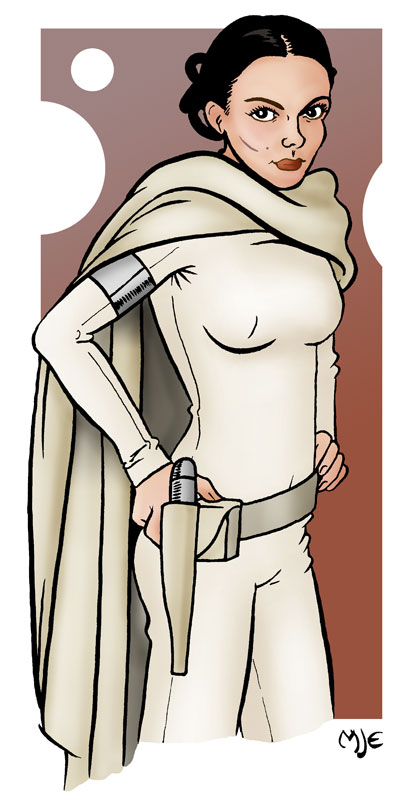
For Star Wars day…


 “To the reader who has followed Titus through the two earlier books Titus Alone administers a profound jolt, and many have not liked it,” writes Malcolm Yorke in My Eyes Mint Gold, his biography of Mervyn Peake. It was warnings such as this that put me off reading the third of Peake’s Titus books back when I read the first two, and which prepared me, on finally getting round to it, not to be disappointed by it not being a Gormenghast book. But, as it is a Titus book, it is at least haunted by Gormenghast, even if the world Titus moves through, and the prose style we get to experience it through, aren’t Gormenghastian, but something less grandiose and Gothic, less solid, and of that much less character, too. At times, it reads like a sort of mannered absurdism, full of details that ought to add up to character and style but without any of the substance that would make them work.
Perhaps the trouble is that Titus, though the figure around whom the whole series revolves, isn’t one of Peake’s more interesting characters. He exists, at first, to be oppressed by Gormenghast, then to defy it and escape from it. But because his identity is so tied up with that vast shadow-haunted castle, once he’s away from it, what is he? This is something Titus himself has to confront, as he finds himself, in Titus Alone, so far from his home that no-one has ever heard of it, and most don’t believe such a place even exists:
“Did you run away, young man?”
“I rode away,” said Titus.
“From… Gormenghast?”
“Yes, your Worship.”
“Leaving your mother…?”
“Yes.”
“And your father…?”
“No, not my father…”
“Ah… is he dead, my boy?”
“Yes, your Worship. He was eaten by owls.”
The Magistrate raised an eyebrow and began to write upon a piece of paper.
Finding himself in a very un-Gormenghastian land of motorcars and helicopters, tall glass buildings and needle-like aeroplanes, Titus is arrested for having no identity. “So my papers are out of order, are they?” he says. “So is my brain and heart.”
 Unfortunately, this lack of identity makes for him being a very weak character to hang a novel on. In the Gormenghast books, relief would be found in other characters, or in Gormenghast itself, but here there’s not much weight to the world Titus finds himself in, and we only get a small handful of characters who have any real character at all. Perhaps there’s only one. And that would be fine, because the whole of “Boy in Darkness” is sustained by the eerie presence of the Lamb alone, but here the one new character of interest, Muzzlehatch, exists mainly to stride in and out of the plot at key points, rescuing Titus when Titus needs rescuing, then to disappear, because Muzzlehatch, “Barbaric to the eye, his silhouette more like something of ropes and bones,” a man “so ragged and yet, at the same time, so like a king”, whose “every movement was a kind of stab in the bosom of the orthodox world” is a kind of hero of indifference, a hero of individuality and self-containment, something Titus aspires to, but fails to achieve until the very final paragraph of the novel. Till then, Muzzlehatch must exist as a heroic example, but one who therefore can’t take centre place in a novel which is all about the attempt to solve the problem Muzzlehatch has already solved — the problem of knowing who you are, of being self-contained — not what Titus is, a ghost of his own past, simultaneously longing for, and trying to deny his need for, Gormenghast. “Give me some proof of me!” Titus cries, at one point. Yet Gormenghast, his once-home, is the only proof of Titus.
I said in my Mewsings on the second Titus book that it didn’t hit its stride, and really get back into the immersive feel of the first book, till about 250 pages in. This is excusable in a book with another 250 pages to go. For me, Titus Alone didn’t hit its stride till the 200 page mark, which might sound like an improvement till you realise Titus Alone is only 260 pages long, leading me to think it might have been better as a novella like “Boy in Darkness” — short, but focused on a single episode. And, if it weren’t for the need to build up the characters that feature in that final episode, it would surely be possible to read just those final 60 pages on their own, because they comprise the only real set-piece of any weight in the book, and almost all of its meaning.
Peake’s at his best with set pieces. His style is all about elaboration, about building up his characters from quirky little cartoons to full-blown human beings, and building up his settings in all their Gothic cobwebbed glory, and then bringing it all together in grand, climactic moments. In Titus Alone, there’s nothing for his elaborations to adhere to till the final scene, where Cheeta, the scientist’s daughter who’s intent on ruining Titus’s mind, builds a mockery of Gormenghast and brings him to it, to parade in front of him grotesque creations meant to represent his mother, his dead sister, his dead father, and the other inhabitants of a world she has only heard about through Titus’s mutterings whilst in a fever.
 The thing that makes the world of Titus Alone most different from that of Gormenghast is that, whilst Gormenghast seemed at most to be a post-World War II world, and that only as a distant echo, Titus Alone is resolutely in the atomic age. Cheeta’s father, described in the book as “the greatest scientist in the world” was in fact, in Peake’s original manuscript (according to John Batchelor’s book on Peake), described as “the greatest deathray scientist in the world” — something which makes a lot more sense of why his factory, and his daughter, should be the focus for the book’s idea of evil. Scientists in Titus Alone are purveyors of death, and inventors of devices for mass killing, and the world of Titus Alone, though slightly futuristic with its tall glass buildings and needle-like aircraft (and its over-leisured middle classes who spend so much time at over-crowded cocktail parties), is a diminished world:
“Once there were islands all a-sprout with palms: and coral reefs and sands as white as milk. What is there now but a vast shambles of the heart? Filth, squalor, and a world of little men.”
Titus Alone isn’t in the same league as the two Gormenghast books, or even the much shorter “Boy in Darkness”, and for most of it, I found myself wondering if I’d get anything out of the reading at all. But the final 60 pages were good — not quite Gormenghast good, but certainly good enough, and unlike the early parts of the book, they tied in enough with the story of Titus’s leaving Gormenghast to make them seem a worthwhile continuation, completing the arc of Titus’s development into manhood that began, in the second book, with the sudden death of “the Thing”, then his decision to leave Gormenghast, to the moment in the final paragraph of Titus Alone where he finds, finally, the link to his past that properly enables him to absorb it, and escape it.
“At the same time a light unexpectedly sprang up, and I saw Carmilla, standing, near the foot of my bed, in her white nightdress, bathed, from her chin to her feet, in one great stain of blood.”
 This, from J S Le Fanu’s “Carmilla” (first published in 1872), is the image that launched a thousand horror films. It’s a characteristic moment for Le Fanu, whose scenes of supernatural horror often burst into view with the force of a jump-cut or a lightning flash, defying reason and rationality — as when, for instance, Justice Harbottle (in the 1872 tale of the same name) looks out from his coach window to see the sudden vision of a gigantic three-branched gallows complete with a hangman whose nose, lips and chin “were pendulous and loose”; or when Schalken the Painter (again, from the tale of the same name) is led into a crypt by the ghost of his former love, Rose Velderkaust, and suddenly shown “the livid and demoniac form” of her undead husband.
Although not his weirdest or most inventive, “Carmilla” is probably Le Fanu’s best-written and best-plotted tale, one of many of his in which a person is tied to a supernatural or fantastic double which they fear but cannot escape, and which becomes a baleful influence draining away their life (the leering monkey-thing in “Green Tea” has an almost Kafkaesque purity in this respect).
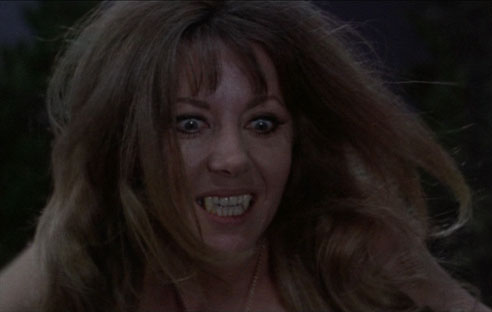
Ingrid Pitt as Carmilla in Hammer’s The Vampire Lovers (1970)
“Carmilla” is a vampire story. Published a quarter of a century before Dracula, its suspense nevertheless relies on its reader understanding the nature of the villain well before the narrator does — knowing, for instance, just what Carmilla’s nighttime absence from her locked-from-the-inside bedroom must mean. But calling Carmilla a villain is wrong. In Le Fanu’s tale, Carmilla is not characterised as evil so much as of a different (and predatory) nature. When the father of her prime victim sits there self-satisfyingly saying that God will protect them from the “plague” of deaths currently affecting the local peasantry, Carmilla (unbeknownst to them the cause of it all) bursts out with:
“Creator! Nature! … And this disease that invades the country is natural. Nature. All things proceed from Nature—don’t they? All things in the heaven, in the earth, and under the earth…”
Later, one character wonders why “Heaven should tolerate so monstrous an indulgence of the lusts and malignity of hell.” But it’s because this is not a good-versus-evil world, and Carmilla is not “malignant” — she’s merely driven by the dictates of her own “nature”, as much prey to her own longings, both emotional and physical, as any human being:
“The vampire is prone to be fascinated with an engrossing vehemence, resembling the passion of love, by particular persons. In pursuit of these it will exercise inexhaustible patience and stratagem, for access to a particular object may be obstructed in a hundred ways. It will never desist until it has satiated its passion, and drained the very life of its coveted victim. But it will, in these cases, husband and protract its murderous enjoyment with the refinement of an epicure, and heighten it by the gradual approaches of an artful courtship. In these cases it seems to yearn for something like sympathy and consent. In ordinary ones it goes direct to its object, overpowers with violence, and strangles and exhausts often at a single feast.”
Le Fanu’s best moments are those where the supernatural makes itself suddenly known. He combines this with the casual delivery of strangely specific details, details which are not necessarily explicit or horrific, but which worry you, make you think, make you imagine, and ultimately convince you they must be real. It’s this two-pronged attack of surreal details delivered with a cool detachment that allows his spooky images to creep in through the back door of your mind, often by way of your spine’s tingle nerve. Another scene of Carmilla appearing by her victim’s bedside at night is just as cinematic as the one I quoted at the start, but this one makes me think of a different generation of horror films — the weird collage-like video of Sadako in the Japanese version of Ring:
“I saw a female figure standing at the foot of the bed, a little to the right side. It was in a dark loose dress, and its hair was down and covered its shoulders. A block of stone could not have been more still. There was not the slightest stir of respiration. As I stared at it, the figure appeared to have changed its place, and was now nearer the door; then, close to it, the door opened, and it passed out.”
The effect is weird, and so specific, yet unreasoned, as to command a great deal of confidence that what the author is describing is real, precisely because it seems so odd.
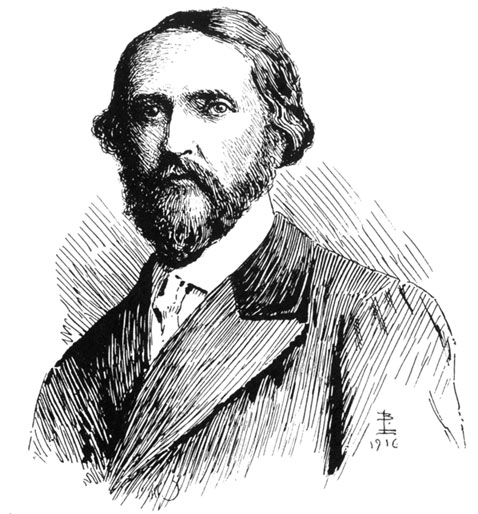
J S Le Fanu, drawn by his son Brinsley Lefanu
The best bit of spooky writing from Le Fanu, though, comes in his “Ghost Stories of the Tiled House” (1861), which mixes utterly believable human behaviour with a sudden flash of tersely-described horror:
“But the worst of all was poor Kitty Halpin, the young woman that died of what she seen. Her mother said it was how she was kept awake all the night with the walking about of someone in the next room, tumbling about boxes and pulling open drawers and talking and sighing to himself, and she, poor thing, wishing to go to sleep and wondering who it could be, when in he comes, a fine man, in a sort of loose silk morning-dress an’ no wig, but a velvet cap on, and to the windy with him quiet and aisy, and she makes a turn in the bed to let him know there was someone there, thinking he’d go away, but instead of that, over he comes to the side of the bed, looking very bad, and says something to her — but his speech was thick and queer, like a dummy’s that id be trying to spake — and she grew very frightened, and says she, ‘I ask your honour’s pardon, sir, but I can’t hear you right,’ and with that he stretches up his neck high out of his cravat, turning his face up towards the ceiling, and — grace between us and harm! — his throat was cut across like another mouth, wide open, laughing at her; she seen no more, but dropped in a dead faint in the bed…”
All text (except quotes) © Murray Ewing 2026. Site powered by WordPress.
