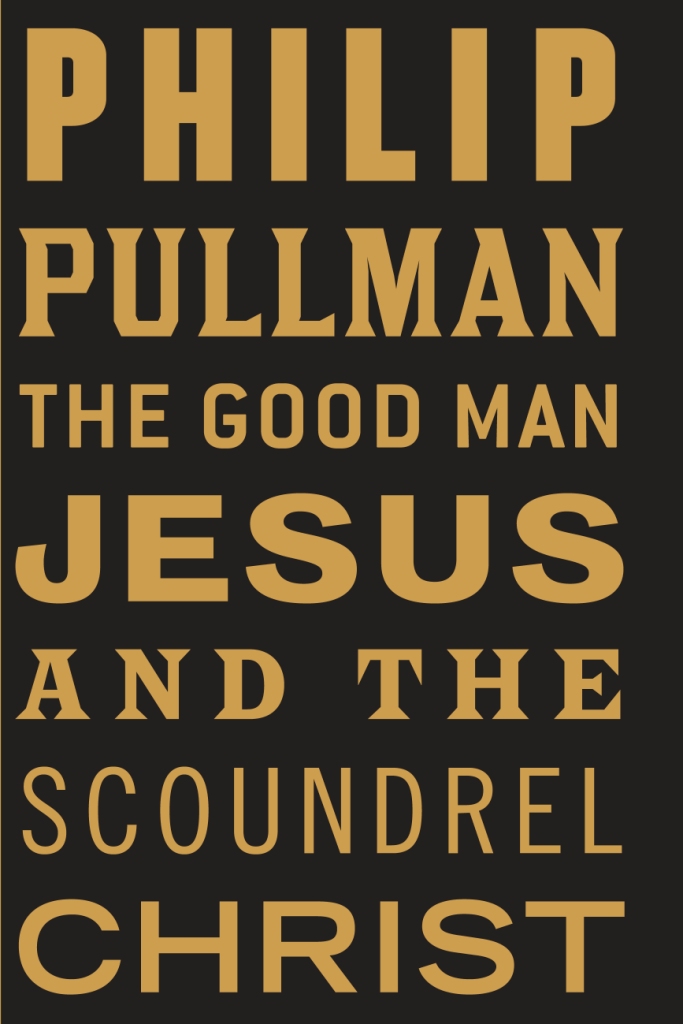
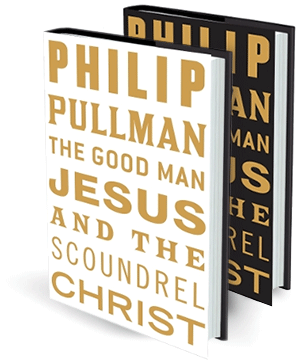
Philip Pullman’s The Good Man Jesus and the Scoundrel Christ

At first, I was a bit puzzled by Philip Pullman’s latest book, The Good Man Jesus and the Scoundrel Christ — puzzled, and a little bit annoyed. This was because I’d been led to expect a quite different book, not just by the title (if it was just the title, it wouldn’t matter, because good titles are often deceptive, or at least gain a new relevance on further reading), but by the summaries people have given of the book in reviews on TV and in the press. For instance, the Archbishop of Canterbury (who gives a favourable review in The Guardian), gives this explanation of the basic idea behind the book:

“Its premise is that Mary gave birth to twins: Jesus, an earthy, generous visionary, radical enough to create panic in conventional religious and political authority; and ‘Christ’ – a nickname for the weaker, self-righteous, fearful brother who shadows Jesus, trying to persuade him to accept a destiny he refuses.”

Yes, Mary gives birth to twins. But the two — Jesus and Christ — are not as Rowan Williams characterises them. To start off with, for instance, the Jesus character is rather withdrawn and distant, in the shadow of his brother, Christ. Later, he comes across as quite resentful, even spiteful, of his brother and his family, even while preaching the message of universal love. Meanwhile the Christ character, though he does at one point try to “persuade [Jesus] to accept a destiny he refuses”, is for most of the book quite passive, self-abnegating, humanly weak as opposed to “fearful”, and entirely accepting of the Jesus character’s view of things. In fact, there’s only one chapter — one short conversation between the two brothers — in which the above characterisation applies; after that, the brothers separate and, learning from the event, the Christ character, at least, changes.

Once I’d got over that slight confusion, I read the bulk of the book thinking Pullman’s title must be ironic — that it is in fact the Jesus character who is the scoundrel, and the Christ character who is the good man, and that worked for a while. But, although there’s an argument to be made, I don’t think that’s entirely true, either. Rather, the Jesus character is an idealist — and idealists can be good, because they offer us visions of good things to strive for, but on the other hand, every idealist is a tyrant in embryo — and the Christ character is a realist — and realists can be scoundrels, because they are always undermining the good we find in ideals, but on the other hand, realists can at least put a plan into action and get things done. In other words, neither character is wholly good nor bad. Things are confused by the roles they find themselves playing: Jesus as the preacher, teacher, and revolutionary proclaimer of the imminent Kingdom of Heaven on Earth (the most potentially damaging idea he or his brother presents in the book), Christ as his chronicler and, later, his betrayer. But the roles are predetermined by the story they are stuck in, and neither character is really responsible for their decision to be in that story. If there is a moral colouring to be applied to anyone in Pullman’s book, it is the the third, never-named character, the angel (or presumed angel), who guides Christ on the way to eventually playing the Judas role. This third character, who at one point explicitly denies that he is Satan, is, I suppose, the embodiment of the story itself, gently prompting characters to play their appointed roles. In fact, I came to think of him as the Philip Pullman character, a sort of shepherd for the potentially unruly three-dimensional characters in a myth, a form that does not comfortably support three-dimensions in its characters.

I finally overcame my ambivalence about the book when I did what I should have done from the start — forgot what other people have said about the book, and decided to understand it in my own terms, in my own way. I realised I wasn’t really interested in The Good Man Jesus and the Scoundrel Christ as a book about religion, or even (as Rowan Williams says) a book about the church (though it is that, too). This is why I’ve been saying “the Jesus character” and “the Christ character”, because I don’t want anyone to happen on this blog and think I’m talking about the religious figure who goes by those names. I’m interested in the book as a story, and the characters as they relate to that story. (Pullman, after all, has “This is a story” emblazoned on the back, but I at first thought this was just him being provocative.)

For me, what The Good Man Jesus and the Scoundrel Christ was about was writing. Pullman’s innovation is to have two boys born to Mary, one called Jesus and one called Christ. When the Jesus character proves to have a vocation as a somewhat revolutionary wandering preacher (whose teaching — all paraphrased, in more modern diction, from, I assume, the Gospels — is often contradictory, with the Jesus character talking of loving your neighbour at one point, then refusing to help a woman because she is not of his race at another, and also being pointedly rude to his family), the Christ character decides to write his brother’s teachings down, seeking to preserve them as accurately as possible. (Because, far from being a scoundrel, he has a deep love of his brother, and a respect for what he is teaching, even though the Jesus character has no love for him.) For most of the book, then, the Christ character is a writer. He is, in effect, producing the version of “Jesus” that will be preserved after his brother’s death, and indeed after his own: the version that we find in the written books of the Gospels.

What makes this aspect of the story interesting is that the Christ character pretty soon becomes aware of the possibility of improving on what the Jesus character says and does. In fact, he is prompted to do this by that third, unnamed character who guides the story. I don’t know if Pullman is providing subtle characterisations in the ways that Christ’s writings differ from what the Jesus character actually says, but anyway I think that’s beside the point. The real point is that by differing from what the Jesus character says and does, an ideal version — a myth — is created.

In effect the book is asking: which is more important, the literal, historical truth, or the ideal, more meaningful version? In some cases — legal cases, for instance — obviously the literal, historical truth is the most important. But when we’re dealing with ideals, it is the myth that is more important. Because we know that reality never lives up to our ideals, and that human beings, though they strive, often fail, or are divided, or feel impure or less-than-holy feelings even when they succeed, or act on baser motives than we might like. But the ideal can exist nevertheless — and ought to be allowed to. Just because, in all history up to now, there has never been a wholly, truly, perfectly “good” man, does that mean we should give up striving to be good? Just because, if we’re honest with ourselves, we know that we will never manage to be fully, truly good, does that mean we should give up trying? No, and no. And really, this is the point about myth. Myth is not, as some definitions would have it, a lie that debases historical truth; rather, it is a truth that has no need to have ever actually occurred in order for it to be true.

So, the Christ character makes the decision, as a writer, to betray the historical Jesus, and write what he feels ought to have been said or done at this or that moment. And this “betrayal” becomes enacted in the story itself, as the Christ character acts out the Judas role that leads to Jesus’s capture and eventual death.

What’s interesting is that the Christ character, who I described above as a realist, acts in order to preserve an ideal. He betrays not just his brother, but himself. This idea of the writer as, necessarily, a betrayer, a traitor, a “scoundrel”, seems somehow fitting, though I can’t quite work out why. Are all writers, necessarily, scoundrels of a sort, in that by creating something — their own version of the truth — they are in fact betraying the truth of the world around them?

(If I can add one reading recommendation, I’d say Ted Chiang’s novelette “Hell is the Absence of God” (collected in Stories of Our Life and Others, a real must-read of an SF collection) is the most powerful exploration of religious themes (also by an atheist, or agnostic, I’m not sure which Chiang is) that I’ve ever read. Pullman’s novella is thought-provoking, but not really on religious themes, though unfortunately this is how everyone’s going to see it, I suppose.)

^TOP

And sometimes balloons go pop…

George Bernard Shaw on Democracy:

…I am going to ask you to begin our study of Democracy by considering it first as a big balloon, filled with gas or hot air, and sent up so that you shall be kept looking up at the sky whilst other people are picking your pockets. When the balloon comes down to earth every five years or so you are invited to get into the basket if you can throw out one of the people who are sitting tightly in it; but as you can afford neither the time nor the money, and there are forty millions of you and hardly room for six hundred in the basket, the balloon goes up again with much the same lot in it and leaves you where you were before. I think you will admit that the balloon as an image of Democracy corresponds to the parliamentary facts.

— from the Preface to The Apple Cart

^TOP

House (the Japanese film, not the US TV series)

Just as there were seven samurai, in House, the 1977 commercial debut from director Nobuhiko Obayashi, there are seven schoolgirls; and just as there were seven dwarfs named Happy, Sleepy, Dopey, Grumpy, Bashful, Doc and Sneezy, the seven schoolgirls are named Angel (who’s always doing her makeup), Fantasy (who’s always imagining things), Prof (who wears glasses and reads a lot), Kung Fu (who does kung fu), Sweetie (can’t remember why), Melody (who plays the piano) & Mac (which is short for Stomach, because she likes eating).

After learning that her father is to remarry, and so as not to have to go on holiday with her new stepmother, Angel writes to an aunt she hasn’t seen in years and arranges to spend the summer with her in her large, ramshackle house on an isolated hill. Taking her six schoolfriends with her, they arrive to find the aunt wheelchair-bound and in poor health, though she recovers remarkably — once the girls start disappearing.

House (whose title in Japan is in fact the English word “House”), was initially commissioned by Toho films to cash in on the popularity of Jaws. Reasoning that a film about a shark that eats people was popular, so a film about anything else that eats people would also be popular, Obayashi wracked his brains for something that wouldn’t be too boringly derivative — at the time, he says (in the excellent hour and half long interview on the DVD) there was a spate of people-eating creature films in response to Jaws, but he wanted to do something different. In the end, he asked his daughter what she would find scary, and from the list she came up with, he got the idea of a house that eats people.

The result is one hell of a weird film.

Is it a horror film? There’s certainly plenty of blood, severed limbs, and people dying in protracted, macabre ways. But the style is a sort of madcap sixties runabout comedy. Prior to making this film, Obayashi was a prolific maker of adverts, as well as, in his spare time, a maker of experimental films, and House seems to be the product of an awful lot of experimentation, wild imagination, and free thinking. Some scenes are deliberately artificial, with a Hollywood musical feel, painted backdrops, and so on. There’s a pop music soundtrack and a lot of playful cutting between shots, pausing of the image, and so on. There’s stop-motion animation (of a man skidding around stuck in a bucket). There’s a severed head that flies around and bites a girl on the bum. There’s a piano whose keys glow in psychedelic colours, and which eats the girl who plays it (though her severed fingers keep playing). Another girl is eaten by a clock, another by a mirror, another by a bath, another is smothered by futons. So, yes, it is horror, but not in the way that, say, Hostel is, or Saw III.

Just as good as the film itself is the long interview with the director, Nobuhiko Obayashi, that comes as an extra on the DVD. Before House was made, Obayashi says, there was really only one way to become a film director in Japan, and that was to join one of the two big corporate studios, Toho or Shochiku (home of Kurosawa and Ozu, respectively), and hope to get apprenticed to the film-making department. You were just as likely, though, to be sent to work in one of the company’s hotels and never get anywhere near a film-set. Even if you did get apprenticed as an assistant director, you weren’t likely to work your way up to actually directing a film till your mid or late forties. As a result, Obayashi says, Japanese films had stagnated, playing safe in both style and content, sticking to tried and tested corporate methods, and dying commercially. Meanwhile, he was working in the boom industry of advertising, and frequently found himself commanding greater budgets for a 60-second commercial than film directors had for a 90-minute feature. People started saying that if only Obayashi were allowed to make a film, he would change the face of Japanese cinema. But even when Toho approached him to discuss the idea, and he pitched House, he realised it would never get made because of the sheer inertia of the juggernaut studio system. So he set about a remarkable media campaign, promoting the film as if it were going to be released by Toho, but before it was even made. He managed to get magazine articles, a novelisation, a radio drama, and even a soundtrack album released in the two years prior to Toho finally green-lighting the project. In the interview extras, Obayashi sits there, smiling modestly, as he thumbs through a stack of scrapbooks showing all the promotional work he did for a film that only existed as a script. It’s a remarkable, and quite inspiring story. By the time House was finally released, it was a storm of a hit.

Nowadays, it’s the sort of film you could imagine Alex Cox enthusing about (whatever happened to Moviedrome?) on some late-night Channel 4 cult film slot. It seems very much a product of the free-thinking sixties (or the generation that grew up in the sixties), but also it’s a teen movie, which seems curiously up to date, as if everything that dated it (like the occasional crude bit of animation) were some postmodern imitation of the movies of the past, knowingly referenced. It’s fast-moving, bizarre, loud, brash, colourful, gruesome, funny, bewildering, and undeniably Japanese.

Just remember that all these stills are from the same film:

^TOP