This is all important stuff to know…
 …
…
 …
…



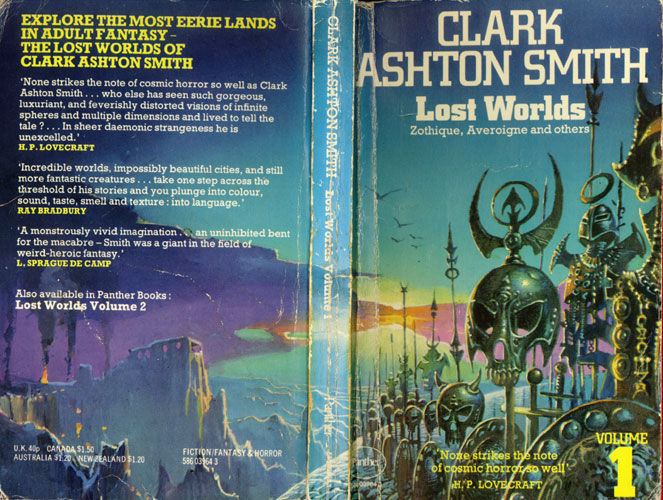
The first Clark Ashton Smith story I read was “The Empire of the Necromancers“. A friend, not wanting to actually lend me his precious copy of Lost Worlds Volume 1 (the Panther paperback edition with the Bruce Pennington cover), let me read it for the half hour it took him to take a quick trip up to town. I chose to read “The Empire of the Necromancers” because, besides being the first story in the book, it was short enough that I was likely to finish it before he returned and took the book back.
I was instantly — not hooked, but bewildered. I had never read anything like it. I was 16 or 17 at the time, and I think I only managed to retain my readerly equilibrium by telling myself the story’s strangeness must be due to its being written in the 1930s. Having since read a good deal of old & classic fantasy, I still find Clark Ashton Smith’s writing irredeemably strange, and now know it’s not because he belonged to another age, but because he was that timeless, ageless thing, an individual with a genuinely unique imagination — a rare thing, even among what should be the most imaginative group of writers, fantasists. It’s only among the likes of Mervyn Peake and E R Eddison that Clark Ashton Smith really meets his match.
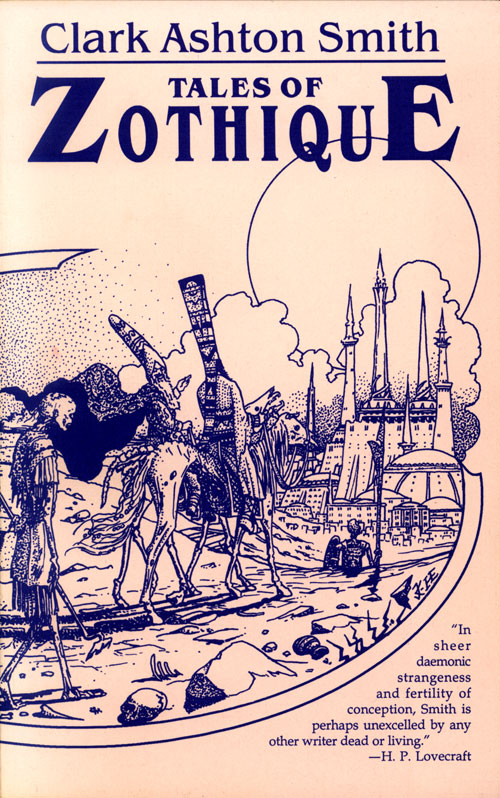
 The strangeness is all there in “The Empire of the Necromancers”. The story opens in the desert, as we follow two sorcerers, Mmatmuor and Sodosma, as they are exiled from the city of Tinarath for the practice of necromancy. Used to reading sword and sorcery tales in which the sorcerers are the villains, it was strange enough to follow this peculiar pair as if they were the tale’s heroes, but this was merely the first of many strangenesses in Smith’s story. Heading south, the necromancers encounter the skeleton of a horse and its rider, and set about reviving the dead mount to carry one of them. (Such practical use of nefarious power!) Then they continue to Yethlyreom, a vast, dead city, in which centuries of mummified nobility are waiting to be brought back to life to serve Mmatmuor and Sodosma, and to people their undead empire.
(Such names as Tinarath and Yethlyreom, I’d soon learn, were due to the influence of Lord Dunsany, not just on Clark Ashton Smith, but on the entire fantasy field, and only absent from my then-current fantasy reading because it had already become passé to imitate Dunsany’s long, poetic-sounding names. Dunsany, like Poe, was obviously an influence on Smith, but even Dunsany would never have created a necromancer called Sodosma.)
 Once the two necromancers have their empire up and running, Smith’s story takes an abrupt turn. So far, the necromancers have been the protagonists. Now, we are introduced to a far more Smithian hero, in the shape of Illerio, the last Emperor of Cincor (of which Yethlyreom was the capital). Illerio is an even more surprising hero than the necromancers, because he is dead. Undead, in fact. Raised from oblivion by Mmatmuor and Sodosma, he is just beginning to resent the fact, in his slow-minded way. In snatches, Illerio plots with Hestaiyon, his eldest ancestor among the throngs of reanimatees. A formidable sorcerer in his own day, Hestaiyon remembers a dark secret in the depths of the palace, a door that opens upon a set of steps that descend into an ever deeper darkness. It is through this doorway that the undead emperors of Cincor descend to their second, final, irrevocable death from which no necromancer can recall them — but not before slicing up Mmatmuor and Sodosma, and enchanting their sundered body parts with a magical immortality to ensure they suffer properly for the indignity to which they put the emperors of Cincor.
Normally, I wouldn’t recount the full plot of a story I like so much, as I wouldn’t want to take the pleasure of discovering it from a new reader. But this doesn’t apply to Clark Ashton Smith stories. Once you get to know Smith, you realise that almost all his tales end in the same way: everyone meets their doom. The dead, if resurrected, long to return to death; the living, meanwhile, achieve a frequently arcane, and generally ironic demise. In a sense, there is no story. A Clark Ashton Smith tale starts with a note of doom and continues ever downwards.
Again and again, in story after story, the dead and the living mix, briefly, in their macabre way, then join one another in oblivion. The poetry of his tales — and it is as poetry they are best appreciated — most often lies, macabrely enough, in the manner of that final death. A willing descent into the abyss for Illerio and his ancestors; a drowning in jewels for the greedy Avoosl Wuthoqquan; Christophe Morand returning to the embrace of a life-draining lamia from whom he has just been saved. (Love and death, in Clark Ashton Smith’s world, are frequently inseparable.) There are exceptions — for instance, the alienated human poet Theophilus Alvor finding love in the (five) arms of an equally alienated princess from another planet in “The Monster of the Prophecy” — but most often it is as Fritz Leiber puts it: “I can hardly think of a Smith story, the principal theme of which is not death.”
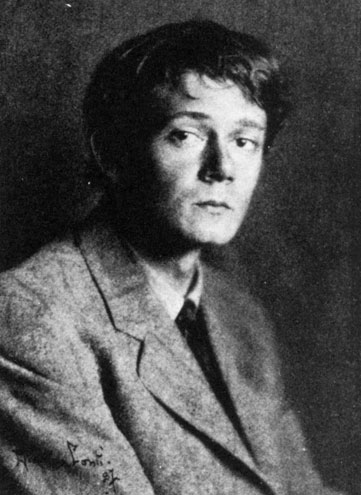 Every writer needs a defining anecdote that sums up their uniqueness. With Smith, it is the fact that he withdrew himself from school and set about educating himself, primarily by reading an unabdridged dictionary all the way through several times, paying particular attention to the etymologies of the words.
Somehow, he remembered it all. Smith’s primary aim was to be a poet. Wilfully anachronistic, he not only set about making a name for himself as a lyric poet in an age that was about to embrace the modernism of T S Eliot and Ezra Pound — and doing so at the boy-genius age of 19 — but also set about making himself a Decadent poet, remotely tagging himself onto the already dying Decadent scene in San Francisco, when European Decadence, as a literary movement, had ceased to be fashionable about twenty years before.
 And as if being a Decadent poet wasn’t showing enough disdain for the Modern Age, when Smith wrote for the pulps (which he did, prolifically, for about a decade) he wrote what must surely be some of the most uncommercial fiction in the most uncommercial, archaic style, but still managed to become one of Weird Tales‘s most popular regulars, through, I can only conclude, the sheer strangeness of his imagination.
And then, at the height of his success, finding that he didn’t need the money from pulp-writing anymore (he’d had to support his ageing parents, and now both of them were dead), he stopped writing fiction and turned to his new love of rock-carving, producing weird little primitive-looking statuettes with names like “Antehuman Grotesque”, “Lemurian Ghost”, and “Sorcerer Undergoing a Bestial Change”.
And, of course, he returned to poetry.
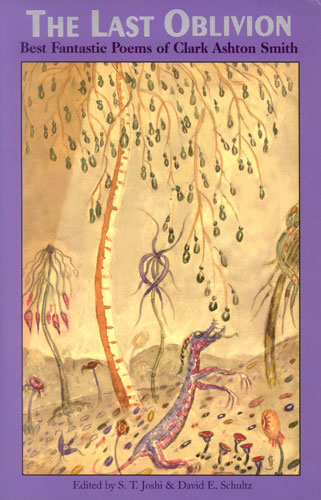 Smith wrote what is, for me, the greatest of all fantasy poems, the stupendous blank-verse “The Hashish Eater; or, The Apocalypse of Evil”, with its torrent of dream-visions building to a crescendo of horror, and an ending borrowed from Poe’s Narrative of Arthur Gordon Pym. There’s also “Nero“, a monologue in which the insane pyromaniac Roman Emperor, watching his city burn, regrets he can’t do the same to the universe itself. Among his shorter lyrics, “Lunar Mystery” has a particularly beautiful word-music, and “Nyctalops” is a good example of Smith’s use of fantasy/horror imagery to achieve an effect of enchanting, unsettling strangeness.
If you haven’t guessed it by now, I think it is strangeness that is the key to Clark Ashton Smith. He felt a kinship with his fellow pulp-writer H P Lovecraft (with whom he corresponded from 1922 until Lovecraft’s death in 1937) in the need to capture, whether in fiction, poetry, sculpture or painting (Smith painted weird little scenes of alien plant-life) a glimpse of something utterly otherworldly. But, although he wrote a few Lovecraftian horror tales, and did desire at times to unsettle his readers, Smith was never as bleak in his outlook as the Gent from Providence. For Lovecraft, the otherworldly was terrifying, because it proved the ultimate meaninglessness of human existence. Smith may have been disdainful of the petty endeavours of his own age, but found great beauty and meaning in the strangeness of the otherworldly, in the freedom of his imagination from the merely mundane. He felt:
“…a wild aspiration toward the unknown, the uncharted, the exotic, the utterly strange and ultra-terrestial. And this aspiration, as I know with a fatal foreknowledge, could never be satisfied by anything on earth or in actual life, but only through dream-ventures such as those in my poems, paintings and stories.” [Letter to HPL, 24th Oct 1930]
Smith’s beloved death, and the world of the dead, was just another realm of the imagination, another otherworldly place in which to achieve the ultimate “escape from the human equation”. [Letter to HPL, 16 Nov 1930]
Ambrose Bierce (who disappeared shortly before Smith entered the San Francisco literary scene) once said, “A jest in the death-chamber conquers by surprise.” Smith, who had a very dry, very dark sense of humour, might well have replied, “But of course it is death itself that is the jest.”
If it is, then only the dead are really in on the joke — the dead, and their fantasist-laureate, Clark Ashton Smith.
(The best place to find out more about Clark Ashton Smith is The Eldritch Dark, including a gallery of his paintings and rock-carvings.)
All text (except quotes) © Murray Ewing 2026. Site powered by WordPress.


