
 In 1981, Robert Calvert, the poet who wanted to be a fighter pilot and became, for a while, the figurehead of the spaceship Hawkwind, published his only novel, Hype, about upcoming rock star Tom Mahler and the promotional shenanigans surrounding the release of his make-or-break third album. In 1982, Calvert released an accompanying LP, Hype: Songs of Tom Mahler, featuring the songs referred to in the novel. It’s an excellent record, and one of the more polished and commercially accessible of Calvert’s solo albums, but it created, in me, a feeling that, as Calvert effectively took the part of Mahler (by singing his songs) on the album, he would naturally identify with him in the novel. The novel’s actual protagonist is Tony Cahn, the Mahawat-smoking APR Records exec who sees the success of Tom Mahler as his route to the top.
I’ve loved Calvert’s witty, incisive lyrics for years. The Charisma-era records he did with Hawkwind (Astounding Sounds, Amazing Music, Quark, Strangeness and Charm, PXR5, 25 Years On) contain some of my all-time favourite lyrics, not to mention songs, period: the brooding “Steppenwolf” still gives me the chills whenever I really listen to it, as Calvert’s Hermann Hesse-inspired misanthropic rant achieves such a height of intensity it slips into German, like a darkly religious ecstasy of speaking in tongues. Calvert’s poetry lies in the cool, precise choice of words, and his novel’s prose is no exception. Everything is succinctly and exactly described, leaving you with a feeling that here is a writer who is really seeing the scene he’s describing:
“Cahn moved his chair forward for Sammy to get by as she went to her usual place at the table. She undid and slid out of the green parachute-silk coat and settled it over the back of her chair. Finger by finger she began pulling off her gloves, revealing long vermillion nails which she combed through the glossy black of her hair.”
This sort of crystal-clear description of little details focuses the reader’s imagination. Its commanding, confident tone leaves you in no doubt about the writer’s authority. But its downside is that, if the writer keeps to the same tone, you can end up feeling detached from the characters, as if you’re watching them on a big cinema screen, rather than being (as in the best fiction) transported to a spot just behind their eyes, connected to their feelings as much as their actions. Throughout Hype, although you spend a lot of time in Tony Cahn’s company, and a lesser but still significant amount in Tom Mahler’s, you don’t really get close to either. You never really understand why they’re doing what they’re doing. You can’t quite tell if, for instance, Tony Cahn is nothing but a cynical manipulator simply in it for his own gain, or if Tom Mahler has any substance as an artist beyond a manufactured cultish appeal. (And I think that, in a novel of any length, the main characters need to have a bit more dimension than that.) Another downside is that such monotone prose, beautiful and precise though it is, prevents any variation in pacing. It wasn’t till right near the end that the story started to rear its head towards a climax, and that, interestingly, is when Calvert loosens up and uses (in the last three or four chapters) different narrative styles (an excerpt from Mahler’s ghostwritten autobiography, for instance, which, because it’s brief and close to the end, doesn’t have much of an effect). The most interesting chapter, “The Evolution of Rock’n’Roll” has Calvert sounding most like himself (or, at least, as he sounds in a series of self-interview tapes he made in response to a fan’s questionnaire — available online as Ramblings at Dawn), as he launches into a non-fictional account of how the British chart system (as it existed back then) could be, and most probably was, easily manipulated.
In some interview quotes on Knut Gerwers’ excellent Calvert resource, Calvert says he was aiming, in Hype, for something like P G Wodehouse’s satires on 1920s Hollywood, but my biggest disappointment with the book was just how unsatirical, how unscathing, it was of the characters it portrays, and often how unwitty it is compared to Calvert’s pithy lyrics (“Quark, Strangeness and Charm”, for instance, or “Over My Head” from the Hype album). Mahler comes across as too uninteresting to be the artist-hero crushed by an uncaring recording industry — he contributes too much to his own downfall, and seems to have no real principles, just a fashionable, and quickly lost, for-the-people attitude. Cahn, on the other hand, is built too much into a hero to be the object of satire, coming up trumps in his one fist fight (against a woman, though — there’s a nasty undertone of misogyny throughout the book, particularly in its numerous, rather shoehorned-in sex scenes), but unrealistically winning through on business deals through nothing but mouthy chutzpah.
Aside from these faults, I found it quite a readable book, but perhaps more because I was interested in the man who wrote it than what he was writing. The scenes featuring Mahler’s band rehearsing and recording were the highlights, both because they must have echeod Calvert’s own experience of such situations, and because their portrayal of the sort of micro-politics that come to bear on creative, collaborative situations was spot on.
 Back when I was just getting into music, and my record collection could have been played in its entirety on a lazy Sunday afternoon (now, according to iTunes, it would take 26 days, 8 hours and 9 minutes), Garen went up to London one day and I asked if he could buy me a couple of records — anything by Hawkwind and the
 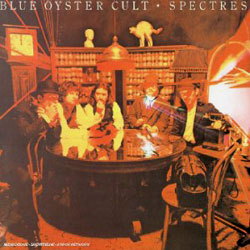 Spectres (1977) and the live album Some Enchanted Evening (1978) have just been remastered and re-released. Both have some great moments (Godzilla, Golden Age of Leather and Nosferatu on Spectres, Astronomy on Some Enchanted Evening), but the main thing I remember from when I first bought Spectres (from

