Ancient Images by Ramsey Campbell

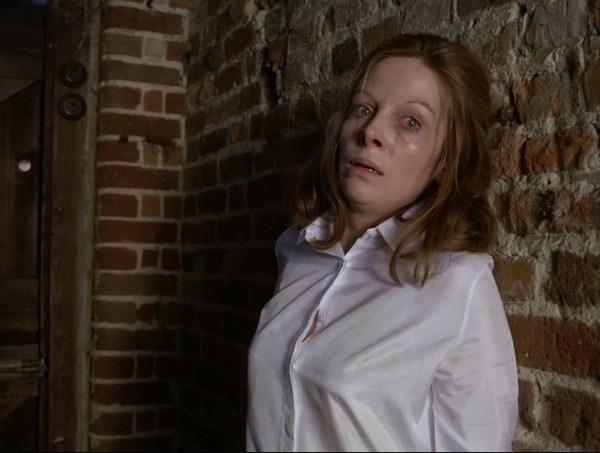
The protagonist of Ramsey Campbell’s Ancient Images (1989) is Sandy Allan, a film editor at Metropolitan TV (which also appears in Campbell’s Incarnate, though here, at the other end of the 1980s, it’s no longer referred to as MTV). Her friend, Graham Nolan, hunts out rare old films to screen on the channel, and after a two-year search has managed to locate a print of a never-released British horror from 1938, Tower of Fear, which starred both Boris Karloff and Bela Lugosi. He invites Sandy to his flat for an initial showing, but she gets there only to witness his death and to find the film gone. When a critic at the Daily Friend newspaper expresses doubt the film had ever been found, Sandy decides to track it down herself, to defend Graham’s reputation.

The film’s director, Giles Spence, died the week shooting finished, and many of the few surviving cast and crew won’t talk about it — some can’t, through infirmity, some won’t, though fear, some are prevented, though whether by accident or design it’s difficult for Sandy to tell, though she increasingly feels that something is dogging her efforts to track the film down. Her quest eventually takes her to the cosy village of Redfield, seat of Lord Redfield, who runs the Staff O’Life bread-making company, and who, it turns out, also owns the Daily Friend. Lord Redfield freely admits his family’s animosity towards the film, which he (and his grandfather, who spoke out against it at the time in the House of Lords) believed to be mocking their family and, through them, the values and traditions of England. But when Sandy learns there’s a legend about Redfield, of a mass-slaughter centuries ago which infused the soil with human blood, giving the village its name and the fields their power to grow an oddly vitalising strain of wheat, she also finds there seems to have been a regular history of human sacrifice, intentional or not, in the village, a fifty-year repeated ritual which last occurred (of course) fifty years ago.

As well as being a horror novel, Ancient Images is a novel about horror, about censorship, repression, and the role horror has in bringing out what ought not to stay hidden. It’s set (and was written) in the late 80s, when horror had come under a new bout of disapproval thanks to the Video Nasties brouhaha — and we get a glimpse of the subculture of people watching illicit films purely for their nasty moments when Sandy visits the editors of Gorehound fanzine — while the film Sandy’s searching for came out shortly after a similar scare in the 1930s, which saw the introduction of the H for Horrific film certificate. Throughout the book, Sandy hears disparaging comments about horror. Her father wonders why she’d bothering to seek out “some trash with two old hams in it”, and asks, “What can be right about a horror film?” Someone else says, “I wish you people would let this wretched film stay buried. Isn’t there already enough horror in the world?” Visiting a Manchester library, she sees “a bookshop from which police were bearing armfuls of confiscated horror magazines” — presumably Savoy Books, which was constantly harassed by James Anderton, the prurient Manchester Chief of Police whose “direct line to God” (as he put it) gave him, he believed, the role of moral arbiter, along with the power to enforce it. As Campbell puts it in his afterword to the book:

“This was the decade when Britain found a new scapegoat for its ills — uncensored films, particularly horror.”

Samhain edition. Art by Kanaxa.

Confronted about his grandfather’s role in suppressing Tower of Fear, the urbane Lord Redfield says, “It’s a curious notion of history that wants to preserve a film which tells so many lies about England and the English.” But the point is that Tower of Fear (in its very oblique way — it was hardly an exposé) wasn’t telling lies, it was unearthing truths. And this is the role horror fiction has, in Ancient Images. Scapegoats are loaded with a society’s sins to rid society of those sins — but before it’s sacrificed, a scapegoat is a bearer of the truth, because the sins are real. Lord Redfield seeks to promote an ultra-traditional vision of England, through the Hovis-like adverts for his Staff O’Life bread with their Vaughan-Williams soundtrack, as well as through the village of Redfield itself, a place where, he assures Sandy, everyone is happy with their place in life — a situation that is obviously too good to be true:

“Tudor cottages gleamed at one another across streets, brown houses sunned their smooth thatched scalps. As Sandy strolled, glancing in shop windows at glass-topped jars of striped sweets sticky as bees, hats like mauve and pink and emerald trophies on poles, elaborately braided loaves, knitting patterns and empty rompers, she heard children chanting answers in a classroom.”

Art by Don Brautigan

Nowadays we’d recognise the second half of this novel as pure folk horror, with its lord so beloved by his forelock-tugging people, the innkeeper who’s suspicious of strangers, the children’s games and “snatches of folksong” Sandy hears as she wanders the streets, as well as the difficulty she has in leaving the village, when she decides to. But in Ancient Images, the folk horror isn’t of an isolated community. As in John Wyndham’s Midwich Cuckoos, a village, here, is used to stand in for England as a whole. Redfield, perhaps, is England, presenting its nostalgia-laden image of cosy traditions to the world, while behind the scenes — or under the soil — there’s blood and violence waiting to erupt.

Lord Redfield bears it in his very name, as well as his position. As a member of the aristocracy, he sees himself as a paternalistic figure, preserving things as they are because that’s best for everyone, but this is to ignore the history of violence that put him there in the first place, and the now-hidden, but once very explicit, violence that keeps him there. Just because he doesn’t have thugs keeping the peace doesn’t mean there’s no threat, it’s just that the threat his power represents has become so much a part of the English class system it no longer needs to be referred to.

Tor 1993 edition, art by Gary Smith

To see it in action, you don’t look at cosy Redfield, where nobody is unhappy with their lot and there are no “For Sale” signs; you look at what happens when a stranger comes along — Sandy Allan, perhaps, or, on a larger scale, Enoch’s Army, a troupe of what would later be called New Age Travellers, wandering the roads of Britain, seeking a place where they can live by their own more peaceful (if equally reactionary, in its own way) philosophy. But they find themselves ousted everywhere they go, and having to be surrounded by police for their own protection. Enoch’s Army feels like the 1980’s remnants of the late-60s counterculture, now thoroughly out of place in a land whose temporary prosperity has caused it to cease to question its values.

It’s rich metaphoric territory — particularly as Campbell, who often refers to horror as “the field”, is here writing about a literal field, and a red one at that — with many resonances with later Campbell works, such as the film-research theme of The Grin of the Dark, and the sense of something hungry lurking under the soil in The Searching Dead. Plus an air of The Wicker Man, and of Theodore Roszack’s Flicker (though, as Campbell points out, this novel was written before Flicker).

For a bit of fun based on the novel, the A Very British Horror podcast did an episode on Giles Spence’s Tower of Fear, on (of course) April 1st 2016.

^TOP

Hammer House of Horror

One of the great British film industry successes of the 1950s and 60s, Hammer Films pretty much died after the Dennis Wheatley adaptation To the Devil a Daughter in 1976. (The final nail in the coffin was a remake of Hitchcock’s The Lady Vanishes, which put them fatally in the red.) Hammer Films Ltd was shut down, but its hastily-conjured doppelgänger Hammer Film Productions remained (backed, at first, by chemical company ICI), though largely to collect royalties. In an effort to regain some liquidity, they resurrected an idea first mooted in the early 70s, of having a Hammer television series, and this time it sparked to life, funded by Lew Grade’s ITC. (Who also financed Jim Henson’s Muppet movies and The Dark Crystal, before Grade was bought out and a more hard-headed businessman took over.) The thirteen (of course) episodes of Hammer House of Horror were broadcast between 13th September and 6th December 1980.

I came to the series knowing nothing about it other than that it was from Hammer, so I was expecting something in the same vein as their more well-known output, with takes on Dracula, Frankenstein, and the Mummy, most probably set in 18th Century rural Europe or 19th Century London (similar, perhaps, to the Mystery and Imagination series of classic horror adaptations on ITV in the late 60s). And the opening titles, with a big old spooky house at night, accompanied by some 60s-style theme music, didn’t do anything to disabuse me of the idea.

From “Guardian of the Abyss”

But the episodes that followed were quite different. At an hour minus ad-breaks each, they were mostly written by the TV writers of the day rather than Hammer’s own writers (the notable exception being John Elder, who’d written a slew of classic Hammers, from The Brides of Dracula to The Ghoul, and had been responsible for suggesting the studio buy the rights to the first Quatermass TV series). The script editor was Anthony Read (who’d written The Invasion of Time and Horns of the Nimon for Doctor Who, as well as episodes of The Omega Factor and Sapphire & Steel). He also wrote the opener, “Witching Hour”, about a modern-day couple menaced by a 17th century witch (who is at first convinced electric lights are the work of the Devil). Also writing for the series was Jeremy Burnham (co-writer of Children of the Stones and Raven, who had one Hammer film to his credit, The Horror of Frankenstein), Gerald Savory (writer of my favourite Dracula adaptation, the BBC’s 1977 Count Dracula), Murray Smith (who hadn’t written a Hammer film, but scripted the 1971 British horror Die Screaming, Marianne), David Fisher (who’d written two Doctor Who’s with Hammer-like titles, The Stones of Blood and The Creature from the Pit, as well as the less-lurid Leisure Hive). The author of perhaps the most memorable episode, “The House that Bled to Death” — memorable because its scene in which a kids’ birthday party is showered in gallons of blood turned up on Channel 4’s 100 Greatest Scary Moments — is David Lloyd, and the strange thing is, it seems to be his only TV or film writing credit. (Prior to that, he was a tennis pro, and afterwards went on to found a chain of gyms and health clubs.)

The infamous children’s birthday party from “The House that Bled to Death”

It seems to me Hammer House of Horror offered something of a unique opportunity to its writers. On the one hand, with the name of Hammer behind it, audiences were primed for lurid Gothic horror with plenty of blood and pulpy shocks. (The publicity claimed they got through five gallons of fake blood a week.) And it’s true, there were werewolves (“Children of the Full Moon”), devil-worshippers (“Guardian of the Abyss”), witches (“Witching Hour”), cannibals (“The Thirteenth Reunion”), and so on. But the writers set everything in modern times, thus bringing in a more realistic feel, and often a more convincing depth of character than you’d find in a Gothic Hammer outing. (Hammer had, of course, done psychological horror, such as the excellent The Nanny, but that’s not what the studio’s name usually brings to mind.) The writers, then, seemed free to experiment with stories set in a world that mixed something very (1980s) modern and realistic with moments of lurid horror, and the results were often stranger than you’d expect from a TV horror anthology show.

In “Rude Awakening”, for instance, Denholm Elliot is an estate agent fed up with a wife who won’t divorce him, and he finds himself waking up in an apparently endless series of nightmare versions of his life in which he has murdered his wife and some supernatural retribution arrives because of it. Once he realises it’s all a series of dreams, though, he decides he might as well go ahead and get some satisfaction by murdering her — only, it turns out, this time he has actually woken up.

Ahhh, it’s Peter Cushing with a puppy.

Something more traditional was “The Silent Scream”, notable for featuring an actual Hammer star, Peter Cushing. Recently-released-from-prison Brian Cox tries to begin a new life on the outside. He goes to see the pet-shop owner (Cushing) who visited him during his time in prison, who said his own experiences in the Nazi Death Camps taught him what it was like to be in prison. But it turns out Cushing’s character wasn’t on the Jewish side of that equation, and is now working, behind the scenes, on a new system of incarceration without bars. He has been testing it on his collection of dangerous animals, but now he’s ready to move on to a human subject…

The show is full of recognisable actors from the British film and TV world of the time, including two stars of Blake’s 7 (Gareth Thomas and Paul Darrow), as well as Warren Clarke, Barbara Kellerman (who’d play the White Witch in the BBC’s The Lion, the Witch and the Wardrobe), Suzanne Danielle (a Movellan in Destiny of the Daleks, and the lead role in Carry on Emmanuelle), and Anthony Valentine (Baron de Belleme in Robin of Sherwood).

The series’ two most disturbing episodes, in my opinion, were the last two. In “The Two Faces of Evil” a family pick up a hitchhiker in the pouring rain, a man whose face they never see, because he starts fighting the husband at the wheel, causing a crash. When the wife (played by Anna Calder-Marshall, who has an excellent face for sustained terror) wakes in hospital, she’s relived to find her son and husband also survived, though her husband received an injury to his throat which means he can’t speak. She and her son go to the cottage they’d booked for their holiday, and it isn’t too long before they’re joined by her husband. She soon starts to suspect, though, that he isn’t her husband at all, but the hitchhiker whose face she never saw.

Anna Calder-Marshall — an excellent face for sustained terror

With a title like “The Mark of Satan”, I was expecting the final episode to go out in a blaze of Gothic glory, but it turns out to be more like a male version of Rosemary’s Baby. Its main character is a worker in a hospital morgue who has become convinced the recurrence of the number 9 in his life is a message that he’s been infected by “the Evil virus”, which killed his father. He’s obviously paranoid and on the verge of a breakdown, but that doesn’t mean he’s not also being pushed into selling his soul to Satan by a conspiracy of devil-worshippers.

Both of these episodes spend a lot time in the blurry territory halfway between mental illness and supernatural horror, which makes me think of the work of Ramsey Campbell — either story might have been an adaptation of his work.

“Witching Time”

Hammer House of Horror didn’t make it to a second series because of Lew Grade’s ITC being bought out, (though it was eventually followed by Hammer House of Mystery and Suspense in 1984), but it’s an unusual slice of British tele-horror, certainly more lurid than you’d normally find on the small screen in those days. It was also more experimental, and though not all the episodes were entirely successful, it was at least an interesting watch.

^TOP

On Fairy-Stories by J R R Tolkien

“On Fairy-Stories” is one of those rare windows — along with Lovecraft’s “Supernatural Horror in Literature”, Moorcock’s Wizardry and Wild Romance, and Le Guin’s key essays in The Language of the Night — into the thinking of a major fantasy writer about fantasy itself. They’re often as much (if not more) about what the writer thinks others are doing wrong than how to do it right, and usually end up having to be mined for a few insightful gems — which, though rare, are always well worth the mining. Tolkien’s idea of the Eucatastrophe, the “sudden, joyous ‘turn’” which he believes ends the truly effective fairy-story, doesn’t appear till about a page before the end of his essay, but it’s certainly worth everything that comes before.

He first presented this piece as “On Fairy Tales”, delivered on 8th March 1939 as an Andrew Lang Lecture at the University of St Andrews. (Other Andrew Lang Lecturers include John Buchan, the Scottish Symbolist painter John Duncan, and, much more recently, fantasy writer Jane Yolen.) It was then published as “On Fairy-Stories” in Essays Presented to Charles Williams in 1947, alongside C S Lewis’s “On Stories”, and others. It would only have reached a wider public in 1964, when it was collected in Tree and Leaf.

Tolkien starts by asking, “What are fairy-stories? What is their origin? What is the use of them?” Much of what he says might sound commonplace today, certainly among people who read — definitely among those who read about — fantasy, but even when I first read it in the late 80s, it was the first time I’d encountered such positive statements about fantasy as a literary form. Perhaps the only thing that seemed off at the time was that Tolkien was using the term “fairy-stories” for what by the 1980s was firmly called “fantasy”, but his definition certainly fit:

“…fairy-stories are not in normal English usage stories about fairies or elves, but stories about Fairy, that is Faërie, the realm or state in which fairies have their being.”

A lot of what Tolkien says in his essay serves to defend fantasy against what was then the generally held view, that it was basically for children, and wasn’t worth taking seriously once you’d grown out of it. Fantasy was seen, at the time, purely as an exercise in “the willing suspension of disbelief” (Coleridge’s phrase), and thus an indulgence, a temporary dip out of the real world. Tolkien instead puts forward the idea of fantasy being an exercise in Sub-creation, in which the writer “makes a Secondary World which your mind can enter. Inside it, what he relates is ‘true’: it accords with the laws of that world.” This might at first sound basically the same as “the willing suspension of disbelief”, aside from its being presented from the creator’s, rather than the reader’s, point of view, but Tolkien’s language is already hinting at the conclusion of his essay. “Sub-creation”, and “Secondary Worlds” are secondary to “Primary Creation” and “the Primary World”, which were, to the Catholic Tolkien, the works of God. Human beings couldn’t create as God did, but also couldn’t help imitating their creator by some act of creation. (Which recalls George MacDonald’s idea that “The imagination of man is made in the image of the imagination of God”, and thus is a route to knowing God.) Fairy-stories, then, aren’t an indulgence, but a fulfilment of all that makes you human.

Tolkien goes on to present four terms for what he believes are the function of fairy-stories: Fantasy, Recovery, Escape, and Consolation. Of these, Fantasy is the vaguest, perhaps because this is the sense in which we now use the word (of literature, films, and so on, anyway). For Tolkien, “Fantasy” is:

“a word which shall embrace both the Sub-creative Art in itself, and a quality of strangeness and wonder in the Expression, derived from image… the power of giving to ideal creations the inner consistency of reality.”

Though perhaps he puts this best by saying:

“To the elvish craft, Enchantment, Fantasy aspires…”

“Recovery” is a more useful idea, though one that can, really, be applied to all creative art. By “Recovery”, Tolkien means a “regaining of a clear view”:

“We need, in any case, to clean our windows; so that the things seen clearly may be freed from the drab blur of triteness or familiarity — from possessiveness.”

Reading a poem about a cat, you might see all cats in a wholly new light; but having seen a dragon (even in your imagination), you’ll find all of reality renewed. One thing that’s interesting in the above quote is how Tolkien links the “drab blur of triteness” by which we can come to see the world when tired or jaded or cynical, with “possessiveness” — which recalls Gollum’s possessiveness of his Precious, and the One Ring’s even greater possessiveness of him.

As to “Escape”, it seems fantasy is less and less dismissed as pure escapism these days, but certainly it felt like the biggest criticism applied to it when I was growing up. Tolkien, though, ties Escape with Recovery in a neat comparison. Fantasy is not “the Flight of the Deserter” but “the Escape of the Prisoner” — the prison, in this case, being that “drab blur of triteness”. (Though in some cases it’s an actual prison, as with Malory or Bunyan.)

Tolkien’s final factor, “Consolation”, is perhaps the one that’s still easiest to dismiss, though it’s the one that, being tied to his idea of Eucatastrophe, is the key idea (for me) of this essay. Consolation is “the Consolation of the Happy Ending”, and is embodied in Eucatastrophe, “a sudden and miraculous grace” that provides “a piercing glimpse of joy, and heart’s desire”. It’s this point, probably, that most critics would say is the essentially escapist (as in “Flight of the Deserter” escapism) aspect of fantasy, because “real life” doesn’t have happy endings. But Tolkien’s point could be taken as saying that it’s to return to the belief in the possibility of happy endings, or at least happy turns, that leads to the strongest sense of Recovery. But Tolkien’s actual point was that there is a happy ending to life, only it’s not in life, but after it. For him, the “Birth of Christ is the eucatastrophe of the story of Man’s history”, and Heaven is the happy ending. But I don’t think you have to believe as he believed to accept the psychological benefits of experiencing a happy ending, however artfully (sub)created, every now and then.

Tolkien, Machen, Lovecraft

It’s interesting to compare Tolkien’s ideas to those of other creators in a fantastic vein. Just as “joy” is, for Tolkien, the true function of a fairy-story, Arthur Machen, in Hieroglyphics (1902), puts forward “ecstasy” as the only mark of “fine literature”. And even though Machen allows other words to stand in for “ecstasy”, it’s obvious he means something darker, perhaps wilder, and certainly more troubling than Tolkien’s “joy”:

“Substitute, if you like, rapture, beauty, adoration, wonder, awe, mystery, sense of the unknown, desire for the unknown. All and each will convey what I mean; for some particular case one term may be more appropriate than another, but in every case there will be that withdrawal from the common life and the common consciousness which justifies my choice of ‘ecstasy’ as the best symbol of my meaning.”

Machen’s is a mystic’s joy.

There’s even more of a contrast with Lovecraft, particularly over Tolkien’s idea that the “joy” he finds in fairy-stories is “a sudden glimpse of the underlying reality of truth”. For Tolkien, this is a glimpse of the underlying reality of Christian truth, but for Lovecraft, whose tales also sought to attain “a sudden glimpse of the underlying reality of truth”, that truth was the antithesis of anything remotely Christian. Nevertheless, for each author, it was the truth — the truth of how they felt about the world, anyway.

Both Tolkien and Lovecraft saw their chosen literary form — fairy-stories and weird fiction — as existing to convey a single feeling, the essence of the world they felt they lived in. And this seems true of many writers, and artists generally, that they have a single essential thing — that might be named by a single word, but which, to them, conveys a whole universe of meaning — a feeling more often than a thought, which sums up reality, or their take on it.

And these are the writers, I think, who keep being read long after their deaths. They come to represent, through their works and their fictional worlds, access to their particular feeling, the thing they were most focused on conveying. I don’t know if this is as true of Tolkien — who you can enjoy as adventure and whose actual happy ending is tempered by a sense of sadness — but it certainly rings true for Lovecraft and Machen.

^TOP