
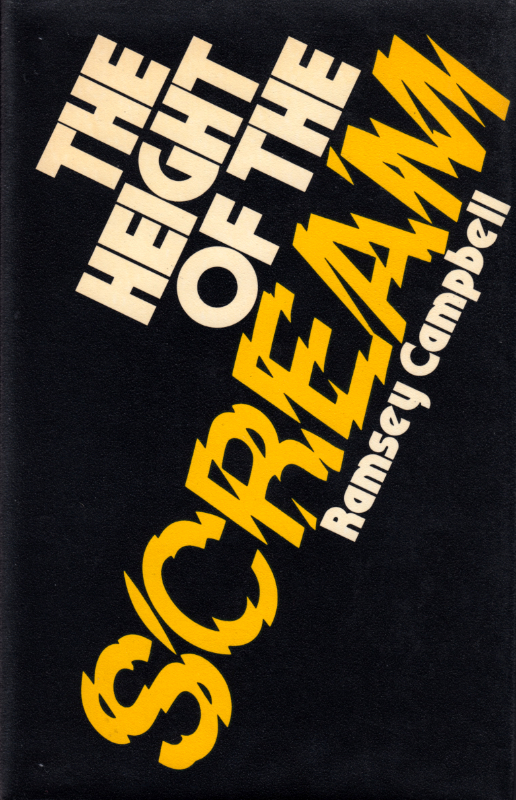
The Height of the Scream by Ramsey Campbell

The Height of the Scream UK 1978 HB cover

The Height of the Scream, Millington (1978). Cover design by Lorie Epstein.

Ramsey Campbell’s third collection, The Height of the Scream, is less of a defining moment than his second, Demons By Daylight. Demons, released in 1973 by Arkham House, was his post-Lovecraft book, the statement of his move away from Lovecraft’s style and subject matter to something more true to his own voice and experience. In The Height of the Scream, he’s consolidating that voice. But there’s also the fact that the stories in Scream cover a period from 1965’s ‘The Cellars’ to 1974’s ‘The Shadows’ (the book was published in 1976 by Arkham House — his last from them till 1993’s career retrospective, Alone with the Horrors — and in the UK by Millington in 1978), so at least half of it overlaps that covered by Demons By Daylight. (Confusingly, one story, ‘The Telephones’, even appeared in both The Height of the Scream and a 1979 US edition of Demons By Daylight.)

My three favourite stories from The Height of the Scream are all, though, from 1973. In the title story, the narrator’s friend Martin reveals he’s discovered an unwanted ability to cause aggression in the people around him. After sparking a very public argument between a couple, and then a violent suicide, these aggressive impulses start to turn on Martin himself, with ultimately fatal consequences — but not before he’s told the narrator that he has the same ability growing inside him, too.
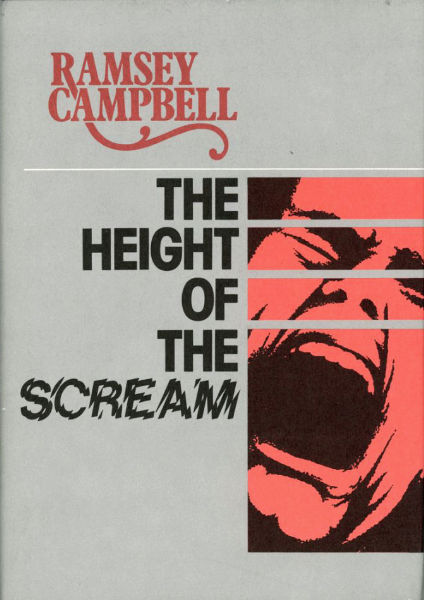
The Height of the Scream, Arkham House

Arkham House HB

‘The Words that Count’ was one of the first Campbell stories I read, and though it might be dismissed by some as a gimmick tale, I still remember the thrill I felt on discovering the trick he’d played with it. (And I think it still works as a story even once you’ve seen it.) It’s narrated by a young woman living with her strictly religious father and beginning to feel the first stirrings of a conflict with his beliefs, as she’s now got a job (in a Christian bookshop) and a boyfriend, and she wonders which she’d side with if it came to the crunch: her boyfriend or her father. She has literary ambitions, and ‘The Words that Count’ is her attempt to write a story about something that happened to her (‘write what you know’), when an unusual pamphlet is put through their letterbox. Each page of the pamphlet has a single word printed on it, and she finds the colours and shapes of the words individually beautiful, so much so that she doesn’t take in what the sequence of words is saying. Her father does, though, and denounces the pamphlet as evil. But by that point it has already started to have its effect.

The best story in the book, for me, was ‘Horror House of Blood’, a deliberately lurid title for a subtle tale about a couple who agree to let the final scenes of a low-budget horror movie be filmed inside their house, and how, afterwards, this creates a charged atmosphere of expectation, as though something is awaiting — and encouraging — the real bloodbath to which the filmed scenes were merely a rehearsal.

The Height of the Scream, UK paperback

Star paperback

In all three of these stories, the horror emerges from the psychology of the characters. The narrator and his friend in ‘The Height of the Scream’ indulge in marijuana, and at first the friend’s belief that he’s causing this aggression in others could be dismissed as pot-smoker’s paranoia. The weirdness of ‘The Words that Count’ emerges through its narrator’s aesthetic sense, which blinds her to the message in the pamphlet, a message that nevertheless implants itself in her head (and replicates itself through her own writing), with the added implication that it may be latching onto a latent desire to kill her over-controlling father. In ‘Horror House of Blood’, it’s ambiguous what the source of the horror is — is it the nastiness of the cheap horror film, the barely contained brutality of its director, or something already present in the house, waiting to be awoken? Whichever it is, it only gains hold thanks to the two lead characters’ increasing obsession with the film’s implied act of bloodshed.

The feeling is that, through delving into dark areas within their own psychologies, the characters in these stories somehow make contact with a supernatural order of reality, one that’s not awakened or active in most people. It’s the characters’ unusual psychological states that connect them to it, and unleash dark, often self-directed, enmities or powers. In a way, then, these stories are still Lovecraftian, in that they’re about how delving into areas better left alone leads to a revelation of horror. But where Lovecraft used scientific or occult research — forbidden knowledge — to achieve his dark revelations, in Campbell they come through the exploration of strange psychologies, the breaking of self-imposed barriers or norms — forbidden experience — something that’s often achieved through encountering or creating art (music in ‘The Dark Show’, shadow puppetry in ‘In the Shadows’, comics in ‘Smoke Kiss’) or through deliberately experimenting with new perceptions (drugs in ‘The Height of the Scream’, metaphysical speculation in ‘Litter’).
The Inhabitant of the Lake by Ramsey CampbellIn some of the stories in this book, rather than bringing in the Lovecraftian entities of his first collection, The Inhabitant of the Lake, Campbell brings in something from the standard trappings of horror — Satanism, voodoo, exorcism — as though feeling the need to provide some sort of justification or explanation for the horror in the story. But this isn’t true of any of the better tales in Scream, where no explanation or justification is offered, or needed. Here, the supernatural doesn’t explicitly emerge — it’s suspected to be there, and the story ends at the point where the protagonists are about to surrender to it, but often before we, as readers, feel there definitely is a supernatural element, meaning the protagonists may be about to do something horrific with, possibly, no need to, beyond being caught up in a deluded belief or obsessive idea.

Campbell’s horror works best without explanation or justification, but as pure experience — his horrors are, fundamentally, horrors that emerge from subjectivity, but which use that subjectivity to open up a potential loss of identity and sanity, isolating his protagonists, or trapping them in patterns of behaviour that can only lead to worse horrors still.

^TOP

The Searching Dead by Ramsey Campbell

cover to The Searching Dead, art by Les Edwards

Set in 1952 and 1953, The Searching Dead (the first volume in a projected trilogy, The Three Births of Daoloth) starts with young Dominic Sheldrake attending a new school, The Holy Ghost, where his form tutor, Mr Noble, turns out to be something of a misfit among the otherwise strictly Roman Catholic staff. Mr Noble has recently started attending a local spiritualist church, not to make contact with any of his own dear departed, but to help the bereaved with new techniques for bringing back the dead — techniques which work rather too well. It’s not long before Mr Noble is fired from his position at The Holy Ghost, but Dominic — who, along with friends Jim and Bobby (Roberta), make up the Tremendous Three — realises he’s only going to get up to much worse now he’s free of restraint.

If Dominic’s gang’s name, the Tremendous Three, sounds a bit Famous Five-ish, that’s only because it’s how Dominic wants to think of them. He’s as keen on writing stories about the trio’s imagined adventures as he is about clinging to the ideal of their childhood friendship. But the reality of Campbell’s post-Blitz Liverpool, with its casually strict parents, repressively religious teachers, and the burgeoning realities of adolescence, are more than enough to undermine any sense of simple Blytonesque adventure. And that’s before the horrors kick in.

Part of the Lovecraftian feel of The Searching Dead (which has none of the grotesquely comic feel of Campbell’s most recent Lovecraftian fiction, The Last Revelations of Gla’aki, and in fact often feels quite low-key and restrained for the often hallucinatory Campbell) comes from parallels with “The Dunwich Horror”. Mr Noble was conceived shortly after his father, a soldier in France during the Second World War, came, during that conflict, to a field he felt held a presence that was hungry for the dead. And the feeling that Mr Noble himself is somehow, in part, parented by that presence (just as the Whateley twins were by Yog-Sothoth in Lovecraft’s story) is intensified when we meet the next generation, Mr Noble’s precocious two-year-old Tina.

Knowing something of Campbell’s own life, it’s impossible not to read biographical elements into The Searching Dead. Dominic has obvious parallels to the young John Ramsey Campbell: raised as a Roman Catholic in 1950s Liverpool, spending his Saturdays watching films at a variety of local cinemas (Dominic tries to sneak into his first X-rated one, about giant ants), and making his first steps in developing as a writer (Dominic finds that he prefers Lucky Jim to The Devil Rides Out, for instance). At the same time, I can’t help reading a shadowy sort of inner biography in the contrasting Noble family. Reverse the sexes, and that family sketches Campbell’s own from when he was growing up. Two-year-old Tina Noble is the entire focus of the mentally-unbalanced/visionary Mr Noble, to the extent that Tina’s mother is ousted from the family; Campbell himself has written about his mother’s increasing mental illness, and how she forbade his father from having any contact with his son, despite living in the same house. Even the presence (and death) of Mr Noble’s father echoes that of Campbell’s maternal grandmother, who lived with Campbell and his mother for a while before her death. It’s as though the biographical portrait of Campbell-as-Dominic is completed by its shadow in Campbell-as-Tina.

The whole novel has a stifling air of religious repression, where conventional religion is used by adults as a force for coercion, control, and setting harsh limits on the inner development of the adolescent protagonists. In contrast, Mr Noble’s beliefs, though horrific, at least seem to be offering genuine truths (he does make the dead come back, after all), however bleak those truths are. But his answer to conventional religion’s repressive frustrations of inner growth is a cosmic breaking of the limits of self that can too easily result in having one’s individuality devoured by something far larger, and darker. In The Searching Dead, death is not the end, but the beginning of a far greater terror, when memory — one of the defining features of selfhood in this novel (and, so the prologue implies, in the trilogy as a whole) — becomes increasingly difficult to hold onto.

I’m really interested to see where Campbell takes this series. Obviously, the title implies Daoloth, the dead-devouring entity that begins to come through in this book, will be making two more appearances, presumably at significant later stages in Dominic’s life. Hints at the start and end of the novel imply things aren’t always going to go as well as they do in this one, whose ending, nevertheless, addresses the loss of childhood innocence thanks both to events in the normal world (the implacable advance of adolescence putting its inevitable strain on relationships in the Tremendous Three, for instance) and in the wider realisation of more terrible truths compared to which Dominic’s conventional religious upbringing, repressive though it is, is a comforting childhood dream.

^TOP

Visions from Brichester by Ramsey Campbell

visions-from-brichester-hc-by-ramsey-campbell-3452-pVisions from Brichester aims to collect all of Ramsey Campbell’s Lovecraftian fiction that came after (or was not included in) his first, extremely Lovecraftian, collection, The Inhabitant of the Lake. Doing so, it spans 40 years of writing, from “The Stone on the Island” (1963) to his 2013 novella, The Last Revelation of Gla’aki. What’s more, it spans several interesting changes in Campbell’s writing.

The first, and most obvious, change is the basic one of finding a voice — the themes that inspire him, and the techniques that work for him. To me, the very early stories in this book (“The Stone on the Island”, and “Before the Storm” (1965)) may be imaginative takes on horror ideas, and have the occasional arresting image, but they just don’t work as stories. Certainly not as those from 1966 and 1967 (“Cold Print” and “The Franklyn Paragraphs”) do. It’s illuminating to compare the latter two stories with their early drafts, included here as appendices. “The Successor”, from 1964 (which was rewritten as “Cold Print”) attempts to blend Lovecraftian horror with details from Campbell’s own life and environment, but the literary and biographical influences feel like separate, unmixing streams. “Cold Print”, on the other hand, is a definite artistic success. It draws a clear parallel between its prurient protagonist Sam Strutt’s interest in hard-to-find power-fantasy smut with those ‘searchers after horror’ who, as Lovecraft puts it, ‘haunt strange, far places’. At the end, it even manages to turn the tables on the reader, reminding them of their own dubious pleasure in witnessing Strutt’s comeuppance (‘somewhere, someone had wanted this to happen’). It’s as much a story about horror as it is a horror story. The same goes for “The Franklyn Paragraphs”. The early version is a straightforward horror story; the rewrite is playful, and, once more, about horror, questioning the legitimacy of writing about the supernatural if you don’t believe in it. Yet, it’s also a tale with a genuine horror element — and a genuine human element — as it’s about being trapped: by relationships, by beliefs, or simply by being a conscious, living mind stuck in a corpse in a grave.

Ramsey CampbellBy the mid-seventies, Campbell is very much in my favourite mode, combining the kitchen-sink realism of sixties British cinema with an often psychedelically-tinged Lovecraftian horror. Examples of this are “The Tugging” (1974), “The Faces at Pine Dunes” (1975) and “The Voice of the Beach” (1977). The latter two are both set in a real place, Freshfield, where, Campbell says in his afterword, ‘I had several seventies chemical experiences’. Here, the supernatural or cosmic horror is utterly entwined with character-based horror, most notably in “The Faces at Pine Dunes”, whose trapped young male protagonist, living a peripatetic life in his parents’ caravan, starts to find his own place in the world, only to have his few personal gains immediately overwhelmed by awful truths about his parents, himself, and (this being a Lovecraftian tale) the universe.

Going straight from these seventies tales to “The Horror under Warrendown” (from 1994), completely wrongfooted me — I was so intent on the serious mode of those earlier stories that I was halfway through “Warrendown” before I got the joke, let alone that it was a joke. An utterly straight-faced (and highly Lovecraftian) handling of an idea that’s very funny, “The Horror under Warrendown” ends in a brilliant but loving parody of Lovecraft’s febrile crescendoes of prose freaked with scientific terminology (‘Partly vitrescent, partly glaucous… pullulating… internodally stunted…’), which is twice as funny once you realise what it’s describing.

Black Wings, front coverIt’s not all comedy from here on. We have another grim piece of socially-minded horror in “The Other Names” (1998), and a tale of writerly horror, “The Correspondence of Cameron Thaddeus Nash” (2010, from Black Wings), whose narrator’s tone can perhaps be detected to a certain extent in Campbell’s own early piece of criticism, “Rusty Links”, also collected here. But Campbell’s later writing as a whole is perhaps best represented by his darkly slapstick Lovecraftian novella, The Last Revelation of Gla’aki (originally published standalone, in 2013). His take on “The Shadow Over Innsmouth”, it’s the tale of university archivist Leonard Fairman travelling to the seaside town of Gulshaw to retrieve what is, for him, ‘the rarest Victorian book’, a complete set of the multi-volume Revelations of Gla’aki. He’s at first frustrated to find the inhabitants are intent on running him something of a dance, as, rather than being handed the full set in one go, he has to collect it a book at a time from different people. His strained relationship with his girlfriend (‘He’d learned to find fondness in her voice, since she hadn’t much time for nicknames or other expressions of intimacy’) is contrasted with the very warm welcome of the people of Gulshaw, who insist on calling him by his first name, and seem intent on making him feel one of them. It’s that same theme again from “The Faces at Pine Dunes” and “The Franklyn Paragraphs”: how human relationships can become traps, and how the supernatural can present a weirdly welcoming alternative, where you can become part of something larger than yourself, though perhaps too literally.

the-last-revelation-of-gla-aki-jhc-by-ramsey-campbell-out-of-print--[3]-2057-pThe Last Revelation of Gla’aki is, like The Grin of the Dark and The Overnight, at once both stark horror and slapstick comedy; its constant playing with perception is halfway between gleefully nonsensical punning and paranoid horror. Is Leonard’s tale one of cosmic horror or deep fulfilment? It seems to be both — but that’s also a brink Lovecraft seemed to be teetering on in his later tales, such as “The Shadow Over Innsmouth”, “The Shadow Out of Time” and “At the Mountains of Madness”.

Visions from Brichester ends with some of Campbell’s Lovecraft-related non-fiction. The early pieces are of mostly historical or biographical interest (in particular his denunciation of HPL, then his denunciation of that denunciation), but the final piece, “On Four Lovecraft Tales”, from 2013, is a brilliant piece of criticism, an insightful look at how Lovecraft achieved his effects through orchestration on a prose level. It’s almost a shock, after the intense, paranoid-hallucinogenic prose of the stories, to find Campbell writing in such a measured, calm and collected manner. I’d love to read more of such in-depth studies by Campbell like this.

^TOP
