
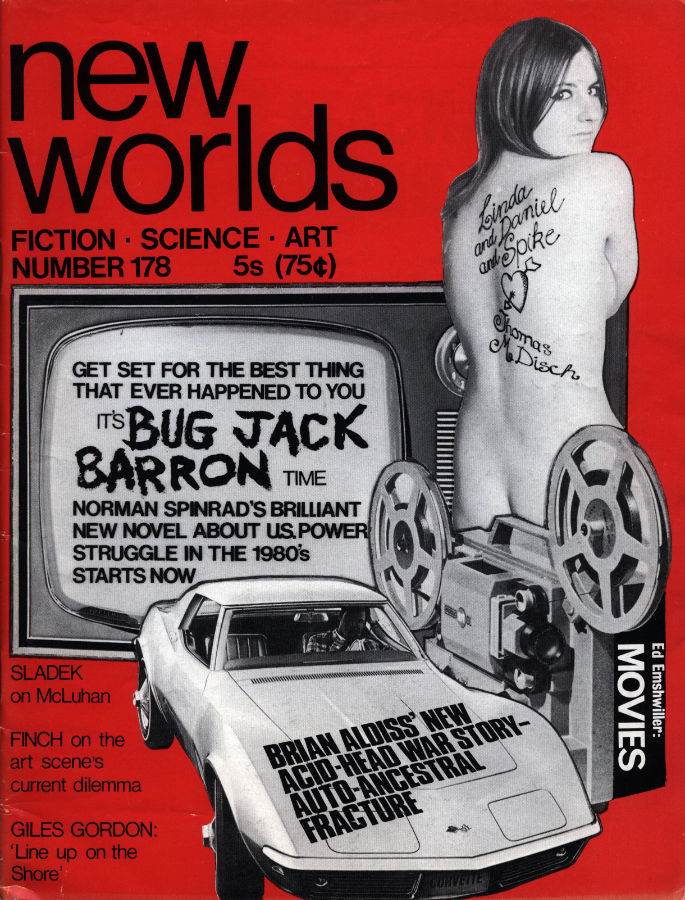
New Worlds December 1967, with the first instalment of Bug Jack Barron
Bug Jack Barron is one of those novels you keep hearing mentioned if you read about the history of science fiction, particularly the New Wave that revolutionised the genre’s literary palette in the late 60s and early 70s. It was initially published in Michael Moorcock’s New Worlds between December 1967 and October 1968 (which, if you don’t have your countercultural periodical publication frequency calculator handy, is six instalments), but the novel’s liberal use of swearing, drug use, and sex caused WHSmith, the largest magazine distributor and vendor in the country at the time, to refuse to stock its March 1968 issue, after which (because New Worlds had an Arts Council grant) “questions were asked” in the House of Commons. (Which you can read here. It’s quite short and mild and, despite the legend, Spinrad never gets called a “degenerate”. He’s not even mentioned by name.) The novel was published in book form in 1969.
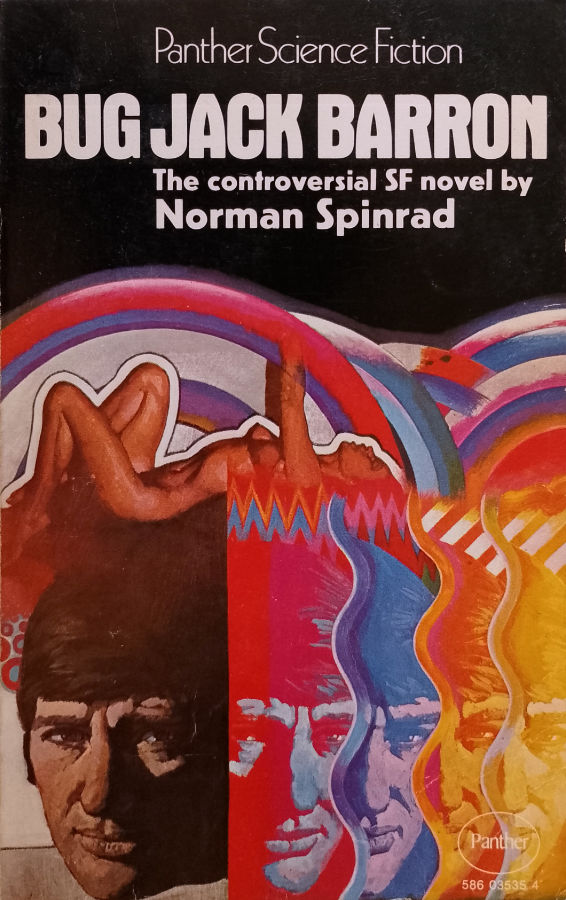
Panther 1972 edition, art by Michael Johnson
It’s set a couple of decades into what was then the future (at least twenty years after Bob Dylan recorded “Tombstone Blues”, according to the novel, so after 1985). Jack Barron has a one-hour Wednesday-evening TV show, in which he invites members of the public to video-phone in and tell him what’s bugging them, after which he phones up those responsible, live on air, and gets them to explain. Things kick off when a man phones in to complain he’s been denied a place in one of the Foundation for Human Immortality’s cryogenic freezers. It turns out this is for legitimate reasons—the Foundation demands a certain amount in liquid assets to be assigned to them for the duration of a person’s freezing, but the man included his home and business in the calculation—the man, though, says he was refused because he’s black. Barron pursues the issue anyway, just to stir up trouble. The Foundation, at that very moment, are trying to get a bill passed that will grant them a monopoly on cryogenic freezing, and Barron has just enough clout (an audience of one hundred million Americans) that he can impact political decisions. This brings him to the attention of the Foundation’s president, Bennedict Howards, who tries to recruit Barron to his cause, by offering him a free place in one of their freezers.
But Barron has had an equally tempting counter-offer: politicians from opposite sides of the left-right spectrum who oppose the Foundation’s bill have realised Barron is the one man who could unite their supporters and get them into power as a coalition. So which does he want, immortality, or to be President of the United States?
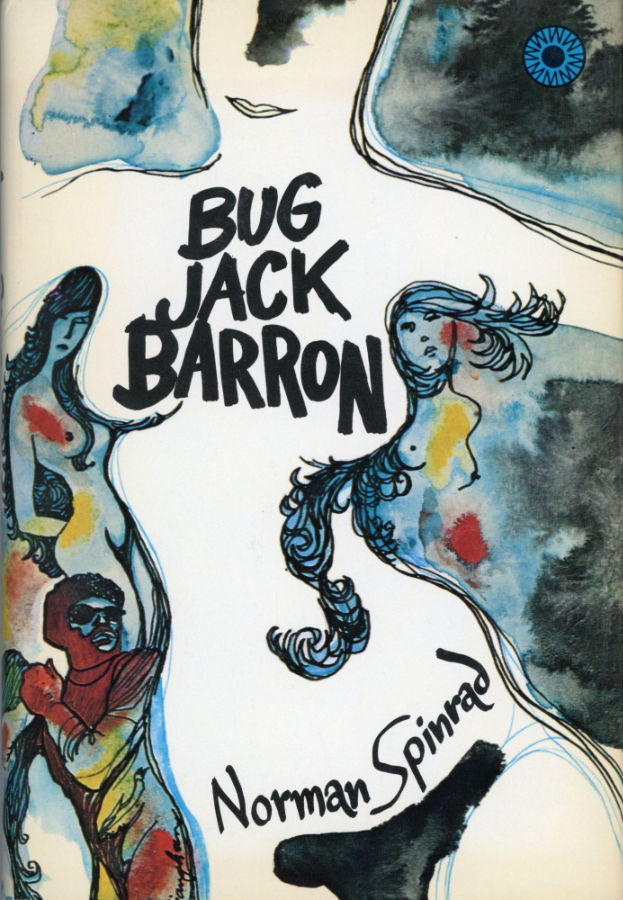
1969 hardback in the US, art by Jack Gaughan
So Howards ups the stakes. First of all he finds Barron’s ex-wife Sara, who left him shortly after he began his media career, feeling he’d abandoned the progressive political ideals the two shared in their student days. (Back then, Barron formed the Social Justice Coalition party, which he left so as not to compromise his TV show’s political neutrality.) Somehow knowing that Barron and Sara are still hung up on each other, Howards convinces her that if she can get Barron to sign his contract for a freezer-place, she’ll get one too. Then he ups the offer again, telling Barron that the Foundation has actually developed an immortality treatment, and that he and Sara can have it whenever they want. They just have to sign the contracts.
Barron, though, starts to suspect there’s something odd about the immortality treatment, and when Howards gets annoyed when Barron covers a seemingly unrelated issue on his show—a poor black man in the deep south who sold his daughter for supposed adoption to a rich white man for $50,000—things start getting complicated.
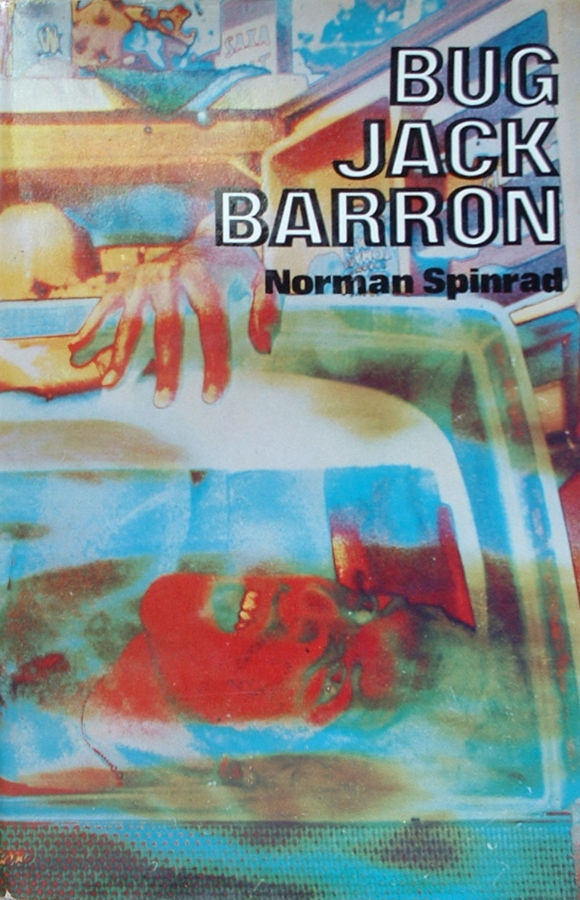
1970 UK hardback, cover design by Hipgnosis (better known for album covers by Pink Floyd)
The novel’s style placed it firmly in the experimental, literary New Wave. Aside from the free use of the sort of street-talk (and a lot of swearing) that was probably how people spoke then anyway, there are occasional passages in a sort of Beat-style stream of consciousness (though these get a bit repetitive as the novel goes on). (I have to say I found the first chapter almost incomprehensible, but fortunately things settled down after that.) Probably the thing that would make it impossible to publish today is its racial language, though the irony is that it uses this language to say what was progressive for its day. On the other hand, its treatment of women is pretty poor. Sara, despite leaving Barron when he gave up on his progressive politics, gives up her own when offered a shot at immortality, and basically exists to worship him (“oh, this is a man”). Once she’s reinstalled into his life, she’s not involved in any of the decision-making, and doesn’t even seem to want to be.
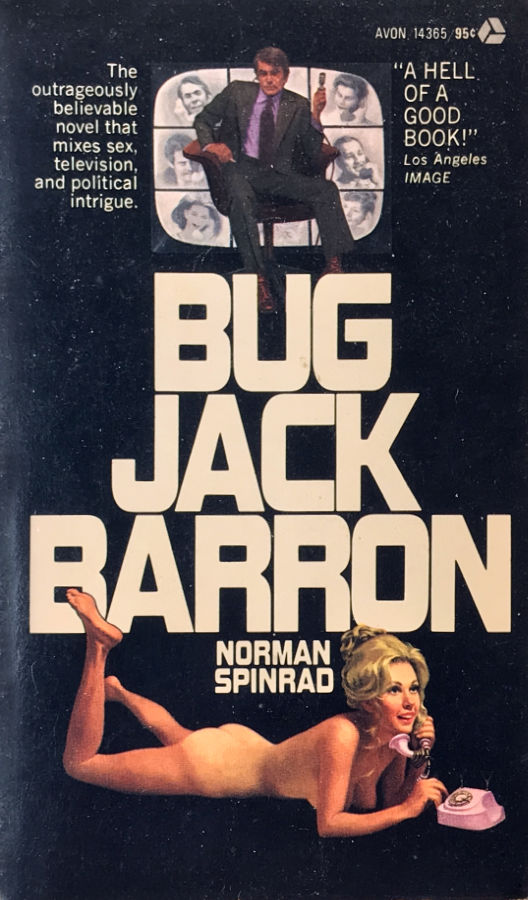
1973 Avon PB. Perhaps the most 70s cover imaginable.
But the novel is really about the battle of wills between two men of power, Barron and Howards, and the worlds (media and business) they represent. In this, it reminded me of Alfred Bester’s The Demolished Man, which is also about the contest between two world-sized personalities (Bester even gets name-checked here: “Jack could always stick a phrase in your head like a Bester mnemonic jingle.”). But Bester’s plots had far more incidents and ideas, and both of his characters really did feel world-sized. One complaint I have about Bug Jack Barron is that Howards, as a villain, is too easily needled into giving his secrets away. As soon as Barron even touches on a sensitive area, Howards breaks into a seething rage. He’s a cartoon villain, and how he ever made it to being CEO of a major corporation is hard to imagine. He couldn’t even play a round of poker.
Read in terms of the time it was written, Bug Jack Barron is a study in the aftermath of 60s-countercultural hopes and ideals (Bob Dylan, in the novel, is dead), in which once-idealistic people have been led into a world of “use me and I’ll use you politics” and world-weary cynicism:
“What happened to all the no-more-war n*****-loving peace-loving happy got nothing need nothing love-truth-and-beauty against the night Baby Bolshevik Galahads. Years happened, hunger happened, and one day, age-thirty happened.”
(Asterisks not in the original publication.)
Immortality, in the novel, is the ultimate corrupting Faustian pact, the one thing that would cause anyone to give up their ideals. As Spinrad says in an LA Review of Books interview from 2012:
“The initial inspiration for Bug Jack Barron was the way the question of immortality was generally treated in science fiction—that is, no one had seriously dealt with the inevitability that it would initially be very expensive, and that it would confer enormous political power on whoever controlled it, indeed on whoever might even be able to promise it one way or another…”
Against this, he says:
“…the only such power that could stand up to the power of the promise of eternal life was the power of television to transform, control, mutate, and manipulate individual and cultural consciousness…”
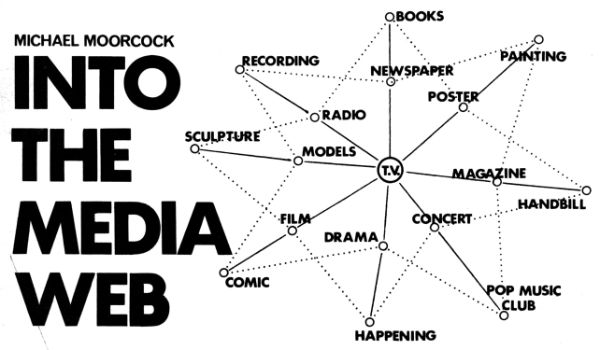
The perceived importance of TV back then is captured in this diagram from a Michael Moorcock article in the same issue of New Worlds as the final instalment of Bug Jack Barron, which places television right at the centre of the “Media Web”:
(Though I couldn’t help thinking of what would be the closest UK equivalent in the day, Esther Rantzen in That’s Life! — hardly Bug Jack Barron stuff. Maybe it’s a UK/US difference.)

Norman Spinrad, from New Worlds February 1968
Nowadays, with broadcast TV flailing for viewers in the same way cinema did when TV came along, Bug Jack Barron has nevertheless attained a new prescience. Barron, alone before the camera in his small studio, sharing screen space with video-callers, feels like an influencer of a certain type, even more so when you consider his emotive stirring-up of his viewing public. Back then, the idea that a media personality such as Barron could be considered for President of the USA was satire (Ronald Reagan was Governor of California at the time); nowadays, reality is so busy satirising itself that Bug Jack Barron reads more like a how-to manual—Machiavelli’s The Prince, updated for the video age.
As a novel, I perhaps found it a little too long (entire chapters were taken up with Barron coming to a decision), and only Barron himself felt like a convincing human being, but it shows how even SF from over fifty years ago can still feel relevant.
(Another thing reading this novel caused me to check out: What happened to all those real-life companies offering cryogenic freezing what seems like only a few years back? Some are still about, yes, but some went out of business. And the freezers were turned off.)
