
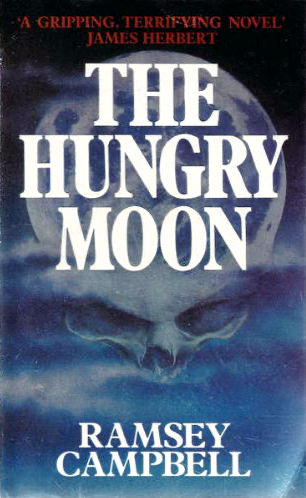
 The Hungry Moon (1986) was the first Ramsey Campbell novel I read, and the second horror novel I ever read. (The first was Salem’s Lot, and I chose The Hungry Moon to follow it because I wanted something similar but set in England.) It evidently impressed me enough to lead to a lifetime of reading Campbell’s fiction, but when I came back and re-read it a number of years later, I remember being disappointed, perhaps because by that point I’d come to expect something more from Campbell and found it lacking. But on this most recent re-read, I really enjoyed it, and I think this was because by this time I knew what sort of a novel it was and how to get the most out of it. How best, then, to approach The Hungry Moon? (Carefully!)
It’s set in the isolated Peak District town of Moonwell, which is known to get the least sunshine of anywhere in England (some feat), and is also the home of one of the oldest druidic ceremonies in the country, as every year the locals “dress” a deep, fifty-foot-wide pothole with flowers. But along comes a young Californian Christian evangelist called Godwin Mann (based, to some extent, on Billy Graham) who announces his intention to stop this pagan ceremony and reclaim both the cave and the town for God. As anyone who’s ever read a horror novel can tell, ending an ages-old pagan ceremony is always a bad idea, particularly if there happens to be something like a nuclear missile base nearby—and, of course, with Moonwell, there is. But Mann’s evangelistic preaching catches on with the locals, and soon most of them are converted by his brand of public confession, forced joyfulness, and self-righteous piety.
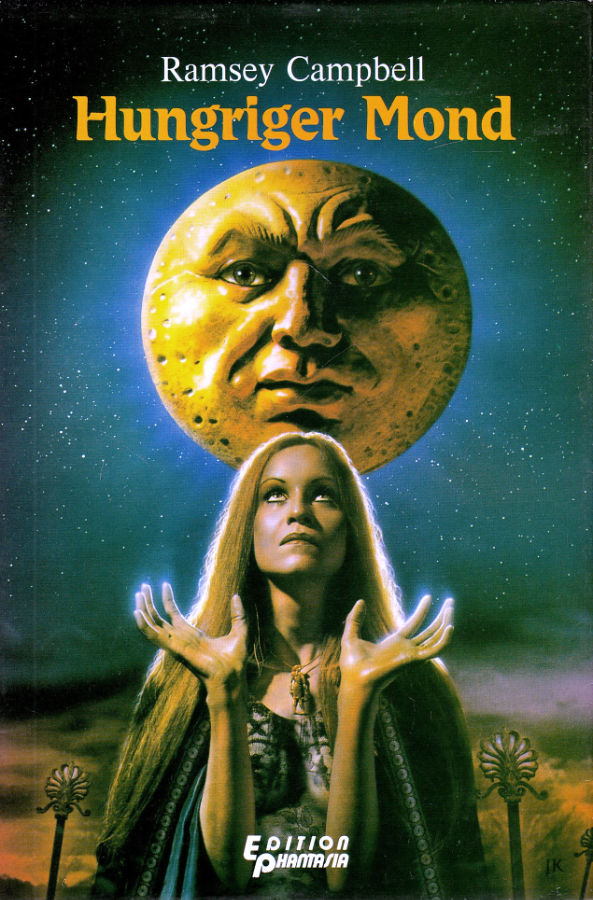
Edition Phantasia, 1987, art by J K Potter
The novel’s main characters are among the few holdouts, including Diana Kramer, a teacher who recently moved from America but has roots in the area; Geraldine and Jeremy Booth, who live in and run a bookshop from a deconsecrated chapel; postman Eustace Gift, who has ambitions as a stand-up comedian; and Nick Reid, a reporter based in Manchester, whose main interest seems to be in Diana Kramer rather than the story of a small town caught up in a religious fever, but who gets trapped in the town as things take a supernatural turn. There are also Craig and Vera Wilde, a pair of ex-nudists whose daughter, Hazel, and her husband (a somewhat useless local builder and security system installer) live in Moonwell and convert, much to the Wildes’ dismay, and eight-year-old Andrew, son of Brian and June Bevan, who run a camping equipment shop, and who convert after June is the first resident to publicly confess—not so much to her sins as her husband’s—when she tells the entire town about Brian’s interest in pornography and the sex games he drags her into.
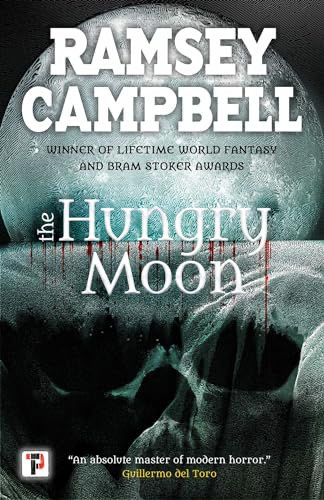
Flame Tree Press 2019 edition
Mann descends into the cave to oust the pagan evil, but after he emerges somewhat changed, the town finds itself trapped in a darkness so profound it actually prevents people from leaving. Meanwhile, people on the outside start forgetting Moonwell ever existed. (And so it joins the long tradition of supernaturally/science-fictionally isolated communities from Midwich to Milbury.) Because, as it turns out, what the druids did many years ago was bring down a vast, godlike entity from the moon, in a last-ditch attempt to defeat the Roman invaders. Somehow, though, it ended up being trapped there, in that dark pothole, and now, no longer held back by the propitiating flower ceremony, it wants out—and, what’s more, it wants revenge on the entire human race for its centuries of imprisonment.
I don’t think Campbell has written a novel since with such a large ensemble cast (and only Incarnate before it came close), though when I think of blockbuster horror novels in general, I tend to think of them as having ensemble casts (Salem’s Lot and IT being prime examples, but I’m also thinking of the few random novels by the likes of Shaun Hutson and Skipp & Spector I’ve read). But, while this could have been a commercial decision on Campbell’s part—to write a novel more like the sort of thing the booming horror market expected—I suspect it was more likely something he just wanted to try for its own sake (he says in his afterword that The Hungry Moon was “my shot at an extravagant supernatural novel splashed on a large canvas”).
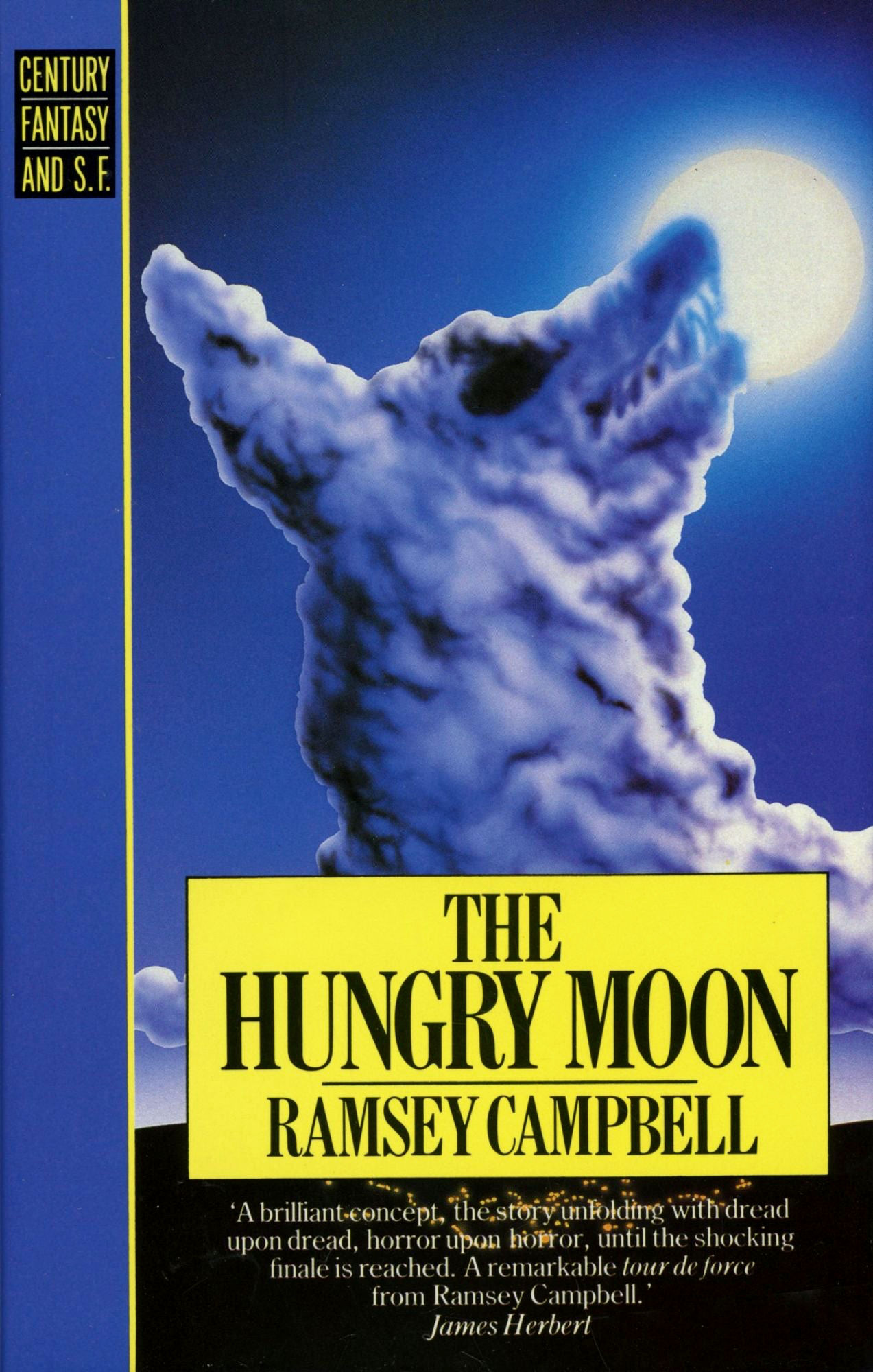
1987 UK HB
One of the things that works about ensemble-cast, multi-plotlined horror is the way initially isolated characters slowly come together once they realise the nature of what’s going on. But the trouble I had on my second read of The Hungry Moon, I think, is that the nature of “what’s going on” is too diverse to really add up to one thing. Aside from the re-emerged Mann being possessed by the moon-thing, and its trio of attack dogs roaming the town (keeping people from leaving, killing the occasional—very random—individual), there are a number of other supernatural occurrences which are of such a different nature, you start to wonder how Campbell is going to bring it all together. Geraldine Booth, whose child died, has a vision of his gravestone in Moonwell’s churchyard, glowing with its own light; Eustace Gift starts to hear his internal comedy duo Mr Gloom and Mr Despondency talking outside his house. These are storylines that seem to fit more into Incarnate, where people’s private dreams and fantasies become real. (Critic Simon MacCulloch sums up this aspect of the novel best when he says that, here, “a Lovecraftian extraterrestrial monstrosity plays the part of Incarnate’s dream thing as the embodiment of the predatory morbid imagination”. That phrase—“the predatory morbid imagination”—is a good summing up of the supernatural in a lot of Campbell’s writing.) And although Campbell does make these disparate elements fit, in the end, into The Hungry Moon’s overall story, I don’t think it’s quite convincing. Is the moon-thing here simply for revenge on the human race? If so, why does it toy with some people’s dreams and fantasies in this way? And, for that matter, why do its attack dogs kill a policeman who is clearly on its side, but not the people who oppose it? Even more, why, after decapitating the local priest (who was thoroughly against Mann’s form of extreme evangelism), does it reanimate his corpse? Reading The Hungry Man, you start to suspect these are great moments, but they don’t necessarily add up.
One way to deal with this is to say that the moon-thing, being an incomprehensibly inhuman entity, brings along with a whole lot of moon-lit weirdness, and it’s simply beyond our ability to understand. But that’s a bit unsatisfying, particularly as Campbell does provide us with a backstory for the thing (via a cosmic visionary sequence that, as he says in his afterword, may have been unconsciously influenced by the long vision sequence in Hodgson’s House on the Borderland). Ultimately, what the moon-thing stands for is nebulous, almost wilfully primal. Somewhat like the catch-all evil represented by the cult in his earlier novel The Nameless, it stands for:
“Everything we’ve been afraid of since we lived in caves, maybe since before we were even human. Everything we tried to believe we weren’t afraid of any longer.”
In other words… fear itself. It, and the darkness it brings, are “a way of trying to reduce people to a primitive state”. And while, on the one hand, that sounds like a vague reasoning intended simply to get the horror underway, on the other it’s saying something about the novel’s core theme, which is the extremes of religious belief and, as Campbell says in an interview in Samhain 2, “this drive so many people seem to have—to have the urge to question taken away from them, to be told what to think”. (Or as one of the characters in the novel says, “The only way to believe in God is let Him rule your life.”) An atmosphere of fear leads to the need for easy certainties, and that is exactly what a superheated air of self-righteousness provides.
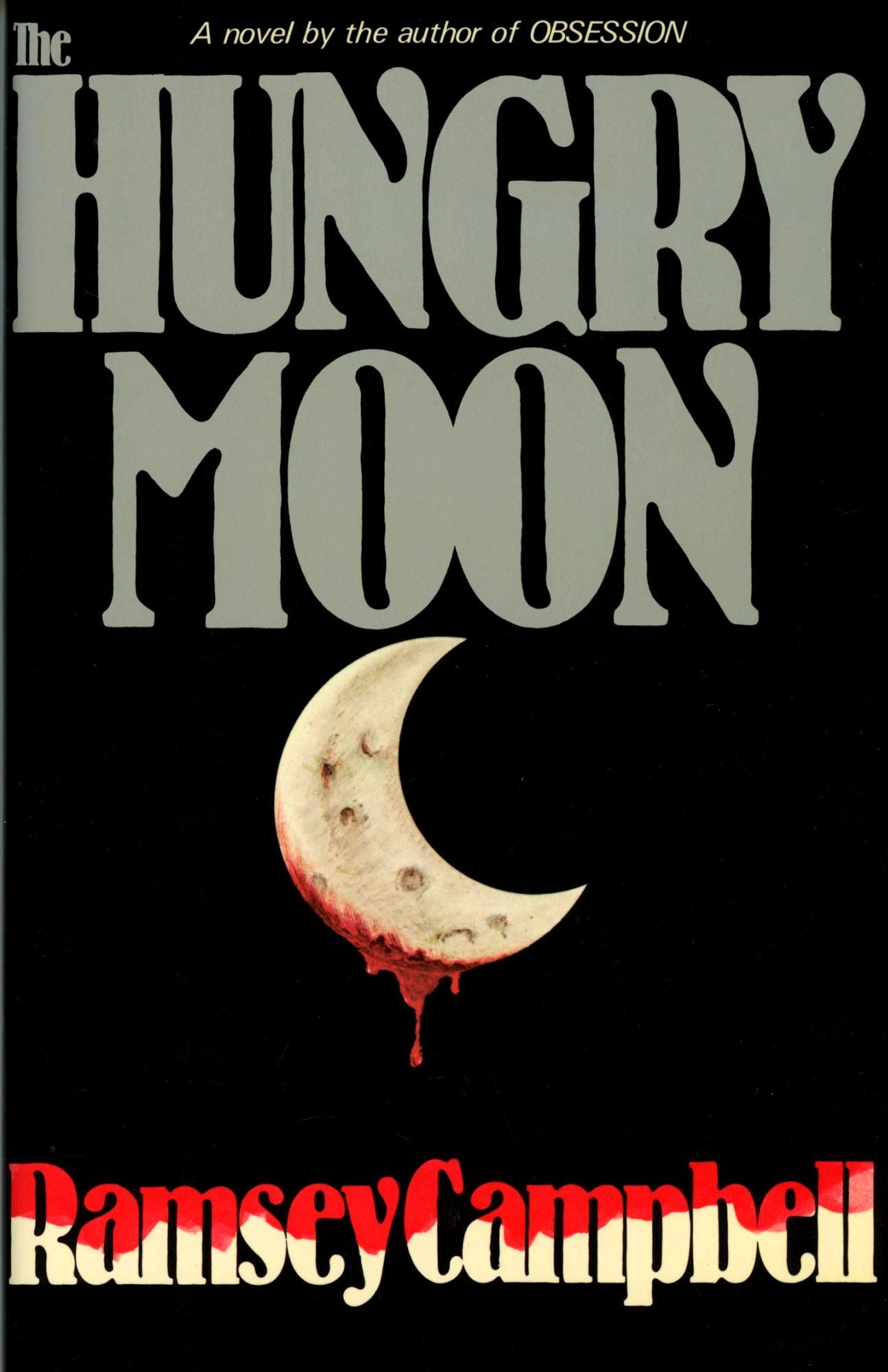
1986 edition from Macmillan
This, then, is why I found the novel just what I wanted on my first read, unsatisfying on my second, but thoroughly enjoyable on my third: it works on two of the three levels you’d expect a good horror novel of this sort to work. On the first level, that of simply telling an engaging narrative with plenty of supernatural incident, it works, largely because of the believability of the characters, which is always a Campbell strong point. On the second level, the level of narrative cohesion, it doesn’t really work, because the supernatural incidents are so diverse, and don’t add up to the entity having some single, meaningful and comprehensible nature. (It’s set up as a thing that’s here “to destroy us all and feast on our souls”, but Campbell isn’t interested in the simplistic sort of kill-scenes this monomaniacal type of monster requires… But, how fitting that a novel called The Hungry Moon should have an absence in the middle.) So that leaves the third, more literary level, which is on the thematic meaning of what’s going on. And it’s here that everything works again. That headless corpse of a Catholic priest fumblingly trying to perform mass in a darkened church makes no sense in terms of the moon-thing’s plans for revenge, but as a symbol of what religion can mean—that very priest, when alive, complained about Mann’s version of Christianity being “The notion that you mustn’t think your way to faith”—it’s a brilliant little vignette.
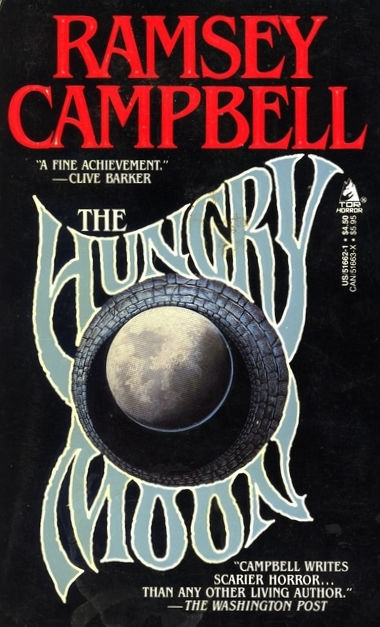
Tor 1987
The Hungry Moon is a big bag of a novel (Campbell himself accuses it of “trying to be too many books”, while Keith M C O’Sullivan in his book-length study of Campbell says it’s “a text that is brimful of ideas”): it’s got folk-horror elements, it’s got Lovecraftian elements, it’s got dream-horror elements, it’s got moments of kitchen-sink realism and psychological horror, as well as moments of visionary fantasy. It also has moments of comedy (some dark—like when Eustace has to joke his way out of a confrontation with the murderous embodiments of his own inventions, Mr Gloom and Mr Despondency—an idea that could, frankly, make for an entire Campbell novel), and satire (as one of Mann’s retinue, encouraging little Andrew to pray, says: “Remember, God likes to look down and see you on your knees.”). The thing is, it’s not any one of these things. If you come expecting a full-on folk horror, or a full-on Lovecraftian horror, or even a full-on monster-takes-over-an-isolated-town horror, it doesn’t quite work.
If you like Campbell’s work, you’ll find plenty of what he does done well here: moments where the supernatural blends seamlessly with the psychological, moments of sheer strangeness or weird awe, glimpses into very real-seeming characters struggling with both normal life and its extremes. Campbell’s penchant for tricksy dialogue is scarily suited to the cult mentality on display here, where believers take everything a non-believer says as an invitation to get the ideological upper hand, simultaneously tripping an interlocutor up with their own words while making themselves feel superior, as with this sort of logic:
“There will always be people who don’t want to listen to what God has to tell us, and that means they’ll hear the devil and do his talking for him.”
And there is, of course, some seriously good writing:
…the dogs padded out of the dimness.
They stopped at the end of the corridor and lay down. The moonlight through the window of the cell gleamed in their eyes. They were licking their lips, which were wet with a liquid that the light turned black.
Campbell is, in my opinion, quite harsh on the novel in his afterword, when he mentions “the amount of naked absurdity the book tries to contain”. I don’t really know what he means by this as, in a way, the absurd is one of the forms of horror he does so well. If he means the fact that the supernatural incidents don’t really cohere into one meaningful explanation (as Joel Lane says, “The second half of the book plays havoc with every rational expectation”), perhaps the best argument in support of this is that it is, ultimately, just part of its satire on religion: if you think God works in mysterious ways, just wait till you see what this cosmic-horror moon-thing does.
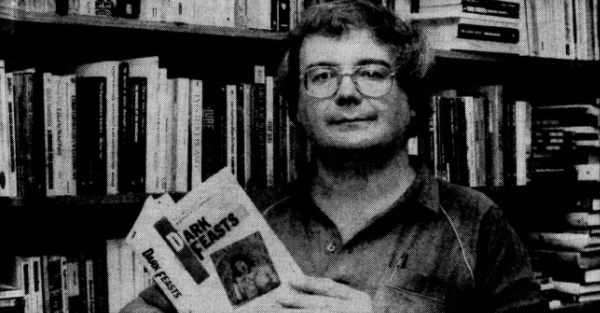
Ramsey Campbell in the Liverpool Daily Post, 26 Aug 1987
