
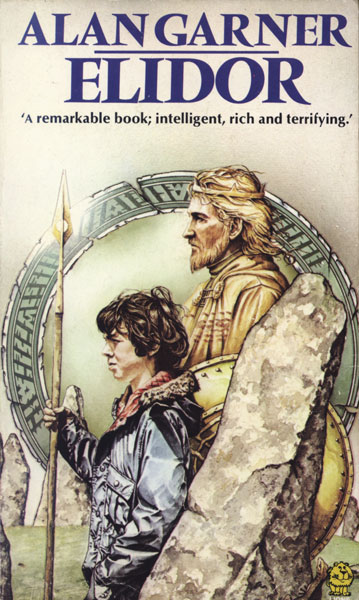
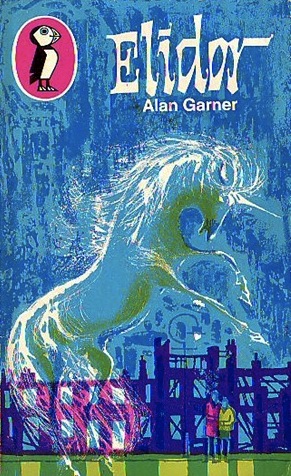
Elidor, cover by Stephen Lavis
Reading Alan Garner’s early novels, I can’t help feeling I’m tracing the development of the twin strands that would combine, in The Owl Service (his fourth book), to truly capture, for the first time, what was driving him as a writer. (And, from the essays in his non-fiction collection, The Voice That Thunders, it’s obvious Garner is a driven writer.) Perhaps the reason he set aside the completion of his Alderley Edge trilogy at the time was the need for a clean start to better pursue that drive beyond the bounds allowed by a sequel. Certainly Elidor, a standalone novel, sees him take a decisive step towards the sort of cut-back, dialogue-driven storytelling technique of The Owl Service, and (the other strand), a step further in encapsulating the complex, fraught, dangerous and potentially tragic world his teen protagonists enter when they become involved with the mythic & fantastic.
Taking its inspiration from several folk tales (see the Wikipedia article on Elidor), the novel begins without any character introductions or scene-setting, straight into a conversation between four children. Named, but not described, it’s left to the reader to work out, from the clues of how they talk and interact, who’s older than whom, as well as where they are and what they’re doing. The four Watson children, Nicholas, David, Helen and Roland, are killing time in Manchester, riding department store lifts and roaming the streets. Roland (the youngest, and most imaginative of the four) suggests selecting a random street from a map and finding it. It turns out to be in a section of the city partway through demolition. They find an abandoned church, Roland kicks a football through its window, then loses his siblings as, one by one, they go to find first the ball then each other, and don’t come back. Finally, Roland follows them into the church, where he meets the slightly scary fiddle player whose music has been haunting their little quest, and who proceeds to send Roland to another world.
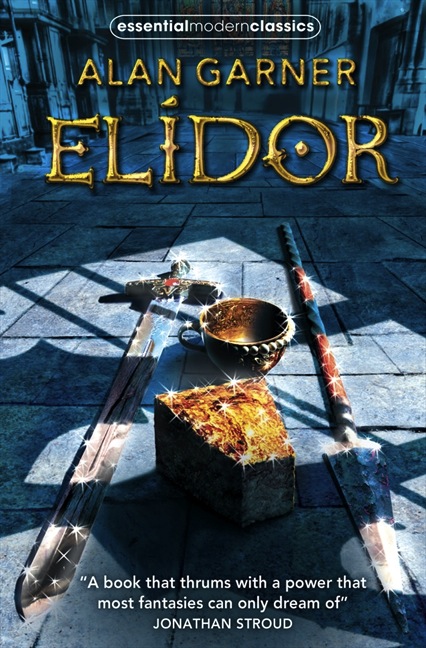 The other world is Elidor, a land of four golden castles, now eclipsed by rising forces of darkness, but preserved from total engulfment by four Treasures — a sword, a spear, a goblet and a stone — which, it is prophesied, four children will claim and protect in the land’s time of need. Roland’s powers of imagination turn to real powers in this world (“The power you know fleetingly in your world is here as real as swords,” he’s told), as he saves his three siblings from the power that holds the Treasures. Fleeing back to our world to protect the Treasures, the children find themselves holding mundane variants — two wooden laths nailed together for the sword, a rusty iron railing for the spear, a cracked cup for the goblet, and a dull lump of stone. Forced to bury them because of the wild, weird electrical effects these objects produce, the children forget or dismiss their adventures, apart from Roland, who soon realises the forces of darkness are still working to capture the Treasures.
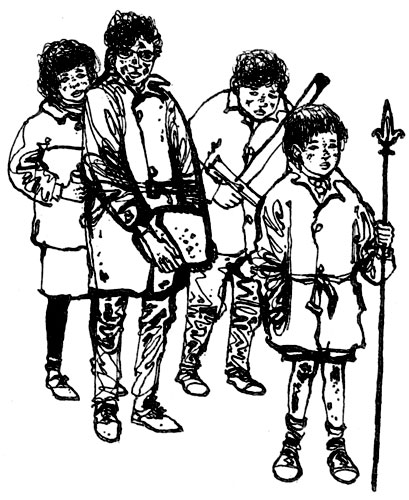
The children with the four Treasures. Internal illustration from Elidor by Charles Keeping.
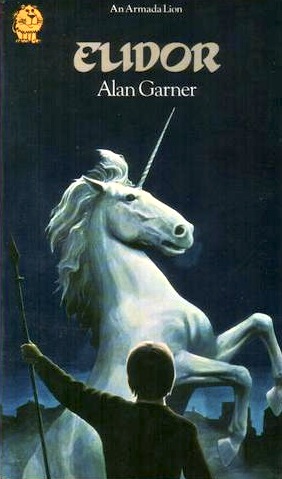 In a book that seems to start out as a slightly updated version of a C S Lewis or E Nesbit-style fantasy adventure, Elidor soon centres on the sort of thing Garner was to write about much more in later work — difficult dramas in which fantastic or strange experiences are troubling influences, things you want to forget or dismiss, but are compelled to face when they simply won’t go away. Roland’s status as “the imaginative one” means he’s generally disbelieved and mocked by the others, even though he’s the one who has the best idea of what’s going on. Nicholas, the eldest, finds the phrase “mass hallucination” in a book, and clings to that as an explanation for what they experienced; Helen, the peacemaker, just wants things to return to normal; David, more scientific, clings to reason, but is the first to be convinced when the evidence that something strange is happening is undeniable. But, like anything repressed in the unconscious, the fantastic forces of Elidor only gain in strength the more they’re ignored, and finally break through. The one thing that can save Elidor from its enemies is that the unicorn Findhorn must sing, and when he’s hunted into our world, the children find him in the wasteland where they first entered Elidor (“Wasteland and boundaries: places that are neither one thing nor the other, neither here nor there — these are the gates of Elidor” — just like the children, who are on the boundary between childhood and adulthood, and, at the beginning of the novel, are between homes). At the end, there’s a sense that, having finally faced the difficult work demanded of them, and witnessed its resultant tragedy, the children are left bereft, not enlightened or comforted by their contact with magic, but exposed to a more troubling, if true, version of reality. Where before, when it had need of them, David has to say:
“You may have finished with Elidor, but Elidor’s not finished with us.”
At the end, their task completed, there’s a sense of a sudden, almost bleak, withdrawal of the fantastic from our world. The last lines of the novel are:
“The song faded.
The children were alone with the broken windows of a slum.”
Tellingly, there’s no wizard like Cadellin of the Alderley Edge books to provide wisdom and a few helpful magic spells. The Watson children’s knowledge of Elidor comes from Malebron, a desperate Elidorian man acting on the utterances of a perhaps mad prophet, but who has as little understanding of what they mean as the children. The magic itself is more like the Old Magic of The Moon of Gomrath — a chaotic thing, not good or bad, just powerful, difficult, not understandable.
 But this is what gives Garner’s books their edge, their sense of honesty. You really feel he’s writing about genuine imaginative experiences — not daydreams, not nightmares, but things emerging from the unconscious which must be dealt with, fought, faced, and which are therefore as real as anything else in our world. This is the stuff of initiations and rites of passage, not escapism. The battle is not for good, but for sanity, balance, selfhood in the face of encroaching darkness. The land of Elidor, at the end, is healed, but only at the cost of a tragedy played out with the four children as unwilling actors, the sort of thing more likely to leave them disillusioned than enchanted. You get the sense that, for Garner, it is not the fantastic that offers escape, but the real world, with its certainties and solidities; nevertheless, the fantastic — the imaginative, the mythic — has to be dealt with.





 .
.