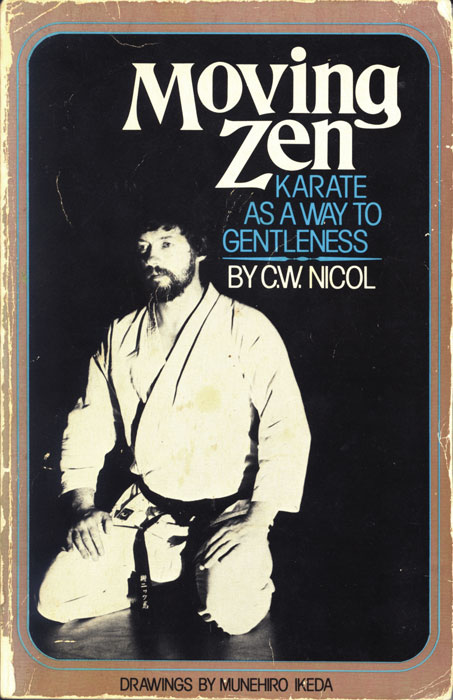
 Writing about Robert K Elder’s The Film That Changed My Life recently made me think about books that have changed mine (in that wordlessly changing way I wrote about), and the one that came most immediately to mind was Moving Zen by C W Nicol. Because I’ve never had much in the way of storage space, my personal library has seen a lot of books come and go, but Moving Zen (given to me as a Christmas present by my brother Garen back in about 1985) is one of the few that have stayed with me. Of course, I first read it because I was heavily into Karate at the time, but it’s the one Karate book I’ve kept, in part because it tells a story that isn’t just about Karate, but something far more universal.
First published in 1975, Moving Zen is C W Nicol’s memoir of the time he went to Japan (in the early sixties) to learn Karate. “I wanted it to be the simple story of a journey from white to black belt”, he says (in an excellent two-part interview which can be found online here (part 1, part 2), and which makes a wonderful afterword to reading Moving Zen), but really it’s about a young man finding a place (both inwardly and outwardly) where he truly feels at home.
The start of his first Karate lesson at the Japan Karate Association’s dojo in Yotsuya is the perfect illustration of this. A Westerner with only a smattering of Japanese, he at first finds the very atmosphere makes an outsider of him:
“Silence. I tried to draw myself into it, but it excluded me, and I held my breath lest I should make a noise, and hovered, uncertain, on the edge of it, for I did not know, and would not know for some time, exactly what we were doing.” — p. 9
And outside the dojo:
“Crowded Tokyo magnified my loneliness. In language and life-style, I lived apart from the people. I had not yet truly found a place to belong. Coming off an Arctic expedition, with its close and isolated companionship, did not equip me emotionally for dealing with huge, alien crowds, or for the many people I had to know, greet, and be friendly with.” — p. 18
As well as learning a martial art, and coming to understand a new culture, Moving Zen‘s subtitle, “Karate as a Way to Gentleness”, points to another conflict Nicol faces, this time with something alien inside himself, a raging temper he was prey to, which had led to him being involved in street-fights as a youngster, and he deals with the paradox of using a martial art as a means of learning to control these urges to violence, eloquently.
In fact, one of the joys of this book is just how well-written it is. Always clear and simple in style, it evokes the Japan that Nicol comes to know in a very Japanese way, using brief, accurate but expressive strokes to describe small incidents, sights and experiences:
“Outside, in the yard of a nearby farmhouse, a little grey-haired old lady bent over a broom, busily sweeping the fallen leaves of a gnarled and ancient persimmon tree. Dark clouds scudded by, over the curves of the eaves. And then came a gust of wind, and a thousand leaves clung to the wet roof, and tears came to my eyes, and my scalp tightened, and the wet leaves and the roof suddenly brought an understanding to me of something that was pure Zen, and therefore wordless, and Sonako and I went home for supper.” — p. 90
It’s these passages that provide some of the most moving episodes in the book, particularly in the final chapters where Nicol looks back on the many experiences he’s had in this once-alien country and realises how far he’s come, not just in terms of learning Karate (and earning his black belt), but in terms of ridding himself of his “foreign-bachelor isolation” and finding a way to truly belong:
“I was part of a family now… Each day was an object lesson in living, and I had so much to learn.” — p. 68
“It was as if the surface were calmer now, and I could begin to see beneath it, coming face to face with the warrior philosophies of Japan… I knew now that I had not come to Japan on a wild goose chase. It was all here.” — p. 100
Is a knowledge of Karate necessary to enjoy the book? I don’t think so, as Nicol was writing at a time when few Westerners would have known much about the subject, and he takes time to introduce the various concepts as he comes across them — mostly those relating to the spirit of Karate, the paradoxical heart of Bushido that turns a fighting method into a discipline, an art, a means of “perfecting one’s character”, rather than becoming some sort of killing machine. But this is certainly not an instructional manual, and the passages that explain aspects of the people and culture of Japan are as frequent as those about the martial arts. For me, there’s something about the very way this book is written, a calmness and clarity in its language, a simplicity in its insight into the many paradoxes of Japanese culture, and Karate in particular, that reveals how deeply Nicol was changed by the experiences he describes.
Doing a web-search, I was surprised to learn that C W Nicol is quite a celebrity in Japan, and has written more than a hundred books, not to mention plays and scripts for TV. He continues to practise Karate, and to follow his other passion, for the environment. His official website’s here, but alas (for me), it’s in Japanese. Amazon lists a couple of other English language books by him, though, so I may well be checking those out in the near future.
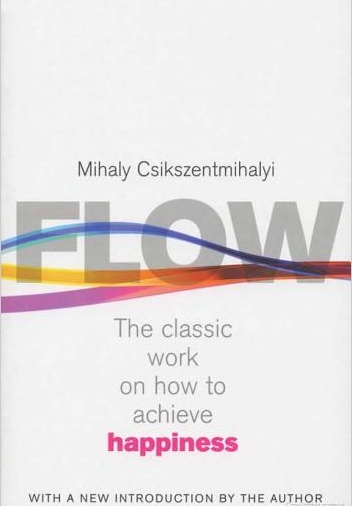
 takes a rather more scientific approach than your general “Yeah! Go for it!” self-improvement type of book. (I love what Sarah Millican said on the recent