
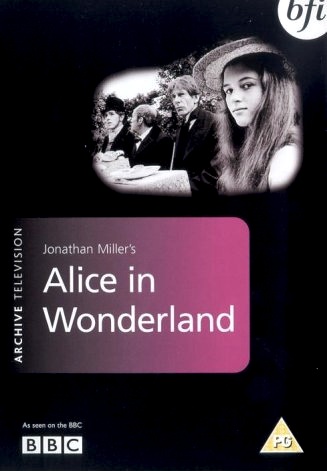
 This adaptation of Alice in Wonderland was filmed for TV broadcast in December 1966. Director/adapter Jonathan Miller aimed to be faithful to the book, with all the dialogue (except where improvised by the actors) lifted directly from Lewis Carroll’s text. But this, I think, is the adaptation’s main fault. Alice in Wonderland is a curious mix of episodes and skits, not really a story at all, and I think what you need to do with Alice is either find a way of making a story out of it, or to adopt some angle or interpretation to provide a constantly-running theme, something to give it a sort of narrative or spine. The original book wins through on sheer prissy impudence; adaptations need to offer something more.
Miller has two angles on Alice, neither of which really works for me. The first is to connect the book with dreams, and various of his directorial decisions (such as sometimes having Alice’s dialogue overdubbed while she doesn’t move her lips) come from his wanting to make the narrative more dreamlike. But I think Alice isn’t about the dream-world as much as it’s about the world of language, which has its own peculiar logic. Wordplay and double-meanings approached with a literal mind, and the ability of words to be strung together correctly but nonsensically, are what Alice, and other nonsense literature, is about. For me, this puts Alice at the head of a continuing tradition of wordplay fantasy, which includes the Oz books, and Piers Anthony’s Xanth series. It’s that tight-but-illogical logic that makes Alice what it is, not its dreaminess, which is more the province of surrealism. (In my mind, nonsense and surrealism are two quite different things. Nonsense applies logic to things that aren’t logical; surrealism revels in the irrational, with no need of logic.)
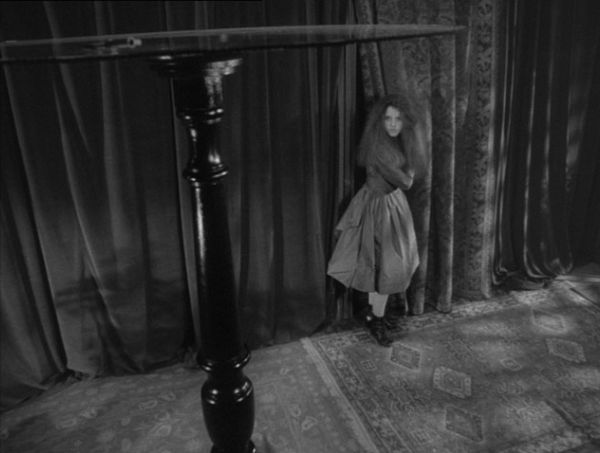
Miller’s other approach is to connect the book with “the longueurs of childhood”, a nostalgia for endless summers of blissful boredom, and in his initial edit, he had some long periods in which the actors just sat around doing nothing, in an attempt to conjure this feeling. These were edited out after a viewing by BBC executives, with only a few hints of them left in, leaving some curious points at which conversation lapses, everyone sits around staring into space, then conversation resumes. But I think the book is too energetic, too little-girl curious, for this to feel right. Kids are only bored until they have something to do; Alice, exploring Wonderland, very much has something to do. (It’s teenagers who get bored even when they have something to do; but then again, Miller’s Alice is a teenager.) Lewis Carroll, an Oxford don who could afford to spend entire days picnicking with the Liddells so he could come up with the Alice story in the first place, probably had no need to feel nostalgic for such long-lost periods free of responsibility, so they weren’t part of his book.
For me, Alice is in Wonderland because she’s a child — childhood, and the way a child views the illogical adult world, is Wonderland. All the various creatures Alice meets on her journey are comic versions of adults stuck in their own peculiarly nonsensical worldviews. Alice is the child regarding these adults with a cutting innocence. The book is all about her, in her self-contained bubble of childhood, coming into contact with the dreadfully meaningless self-importance of the adult world, and seeing it for the farce it really is: tea parties and courtrooms at which one must know the nonsensical rules of how to behave, a Queen with the power to cut off your head on a whim, and so on.

Peter Cook as the Mad Hatter
The result of Miller wanting to be faithful to the book is that the TV film feels just like a series of sketches. It relies entirely on the performers’ abilities to enchant with their personalities, rather than a story’s, or thematic argument’s, ability to keep you interested. Thus there are a few highlights that linger in the mind (Peter Cook is excellent as the Mad Hatter, John Bird is funny but too brief, Peter Sellers as the Red King, etc.), but elsewhere a good deal of puzzlement as the film moves from scene to scene without making it clear how or why. Thus, Alice stands outside a door trying to get in, then has a conversation with John Bird, then just opens the door and goes through. Why didn’t she do that first of all? You certainly have to know the book to be able to tell what’s going on, which has the unfortunate effect of making an adaptation nothing but a companion piece to the book, rather than an interesting work in its own right.
It’s easy to be too reverential to the book that’s the source of an adaptation. I enjoy watching film adaptations of books I’ve read, not to quibble with how they’ve departed from the text, but rather to see what they’ve made of it, what their interpretation is. An adaptation is a thing that exists alongside a book, and only subtracts from the original when, by being too literal, it reveals how shallow that original was in the first place.
For a more positive view of Miller’s Alice, see Jonathan Coulthart’s blog post on it. (I really like Miller’s Oh Whistle and I’ll Come To You adaptation.)
 If there was any need to prove J K Rowling’s Harry Potter books weren’t created ex nihilo, but as part of an existing tradition of magical fantasy in English fiction (which includes Jill Murphy’s The Worst Witch series, and Mary Norton’s The Magic Bed Knob; or, How to Become a Witch in Ten Easy Lessons (filmed as Bedknobs and Broomsticks)), here it is.
 I was once asked, in an interview for a job in a bookshop (which I didn’t get), whether a book had ever changed my life, and if so, how. I remember being completely stumped by this (unprepared, as ever). The answer to the first part, I knew, was yes, several times over, but the how of it felt just too immense for a quick, slick answer. It was more the sort of thing I’d want to retreat and write about for several hours, editing, thinking, then leaving for a few weeks before going back to it and writing some more, perhaps producing something of a moderate book length by the end of it. Which is one of the reasons I was so interested in this book,