Heart of Darkness by Joseph Conrad

Heart of Darkness (1899) ends with a moment in which its protagonist and narrator Marlow, returned to Europe after his adventure in the Congo, feels alienated from his fellow human beings:

‘I found myself back in the sepulchral city resenting the sight of people hurrying through the streets to filch a little money from each other, to devour their infamous cookery, to gulp their unwholesome beer, to dream their insignificant and silly dreams. They trespassed upon my thoughts. They were intruders whose knowledge of life was to me an irritating pretence, because I felt so sure they could not possibly know the things I knew. Their bearing, which was simply the bearing of commonplace individuals going about their business in the assurance of perfect safety, was offensive to me like outrageous flauntings of folly in the face of a danger it is unable to comprehend.’

There’s a similar moment at the end of HG Wells’s books from the same time. This is from The War of the Worlds (1898):

‘I must confess the stress and danger of the time have left an abiding sense of doubt and insecurity in my mind. I sit in my study writing by lamplight, and suddenly I see again the healing valley below set with writhing flames, and feel the house behind and about me empty and desolate. I go out into the Byfleet Road, and vehicles pass me, a butcher-boy in a cart, a cabful of visitors, a workman on a bicycle, children going to school, and suddenly they become vague and unreal… Of a night I see the black powder darkening the silent streets, and the contorted bodies shrouded in that layer… I go to London and see the busy multitudes in Fleet Street and the Strand, and it comes across my mind that they are but the ghosts of the past, haunting the streets that I have seen silent and wretched, going to and fro, phantasms in a dead city, the mockery of life in a galvanised body…’

Or, in The Island of Doctor Moreau (1896):

‘Then I look about me at my fellow-men; and I go in fear. I see faces, keen and bright; others dull or dangerous; others, unsteady, insincere,—none that have the calm authority of a reasonable soul. I feel as though the animal was surging up through them; that presently the degradation of the Islanders will be played over again on a larger scale. I know this is an illusion; that these seeming men and women about me are indeed men and women,—men and women for ever, perfectly reasonable creatures, full of human desires and tender solicitude, emancipated from instinct and the slaves of no fantastic Law,—beings altogether different from the Beast Folk. Yet I shrink from them… When I lived in London the horror was well-nigh insupportable. I could not get away from men: their voices came through windows; locked doors were flimsy safeguards. I would go out into the streets to fight with my delusion, and prowling women would mew after me; furtive, craving men glance jealously at me; weary, pale workers go coughing by me with tired eyes and eager paces, like wounded deer dripping blood; old people, bent and dull, pass murmuring to themselves; and, all unheeding, a ragged tail of gibing children. Then I would turn aside into some chapel,—and even there, such was my disturbance, it seemed that the preacher gibbered “Big Thinks,” even as the Ape-man had done; or into some library, and there the intent faces over the books seemed but patient creatures waiting for prey. Particularly nauseous were the blank, expressionless faces of people in trains and omnibuses; they seemed no more my fellow-creatures than dead bodies would be…’

In each case, an adventure into darkness has given the narrator a double vision of the world or humankind: the civilised surface and the horror beneath. Usually, Conrad’s novella is read as being about how Kurtz, sent to the Congo by the Company to plunder it for ivory, allowed himself to become debased by the supposed savagery of the region. But on a recent re-read of Heart of Darkness, I was also making my way through John Higgs’s book, Stranger Than We Can Imagine: Making Sense of the 20th Century, and the two books kept chiming together. The chief characteristic of the 20th century, for Higgs, was its loss of any shared central ‘omphalos’ — belief, political system, or cultural perspective — with the result that societies are reduced to nothing but a collection of dissociated individuals, each of whose needs become their own centre, with no larger, more encompassing ideal to bind them together. Higgs’s chapter on ‘Growth’ goes into the idea of how corporations, empowered by the legal fiction that they are individuals, with equal rights to human individuals (though incapable of being imprisoned, or of dying of old age), ‘had no choice but to become undying, unjailable profit-taking machines’. And I think the real darkness Kurtz encounters when he heads down the Congo to rape the natural world of its resources, is the one he brought with him. Unlike the other ‘pilgrims’ (as the narrator Marlow refers to the other Company agents) who are kicking their heels while they wait for an opportunity to pillage some ivory and make their personal fortunes, Kurtz has taken the Company’s driving need for profit as a fervent belief and philosophical ideal — his ‘omphalos’ — and it has made him the most successful ivory-gatherer in the Congo. But it has also made him the most spiritually bankrupt, and utterly dehumanised creature Marlow has ever met. Kurtz has raped the world and debased the people of the Congo to serve his and the Company’s need, and has dehumanised himself in the process. This is not a vision of Imperialistic Europe, but of 20th century corporate man, who serves the need to increase his employer’s profit and believes in nothing else, no other ideals, not even the worth of his fellow human beings.

Returning to Europe, Marlow is brought up short when he visits Kurtz’s ‘Intended’, and finds her talking of her fiancé’s nobility, his vision, his love, and his greatness, when all Marlow has seen is the depths to which a human being can go if he has the capacity to believe in an ideal that is, at heart, utterly corrupt.

HG Wells had his narrators see different hearts of darkness — the ‘Beast in Man’ (John Higgs says that the foregrounding of the previously-hidden id was a defining mark of the 20th century) in The Island of Doctor Moreau, and the way that civilised Europeans might be treated as they themselves treated those they ‘colonised’, when sufficiently powerful yet uncaring aliens invade in The War of the Worlds — but there’s an undeniable feeling that, as the 19th century moved into the 20th, there were idealistic shocks to come, and Wells and Conrad, prophetic writers both, were sensing the early-warning tremors.

Apocalypse Now! is one of my favourite films, and I only really understood Heart of Darkness once I’d seen its transplanting of Conrad’s tale to the US war in Vietnam. But, in a sense, it weakens the story, implying that it takes special conditions, such as war, to reveal the heart of darkness. Conrad’s novel may take place in what was then seen, at the time, by his intended audience, as an exotic distant land, but it’s about everyday things, not war: it’s about work, and the corporations who provide us with employment, and how serving them may lead us to dehumanise ourselves and others, even as we ravage the world in the name of profit.

(John Higgs’s interview with Alan Moore, about H P Lovecraft and the 20th Century, is worth a watch on YouTube (23 minutes).)

^TOP

Stag Boy by William Rayner

Stag Boy, cover art by Michael Heslop

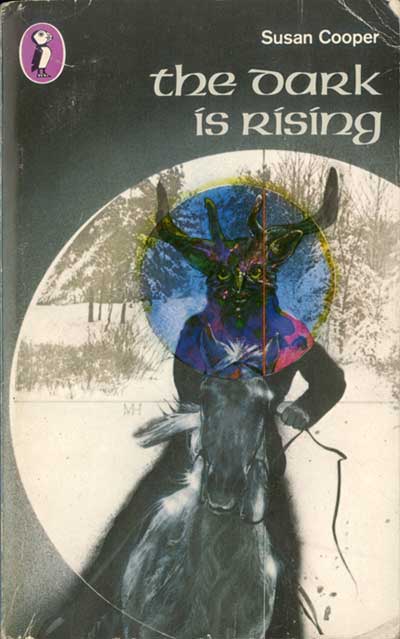
Stag-men of various sorts have been popping up on this site from time to time, from the antler-wearing shaman of Robin of Sherwood, to Herne the Hunter in Susan Cooper’s The Dark is Rising, or the bothersome creature of imagination and sexuality that intrudes upon the narrator’s life in Patricia McKillip’s Stepping Out of the Shadows. In William Rayner’s Stag Boy (first published in 1972), fifteen-year-old Jim Hooper returns to the farm he grew up in to convalesce after life in nearby Wolverhampton begins to affect his health. There, he finds his childhood friend Mary Rawle being courted by Edward Blake, two years older, richer, and far more worldly than Jim, as well as being ‘tall and strongly made, a good rugger player and a first-rate horseman.’ Jim can’t help but feel trapped by the boy-ness of his own adolescent body:

‘Then he looked down at his whitening knuckles, the narrowness of his wrists, and felt a choking anger at being shut up in such a poor thing of a body. He was overtaken by a longing so enormous it shook him physically… His spirit, if it could only get free, he felt sure would be as strong and wild as a hawk.’

An idle wish made in a ruined witch’s cottage leads him to find an ancient, stag-horned helmet which, when worn, allows Jim to share in the life of the ‘black stag’ — a creature of local repute, and the prize target of the hunt (to which both Mary Rawle and Edward Blake belong). While he’s one with the stag, Jim can lend it his intelligence, meaning it can out-think the hunt instead of just trying to out-run them; and being with the stag plugs Jim into the natural power and dignity of this king-animal’s physicality, which rubs off on him as his own body starts to mature and he gains in confidence.

At first, Mary’s not interested in Jim. To her, he’s part of the past, a relic of her childhood and of the closed-in, dead-end world of ‘the moor and the woods’. Edward makes her feel grown-up, and seems like the gateway to the adult life she’s always dreamed of living, one of:

‘parties and dances… famous people, amusing people, rich people, and something new and exciting would happen every day.’

But Jim brings the black stag to stand outside her window at night, tempting her to touch it, even ride it. At first she resists:

‘I don’t want strange things in my life… I don’t want my life to be different… It’s like stepping out of a lighted room into the dark.’

‘How much more comfortable it was when you had the right dreams, the ones that people understood and sympathised with.’ But she can’t ignore the wonder of a stag of such power and dignity and gentleness that lets her ride it, or Jim’s uncanny connection with it. At this point, Jim and Mary’s relationship becomes a world of its own, a secret that binds the two of them, and goes beyond her dreams of ‘parties and dances’ to something that mixes physicality and vulnerability, intimacy and meaning:

‘They were timid, too much aware of other people’s opinions and of their own youth and ignorance. Only in their wordless journeys through the dark did all worries and embarrassment fall away, leaving them free and happy, and innocent.’

But the stag’s animal nature threatens to unbalance Jim. That strength and nobility can veer into arrogance and an animal sexuality Jim has to fight to control. And now it’s the stag that calls Jim when it needs him, not the other way round, and its need is desperate. The hunt, fed up of hearing about this ‘proud, mettlesome, outrageous beast’ parading itself openly through populated towns, bringing traffic to a standstill and running rings round them whenever they chase it, is intent on bagging this creature before the season’s over. And what will happen if Jim is joined to it when it’s killed?

Part of the strength of this short YA novel comes from how naked the central metaphor is. Contact with the stag connects Jim with his own burgeoning masculinity (it’s significant that his father is dead) and adolescent sexuality. It teaches him the natural confidence and strength he ought to feel, but can also at times be a wild ride with forces that will not be tamed, or contained, or made civilised. Jim has to learn how to set the limit, how to be fully human not merely an animal, before he’s overtaken.

Although William Rayner’s sympathies are obviously with the black stag in its conflict with the hunt, by the end of the book, when it’s obvious Jim has to separate himself from the influence of the stag, the hunt takes its place as part of the natural order of things, particularly when contrasted to what Rayner sees as even more degenerate ways of taming nature. The hunt is ‘the ritual that should attend [the stag’s] death’, as it means death with dignity, and this is contrasted with the artificial, constricted life of battery hens and, beyond that, human lives in cities with their:

‘…endless mazes of streets, the houses like cages, that world of hutches and batteries and stunted lives.’

‘To deny nature — that was the worst sin, the sin against life’ — but, in the end, to live as a human being, Jim must civilise the more powerful natural impulses. A balance has to be found against the force of male adolescence, and so of course it’s Mary, finally, who redeems him, despite being told ‘This is not a thing for women.’

The Wild Hunt of Hagworthy by Penelope Lively, cover by Yvonne Gilber

Like The Wild Hunt of Hagworthy and The Owl Service, Stag Boy is another YA novel from the 60s and early 70s that explores the clash between modernity and tradition, nature and civility, by having normal, vulnerable teenagers trying to adjust to themselves and their burgeoning adolescence, while facing forces of folklore, myth, and the supernatural. And it’s a good mix.

I can’t find out much about William Rayner, other than that he was born in 1929. Stag Boy came out in hardback (in 1972) and paperback (1976), both with the same cover by Mike Heslop (who also did my favourite cover for The Dark is Rising). And, if you’re looking at that cover and thinking, ‘Isn’t that…?’, well, the answer is yes, it is. Heslop used a photo of David Bowie as a reference. (One more influence by Bowie on 1970s YA.)

^TOP

Electric Eden by Rob Young

ElectricEdenFolk rock flourished in Britain between 1969 and 1972, a period I’ve become increasingly fascinated by, mostly because of the YA fiction of the time (Penelope Lively’s, most recently), and the telefantasy that followed soon after (The Changes, Children of the Stones, Sky, and so on). All of these shared an interest in British landscape and British folklore. Rob Young’s Electric Eden traces the history of the ‘electric folk movement’ throughout the twentieth century, from the moment Cecil Sharp began seeking out and transcribing folk songs in 1903, to their adoption by the political left as the authentic voice of the working classes in the 50s and early 60s, and then to their more individualistic use among the hippie generation that bridged the 60s and 70s.

In fact, there are a few parallels to be drawn between the development of folk music and children’s fantasy literature in the 20th century. In From Alice to Harry Potter: Children’s Fantasy in England, Colin Manlove characterises the kids’ fantasy of the 50s and early 60s as being ‘social in tendency, in that the story involved either fitting in with a given collective, or, in the more secure and conformist 1960s, making friends with often very different people or creatures’ — which could be compared to the contemporaneous socially-minded use of folk music by the left — while, in the 1970s, ‘the problem of identity in these fantasies becomes much more acute’, alongside, in some writers at least, ‘a desire to reconnect with the past and traditional values that are now more distant’. And it’s the individualism of folk music in its brief 60s/70s flourish that comes to the fore in Electric Eden, with so many different musicians using the same basic materials — the songs, ballads, dances and music of the pre-World War working classes — in so many different ways.

What nailed this parallel for me, though, was when Young says:

‘A significant portion of Britain’s cultural identity is built on a succession of golden ages… The ‘Visionary Music’ invoked in this book’s title refers to any music that contributes to this sensation of travel between time zones, of retreat to a secret garden, in order to draw strength and inspiration for facing the future.’

Golden ages and secret gardens — this could be straight out of Humphrey Carpenter’s book about the ‘Arcadian’ writers of classic children’s fantasy, and their use of ‘travel between time zones’ and ‘retreat to a secret garden’ to reconnect with the ‘golden age’ of childhood.

Comus's First Utterance, one of the stranger (and darker) uses of folkishness

Comus’s First Utterance (1971), one of the stranger (and darker) uses of folkishness

Perhaps one key to why there was this sudden movement to rediscover (or remake) the traditions of the past at this time is down to the fact that the people doing the rediscovering/remaking were the children of the generation who’d lived through two World Wars. Perhaps there was a need to reach over the immediate, bloody past and mend the connection with whatever life had been like before those two horrific cataclysms, to find a way of dealing with a daily life in which you weren’t continually threatened by industrial levels of death. Folk music felt like a discovery to the rockers of the late 60s, something they could both participate in and make their own. (This could be a workable definition of what ‘folk’ music is — music that’s both participatory, and individually interpretable.) If nothing else, there was a lot more you could do if you were interested in folk music, as Electric Eden quotes folk musician Dave Arthur as saying:

‘So we were morris dancing, clog dancing, playing instrumental music, singing ballads and songs, researching, going off to manuscript collections and working on material, original stuff that nobody else was working on.’

Dave Arthur was married to Toni Arthur, later a presenter on Play School and Play Away, and the pair recorded several folk albums, including Hearken to the Witches Rune in 1970/1971, a collection of witchy-themed folk songs (including ‘Alison Gross’ — about the ‘ugliest witch in the north country’ — ‘The Standing Stones’, and ‘The Fairy Child’), which had an excerpt from the Wiccan ‘Witch’s Chant’ printed on the sleeve.

There seems to have been a strong connection between folk music and something darker, or at least weirder. When Cecil Sharp first saw morris dancing in 1899, Rob Young says, the:

‘…sheer otherness of the display entranced him — it seemed to appear from the darkest, least conspicuous corners of English provincial life, and to be innately understood by the people who practised it.’

As Young says:

‘Even to dip a toe into the world of folklore is to unearth an Other Britain, one composed of mysterious fragments and survivals…’

Meanwhile, back in the early 70s, folk horror had its own brief efflorescence, with Play For Today Robin Redbreast showing on 10th December 1970, Blood on Satan’s Claw out in cinemas in 1971, and of course the folk-horror-musical The Wicker Man in 1973.

DoctorWho_Daemons

Jon Pertwee’s Doctor captured by sinister morris dancers (are there any other sort?), in The Daemons (1971)

And then it all ended. 1972 was a ‘reckoning year… a time of structural adjustment in the rock economy’:

‘The inescapable truth was that if you were still making Albion-centric, historically resonant folk-rock after 1974, then the zeitgeist had deserted you.’

Why did it end? Was the search for a new identity successful, were all problems resolved? Or was this particular solution limited to the one post-War generation’s brief coming of age? Young puts forward the idea that Thatcher’s government deliberately set out to provide a new, more modern self-image for Britain, taking it away from dreams of the countryside to something more solidly urban and suburban, but he says a similar thing about Harold Wilson’s speech to the Labour Party Conference in 1963, too:

‘…the speech signalled a new British self-consciousness as a metropolitan society whose successful destiny lay in skewering the balance towards its urban population and industrial prowess.’

fotheringay

Sandy Denny’s post-Fairport Convention band’s first (1970) album

On the other hand, perhaps it was simply that the connection to a more peaceful, pre-war ‘golden age’ just couldn’t work in the late 1970s and 80s, or indeed in any globally-connected age, where it was impossible to ignore wars in other countries, terrorism, industrial unrest, rising unemployment, and the renewed threat of nuclear war. The world-warding barriers around one’s country retreat were too thin.

But the visionary ‘golden age’ aspect of folk music didn’t entirely disappear. Young traces its spirit in the work of a number of artists in the following years (culminating in the very un-folky electronica of the Ghost Box label in the 2010s). Perhaps, then, it’s similar to what happened to the ghost story, as presented in Julia Briggs’ study, Night Visitors, and the real oddity is not why folk rock’s popularity so suddenly waned, as why a minority interest, deeply meaningful to only a few, flared up into such brief but bright cultural relevance, and became, for even so short a period, as popular as it did.

^TOP