Frank Frazetta

The Barbarian, by Frank Frazetta

The Barbarian, by Frank Frazetta, from FrankFrazetta.net

He’s elemental. He’s ugly. His body is scarred, nicked, battered, and beaten. His face is a face that’s been punched many times; but it’s the face of a man who comes back every time. His limbs are taut-muscled and gnarly-veined like twisted tree roots; his skin has a green sheen like verdigrised copper. Barbarous, piratical, adventurous, dark-eyed, deadly and dignified, the epitome of contained power in glorious, brooding, post-melee repose, Frank Frazetta’s ‘The Barbarian’ — painted in 1965, and used as the cover for the first of Lancer Books’ Conan paperbacks — is, to me, the essence of the sword and sorcery hero.

He is, of course, surrounded by death — the ghostly skulls hanging like a desert mirage in the flaming sky behind him, and the gloopy mass of blood, bones, and corpse-parts he’s standing on — but he’s triumphant. Unlike the rather stiffly-posed Conans that came before, with their neatly cut hair, their sandals and freshly-pressed tunics, here Frazetta brings mess and dirt to fantasy painting. More than a decade before George Lucas’s idea of a ‘used future’ made Star Wars so convincing, this Conan has been through the wars.

Gustav Adolf Mossa, She (1905)

Gustav-Adolf Mossa, She (1905)

There’s a woman clinging to his leg — the sex to compliment the icky-sticky death, because this is a male fantasy — but I don’t think she’s submissive. She’s holding onto his leg with what seems to me (I may be wrong — there is a chain in the background) to be genuine affection, as if to say, ‘This man’s mine. Clear off.’ And I think she can back that threat up. I’m pretty sure that’s her axe sticking out of the ground behind her.

‘The Barbarian’ is a Symbolist work of art, as the decadent Symbolists (much as I love them) could never have painted it. It’s simply too vital. Just compare it with a similar (though late-Symbolist period) work, Gustav-Adolf Mossa’s ‘She’ (from 1905). Mossa’s ‘She’ is that Symbolist nightmare, the femme fatale, here presiding over a mound of dead bodies; pale and languid-eyed, crows and skulls are in her hair (and a pistol, among other weapons, hangs from her necklace) because she, unlike Frazetta’s barbarous pair, is on the side of death. Frazetta’s barbarian, and his recumbent barbarienne, are on the side of life. But, it should be noted, their life, not yours. This pair is no abstract celebration of vitality. If you get too close, you may end up as one more decoration on their mound of corpses.

Egyptian Queen, by Frank Frazetta

Egyptian Queen, by Frank Frazetta, from FrankFrazetta.net

‘Egyptian Queen’, painted for the cover of Eerie issue 23 in 1968 (though Frazetta modified the face soon afterwards), is perhaps the archetypal Frazettan female. Sultry and kitten-faced, she exudes the same elemental power and dignity as ‘The Barbarian’, only with a shade more (though a very gloomy shade, it has to be said) civility. Her pedestal isn’t a mound of corpses, it’s an actual pedestal (though the chipped stone edge implies battles have been fought in this chamber), and she stands between her snarling pet leopard, and her scimitar-wielding bodyguard, with regal calm. Even that marble pillar presents its flame-like lustre as an aspect of her smouldering vitality. Again, it’s a painting that encapsulates power, perhaps recently-exercised, now in brief repose; and though it may, in this case, be political rather than physical power, it very much resides in the physical figure of the queen herself — not in statutes of law or machineries of state, but in sheer, living vitality. She perhaps owes something to Hollywood — her headgear and leopard could have come from 1934’s Cleopatra — but she has none of that film-star frivolity & foot-stamping pettishness about her. This is a woman who really could rule an empire (albeit a crumbling one — but they’re the best ones to rule).

Claudette Colbert as Cleopatra, 1934

Claudette Colbert as Cleopatra, 1934

Frazetta_TigerFrazetta’s greatest artistic quality is, I think, the combination of vitality and dignity he gives his figures. (And I don’t just mean his human figures, but his apes and lions and lizards, too.) His battles are always battles between equals. They’re not contests of physical prowess, they’re contests of dynamism and heroism, of sheer vitality. The un-armoured woman with only a dagger in her hand is clearly the equal, in Frazetta’s world, of that flame-eyed tiger, or that pack of wolves, or that flock of pterodactyls, because she has just as fierce a will to live. The conflict isn’t really conflict, it’s a pairing, a flashing moment of dynamic tension between equals.

It’s true, not all his paintings present women as heroically as they do the men, but in the best of them it’s vitality itself that’s the subject, heroically embodied, whether in the human body, male or female, or in troglodytes, gorillas, crocodiles or panthers. It even seethes out of the twisting roots of jungle trees, and the roiling waves of storm-tossed oceans. It’s that sense of elemental vitality I like to find in the best sword and sorcery: the feeling that the life-force (an old-fashioned term, but surely worth a non-scientific resurrection) is at its most potent when faced with death and darkness, surrounded by wildness and fierceness, and couched in the nobility of the individual, however rough and haggard, or svelte and beautiful. Frazetta’s work is, above all, exciting, living, and elemental — the essence of sword and sorcery.

^TOP

The Loch Ness Monster

A Monstrous CommotionThe mysteries of the unexplained — UFOs, ESP, ghosts, and so on — were an integral part of growing up in the 1970s, just as the threat of global thermonuclear war was in the 1980s. And, just as, sometime in the mid-90s, I found myself looking back and thinking, ‘Hey, it seems we’re not going to die a horrendous radioactive death after all,’ I’ve recently found myself looking back on those unexplained mysteries I grew up with, wondering what happened to them.

In a sense, the Loch Ness Monster is the purest example of a ‘mystery of the unexplained’. Belief in UFOs implies belief in technologically advanced aliens; belief in ghosts implies belief in life after death; but belief in the Loch Ness Monster doesn’t imply anything other than belief in a ‘large living creature of an anomalous species’ in one particular body of water. It doesn’t even have to be, as the popular image has it, a plesiosaur — a reptile, and hence entirely unsuited to living in a cold-water loch, and, what’s more, a creature whose fossilised bones reveal it to be entirely incapable of raising its neck above the vertical, Nessie-style — it could be any dark, humped, long-necked, small-headed, giant water beastie, just so long as it (a) can be described as a monster, and (b) is in Loch Ness.

One of the things that fascinated me about the story of the Loch Ness Monster, as detailed in Gareth Williams’s comprehensive A Monstrous Commotion: The Mysteries of Loch Ness, was how, despite its having no religious or idealogical baggage, belief in the monster nevertheless inspires religious levels of devotion (as well as inter-factional and cross-factional squabbling). One sighting of an anomalous, glistening hump travelling across an otherwise glassy-calm loch can change lives. It can certainly ruin careers, as it did to Denys Tucker, only 26 years old when he was made Curator of Fishes by the British Museum in 1949, but sacked eleven years later, in part because of his insistence that the Museum investigate the Loch Ness Monster — but also because he was ‘shortfused and easily goaded into “intemperate” language and firing off abusive memos’. A martyr to the monster, maybe, but no saint.

Sir Peter Scott, son of the famous explorer and a natural history presenter for nearly three decades of BBC documentaries, planning a serious scientific expedition to Loch Ness, was advised (by the Assistant Private Secretary to Her Majesty, no less):

‘I’m sure that you would be right to enlist a psychologist amongst your team, as there is obviously something about the Loch Ness Monster which makes normally sane and balanced people behave in a highly emotional manner. Even if of no use to you, he would have an interesting time examining the causes of the Loch Ness Monster neuroses.’

And, as Gareth Williams says of another scientist/monster hunter:

‘Roy Mackal was knocked spectacularly off course by the Monster and became almost schizophrenic as a researcher. Back home in his molecular virology lab in Chicago, he was a methodical experimenter who published good work in high-quality journals. At Loch Ness, however, he behaved as though the water contained some mind-altering substance that made him throw away the basic principles of his research training. He bent facts, re-wrote evolution, invented new species which had no grounding in zoology and covered pages with lengthy calculations that were obviously wrong.’

Doctor_Who_and_the_Loch_Ness_MonsterAs a piece of modern cultural history, the Loch Ness Monster story is fascinating in its own little way, starting out with several sightings in the early 1930s, including that of a large ‘prehistoric’ animal crossing the newly-built road around the loch, it quickly attracts further sightings, rebuttals, parodies and hoaxes (when big-game hunter Marmaduke Wetherell was financed by the Daily Mail to track down the beastie, he found footprints — that were later identified as the foot of a hippo, and just the single foot, not a pair, and a withered, dead foot at that, as these had been produced by an umbrella stand); it moves from the local paper to the nationals, and gets mentioned in Parliament, and on radio, and TV. It has films made about it (the first being The Secret of the Loch in 1934, edited by David Lean!). Books are published, books that collect the evidence, books that focus on particular theories, books that disprove other books. Photographs appear, and snippets of film, and, as technology moves on, underwater images, and sonar. Submarines are used, and a gyrocopter (straight off You Only Live Twice). The Loch gets dynamited, and peppered with biopsy darts. The Loch Ness Phenomena Investigation Bureau is formed as a scientific investigation of the monster in the 1960s, and quickly gets derailed when an over-enthusiastic MP gets on board (who later loses his Brighton seat for spending too much time by a Scottish Loch). Then, in the 1970s, the Americans come along, with their money, and their new technology, and the whole thing gets a new lease of life. Photographs (enhanced first of all by cutting edge computer-scanning methods, but also, perhaps, by dodgy-but-traditional paintbrush methods) are printed in the most prestigious scientific journal of all, Nature. It even gets onto Blue Peter.

How can this mystery, fixated on one large but limited loch, go on for so long? At every stage, each new method for finding the monster, often driven by new technologies and new ideas about what it is and how it must behave, brings it own unique grey areas. Sonar scans, for instance, find anomalously large, fast-moving objects deep in the loch that get everyone’s pulse racing, but are later explained as artefacts caused by reflections off the thermocline, the border between regions of water with different temperatures. The loch itself, with its deep, deep bottom, can produce powerful underwater waves with startling effects on the surface, and even boat-wakes can reflect and linger in all sorts of monstrously deceptive ways. The most persistent and convincing pieces of evidence (to believers, anyway) are almost always found, later — often, as in the case of the celebrated ‘Surgeon’s Photograph’, much later — to be hoaxes. It’s not, as Denys Tucker insisted, an Elasmosaurus neck standing a clear twelve feet out of the water, but a home-made model on a clockwork submarine, and much smaller.

The 'Surgeon's Photograph' - a model monster on a clockwork submarine

The ‘Surgeon’s Photograph’ – a model monster on a clockwork submarine

The mystery of the Loch Ness Monster isn’t so much a cryptozoological one, as a human one. The monster hunters are, as Gareth Williams puts it, ‘a wonderful collection of one-offs’, and their quest:

‘…a magical mystery tour, complete with a yellow submarine, a flying machine lifted from James Bond and electronic wizardry straight out of Tomorrow’s World.’

In this purest of all quests to plumb the ‘mysteries of the unexplained’, it’s the quest for mystery itself, whatever form it takes, that comes out the strongest. It only takes a human pair of eyes, and something deep enough, or dark enough, or fuzzily-edged or murky enough, or simply something (like the Loch’s waters) that does something strange every so often. That, and a nudge towards an interpretation: a myth, a story, a bit of folklore, a modicum of fear and of excitement. ‘Am I seeing a monster? What else could it be?’ After all, as recent political events have proved, human beings can find monsters anywhere.

^TOP

The Atrocity Exhibition by J G Ballard

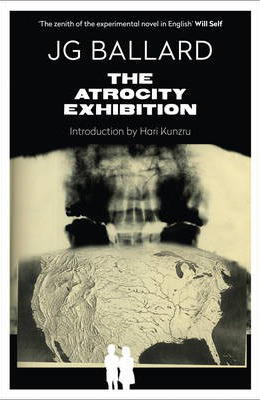
AtrocityExhibitionIt’s oddly comforting to know that J G Ballard’s most experimental, challenging, and controversial pieces of fiction, the ‘condensed novels’ that make up The Atrocity Exhibition, were written between, on the one hand, a children’s story for the much-loved BBC series Jackanory (‘Gulliver in Space’, broadcast 11th Feb 1966) and a treatment for one of Hammer Films’ fur bikini efforts, When Dinosaurs Ruled the Earth (1970). In contrast, The Atrocity Exhibition stories are deliberately difficult, intentionally obsessive, and wilfully confrontational. As much experiments in form as they are in content, they were Ballard’s attempt to break away from his early, more conventional (though still firmly ‘New Wave’) science fiction, to something that felt more relevant both to himself and to the time in which he was writing. As he states in a 1973 interview with Peter Linnet (included in Extreme Metaphors: Collected Interviews):

‘I wanted to write directly about the present day, and this peculiar psychological climate that existed in the middle sixties… It seemed to me that the only way to write about all this was to meet the landscape on its own terms. Useless to try to impose the conventions of the nineteenth-century realistic novel on this incredible five-dimensional fiction moving around us all the time at high speed.’

AtrocityExhibition02As much as they were a response to the ‘peculiar psychological climate’ of the mid-1960s, the Atrocity Exhibition stories were also a response to Ballard’s own psychological ecosystem. The protagonists of these fragmented stories, variously called Trabert, Traven, Talbert, Tallis, Travers, or left unnamed, usually start their stories working in some sort of institute (a hospital or a university), but leave to pursue their increasingly obsessive private projects. Similarly, Ballard gave up his medical training when the urge to write became too strong. The Atrocity Exhibition protagonists’ private projects are often artistic, but always, like the Atrocity Exhibition stories themselves, highly experimental, and more often than not entirely conceptual. In the story called ‘The Atrocity Exhibition’, Travis plans to make himself the first victim in an entirely imaginary, though very real to him, World War III; in ‘Notes Towards a Mental Breakdown’, Trabert wants to somehow resurrect the Apollo 1 astronauts. These men are usually trying to somehow recreate the decade’s most celebrated tragedies — those which most challenged the post-war optimism of the 1950s — but do so in a way that somehow, this time, makes sense. Their key working method, it seems, is to collect disparate photographs, scientific images, artworks, and other ‘terminal documents’, while somehow insisting that ‘all these make up one picture’:

‘(1) a thick-set man in an Air Force jacket, unshaven face half hidden by the dented hat-peak; (2) a transverse section through the spinal level T-12; (3) a crayon self-portrait by David Feary, seven-year-old schizophrenic at the Belmont Asylum, Sutton; (4) radio-spectra from the quasar CTA 102; (5) an antero-posterior radiograph of a skull, estimated capacity 1500cc; (6) spectro-heliogram of the sun taken with the K line of calcium; (7) left and right handprints showing massive scarring between second and third metacarpal bones…’

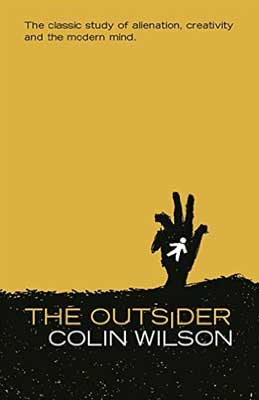
Wilson_TheOutsider_2001When writing about Colin Wilson’s The Outsider, I mentioned The Atrocity Exhibition as an example of what I called ‘crisis literature’ — books written on the edge of, or just past, a traumatic, and often psychologically destabilising crisis, which forced their writers into new, experimental, and often difficult narrative forms to capture and somehow master that crisis. Alan Garner’s Red Shift was perhaps the first example of this kind of book I really stuck with, and T S Eliot’s The Waste Land is perhaps the most well-known. Such books, I said, present themselves as highly intellectualised puzzles, but are really about deep emotional trauma. They take the form of fractured narratives (the multiple time strands of Garner’s Red Shift) or a barrage of seemingly unrelated fragments (the many styles and images of The Waste Land), that, like the Atrocity Exhibition protagonists’ ‘terminal documents’, the authors insist belong together as a single statement. (One such disparate list of peculiar photostats — ‘(1) Front elevation of a multi-storey car park; (2) mean intra-patellar distances (estimated during funeral services) of Coretta King and Ethel M. Kennedy…’ and so on — is titled ‘Fusing Devices’, making their function in an attempt at self-integration clear.) This is something Jung has said is a general characteristic of psychological healing: the search to resolve highly polarised, conflicting internal forces (a thesis and an antithesis) into a new synthesis, a new unity. The Atrocity Exhibition is fragmented in form (all those short paragraph-long chapters with their wonderful Ballardian titles), narrative sequence (Ballard says you don’t have to read the chapters in the order presented, but can pick and choose at random), and images. ‘At times it was almost as if he were trying to put himself together out of some bizarre jigsaw,’ as someone says of the protagonist of ‘You and Me and the Continuum’.

What may be another characteristic of ‘crisis literature’ is the way that violence, or violent images, are always waiting to burst through any apparently normal facade. Dr Nathan, one of the recurring figures in the ‘condensed novels’, who Ballard calls, in his later footnotes to the stories, ‘the safe and sane voice of the sciences’ — though with a hint that it’s not necessarily safety or sanity that are needed to solve these post-traumatic conundrums — provides a key to understanding this element of the Atrocity Exhibition:

‘The only way we can make contact with each other is in terms of conceptualisations. Violence is the conceptualisation of pain. By the same token psychopathology is the conceptual system of sex.’

TAtrocityExhibition03he many violent images in The Atrocity Exhibition stories — car crashes, assassinations, murders — are, then, attempts to externalise a deeply repressed or dissociated pain, a pain so intense it destabilises the very landscape around the protagonists, disconnecting them from a sense of reality, and from normal contact with their fellow human beings. Half of what happens in each of the stories is probably hallucinated — certainly, some of the characters are, including that mostly-silent recurring trinity of Kline, Coma, and Xero — while the other half is overwritten by a fictionalisation of reality which is, nevertheless, more real, or at least more meaningful, to the protagonists than reality itself.


I’m not a great one for experimental fiction. The Ballard I like is mostly the writer of weird disaster novels (The Drowned World, The Crystal World), dream-like psychological short stories, and a few of the mid-period novels (High-Rise, The Unlimited Dream Company). But after a while, reading interviews and articles about Ballard, you have to admit that, at some point, you’re going to have to read The Atrocity Exhibition, just to find out if it can really live up to all he said about it.

jg_ballardIn a way, what we have here is Ballard’s own commedia dell’arte taken to max — reusing the same stock figures (the mentally exhausted doctor/lecturer protagonist, the psychologist colleague who wryly, calmly comments and explains, the rather passive abandoned wife, the rather passive younger girlfriend), stock props (a torn flying jacket, a helicopter, a crashed car), stock images (the angle between two walls, cubicular screens or mirrors, vastly blown-up fragmented images of a woman’s face and body), and stock situations (car crashes, bizarre artistic exhibits) and landscapes (abandoned military testing sights, abandoned motorways, and other concrete wastelands), played and replayed, re-imagined and re-fit, in an attempt to find the combination that will unlock this particular meaning, solve this particular riddle. (The exception that proves this rule is, perhaps, ‘The Summer Cannibals’, which reads as though Ballard were deliberately trying not to use any of his standard tropes, and finds there’s nothing worth writing about. It’s the least interesting of the Atrocity Exhibition stories.)

Having read them, I have to say I didn’t find the whole as powerful as I’d hoped. The shock of the fragmented form works at first, but after a while the repetition doesn’t quite gain power through accumulation. What’s undeniable — as always — is the strength and integrity with which Ballard follows his obsessions. This is something you get, though, even in his more conventional narratives, the early novels and short stories. Here, in condensed form, sometimes the effect is of shocking juxtaposition, but sometimes it’s tired repetition. Undoubtedly, The Atrocity Exhibition was important for Ballard to write; it revitalised his novel-writing and set him on a new direction for a new decade. It’s almost as though he had to go to such experimental, obsessive lengths to break free of all the generic and standard novelistic conventions he’d been following, so as to return to them (with Crash, Concrete Island, and High-Rise) with a new strength. And I think the condensed novel form can really work, and it would be great to read other writers attempting it — if, that is, they don’t just take it as an excuse to throw together a bunch of random paragraphs. (It would work well, I think, with cosmic horror.)

If, as I say, The Atrocity Exhibition was important for Ballard to write — so as to confront, and perhaps master, the dehumanising forces of trauma, despair, and the ‘death of affect’ in his own life in the mid-60s — then his final book, Miracles of Life, was the equally important answer to it, as that book is about the humanising forces that saw him through life, most notably being his children.

^TOP