Skallagrigg by William Horwood

Skallagrigg (hardback), cover by David Kearney

Skallagrigg (hardback), cover by David Kearney

I first read William Horwood’s Skallagrigg twelve years ago, on a word-of-mouth recommendation — actually, less than that, an overheard snippet of a recommendation to someone else — which is a particularly appropriate way to come to a novel that’s about a quest to find the source of a cycle of stories spread among the disabled residents of Britain’s hospitals, institutions and places of care, always by word of mouth, never written down. I’ve mentioned before on this blog, writing about Theodore Roszak’s Flicker, how much I like this sort of quest-for-the-artist kind of tale (I also included Ramsey Campbell’s The Grin of the Dark in the same category; his Ancient Images would be another, as would Paul Auster’s The Book of Illusions). Skallagrigg follows a similar labyrinthine path, and although it does so without straying into the supernatural or conspiracy territories of Campbell’s or Roszak’s, it provides a very satisfying and moving conclusion to the quest on all levels, and is, I’d say, one of the most powerful novels I’ve read — and a damned good read, too.

The “Skallagrigg” stories centre around Arthur, brought as a boy at the beginning of the 20th century to a “towering place of dirty yellow brick and sunless, barred windows”, because his cerebral palsy has branded him, in the all too ready-to-label eye of the era’s establishment, an idiot. Arthur is, in fact, highly intelligent, and through a fellow patient who can understand his difficult speech tells stories of a figure he calls “the Skallagrigg”, who will one day come and take him from the hell that is the ward ruled over by a violent, or at best indifferent, staff of supposed carers, and one particular demon with a hooked window-stick known as Dilke. Arthur’s stories spread among the disabled, never the able-bodied, and become a sort of myth, hinting at a promise of hope, of escape, of freedom, perhaps even of cure, until it’s difficult to tell if this “Skallagrigg” is an actual person or a saviour figure — for how else could he or she or it possibly live up to all that Arthur, and the others that hear the stories, hope for?

Skallagrigg (paperback)The novel’s main story follows Esther Marquand, who is, like Arthur, born with cerebral palsy, though into a far more enlightened age. This does not, however, make her journey through life at all easy. On the way there are difficulties to face, both physical and emotional — Esther’s condition, and the circumstances of her birth (born via Caesarian after her mother was killed in a car accident), have torn apart her family. But just as the “quest” strand of Skallagrigg is about bringing together disparate clues to find a lost truth, so Esther’s story is about reconciliation, about facing difficult emotional truths and overcoming them to heal what does not seem can be healed. Skallagrigg is a long book (572 pages in hardback, 736 in paperback), but necessarily long, to properly convey the considerable struggle Esther faces at every stage of both her life and her quest for the source of the “Skallagrigg” stories. As someone who generally doesn’t like long books, I have to say this is one that thoroughly justifies its length. (Which is why the 1994 TV adaptation of the novel by the BBC, though a good film in its own right, can only ever be a whistle-stop tour of the novel’s highlights, a compression of its very full story, and probably best watched after you’ve read the book, otherwise it might wrongfoot you on a few plot-strands. Still, highly recommended as a sort of dessert to the novel itself. Richard Briers never fails to surprise!)

One of the things I love about this book is that it’s also about the early days of home computers (it was published in 1987). Esther’s quest for the Skallagrigg informs her growing ability as a creator of computer games, leading her to make a game that takes the player through as much of an analogue of her own difficult journey as it can — both through life, and in search of the Skallagrigg:

“She must already have made the key decision for ‘Skallagrigg’ [the game she creates] that the journeyer — the player — would have to become successively more severely handicapped if he or she was to reach the end of the quest. The game was becoming a journey into nightmare, of terrible self-acceptance, and the options the successful player would have to make would be ones towards self-abasement, humiliation, weakness and physical destruction in order to gain a spiritual victory.”

Horwood tells of how he came to write Skallagrigg in a lecture given in the 1990s, “The novel and the safe journey of healing”, (later published in The Novel, Spirituality and Modern Culture):

“I picked up a pocket tape-recorder one day and posed myself a challenge. Was there anything, I asked myself, that I could not speak into it. Some secret perhaps. Some unadmitted truth, something, anything…”

By taking up such a challenging and essentially unanswerable subject as the blind injustice of being born so physically powerless as Esther or Arthur, Horwood plunges his reader into a confrontation with the limits we all face. Ultimately the Skallagrigg stories, like the truest stories and mythologies, are about finding a way to deal with the dark areas, the difficult and impossible areas, of life — not by “solving” them, not by having the difficulties magically taken away or made “normal”, but by finding meaning in the face of them, by accepting and then transcending them.

I recently re-read Skallagrigg and found it just as compelling as my first read. (I had in fact forgotten what the ultimate solution to Esther’s quest was, and when it came round again, found it just as spot-on, just as fulfilling of all its hints and puzzles, right down to origin of the word “Skallagrigg” itself.)

A wonderful book.
^TOP

Kingdoms of Elfin by Sylvia Townsend Warner

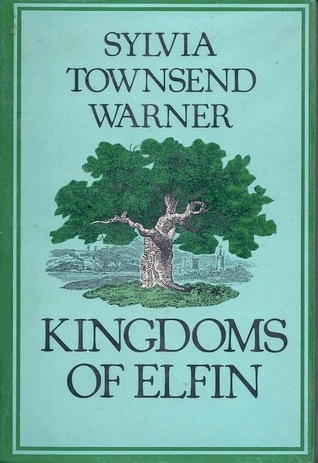
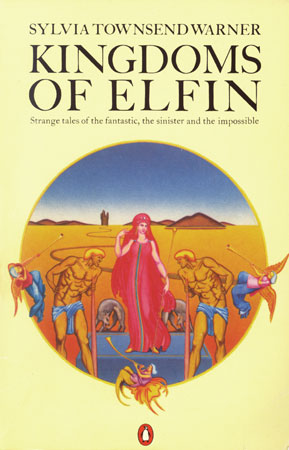
Sylvia Townsend Warner's Kingdoms of ElfinThe Little People, it seems, have no middle class. They are either the earthy, woodland-living folk of Alan Lee and Brian Froud’s Faeries, or the distant, beautiful, highly-cultured nobles of Tolkien. Sylvia Townsend Warner’s elves are firmly in the Beautiful People category, with something of a Bohemian, perhaps Bloomsbury tinge to them. The Bloomsbury tint is understandable — Warner began writing fiction in the 1920s, having been encouraged to do so by Bloomsbury-ite David Garnett. Cultured, with nevertheless a humanising irony, a slightly disapproving-but-forgiving distance of tone, these stories of the Kingdoms of Elfin were in fact published in the 1970s, in The New Yorker (though two are original to this collection), but you can feel their roots in those earlier days of advanced thinking, self-improvement, and the intellectual rebellion against the remnants of an aristocratic, paternalistic Victorian culture. Not too much of a rebellion, though — Warner’s fairies play golf and cards, they obey the dictates of courtly fashions, they gossip and have that aristocratic mix of disapproval of, and tolerance for, those who are different. Warner’s stories focus on those who are different, but her rebels are rarely different enough to leave off being aristocratic. They dip their toes in rebellion with the air of assuming a new fashion:

“It is widely known that a group of dissident fairies seceded from the Court of Elfhame in order to have more time for self-improvement. The Elfhame Dissidents had sickened of the frivolity of court life: pleasure was a burden to them; so was politeness. Beset with banquetings, love affairs, sonnets, whist drives, masquerades, and lotteries, they had no time to take themselves seriously.”

Leaving the Court of Elfhame, these dissident fairies of “The Occupation” nevertheless fail to truly take themselves seriously: “Conversation persisted, since in the main they talked about themselves, but was repetitive.” They puzzle over the mortals they encounter, taking a quaint interest in church worship and the birth of a mortal baby, before passing on, hardly noticing the tragedy they leave in their wake.

Some of the stories make brief, passing reference to folklore: “The Five Black Swans” contains a glimpse of the story of Thomas the Rhymer from the fairy lady’s point of view, and “Elphenor and Weasel” ends with an allusion to the Green Children of Woolpit. There are references to fairy literature, too: James Hogg appears, as a shepherd (which he was, prior to writing The Memoirs and Confessions of a Justified Sinner) in “The Occupation”, which also has a minister refer to Robert Kirk’s The Secret Commonwealth in an effort to learn about the fairy visitors he suspects are living in his house.

Kingdoms of ElfinThe last story in the book, “Foxcastle”, tells of a mortal scholar who, trying to find evidence that fairies exist, is taken in and studied by them. Here at last we get to see the fairies from a mortal’s point of view rather than, as in the rest of the book, from their own. Which perhaps goes best towards describing the overall tone of the stories in Kingdoms of Elfin: Warner’s fairies, although they have wings and can fly (though the aristocratic ones scorn flight, thinking it only suitable for servants), and although they are long-lived and capable of invisibility, don’t come across as magical in the way of Tolkien’s elves, nor dangerously unpredictable in the way of Froud and Lee’s, because we’re seeing them as they would see themselves: as objects of a wit and irony so light in touch it can seem to fade like fairy gold in mortal hands. But nevertheless these stories are told with a bite, the classic storyteller’s indifference of true fairy tales, that makes these little comic tragedies, and tragic comedies, both subtly knowing and subtly forgiving, but never merely delicate or fey.

^TOP

Titus Alone by Mervyn Peake

Titus Alone, by Mervyn Peake “To the reader who has followed Titus through the two earlier books Titus Alone administers a profound jolt, and many have not liked it,” writes Malcolm Yorke in My Eyes Mint Gold, his biography of Mervyn Peake. It was warnings such as this that put me off reading the third of Peake’s Titus books back when I read the first two, and which prepared me, on finally getting round to it, not to be disappointed by it not being a Gormenghast book. But, as it is a Titus book, it is at least haunted by Gormenghast, even if the world Titus moves through, and the prose style we get to experience it through, aren’t Gormenghastian, but something less grandiose and Gothic, less solid, and of that much less character, too. At times, it reads like a sort of mannered absurdism, full of details that ought to add up to character and style but without any of the substance that would make them work.

Perhaps the trouble is that Titus, though the figure around whom the whole series revolves, isn’t one of Peake’s more interesting characters. He exists, at first, to be oppressed by Gormenghast, then to defy it and escape from it. But because his identity is so tied up with that vast shadow-haunted castle, once he’s away from it, what is he? This is something Titus himself has to confront, as he finds himself, in Titus Alone, so far from his home that no-one has ever heard of it, and most don’t believe such a place even exists:

“Did you run away, young man?”

“I rode away,” said Titus.

“From… Gormenghast?”

“Yes, your Worship.”

“Leaving your mother…?”

“Yes.”

“And your father…?”

“No, not my father…”

“Ah… is he dead, my boy?”

“Yes, your Worship. He was eaten by owls.”

The Magistrate raised an eyebrow and began to write upon a piece of paper.

Finding himself in a very un-Gormenghastian land of motorcars and helicopters, tall glass buildings and needle-like aeroplanes, Titus is arrested for having no identity. “So my papers are out of order, are they?” he says. “So is my brain and heart.”

MuzzlehatchUnfortunately, this lack of identity makes for him being a very weak character to hang a novel on. In the Gormenghast books, relief would be found in other characters, or in Gormenghast itself, but here there’s not much weight to the world Titus finds himself in, and we only get a small handful of characters who have any real character at all. Perhaps there’s only one. And that would be fine, because the whole of “Boy in Darkness” is sustained by the eerie presence of the Lamb alone, but here the one new character of interest, Muzzlehatch, exists mainly to stride in and out of the plot at key points, rescuing Titus when Titus needs rescuing, then to disappear, because Muzzlehatch, “Barbaric to the eye, his silhouette more like something of ropes and bones,” a man “so ragged and yet, at the same time, so like a king”, whose “every movement was a kind of stab in the bosom of the orthodox world” is a kind of hero of indifference, a hero of individuality and self-containment, something Titus aspires to, but fails to achieve until the very final paragraph of the novel. Till then, Muzzlehatch must exist as a heroic example, but one who therefore can’t take centre place in a novel which is all about the attempt to solve the problem Muzzlehatch has already solved — the problem of knowing who you are, of being self-contained — not what Titus is, a ghost of his own past, simultaneously longing for, and trying to deny his need for, Gormenghast. “Give me some proof of me!” Titus cries, at one point. Yet Gormenghast, his once-home, is the only proof of Titus.

I said in my Mewsings on the second Titus book that it didn’t hit its stride, and really get back into the immersive feel of the first book, till about 250 pages in. This is excusable in a book with another 250 pages to go. For me, Titus Alone didn’t hit its stride till the 200 page mark, which might sound like an improvement till you realise Titus Alone is only 260 pages long, leading me to think it might have been better as a novella like “Boy in Darkness” — short, but focused on a single episode. And, if it weren’t for the need to build up the characters that feature in that final episode, it would surely be possible to read just those final 60 pages on their own, because they comprise the only real set-piece of any weight in the book, and almost all of its meaning.

Peake’s at his best with set pieces. His style is all about elaboration, about building up his characters from quirky little cartoons to full-blown human beings, and building up his settings in all their Gothic cobwebbed glory, and then bringing it all together in grand, climactic moments. In Titus Alone, there’s nothing for his elaborations to adhere to till the final scene, where Cheeta, the scientist’s daughter who’s intent on ruining Titus’s mind, builds a mockery of Gormenghast and brings him to it, to parade in front of him grotesque creations meant to represent his mother, his dead sister, his dead father, and the other inhabitants of a world she has only heard about through Titus’s mutterings whilst in a fever.

Titus Alone, by Mervyn PeakeThe thing that makes the world of Titus Alone most different from that of Gormenghast is that, whilst Gormenghast seemed at most to be a post-World War II world, and that only as a distant echo, Titus Alone is resolutely in the atomic age. Cheeta’s father, described in the book as “the greatest scientist in the world” was in fact, in Peake’s original manuscript (according to John Batchelor’s book on Peake), described as “the greatest deathray scientist in the world” — something which makes a lot more sense of why his factory, and his daughter, should be the focus for the book’s idea of evil. Scientists in Titus Alone are purveyors of death, and inventors of devices for mass killing, and the world of Titus Alone, though slightly futuristic with its tall glass buildings and needle-like aircraft (and its over-leisured middle classes who spend so much time at over-crowded cocktail parties), is a diminished world:

“Once there were islands all a-sprout with palms: and coral reefs and sands as white as milk. What is there now but a vast shambles of the heart? Filth, squalor, and a world of little men.”

Titus Alone isn’t in the same league as the two Gormenghast books, or even the much shorter “Boy in Darkness”, and for most of it, I found myself wondering if I’d get anything out of the reading at all. But the final 60 pages were good — not quite Gormenghast good, but certainly good enough, and unlike the early parts of the book, they tied in enough with the story of Titus’s leaving Gormenghast to make them seem a worthwhile continuation, completing the arc of Titus’s development into manhood that began, in the second book, with the sudden death of “the Thing”, then his decision to leave Gormenghast, to the moment in the final paragraph of Titus Alone where he finds, finally, the link to his past that properly enables him to absorb it, and escape it.

^TOP