
Phantastes by George MacDonald

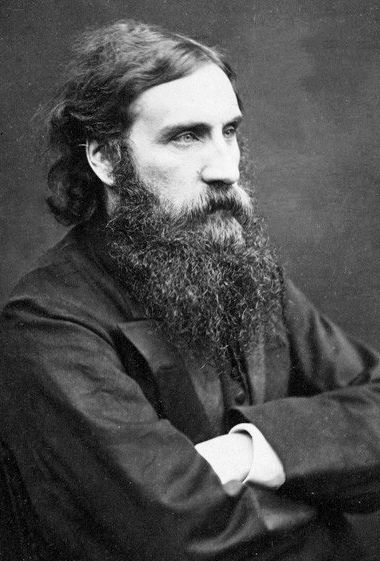
George MacDonald is a key figure in the development of modern fantasy. A friend of Lewis Carroll (whose Alice in Wonderland he read to his children in manuscript, and encouraged the Reverend Dodgson to publish), and an influence on the Inklings (C S Lewis first read Phantastes in 1916 and went on to champion MacDonald’s writings; Tolkien’s Smith of Wootton Major was the result of his trying, and failing, to write an introduction to MacDonald’s The Golden Key). As well as fairy tales for children, realistic novels, sermons, etc., MacDonald wrote two “faerie romances” for adults, one at the start of his career (Phantastes, in 1858) and one near the end (Lilith, in 1895) — though one of his most famous statements, in the essay “The Fantastic Imagination”, makes it clear he made no real distinction about age:

For my part, I do not write for children, but for the childlike, whether of five, or fifty, or seventy-five.

MacDonald’s approach to fantasy owed a lot to the German Romantics (of whose Märchen, or literary fairy tales, de la Motte Fouqué’s Undine was his favourite), in believing that the imagination, just like the landscape was to so many Romantic artists and poets, was not just a frivolous indulgence, but a realm in which serious spiritual truths could be revealed, for, he believed:

The imagination of man is made in the image of the imagination of God.

And it’s this idea, perhaps, that most attracted Lewis and Tolkien (whose idea of “secondary creation” seems closely related), but also, I think, it’s this sort of moral seriousness that influenced David Lindsay, another reader of MacDonald. At his best (but not always), MacDonald managed to be serious in meaning without having to underline any explicit moral. As he says in “The Fantastic Imagination”:

The best thing you can do for your fellow, next to rousing his conscience, is—not to give him things to think about, but to wake things up that are in him; or say, to make him think things for himself.

Phantastes cover by Gervasio Gallardo, for the Ballantine Adult Fantasy series

The protagonist of Phantastes (and I haven’t found a really good explanation of the title’s meaning, nor how it’s pronounced) is Anodos, whose name means either “pathless” or “upward path” in Ancient Greek (and as he at one point in his adventures hears tittering fairies saying “Look at him! Look at him! He has begun a story without a beginning, and it will never have any end. He! he! he! Look at him!”, it’s at least the former, but most likely both). On his 21st birthday, given the keys to his dead father’s escritoire, he finds a secret compartment that holds a tiny fairy, who grows to full size and tells him he’ll be journeying to Fairy Land tomorrow. The next day, he wakes to find his bedroom half-transformed into a fairy landscape, with a stream pouring from his wash-stand and grass in place of a carpet.

What follows is more a series of episodes than a single narrative, though there is a general movement towards some sort of a moral education on Anodos’s part (this is a coming-of-age story, after all). First, there’s some slapstick with tiny flower fairies, which might come straight out of an early Disney film, but afterwards there’s horror, as Anodos is pursed through the wood by some sort of shadowy walking tree. He’s saved from that by another tree, or tree-woman, who warns him to “shun the Ash and the Alder; for the Ash is an ogre,—you will know him by his thick fingers; and the Alder will smother you with her web of hair”. Later, he finds a woman encased in alabaster, though she runs away when he frees her, and when later still he thinks he’s found her again, it proves to be the deceptive Alder, who looks beautiful from the front, but behind is “hollow, as if made of decaying bark torn from a tree”. After this, he acquires a living shadow, which casts a disillusioning, cynicising darkness on everything it passes over. He finds temporary release in a Fairy Palace, which seems to represent the world of art, both as escape (Anodos spends time sampling other, very real-seeming worlds through the palace’s library) and redemption (he finds, again, his alabaster woman, shrouded by his shadow, and realises he can free her by singing).
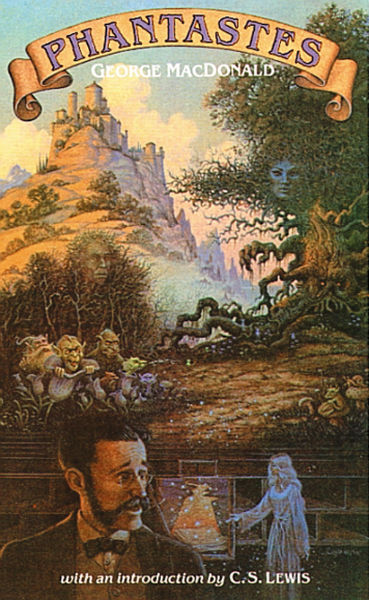
Cover by Jim Lamb for 1981 Eerdmans edition

The story seems to consist of a constant shuttling between states of darkness (entrapment by the Alder, disillusionment by the shadow) and visions of light or beauty (the alabaster woman, the fairy palace), with Anodos coming to learn of his own powers as a poet (his singing), while also being genuinely disillusioned that he might be some sort of knightly hero. He finally accepts this and becomes the squire to a genuine knight, but in the end finds a capability that this knight, because of his purity, lacks: having been corrupted by his contact with evil, Anodos is better at spotting it, and when the knight is taken in by the apparent holiness of a church that is actually sacrificing its young worshippers, Anodos realises it is evil, and fights against it. (Something that can’t help making me think of MacDonald’s own background. He was, initially, a minister, but couldn’t bring himself to preach the Calvinist idea that only a predestined elect would go to Heaven. His wages were cut in half, and he soon gave up on a church career.)

MacDonald’s primary motive in Phantastes seems more to have been following the whims of his imagination, and exploring this faerie realm to see what it could teach him (and his readers). He wrote the book in part under the patronage of Lady Byron (mother to Ada Lovelace, and a mathematician in her own right), and although Phantastes was not a critical or popular success when it came out, it did earn him some recognition, and led to a lifelong career as a writer.

John Bell illustration from an 1894 edition

To me, Phantastes is one of the founding texts of modern fantasy, standing in the same relation to the genre as The Turn of the Screw, The Picture of Dorian Gray, Dracula, and Jekyll and Hyde do to modern horror. Like them, it has the feel of illustrating the findings of twentieth century psychology a good half century before they were discovered. The difference with Phantastes, though, is that its story is too messy for it to make the same impact as those seminal horror novels and stories. With Phantastes, the fundamental story of psychological growth reads almost in pure Jungian terms — Anodos is drawn on by his quest for the anima-like “Alabaster woman”, who has, like the seed of his own psyche, “the face that had been born with me in my soul”, while fleeing his Jungian shadow, which at one point is literally his shadow — but that story has to be sought amidst a welter of wonders, side-stories, and diversions. In story terms, Phantastes resembles the tangled, sometimes-treacherous fairy wood Anodos himself tramps through, and it feels as though the story is something that emerged from those tangles as MacDonald went along, rather than something he told intentionally.

MacDonald, like Jung, had faith in the imagination as a self-healing realm of inner meaning. As he says in his long essay, “The Imagination, its Functions and its Culture”:

If the dark portion of our own being were the origin of our imaginations, we might well fear the apparition of such monsters as would be generated in the sickness of a decay which could never feel—only declare—a slow return towards primeval chaos. But… a wise imagination, which is the presence of the spirit of God, is the best guide that man or woman can have… For the end of imagination is harmony. A right imagination, being the reflex of the creation, will fall in with the divine order of things as the highest form of its own operation…

And it’s his taking the imagination seriously that makes him so important as a fantasist in the modern tradition, and lifted him above the twee, imitative fairy tales of his day. Phantastes might read more like an experiment in imagination than a polished masterpiece, but it is nevertheless a significant work.

^TOP

Dragonsbane by Barbara Hambly

Peering at the blurry bookshelves behind me in a photo taken after I came back from Conspiracy 87 (my one and only Worldcon), I was reminded of a book I bought at the time (largely because of its Michael Whelan cover), and never got round to finishing. So, I thought I’d seek it out secondhand and give it another go.

Dragonsbane (1986) was issued in the UK by Tolkien’s publishers Unwin, via their Unicorn fantasy imprint. Unicorn was around from 1982 to 1988, reprinting some of the genre’s classics (Lord Dunsany and James Branch Cabell), and publishing originals from established and new writers, including Louise Cooper, M John Harrison, Colin Greenland and Geoff Ryman. Unusually, it seems to have been strictly fantasy, with no SF or horror, which perhaps says something about fantasy’s popularity in the mid 80s, or at least Unwin’s faith in it.

cover art by Michael Whelan

The novel starts with Gareth of Magloshaldon journeying to the northern Winterlands, to summon Lord John Aversin to the King’s court in the south. John is the only living man to bear the title Dragonsbane, for having killed the Golden Dragon of Wyr, albeit many years ago. Now another dragon is wreaking havoc in the south, and every knight the King has sent to deal with it has been killed. But Gareth, an unworldly young man and a scholar of the heavily-romanticised ballads of dragon-slayings past, is appalled to find this Dragonsbane knee-deep in mud, discussing the care of pigs with a commoner. He’s even more appalled to learn that John didn’t walk boldly up to the dragon and lop off its head, but first stuck it with as many poisoned javelins as he could, to even the odds. But John agrees to come south, not because he relishes facing another dragon, but in the hope he can remind the King of his northern subjects, who need their liege’s help seeing off the increasingly damaging waves of seasonal sea-raiders.

Another thing that appals Gareth is the presence of Jenny Waynest, a witch and the mother of John’s children. These children are cared for by John’s aunt, because, in this world, being a witch, wizard, or sorcerer means living a life dedicated to working with, furthering, and understanding one’s magical power. “To be a mage you must be a mage,” Jenny was told by her old teacher, Caerdinn. “Magic is the only key to magic.” There’s no room for human relations and family. Jenny loves her children, and though she visits them, and John, when she can, she knows she can’t give herself to them fully whilst serving the thing that, like it or not, is most precious to her — her own magical abilities.

art by Walter Velez, from isfdb.org

Gareth’s reaction to her, though, is evidently based on more than social disapproval. And as Jenny accompanies the two men south (she played a key, though unsung, role in the slaying of the dragon, so John’s going to need her), she learns of Zyerne, the King’s beautiful young mistress — a mistress who, like Jenny, is also a witch. But, it turns out, she’s a witch of immense power. She can, it seems, shape-change casually, for her own and others’ amusement, even though shape-changing is something that ought to take a lot out of even the most powerful sorcerer or sorceress. As she heads to the court of the King in the south, Jenny prepares to meet with someone who is all that she isn’t, and seemingly never can be — young, beautiful, and immensely powerful.

And, it turns out, there’s more than just a dragon to deal with in the south. Not only is there Zyerne’s manipulation of the King and his courtiers, but the King’s cousin, after an apparent throne-grab, is now holed up in the besieged city of Halnath; meanwhile, the wealthy gnomes, ousted from their home in the Deep of Ylferdun (where the dragon has made its lair), are subject to racist attacks in a land where the gap between the common folk and their indifferent, wealthy rulers is widening daily. Insert your own modern-day parallels here.

With its early emphasis on the difference between Gareth’s romantic expectations and the messy, muddy reality, Dragonsbane is one of those books that seeks to bring a bit of realism to the genre. (And I’d say fantasy needs constant balancing on both sides, with doses of gritty realism, but also of wondrous magic, and this book has some of the latter, too.) This air of realism, and the fact the book starts with a retired hero from the wintery north being summoned to the decadent court of the king in the south, reminded me somewhat of Game of Thrones.

Also like Game of Thrones, Dragonsbane is about power. Though Jenny manages to stave off jealousy of Zyerne (largely because she realises what a dark-souled creature Zyerne is beneath all her beauty, youth, and magical ability), she finds herself facing a different sort of temptation, when her own magical powers receive an unexpected boost. Suddenly, Jenny must make the decision between becoming what her newly-grown power would make her into, or of deliberately turning her back on her teacher’s maxims, and not dedicating her life only to studying her own magical ability. “All power must be paid for,” is another rule in this world, and if you don’t pay with hard work and dedication, the price will, it seems, be extracted from your soul, and all that makes you human.

I was glad I gave Dragonsbane a second go. I can see, I think, what put the fifteen-year-old me off, back then. Hambly writes some wonderfully poetic descriptions — she’s particularly keen on the effects of light, be it moonlight glinting off a dragon’s scales, or a landscape bathed by a dawning sun — and these perhaps slowed down the action a bit too much for the reader I was at the time. Now, I can appreciate them more.

It was, when it came out, a standalone novel, and though Hambly has since written more books with the same characters, it can still be read on its own, and I’m glad I finally did.

^TOP

Camelot 3000

Camelot 3000 issue 1, art by Brian Bolland

I remember this series feeling really special when it came out in the early 1980s. But it was meant to feel special. Camelot 3000 was DC Comics’ first “maxi-series”, a 12-issue story printed on higher-than-normal quality “Baxter” paper (which also resulted in stronger colours, I seem to recall), intended to be sold solely through specialist comic shops. This last point meant it wasn’t subject to the Comics Code Authority’s stamp of approval, so could contain, as writer Mike W Barr says in his introduction to the Deluxe Edition, “a transsexual knight, lesbianism, incest and various other Code-breaking plot points” — though nothing as graphic as that might make it sound to modern ears.

It’s set in a technologically advanced future which has recovered from nuclear war to, somehow, return to pretty much the 1980s’ version of world political power-balance, with a communist China and Russia in uneasy relations with a caricature cowboy President of the USA, and a psychopath dictator in charge of the African country of Rakmaburg. Aliens from the tenth planet are invading Earth, and have taken over England, while the rest of the world struggles to work out what to do. Tom Prentice, an archaeological student working at Glastonbury, accidentally reawakens the Once and Future King whilst fleeing aliens, and Arthur immediately grasps the situation: England, and the world, need him once more.

His first step is to free a grumpy Merlin (the series’ best character) from Stonehenge, then recover Excalibur (whose lake resting place is currently inside a nuclear power plant). Merlin then awakens six of Arthur’s knights from their current reincarnations: Sir Lancelot is Jules Futrelle, the world’s richest man (who has a handy castle-like home in orbit round Earth, all ready to become this future’s new Camelot); Guinevere is Commander Joan Acton, head of the Earth’s defence forces; Sir Kay is a minor criminal; Sir Galahad a dishonoured samurai; Sir Gawain a black South African family man; Sir Tristan, meanwhile, has been reincarnated as a woman, Amber March, and is awakened to her/his true identity just before she’s about to be married; finally, Sir Percival is reawakened the moment before he’s turned into a “Neo-Man”, a super-strong, near-invincible dumb giant, used by this future’s governments for law enforcement, created from criminals as a punishment for their crimes.

When it’s revealed, later in the series, that one of the crimes that can get you turned into a Neo-Man is “dissent”, it underlines how generic this book’s vision of the year 3000 is. It’s presented as a future version of the 1980s, but it’s also post-nuclear, technologically advanced, and overpopulated, and it’s also, evidently, from this need to punish “dissenters”, dystopian, though it’s never made clear how or why it is dystopian, aside from the selfishness of its leaders. The future, in Camelot 3000, has laser guns and flying cars, a hint of dystopia, a hint of post-nuclear holocaust, a hint of looming population crisis, a hint of satire, as well as a lack of the sort of technology that would actually help the characters (Tom Prentice’s laser burns can only be healed by the Holy Grail, Sir Tristan’s desire to be turned into a man can only be achieved through sorcery, not surgery). All in all, this future feels a little bit like the sort you’d find in 2000A.D., though more Mega-City Lite than the full Dredd.

The setting, though, isn’t the point. This generic future is there to be a background against which we see a sword-wielding King Arthur and his reincarnated knights fight insectoid aliens and a vengeful Morgan Le Fay. One of the things I remember liking most about the series was the knights’ individual struggles between their current incarnations and their mythic “real” identities. (In this way it could be said to tie in, though very lightly, with Alan Garner’s The Owl Service.) Writer Mike W Barr updates some aspects of the original Arthurian myths with modern, or futuristic, equivalents. For instance, Tristan and Isolde’s love in the original is frustrated by the fact that Isolde is promised to another man and Tristan has been charged on his knightly honour to bring her to him; in Camelot 3000 that frustration comes from Tristan’s being a woman. (And many modern reviews pat the series condescendingly on the head in a “nice try” manner for addressing such outside-the-gender-norm issues without today’s nuances, but I remember this being a really surprising and original-feeling plotline at the time.) Meanwhile, Sir Percival was, in the original myths, the most perfect and innocent of Arthur’s knights; in Camelot 3000, he’s perfect and innocent because he’s been turned into a dumb, giant Neo-Man.

Some things, though, don’t change, and everyone has a doomed acceptance of the inevitable adultery between Lancelot and Guinevere, though it nearly tears New Camelot apart before it can face the alien threat. But ultimately, Camelot 3000 isn’t about the constrictive patterns of myth (as with The Owl Service), it’s about King Arthur and his knights being a symbol of hope in a future very much in need of it. So, the reliving of past mistakes provides interesting storylines, but ultimately the series is about our heroes’ triumphs despite their flaws, not the dark undertow of a bleak mythic destiny.

Camelot 3000 was intended to come out monthly, and did, for the first nine issues, after which it slowed down. In his introduction, Mike Barr says he warned DC they should stockpile issues before launching the series, knowing penciller Brian Bolland wouldn’t be able to stick to a monthly schedule, but they ignored him. As a result, although the first issue came out in December 1982, the last (with almost a year between it and issue 11) came out in April 1985.

It’s a fun series, feeling a little 2000AD-ish in places with its touches of anarchic satire, but no way near as dark as 1980s comics would become. Brian Bolland’s art remains one of the main selling points, though he’s not inking his own work, and it looks a little cruder than we tend to get from him now (particularly in the last issue, making me wonder if it was perhaps a little squeezed in between other projects). And I like the idea of how King Arthur’s return is handled. According to Barr, this was the first story to address the actual return of the Once and Future King — though Merlin pops up all the time in 1970s and 1980s UK kids’ TV; and one series at least, Raven (1977), is about a reincarnation of King Arthur, though not of the swords-versus-aliens type.

^TOP
