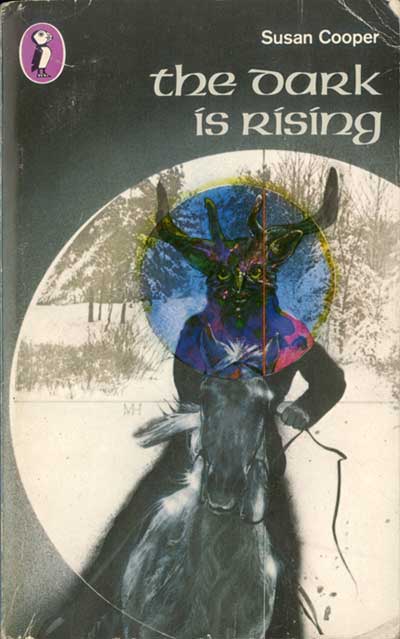
Stag Boy by William Rayner

Stag Boy, cover art by Michael Heslop

Stag-men of various sorts have been popping up on this site from time to time, from the antler-wearing shaman of Robin of Sherwood, to Herne the Hunter in Susan Cooper’s The Dark is Rising, or the bothersome creature of imagination and sexuality that intrudes upon the narrator’s life in Patricia McKillip’s Stepping Out of the Shadows. In William Rayner’s Stag Boy (first published in 1972), fifteen-year-old Jim Hooper returns to the farm he grew up in to convalesce after life in nearby Wolverhampton begins to affect his health. There, he finds his childhood friend Mary Rawle being courted by Edward Blake, two years older, richer, and far more worldly than Jim, as well as being ‘tall and strongly made, a good rugger player and a first-rate horseman.’ Jim can’t help but feel trapped by the boy-ness of his own adolescent body:

‘Then he looked down at his whitening knuckles, the narrowness of his wrists, and felt a choking anger at being shut up in such a poor thing of a body. He was overtaken by a longing so enormous it shook him physically… His spirit, if it could only get free, he felt sure would be as strong and wild as a hawk.’

An idle wish made in a ruined witch’s cottage leads him to find an ancient, stag-horned helmet which, when worn, allows Jim to share in the life of the ‘black stag’ — a creature of local repute, and the prize target of the hunt (to which both Mary Rawle and Edward Blake belong). While he’s one with the stag, Jim can lend it his intelligence, meaning it can out-think the hunt instead of just trying to out-run them; and being with the stag plugs Jim into the natural power and dignity of this king-animal’s physicality, which rubs off on him as his own body starts to mature and he gains in confidence.

At first, Mary’s not interested in Jim. To her, he’s part of the past, a relic of her childhood and of the closed-in, dead-end world of ‘the moor and the woods’. Edward makes her feel grown-up, and seems like the gateway to the adult life she’s always dreamed of living, one of:

‘parties and dances… famous people, amusing people, rich people, and something new and exciting would happen every day.’

But Jim brings the black stag to stand outside her window at night, tempting her to touch it, even ride it. At first she resists:

‘I don’t want strange things in my life… I don’t want my life to be different… It’s like stepping out of a lighted room into the dark.’

‘How much more comfortable it was when you had the right dreams, the ones that people understood and sympathised with.’ But she can’t ignore the wonder of a stag of such power and dignity and gentleness that lets her ride it, or Jim’s uncanny connection with it. At this point, Jim and Mary’s relationship becomes a world of its own, a secret that binds the two of them, and goes beyond her dreams of ‘parties and dances’ to something that mixes physicality and vulnerability, intimacy and meaning:

‘They were timid, too much aware of other people’s opinions and of their own youth and ignorance. Only in their wordless journeys through the dark did all worries and embarrassment fall away, leaving them free and happy, and innocent.’

But the stag’s animal nature threatens to unbalance Jim. That strength and nobility can veer into arrogance and an animal sexuality Jim has to fight to control. And now it’s the stag that calls Jim when it needs him, not the other way round, and its need is desperate. The hunt, fed up of hearing about this ‘proud, mettlesome, outrageous beast’ parading itself openly through populated towns, bringing traffic to a standstill and running rings round them whenever they chase it, is intent on bagging this creature before the season’s over. And what will happen if Jim is joined to it when it’s killed?

Part of the strength of this short YA novel comes from how naked the central metaphor is. Contact with the stag connects Jim with his own burgeoning masculinity (it’s significant that his father is dead) and adolescent sexuality. It teaches him the natural confidence and strength he ought to feel, but can also at times be a wild ride with forces that will not be tamed, or contained, or made civilised. Jim has to learn how to set the limit, how to be fully human not merely an animal, before he’s overtaken.

Although William Rayner’s sympathies are obviously with the black stag in its conflict with the hunt, by the end of the book, when it’s obvious Jim has to separate himself from the influence of the stag, the hunt takes its place as part of the natural order of things, particularly when contrasted to what Rayner sees as even more degenerate ways of taming nature. The hunt is ‘the ritual that should attend [the stag’s] death’, as it means death with dignity, and this is contrasted with the artificial, constricted life of battery hens and, beyond that, human lives in cities with their:

‘…endless mazes of streets, the houses like cages, that world of hutches and batteries and stunted lives.’

‘To deny nature — that was the worst sin, the sin against life’ — but, in the end, to live as a human being, Jim must civilise the more powerful natural impulses. A balance has to be found against the force of male adolescence, and so of course it’s Mary, finally, who redeems him, despite being told ‘This is not a thing for women.’

The Wild Hunt of Hagworthy by Penelope Lively, cover by Yvonne Gilber

Like The Wild Hunt of Hagworthy and The Owl Service, Stag Boy is another YA novel from the 60s and early 70s that explores the clash between modernity and tradition, nature and civility, by having normal, vulnerable teenagers trying to adjust to themselves and their burgeoning adolescence, while facing forces of folklore, myth, and the supernatural. And it’s a good mix.

I can’t find out much about William Rayner, other than that he was born in 1929. Stag Boy came out in hardback (in 1972) and paperback (1976), both with the same cover by Mike Heslop (who also did my favourite cover for The Dark is Rising). And, if you’re looking at that cover and thinking, ‘Isn’t that…?’, well, the answer is yes, it is. Heslop used a photo of David Bowie as a reference. (One more influence by Bowie on 1970s YA.)

^TOP

Astercote, The Whispering Knights, The Wild Hunt of Hagworthy by Penelope Lively

Astercote by Penelope Lively, cover by Neil Reed

Astercote by Penelope Lively, cover by Neil Reed

In Astercote (1970), when a chalice known only as ‘the Thing’, which is supposed to have protected the village of Charlton Underwood from the Black Death in medieval times, goes missing, the modern-day villagers begin to cut themselves off from the outside, and chalk white crosses — indicators of infection — on houses where people are showing the slightest sign of being unwell. In The Whispering Knights (1971), three children, bored in their school holidays, boil up a witches’ brew (or the closest they can get to it — ordering frogs’ legs from a London shop, for instance, but having to use drawings for some of the more hard-to-obtain ingredients, like the wing of a bat) in a barn supposedly once inhabited by a real witch, and manage to bring themselves and their village to the attention of an increasingly baleful supernatural presence. In The Wild Hunt of Hagworthy (also 1971), a new vicar (‘Frightfully nice man — full of ideas’) decides to revive the quaint old Horn Dance of Hagworthy as part of a fête to raise money for the church roof. But the Dance is linked with the far more ancient and powerful Wild Hunt, which isn’t something any of the village oldsters want to see revived.

The Whispering Knights by Penelope Lively, cover by Neil Reed

The Whispering Knights by Penelope Lively, cover by Neil Reed

Penelope Lively’s first three books for young teens are characteristic of a type of British YA fiction in the late 60s and early 70s (as well as the TV shows of the time, like Children of the Stones, or The Changes), mixing Famous Five-ish ‘what we did on our holidays’ adventure with touches of 1960s kitchen sink realism and incursions of the folkloristic supernatural. The Whispering Knights is the most Famous Five-ish, with the characters feeling a little light and cartoonish, and the adventures being mostly episodic. (It’s also the most explicitly supernatural of the three.) The Wild Hunt of Hagworthy, on the other hand, has the most realistic development of its two lead characters, with the slightly withdrawn Lucy Clough and the rebellious Kester Lang both feeling like proper teenagers. And, in both The Wild Hunt and Astercote, the supernatural is more a psychological force than an external one, working through people’s superstitions and prejudices more than through actual manifestation. (Though manifestations do occur.)

At the heart of each book is an abuse of something traditional and sacred, something tied to the village as a continuing way of life, but also to the dark, dangerous forces of superstition and the supernatural. This means there’s an odd tension in each story, with the sacred thing — be it an object, such as the chalice in Astercote, or a practice, like the Horn Dance in The Wild Hunt — needing at once to be preserved, and to be hidden away or suppressed; protected for the village, and from the villagers.

The Wild Hunt of Hagworthy by Penelope Lively, cover by Yvonne Gilber

The Wild Hunt of Hagworthy by Penelope Lively, cover by Yvonne Gilbert

In both Astercote and The Wild Hunt, the sacred thing is abused for financial reward (even if, in one case, it’s for the repair of a church roof). In The Whispering Knights, it’s the children’s playing at witchcraft that feels like an abuse, even though it isn’t done for gain; afterwards, with the witch Morgan on the loose, it’s village life itself that comes under threat, when the newly-embodied witch marries a local factory owner, and gets a proposed motorway’s route altered to take it straight through the centre of the village. At first, the children who summon Morgan are told that she thrives on superstition, and that their best weapon against her is reason; later, it’s their very belief in her — that she represents a supernatural threat, rather than just a physical one — that means they can combat her in the proper way, and so save their village.

If there is a right way to deal with the sacred in these three books, it seems to be to revere the idea of it, while keeping the reality hidden away. This is most obvious in the attitude of Kester Lang’s uncle, the blacksmith of Hagworthy, towards the Wild Hunt. On the one hand, he says:

‘It were a great thing, once, the Hunt. Nothing to be afraid of. It were a splendid thing…’

But, at the same time, it was ‘not for a man to look on with his eyes’:

‘Because once you seen them you’re a part of them, aren’t you, girl? You’re with them under the same sky and treading the same ground. And they’re a Hunt, aren’t they? They have to hunt something, or someone, don’t they?’

This ambivalence may explain what I found to be the main fault of the first two books (and present in the third, but not as a fault), in that, in each case, once it was obvious, quite early on, what the problem was — a missing chalice, a summoned witch — the teen protagonists don’t really do anything, but sit around watching events unfold, and only right near the end suddenly clock that some action needs to be taken. The Wild Hunt has a similar delay, but in this case the time when nothing happens is used to build tension and deepen the characters’ relationships. Perhaps it’s significant that in this book the building supernatural tension causes a split between the two main characters, Lucy and Kester, and they have to heal that rift before they can act, together, against the supernatural.

Red Shift by Alan GarnerThis idea of a threatened sacred ‘thing’ (chalice, village life, dance) reminds me of the similar ‘sacred thing’ in Alan Garner’s novels — usually a nonsensically-named, apparently worthless but in fact deeply important object which comes to stand for a precious relationship, or a person’s identity, or the sacredness of the landscape itself — but in these three of Lively’s YA books, this ambivalence, this need to treat the sacred as both easily endangered and supernaturally dangerous, adds an interesting layer of complexity, even if it isn’t explored as deeply as in Garner’s novels.

The teens in these late-60s/early-70s ‘folk-fantasy’ style YA books are liminal creatures, existing on the border between the past and the future, tradition and progress, rational knowledge and irrational imagination, just as they’re hovering on the verge of adulthood. They listen to the old folks’ superstitions and take them seriously; they believe in the strange things they themselves see and hear; but they also believe these things can be changed, challenged, and faced, which (usually) the overly superstitious old folks don’t.

There’s a real feeling in these books (both Lively’s and others of the time) of being at an important cultural crossroads, with the possibility of genuinely sacred things being put at risk from a galloping, money-minded modernity, severing life from the quiet meaningfulness symbolised by village life, while also needing to take a properly rationalistic attitude towards the prejudices and superstitions of the past. It’s not, in any of these books, a clear-cut choice, and all of them end with a feeling of real peril as the forces of the irrational are let loose in a series of wild hunts (be they motorbike gangs, ancient witches in modern limousines, or stag-antlered faerie men with green-flame-eyed dogs) across stormy but beautifully-described landscapes.

To me, there’s something haunting about that cultural crossroads. Is it just nostalgia on my part? Or was there something genuinely sacred — some idea or ideal — which was lost in a battle with modernity midway through the 1970s?

(I was prompted to read these three novels after listening to The Heartwood Institute’s two albums inspired by them, both available at Bandcamp, The Wild Hunt of Hagworthy, and Astercote.)

^TOP

The Worm Ouroboros by E R Eddison

cover to the 1991 Dell edition, by Tim Hildebrandt

cover to the 1991 Dell edition, by Tim Hildebrandt

It’s hard to think of E R Eddison’s The Worm Ouroboros as being published in 1922. How can any character — and the most heroic of the novel’s heroes, no less — say, with such regret, so close to the end of the horrors of the First World War, ‘we, that fought but for fighting’s sake, have in the end fought so well we never may fight more’? But, when you consider the elements that make up this mercurial novel, it can, perhaps, be understood as a response to the First World War, though not, for instance, in the same way as T S Eliot’s The Waste Land (also published in 1922). The Waste Land tried to capture a world shattered into meaningless fragments; The Worm can be seen as trying to contain all the things that made the world into a meaningful whole before the war — at least, the things that made it a meaningful whole for Eddison — in an act of what Tolkien thought of as the key function of fantasy: Recovery.

Tolkien called Eddison ‘the greatest and most convincing writer of “invented worlds”’, but criticised him for his ‘slipshod nomenclature’. In contrast, Rider Haggard, writing to Eddison to thank him for a copy of The Worm, said, ‘What a wonderful talent you have for the invention of names.’ And Eddison surely can out-Dunsany Lord Dunsany in the coining of lyrical, evocative, fantastical names: Zajë Zaculo, Jalcanaius Fostus, the Salapanta Hills, Krothering, Fax Fay Faz, Melikaphkaz, Queen Sophonisba, as well as a very homely clutch of English-sounding place-names such as Owlswick, Lychness, Elmerstead, and Throwater, all found in Demonland. And it is, no doubt, that ‘Demonland’ that Tolkien found so grating, along with the other names Eddison chose for his peoples: the Witches, the Imps, the Goblins, the Pixies.

Cover to Laura Miller's The Magician's BookUnlike Tolkien, who grew his secondary world from a single seed (his invented languages), in The Worm Eddison used something closer to C S Lewis’s omnigatherum approach to world-building, where every fragment of myth, folklore, fairy tale and daydream Lewis liked was thrown into the Narnian cauldron without any particular care for consistency, driven by what Laura Miller, in The Magician’s Book, termed so wonderfully ‘readerly desire’. Eddison did the same, mixing the characters that populated his boyhood stories (and illustrations) with an adult enthusiasm for Homer, Norse saga, and Jacobean tragedy.

If The Worm Ouroboros has a flaw, for me, it’s that some of these elements don’t quite mix. The heroes, the lords of Demonland, are action heroes, straight out of boyhood daydreams. They’re defined entirely by what they’re up against: by the fiercely-contested battles they fight, by the impossible mountains they climb, by the terrifying monsters they face, and, most of all, by the dastardliness of their enemies.

The_Worm_Ouroboros_book_coverBut their enemies, the Witches, are of a different order. They aren’t characters from boyhood daydreams, but from Jacobean tragedy. Selfish, cruel, envious, mocking, deceptive, cunning, and destructive they may be, but at least they have the passions, lusts, angers and jealousies that drive them to such nefarious plots, counterplots, and dastardlinesses. The Demons are undeniably the heroes of The Worm Ouroboros, being the most admirable in the actions they perform, but after a while their company can get a bit boring. Not because they lack for wonders to witness or heroic deeds to accomplish, but because that’s all they do — witness wonders and accomplish heroic deeds — things even Lord Dunsany, in a story such as ‘The Fortress Unvanquishable, Save for Sacnoth’, can spin out for only so long. The Witches — well, put them alone together in one room, and they’ll soon play out countless dramas, before killing one another in the cruellest ways. The Demons are heroic but one-dimensional; the Witches are unheroic, unadmirable, but at least interesting.

The Conjuring in the Iron Tower, illustration by Keith Henderson

Although the two sides clash many times on the battlefield, the real collision point for this oil-and-water mix is, I think, when the Demons, having broken into the Witchland stronghold of Carcë, find only Queen Prezmyra left alive. The ever-honourable Demons assure her she’ll be treated honourably and restored to queenhood in her native land, but she throws their words back at them. Everyone who ever mattered to her has just been killed. The Demons express regret, but you can’t help feeling they don’t actually know what regret is. There’s a feeling of a boy’s game gone horribly wrong. Then Prezmyra joins her loved ones, and it’s all forgotten.

There is, though, a hint of the The Waste Land in The Worm. When Lord Juss climbs the immense mountain Zora Rach Nam Psarrion (a ‘mountain of affliction and despair’), to the citadel of brass where his brother Goldry Bluzsco is held, he glimpses something of Eliot’s existential — and Lovecraft’s cosmic — dread, feeling ‘a death-like horror as of the houseless loneliness of naked space, which gripped him at the heart.’ When he finds his brother apparently lifeless, the despair deepens:

‘…it was as if the bottom of the world were opened and truth laid bare: the ultimate Nothing… He bowed his head as if to avoid a blow, so plain he seemed to hear somewhat within him crying with a high voice and loud, “Thou art nothing. And all thy desires and memories and loves and dreams, nothing. The little dead earth-louse were of greater avail than thou, were it not nothing as thou art nothing. For all is nothing: earth and sky and sea and they that dwell therein. Nor shall this illusion comfort thee, if it might, that when thou art abolished these things shall endure for a season, stars and months return, and men grow old and die, and new men and women live and love and die and be forgotten. For what is it to thee, that shalt be as a blown-out flame? And all things in earth and heaven, and things past and things for to come, and life and death, and the mere elements of space and time, of being and not being, all shall be nothing unto thee; because thou shalt be nothing, for ever.”

Yet, a moment later the despair begins to lift:

‘In this black mood of horror he abode for awhile, until a sound of weeping and wailing made him raise his head, and he beheld a company of mourners walking one behind another about the brazen floor, all cloaked in funeral black, mourning the death of Lord Goldry Bluszco. And they rehearsed his glorious deeds and praised his beauty and prowess and goodliness and strength: soft women’s voices lamenting, so that the Lord Juss’s soul seemed as he listened to arise again out of annihilation’s Waste, and his heart grew soft again, even unto tears.’

So, it’s a story that brings Juss back from despair, the story of Goldry Bluzsco’s heroic deeds. And perhaps this is what Eddison, too, was doing after the ‘mountain of affliction and despair’ that was the First World War — telling a story of heroic deeds, and using it to luxuriate in a cultured, poetic language, and in oodles of bejewelled detail, as if to remind himself, and the entire waste-landed world, of what life was supposed to be about.

Worm_DelReyEddison’s version of what life’s supposed to be about, though, is a somewhat refined taste. His ideal was the heroic aristocrat, one whose great deeds defied death and despair through sheer vivacity, and who lived a life of fine things in luxurious surroundings. In Fantasy: The 100 Best Books, Moorcock & Cawthorn say, of Eddison, ‘Seldom has any author conveyed so convincingly the sheer joy of being consciously a hero’, but also point out that his heroes ‘are a fine, full-blooded crew with a truly aristocratic disregard for the wider social implications of their deeds.’ Hundreds die in massive battles and it doesn’t matter, but when Goldry Bluzsco is taken away, the world itself seems to weep.

Eddison’s Mercury is a fine reminder of what life is supposed to be about, yes, but only if you’re one of the heroes. However, this is a fantasy, so perhaps there’s room enough on Mercury for everyone to be a hero. That is, after all, how fantasy works.

^TOP