Steppenwolf by Hermann Hesse

steppenwolf_penguinHermann Hesse says in his 1961 Author’s Note to Steppenwolf (the book itself was first published in 1927), that this is the book of his that is ‘more often and more violently misunderstood than any other’, whose readers ‘perceived only half of what I intended’. And it’s easy to see why. A novel about the passage through the extremes of personal darkness to a renewed interest in life, it does the darkness so well, you can be inclined to think that’s all it’s about.

On a first reading, the thing that lingers most in the memory is the opening sections, where we’re introduced to Harry Haller, the middle-aged ‘Steppenwolf’ dragging himself through a weary, self-conflicted and exhausted life. A highly-cultured writer of independent means, he lives a transient existence, settling in boarding houses for a few months at a time, reading, walking, drinking, and wallowing in a constantly alternating self-disgust and a disgust with the modern world he lives in. Harry, we’re told, is ‘a genius of suffering’, seeing himself at times as a refined, poetic, cultured man, at others, a wild, dark-souled ‘wolf of the Steppes that had lost its way and strayed into the towns…’, constantly tearing at himself with his own too-sharp teeth:

‘For example, if Harry, as man, had a beautiful thought, felt a fine and noble emotion, or performed a so-called good act, then the wolf bared his teeth at him and laughed and showed him with bitter scorn how laughable this whole noble show was in the eyes of a beast…’

But then a little magic starts to seep into Harry’s life. Walking down a darkened street one night, he sees a door where there had not been one before, and above it a flickering neon sign:

MAGIC THEATRE
ENTRANCE NOT FOR EVERYBODY
FOR MADMEN ONLY!

Something in his weary soul stirs, but the door is locked, and when he returns to try it again, it has disappeared entirely. He finds a man with a sign-board apparently advertising the event (now an ‘ANARCHIST EVENING ENTERTAINMENT’), but in response to his queries, all he gets is a pamphlet. Entitled ‘TREATISE ON THE STEPPENWOLF’, this pamphlet lays bare Harry’s deepest recesses, itemising his beliefs, his poses and psychological defences, while lightly mocking them as the self-delusions of a man who only thinks he’s drunk life to the dregs.

Bantam books edition, 1969

Bantam books edition, 1969

Up to this point, Harry seems the archetypal Outsider (as Colin Wilson defined the type): a sort of unfulfilled genius unable to accept bourgeois life, or perhaps any human life, growling behind the bars of some societal cage he’s seeking to escape or destroy, whatever the cost. This is the version of Steppenwolf that appears in the song that brought me to the book in the first place, Robert Calvert’s brooding incantation on Hawkwind’s 1976 album, Astounding Sounds, Amazing Music: ‘a wolf-man who despises the strivings of common men’, ‘half in love with dark and despair’. (Hawkwind’s “Steppenwolf” is, along with Queen’s “Fairy Feller’s Masterstroke” and Jefferson Airplane’s “White Rabbit“, one of the few works inspired by a novel that equal it in power, in my opinion.)

But after this evocation of a dark, self-devouring and suicidal soul at utter odds with the world he lives in, there comes salvation, though it’s not an easy one. After deciding to end his life, but unwilling to actually go back to his lodgings and face the task, Harry lingers in a late-night tavern, where he’s taken in hand by someone who seems his exact opposite, Hermine, a young woman of the hedonistic flapper generation. She gets Harry to eat a little, and drink a little, then makes him promise to do whatever she tells him to do, as a cure for his desperation. And what is her key commandment? Harry Haller, the ageing set-in-his-ways Steppenwolf, has to learn to dance — and not just dance, but dance to a form of music he despises, the jazz-dances of the age: the fox-trot, the Boston, and the Tango.

steppenwolf_penguin2Of course, this is just a symbol for the real process Harry and his Steppenwolf alter-ego must undergo. Harry and the Steppenwolf fight because they despise each other, but they are one person. The only way to find peace is for Harry to overcome his disgust at the Steppenwolf’s more earthy appetites for drink, for women, for anger, for destruction, for life. He has to learn to be whole, however ‘uncultured’ or ‘unrefined’ that whole is. For Harry is a man with ‘a profusion of gifts and powers which had not achieved harmony’, ‘always recognising and affirming with one half of himself, in thought and act, what, with the other half he fought against and denied’, suffering ‘the unendurable tension between inability to live and inability to die’. But, as Hermine says:

‘You have always done the difficult and complicated things and the simple ones you haven’t even learned.’

(Or, as he’s later told: ‘You are willing to die, you coward, but not to live.’)

Steppenwolf is based on Hesse’s own spiritual crisis of the 1920s. Just like his hero, Hesse spoke out against the growing fascistic elements in his post-war homeland, and was both reviled and exiled by the German elite of the day. Hesse applied to C G Jung for help, and some of what happens to Harry can be read in Jungian terms. Hermine is his anima, an imaginative embodiment of all he aspires to, all he needs in order to grow and live. As she herself says:

‘Doesn’t your learning reveal to you that the reason why I please you and mean so much to you is because I am a kind of looking-glass for you, because there’s something in me that answers you and understands you.’

But also she’s his Jungian shadow, the symbol for all he has repressed, despised or disowned: ‘Why, you’re my opposite,’ he tells her. ‘You have all that I lack.’

Hermann Hesse, image from The Dutch National Archives, via Wikipedia.

Hermann Hesse, image from The Dutch National Archives, via Wikipedia.

If this is so, then the final section of the book, when Harry finally gains entrance to the Magic Theatre, could be Jung’s idea of ‘Active Imagination’, a sort of self-healing through indulging in vivid waking daydreams and fantasies. For Harry, the Magic Theatre is a corridor with an infinite number of doors, each of which leads to a whole new world, a whole new existence, but always one that seeks to explore some unfulfilled aspect of himself. In one, his loathing for modernity is allowed free range in a war between men and machines, where he perches in a tree and takes potshots at passing automobiles; in another, he’s taught to break his personality into a thousand fragments and play with them like chess pieces; in another, he sees, acted out, the utter degradation of his inner wolf by his civilised man-self — then its equally degrading reversal… Only through living every aspect of himself to its fullest potential, through giving every despised and belittled and forgotten and dismissed part its full value, can Harry achieve unity and new life. As Pablo, dance-band saxophonist and proprietor of this Magic Theatre, tells him:

‘You have often been sorely weary of your life. You were striving, were you not, for escape? You have a longing to forsake this world and its reality and to penetrate to a reality more native to you, to a world beyond time. Now I invite you to do so. You know, of course, where this other world lies hidden. It is the world of your own soul that you seek. Only within yourself exists that other reality for which you long. I can give you nothing that has not already its being within yourself. I can throw open to you no picture-gallery but your own soul…’

Steppenwolf is about a man breaking free of a lifetime self-locked in inner conflict. Harry Haller achieves this by stepping out of reality itself — or, at least, reality as he has come, through disenchanted, weary and cynical eyes, to see it — to something that is magical, dangerous, but also healing and re-humanising. And behind it he glimpses another reality — a world of the Immortals, those greats such as Mozart and Goethe whom Harry venerates, but a world which, he’s at first distressed to learn, is infused not with seriousness and poetry and lofty ideals, but with an all-encompassing, all-accepting laughter. Laughter and fantasy, then, are the cure for Hesse’s Steppenwolf:

‘…the laughter of the immortals. It was a laughter without an object. It was simply light and lucidity. It was that which is left over when a true man has passed through all the sufferings, vices, mistakes, passions and misunderstandings of men and got through to eternity…’

Max von Sydow in Steppenwolf

Steppenwolf was filmed in 1974, with Max von Sydow in the lead — a perfect piece of casting. It remains faithful to the book, though perhaps too faithful for anyone who hasn’t read it to understand what’s going on at the end, I can’t help feeling. But it has some inspired moments — visualising the ‘Treatise on the Steppenwolf’ as a sort of Terry Gilliam-esque animation, for instance, really works. But the then-cutting edge video effects that dominate the Magic Theatre sequences now seem so dated as to make the whole thing feel like a bad 80s pop video wed to a 70s euro-arthouse film, all driven by a 60s sensibility. (Plus some truly awful dubbing.) For madmen only, perhaps.

^TOP

The Night-Watchmen by Helen Cresswell

The Night-Watchmen by Helen Cresswell, illustration by Gareth Floyd

cover illustration by Gareth Floyd

Like Catherine Storr’s Marianne Dreams, The Night-Watchmen starts with its young protagonist, Henry, confined to bed after a month-long illness. But within pages he’s given the OK to get up for a few hours a day — a limit that’s promptly forgotten as he spends the rest of this short book tramping around town, at all hours, at one point even engaging in some heavy labour, helping dig a hole in the street. Unlike in Marianne Dreams, then, the illness isn’t an essential part of the plot, just an excuse to get young Henry on his own and out of school for a bit of adventure.

Pretty soon, he falls in with a pair of brothers, Josh and Caleb, who call themselves ‘Do-as-you-pleasers’ (i.e., tramps). Josh is writing a long, perhaps never-ending book on all the places they visit, while Caleb concentrates on rustling up gourmet-level meals three times a day. (For tramps, the two have a lot of possessions, including a gas stove, a portable hut, picks and shovels, a small library, and a good deal of cooking equipment, all carried about in a pair of wooden hand-carts.) There’s something else about the pair that’s different, though: they’re from ‘There’. ‘There’ is only defined as different from ‘Here’ (our world) by the fact that it can only be reached by the Night-Train: a steam locomotive that can appear on any rail-track as soon as it’s whistled for, though only, of course, at night. (It feels a bit like the Knight Bus from the Harry Potter books — a magical go-anywhere-in-next-to-no-time transport system.)

illustration by Gareth Floyd

Josh and Henry, illustration by Gareth Floyd

Henry spends as much time as possible with the pair, helping them dig a hole in an out-of-the-way street just so they can erect their workman’s hut:

‘You see, if we was to go putting up huts all over the place, there’d be questions asked. There’d be police and Authority on us before we’d so much as got the stove lit. But a hut with a hole, ah, that’s a different matter!’

The only trouble in Josh and Caleb’s lives is ‘Them’, the Greeneyes: human-like creatures who are trying to get to the tramps’ home-place of ‘There’, and need the Night-Train to do so. And to get the Night-Train, they need Josh and Caleb, so the two have to keep an eye out for these creatures. The one thing they’ve got on their side is the fact that the Greeneyes can’t see in daylight — night is their day, and light blinds them.

illustration by Gareth Floyd

illustration by Gareth Floyd

It’s a light book, almost all taken up with Henry getting to know the tramps and having a glimpse at their (mostly) carefree way of life. The fantasy and world-building are entirely done by suggestion: we don’t know anything more about ‘There’ than that it’s not ‘Here’, and the only thing we know about the Greeneyes is they’ve got green eyes and are the enemy. But it works. Henry has his little holiday from real life, his glimpse of something other than a untroubled child’s view of an otherwise comfortable and ordered life, one of those self-defining moments you feel, by the end, has set him up to be something other than a dull do-as-you’re-told-to, or a do-as-others-do.

Published in 1969, The Night-Watchmen was in the running for the Carnegie Medal, as was Cresswell’s 1967 book, The Piemakers, and her later Up the Pier (1971) and Bongleweed (1973). Cresswell has written scripts for TV, adapting her own novel, The Moondial, and Gillian Cross’s The Demon Headmaster. (The Night-Watchmen, I think, is more radio-play material.) It’s hard to imagine such a quietly-paced, gentle sort of adventure being published today, but I hope they are.

^TOP

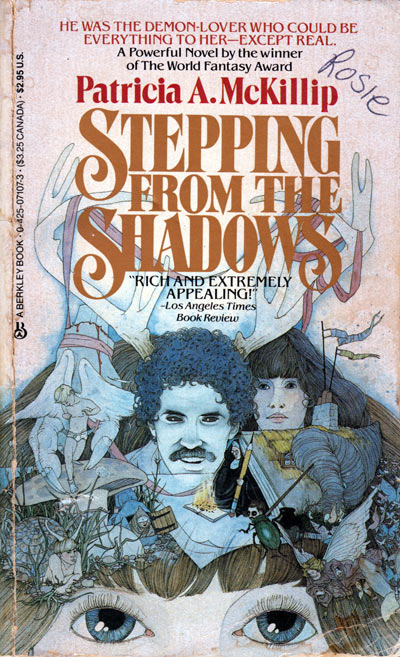
Stepping from the Shadows by Patricia McKillip

The Encyclopedia of Fantasy calls Stepping from the Shadows (published 1982) ‘an interesting naturalistic novel about the making of a fantasy writer’, which immediately piqued my interest. It is, then, a Bildungsroman — a novel about the formation of an individual. And, though it’s not a fantasy novel (certainly not in the sense that McKillip’s earlier books, like The Forgotten Beasts of Eld and The Riddle-Master of Hed trilogy), it’s very much about imagination, and not just idle daydreamery: its young narrator has a strong imaginative life, one that threatens, at times, to unbalance her.

The book starts with an interesting narrative approach that won me over immediately. The first person narrator (a young girl, seven years old in the first chapter) is constantly accompanied by ‘Frances’, a dreamy soul apt to be lost in stories, reveries and idle distractions, often at the most inconvenient times, like when Sister Thomas Augustine is asking her a question in class. It’s obvious Frances and the narrating ‘I’ are the same person, but one is the inner self, the dreamer, the storyteller, while the other, the narrating ‘I’, is the one who has to deal with the moment-by-moment realities of life. Frances is annoying but rewarding. It’s she who decides the cacti they pass on the way to primary school in this small America town are in fact the fingers of Hell-Giants, poking out of the ground; it’s she who provides the magic, imagination, and deeper meaning in the narrator’s life.

Each chapter is a leap forward in age. In chapter two, Frances-and-I are in Germany, and in chapter three they’re in England, following her military father’s various postings. The England chapter is my favourite, a wonderfully evoked autumn and winter in which Frances’s sensitive nature blooms into at first poetry, then full-blown imaginative vision, as a stag she sees transforms into something both magical and startlingly real, a man with antlers:

‘I wanted to cry or yell at Frances for waking something like that out of the past around us, putting it into my mind. Now that you’ve got him, I wanted to shout, what am I going to do with him? Most of all, I wanted to run. But I couldn’t take my eyes off him. After a while, I stopped wanting to run.’

As in Alan Garner and Susan Cooper’s books, the stag-horned man represents something deep and true coming from the primal realms of the imagination — but also something troubling and potentially dangerous. Here, it represents the true awakening of Frances’s creative life. Having seen it, she’s compelled to follow this striking vision (in the secret, private stories she writes) to try and solve this ‘unsolvable problem in quest of an answer’. The narrator, though, struggles with the sheer peculiarity of her suddenly over-alive inner life:

“God damn it!” I yelled at Frances. “Nobody else has a Stagman — why should I have one? I’m trying to lead a normal, ordinary, mediocre existence!”

But, impossible as it is to live with this constant, impossible companion, it’s worse trying to live without the vital inner link he represents:

‘…the Stagman was part of my own shadow, or my dreams, to be endlessly pursued, endlessly challenging, forcing the best of strength, creativity, passion from me.’

Even when Frances seems to have understood the Stagman creatively (it passes almost unmentioned, but in the later chapters, she has written about him, and got published, giving her the money she needs to drop out and find herself) he changes, as all such tricksy figures do: suddenly, he takes on a new aspect, representing Frances’s sexuality, as she starts seeing the Stagman all around, in the young men she’s both attracted to and terrified of.

Stepping from the Shadows is set mostly in the 1960s. While Frances is at school, President Kennedy is assassinated (she also overhears a conversation two fellow pupils are having: ‘What’s a hobbit?’, one says). Later, at high school, she’s involved in various political demonstrations. The novel reminded me of Hermann Hesse’s Demian, another Bildungsroman about a divided protagonist on a creative quest, and both books, I have to say, have slightly disappointing endings. But the thing is, how can you end the story of someone’s quest for what is, in essence, a beginning — both McKillip’s Frances and Hesse’s Demian are in search of themselves so they can start on their proper lives. Their ‘happily ever after’ is an inner event, a moment of certainty, of commitment, a moment of finding oneself, a moment when things begin. In a film, you’d end with them walking off down a road towards some hopeful future, and the camera would lift up, leaving them to find new adventures; neither McKillip nor Hesse find the literary equivalent of that lifting camera, so both peter out a bit (though in different ways). But it’s the journey to reach that point that counts, not the actual moment of ending, so that’s what these books should be judged upon.

A poetic book about the formative years of a sensitive, imaginative soul, Stepping from the Shadows is more engaging than The Forgotten Beasts of Eld, whose main character I found a bit aloof. Frances, here — or her narrator-I self — is so much more directly engaged in the very difficult task of being and becoming a whole human being (as Eld’s super-cool, powerful Sybel wasn’t) that the novel feels, moment by moment, so much more alive.

^TOP