The Blazing World by Margaret Cavendish

The Blazing World (Penguin) coverThe Blazing World by Margaret Cavendish — or, to give both their full titles, The Description of a New World, Called The Blazing-World, by Margaret Cavendish, Duchess of Newcastle — was first published in 1666 (‘a year of blaze and revelation’ as Alan Moore calls it, as it also saw the Great Fire of London), oddly paired under the same covers as her non-fictional Observations on Experimental Philosophy. But Cavendish regarded the two pieces of writing as complimentary, as though the ‘fantastical’ narrative rounded off the rational one. The two parts, she said ‘were joyned together as Two several Worlds, at their Two Poles’, which is how The Blazing World itself starts, with its protagonist, known at first only as the Lady (later, as the Empress), kidnapped by a merchant who wants to marry her. But the boat in which she’s carried away is somehow drawn to the pole, where, it turns out, two worlds touch. Everyone in the boat is killed by the extreme cold, except the Lady, who survives ‘by the light of her beauty, the heat of her youth, and protection of the gods’. It feels like an allegory of the human brain, divided into the rational and imaginative, joined at a central bridge-point, through which the rational (the men in the boat) can’t pass.

Having travelled to the Blazing World, the Lady meets some bear-men, who decide to take her to their Emperor. On the way, she meets various other fantastical beings: fish-men, bird-men, fox-men, worm-men, geese-men, even lice-men and spider-men. The Emperor’s Imperial City, Paradise, is reached through a winding watery passage between rocks, a little reminiscent of the sea-maze that protects Melniboné in the Elric books. The Emperor is instantly fascinated with the Lady and marries her, whereupon she settles down to improving this already magical world by gathering together its various ‘natural philosophers’ and quizzing them on what they’ve learned. Rather a lot of the book is made up of these inquisitions — which aren’t really interesting, except to throw some light on the scientific speculations of the time, perhaps — but we do at least learn why this world is called the Blazing World:

‘Having thus finished their discourse of the Sun and Moon, the Empress desired to know what Stars there were besides? But they answer’d, that they could perceive in that World none other but Blazing Stars, and from thence it had the name that it was called the Blazing-World; and these Blazing-Stars, said they, were such solid, firm and shining bodies as the Sun and Moon, not of a Globular, but of several sorts of figures: some had tails; and some, other kinds of shapes.’

Soon after this, things get a bit metafictional. The Empress summons the spirit of the Duchess of Newcastle to be her scribe. (It’s only at this point that we learn that the world the Lady originally came from is not our world, as I’d assumed, but another one.) After being told all about the Empress and her story, the Duchess becomes melancholy, as she’d like to be Empress of a world, too. The Empress sends out her spirits to find a world the Duchess can rule, but they come back saying that though there are infinite worlds, they’re all inhabited, and to rule one would mean having to conquer it first, and ‘for the most part, Conquerers seldom enjoy their conquest, for they being more feared than loved, most commonly come to an untimely end’.

The spirits, though, have another suggestion:

‘Yes, answered the Spirits; for every human Creature can create an Immaterial World fully inhabited by Immaterial Creatures, and populous of Immaterial subjects, such as we are, and all this within the compass of the head or scull; nay, not only so, but he may create a World of what fashion and Government he will…’

The Duchess, then, resolves to make her own world in her own head, and be its Empress. She tries out various approaches to world-creation, based on the thinking of various philosophers: Thales, Pythagoras, Plato, Epicurus, Aristotle, Descartes and Hobbs. None work. With the Pythagorean approach, for instance:

‘…she was so puzzled with numbers, how to order and compose the several parts, that she having no skill in Arithmetick, was forced also to desist from the making of that World.’

Or a world based on the ideas of the atomistic Epicurus:

‘…but the infinite Atoms made such a mist, that it quite blinded the perception of her mind; neither was she able to make a Vacuum as a receptacle for those Atoms, or a place which they might retire into…’

Eventually she settles on her own approach:

‘…she was resolved to make a World of her own Invention, and this World was composed of sensitive and rational self-moving Matter; indeed, it was composed only of the Rational, which is the subtlest and purest degree of Matter; for as the Sensitive did move and act both to the perceptions and consistency of the body, so this degree of Matter at the same point of time (for though the degrees are mixt, yet the several parts may move several ways at one time) did move to the Creation of the Imaginary World; which World after it was made, appear’d so curious and full of variety, so well order’d and wisely govern’d, that it cannot possibly be expressed by words, nor the delight and pleasure which the Duchess took in making this World-of-her-own.’

Great results, then, but it makes no sense to me.

The Duchess invites the Empress into her imaginary world, and the two travel there as disembodied spirits. Then, getting homesick, they travel to the Duchess’s home — our world — to visit her husband. As they’re spirits, they can’t talk to him. So, in a potentially awkward move, the Empress and the Duchess pile into the Duke’s body:

‘And then the Duke had three Souls in one Body; and had there been some such Souls more, the Duke would have been like the Grand-Signior in his Seraglio, only it would have been a Platonick Seraglio. But the Duke’s Soul being wise, honest, witty, complaisant and noble, afforded such delight and pleasure to the Empress’s Soul by his conversation, that these two souls became enamoured of each other; which the Duchess’s soul perceiving, grew jealous at first, but then considering that no Adultery could be committed amongst Platonick Lovers, and that Platonism, was Divine, as being derived from Divine Plato, cast forth of her mind that Idea of Jealousie.’

So far, the book has been more about imaginative play and philosophical speculation than any sort of story (the Lady’s initial journey is over with very quickly), but in the final quarter, we do get a story of sorts, as the Empress hears that her original homeland is about to lose a war fought against all the other lands of that world. She decides to help it, using the natural wonders of the Blazing World, including wet-burning fire-stone and light-giving star-stone, and forces of bird-men, fish-men and worm-men. She trounces the opposition at sea, then harries them on land, planting fire-stone bombs under their very towns thanks to the worm-men being able to move through the earth. Then, much praised by everyone, she returns home.

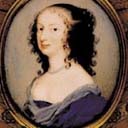
Margaret Cavendish (portrait)Cavendish herself was quite a character, who ‘self-consciously produced herself as a fantastic and singular woman’ (as Kate Lilley writes in the introduction to the Penguin edition), at a time when just to be a woman who wrote was singular enough. The Blazing World is by no means a fantasy as we know it today, nor, really, is it much of a utopia (which is how it’s often classed). With utopias, you expect some sort of blueprint or example of how to change our world for the better, but the Blazing World is wonderful because it’s a place of wonders, not because it has any political or philosophical answers. If it’s selling anything, it’s imagination: the chance that everyone has to make a world for themselves, inside their own heads.

The thing that makes it still readable (though it has its longueurs) is its playful quality, the entirely innocent approach to fantasy world-making, which Cavendish says in her introduction is her main aim and pleasure in writing it:

‘That though I cannot be Henry the Fifth, or Charles the Second; yet, I will endeavour to be, Margaret the First: and, though I have neither Power, Time nor Occasion, to be a great Conqueror, like Alexander, or Cesar; yet, rather than not be Mistress of a World, since Fortune and the Fates would give me none, I have made One of my own.’

And, in a bold move that may well make her the creator of the Restoration equivalent of a multi-user dungeon — or which certainly places her alongside the likes of Tolkien, and MAR Barker, and the Lovecraft circle, as well of course as Gary Gygax & co., as people who don’t just make up fantasy worlds to tell stories, but keep them on as game-worlds and places to bring invented languages to life — she issues an invitation to her readers:

‘…and if any should like the World I have made, and be willing to be my Subjects, they may imagine themselves such, and they are such, I mean in their Minds, Fancies or Imaginations; but if they cannot endure to be Subjects, they may create Worlds of their own, and Govern themselves as they please.’

The Blazing World can be read online here.

^TOP

The Language of the Night by Ursula K Le Guin

Le Guin, The Language Of The NightFollowing my mewsings on Michael Moorcock’s Wizardry & Wild Romance, I thought I’d take a look at another book on imaginative fiction (fantasy and science fiction, in this case) which I came across early on — in one of those wonderful bookshop sales where a single table would be crammed with all sorts, from academic obscurities to battered, failed bestsellers, and where you really could make discoveries, back before the internet neatly ordered everything — Ursula Le Guin’s collection of essays, introductions and talks, The Language of the Night (or the revised edition, anyway, issued by The Women’s Press in 1989). This book contains some touchstones of writing about fantasy that have stayed with me ever since.

In ‘The Child and the Shadow’, Le Guin retells a Hans Anderson fable and relates it to Jung’s ideas on archetypes (particularly the one he calls the Shadow) and the process of individuation. Fantasy, she says, ‘is the natural, the appropriate language for the recounting of the spiritual journey and the struggle of good and evil in the soul… Fantasy is the language of the inner self.’ This led to me making several attempts on Jung’s own tangled thickets of prose — books about his ideas are usually better than those he wrote himself, with Man and His Symbols being perhaps the best (it has pictures!). And, whether Jung’s ideas are ‘true’ or not — whether they’re the roots of a very peculiar science or (far more likely) an extended, imaginative metaphor for the inner life — I’ve always found them useful.

TheLanguageoftheNightIn ‘Myth and Archetype in Science Fiction’, Le Guin talks about what a myth is, in terms of what a writer is trying to do when they write fantasy or science fiction, and how it comes not purely from the unconscious, or the conscious, but from an equal meeting of the two, a forging of something somehow universal from the deeply personal — something another favourite writer of mine, Alan Garner, has said, too (‘A writer has to live an insoluble paradox. He requires a public, and can achieve it only by becoming most private.’ To which Le Guin would no doubt have said, ‘Less of the “he”, please.’).

The essential essay, from a fantasy reader’s point of view, is ‘From Elfland to Poughkeepsie’. Here, Le Guin provides an almost cruelly neat test to tell the would-be fantasy that just mimics the proper use of faraway never-never lands, dragons, wizards and magic, from a genuine emanation of Elfland. For Le Guin, it’s style that makes something fantasy. She praises Dunsany, E R Eddison, Kenneth Morris and James Branch Cabell, and says Leiber and Zelazny could do better (‘When humour is intended the characters talk colloquial American English, or even slang, and at earnest moments they revert to old formal usages.’). The test is simple: take any passage, change the names from mock-fantasy ones to mundane ones, and see if it still reads as fantasy. She uses as an example a passage from Katherine Kurtz’s Deryni series, which neatly summed up my own feelings the one time I tried to read it — it’s not fantasy, it’s fancy dress.

Elsewhere, there are good short essays on Philip K Dick, James Tiptree Jr., and Tolkien. Moorcock, of course, hated Tolkien with a profound hatred, but for Le Guin, he’s the high point of the genre, a writer she’s glad she didn’t read too early, because that might have skewed her own writing:

‘Those who fault Tolkien on the Problem of Evil are usually those who have an answer to the Problem of Evil — which he did not. What kind of answer, after all, is it to drop a magic ring into an imaginary volcano?’

Wizardry & Wild Romance cover

Wizardry and Wild Romance, Gollancz (1987), cover by Les Edwards

But here, Le Guin is doing a very different job from Moorcock. She is, mostly, defending fantasy and science fiction for their own sakes — often, defending imagination for its own sake — rather than sifting out the good from the bad. (She does have the occasional go at a specific author — not as frothingly vitriolic as Moorcock, but just as damning: ‘The recent fantasy best-seller Jonathan Livingstone Seagull is a serious book, unmistakably sincere. It is also intellectually, ethically and emotionally trivial. The author has not thought things through. He is pushing one of the beautifully packaged Instant Answers we specialise in in this country.’)

Like Wizardry and Wild Romance, The Language of the Night is very much of its time, as a lot of the essays chart the early stages of SF’s emergence from the ghettoes of the past:

‘SF is pretty well grown up now. We’ve been through our illiterate stage, our latent nonsexual stage, and the stage when you can’t think of anything but sex, and the other stages, and we really do seem to be on the verge of maturity now.’

But some of Le Guin’s exhortations are just as relevant. In ‘Stalin in the Soul’ — a wonderfully-argued piece about the art of art — Le Guin holds up Zamyatin’s We as an example of what she thinks is the best of all SF novels, yet one that was written under a repressive regime, and only ever published outside its author’s home country. She compares this to the sort of art most often produced in her own, free country, which is all too often self-enslaved to the market.

Threshold, Gollancz edition. Cover by Alan Cracknell

Threshold, Gollancz edition. Cover by Alan Cracknell

Perhaps the problem nowadays is that fantasy and SF — in certain forms — are too easily accepted, so much so that we fail to remember what they can do, what they can be. ‘Fantasy,’ Le Guin says, ‘is nearer to poetry, to mysticism, and to insanity than naturalistic fiction is.’ It’s a jolt to read this, in a culture swamped with fantastic imagery, in novels, films, and games. It reminds you there are really profound, great, even dangerous things to be found in works of the imagination, and that they are, perhaps, just as rare today, even when fantasy and SF are so much more culturally acceptable.

‘The great fantasies, myths and tales are indeed like dreams: they speak from the unconscious to the unconscious, in the language of the unconscious — symbol and archetype. Though they use words, they work the way music does: they short-circuit verbal reasoning, and go straight to the thoughts that lie too deep to utter.’

^TOP

Threshold by Ursula Le Guin

I think one of the reasons I may have gone away from fantasy literature after my initial love of it when I was a young teen reading and re-reading David Eddings’s The Belgariad, was it was so hard to find fantasy that matured as I did. After that early enthusiasm for fairy-tale-ish adventure, what came next, where were the works of deeper power, or greater complexity? There were some, but they seemed as rare as they were wonderful: Holdstock’s Mythago Wood and Lavondyss, Peake’s Gormenghast books, Ursula Le Guin’s Earthsea.

Threshold, Gollancz edition. Cover by Alan Cracknell

Threshold, Gollancz edition. Cover by Alan Cracknell

At my first reading, I found Le Guin’s 1980 novel Threshold (The Beginning Place in the US) a little dour, I think, but a recent re-read made me realise it was certainly one of those books that were taking existing fantasy ideas and adding much greater depth and weight, exploring the implications, adding complexity to the characters and ideas. Taking the Narnia-like premise of people from this world going into another, magical world, the difference with Threshold is that, unlike the children of The Lion, The Witch and the Wardrobe, who go to another world to essentially become fairy-tale versions of themselves (children in this world, adventurers then kings & queens in that world), the protagonists of Le Guin’s novel very much take the preoccupations and problems of their this-world lives with them. Initially using this other world as a refuge from difficult relationships and worldly hardships, the novel’s two protagonists (who, at first, are deeply resentful of each other’s presence in what they thought was their own personal hideaway) are drawn into the troubles of this other world in which they must play a key role.

Hugh Rogers (“Run-and-hide Rogers” as he calls himself) is twenty years old, working on the checkout of a local Thrift-E-Mart, and stifled by his over-controlling mother. Recently moved to the area, he discovers the very edge of the “twilight world” as he calls it (because its light is in a perpetual edge-of-day state) and finds in it the only real place where he can be himself. Irena Pannis, a little younger, has known the “ain country” (which she names after a line in a folk song she once heard) longer, having spent time in its mountain town of Tembreabrezi, where she has learned the language. For her it’s a refuge from a starkly unloving world, a world in which “Everybody I know just hurts each other. All the time”, and “Love is just a fancy word for how to hurt somebody worse.”

threshold_pbTembreabrezi is a way-station for travellers on the roads that pass through it, but recently something has changed: the town-dwellers themselves cannot walk the roads, cannot leave their town, and nobody is coming to them anymore. Something has to be done, something that was done, once, long before — a confrontation on a nearby mountain which left a previous lord of the town with a withered hand — something that Irena, with her basic grasp of the language, can’t quite translate or understand, something that the townspeople believe Hugh has come here to do.

A monster has to be faced. Like the worm in William Mayne’s A Game of Dark, it’s a pale, stinking, disgusting thing, almost too horrible to face, something that strips Irena and Hugh of all pretensions that they might, like the Narnia children, be in some way destined, blessed heroes in this realm — but also it’s a thing of pain and suffering, a thing that cries, “howling and sobbing”, an embodiment of something “horrible and desolate, enormous, craving”.

Quite what the monster is, why the roads are closed, and what the very palpable fear the townspeople feel is, is never stated, but I felt it was, in some way, tied deeply to Irena and Hugh’s own need for this escape-world that they find themselves in — as if, by leaving behind the fears and difficulties of the outside world when they come to the “ain country”, it in fact separates from them, into a sort of intensified, separate and monstrous form. The horror they face in this sad beast is real and loathsome and genuinely dangerous. But what happens changes Irena and Hugh, as though facing any fearful thing, if horrific and dangerous enough, can wash them clean of the lesser fears they deal with in their normal, daily lives.

Threshold is certainly a book worth not just reading but re-reading, one that feels it’s saying something new about the traditional ideas behind fantasy fiction, more than thirty years after its first publication.

^TOP