The Cold Flame by James Reeves

Brothers Grimm - The Complete Fairy Tales (Vintage Classics)For some months, now, I’ve been reading a tale a day from Jack Zipes’ translation of the Grimm Brothers’ fairy tales, only having known the more famous ones till now. And they’re a mixed bunch. As well as the very fairy-tale-like stories of princes transformed into foxes or frogs, brothers turned into swans, princesses setting three impossible tasks for their suitors, or that overlooked third brother winning through despite everyone thinking he’s a clod, there are plenty of duds: shaggy-dog jokes about stupid people (“Clever Hans”, “Clever Else”, “The Brave Little Tailor”) or the (once, no doubt very funny, not-so now) misadventures of odd collections of companions (“The Straw, the Coal and the Bean”, “The Mouse, the Bird and the Sausage”), as well as some of the more traditional kind of tale that don’t quite satisfy as much as the well-known ones do.

Reading these lesser tales, where the shortcomings of the story are often made up for by an appeal to the listeners’ baser nature, you get a sense of their pulpy, lowest-common-denominator approach: silly jokes about talking sausages and stupid people on the one hand, lashings of revenge on the other. It’s not saying anything new to note how gleeful fairy tales can be in not just righting wrongs, but in getting a downright over-the-top bloody revenge into the bargain:

“The evil mother was brought before the court and put into a barrel that was filled with boiling oil and poisonous snakes. Indeed, she died a horrible death.”

or,

“‘The scoundrel deserves nothing better than to be put into a barrel studded with nails on the inside,’ said the old woman. ‘And then he should be rolled down the hill into the water.’”

or,

“‘She deserves nothing better… than to be stripped completely naked and put inside a barrel studded with sharp nails. Then two white horses should be harnessed to the barrel and made to drag her through the streets until she’s dead.’”

…being just three examples. Cinderella may win your sympathy by being forced to drudge for her nasty step-sisters, but some fairy tale heroes and heroines have very little going for them, morally or empathetically, yet the stories only work if you’re rooting for them to lord it over everyone by the end — and not just their oppressors, but often their oppressor’s entirely innocent children, too.

The Cold Flame by James Reeves, cover by Charles Keeping

The Cold Flame by James Reeves, cover by Charles Keeping

The Cold Flame, published in 1967, is James Reeves’ retelling of “The Blue Light” from the Grimms’ book of fairy tales — certainly not one of the more famous ones, but not entirely a dud, either. The protagonist is (unusually, for these mostly coming-of-age tales) a long-serving soldier, dismissed after twenty-five years in the King’s service (“Five-and-twenty years, five-and-twenty wounds”) with only a silver dollar in pay. He falls into the hands of a witch, who makes him drudge for a couple of days, then sends him down a well to fetch a cold, blue, obviously magical light she dropped there. He refuses to hand it over till she’s helped him from the well, so she lets him fall back down to the bottom. Deciding to smoke one final time before he dies of starvation, the soldier lights his pipe with the blue light and thereby summons a little demon, who offers to do anything he demands. And so the soldier gets out of the well, is provided with riches, returns to the city where he was dismissed so off-handedly, and sets about getting his revenge by summoning the King’s daughter each night to clean up his room. He’s caught (on the third night, of course) and arrested, but thanks to his little demon turns the situation round, and by the end is not only king himself but getting inviting looks from the princess.

Perhaps it’s because the main character isn’t such an innocent as Cinderella or Snow White, but although the wrong to him is genuine (dismissed after twenty-five years with only enough pay to buy a single meal), having the tale expanded from short story to short novel only seems to emphasise how unfair it is that the king’s daughter — entirely innocent, as far as I can see — should be dragged into her father’s punishment. It seems even stranger in Reeves’ retelling, because he makes it clear that, for some reason, after being forced to drudge for him, she’s fallen in love with this raddled old soldier, whose only redeeming feature (as in so many fairy tales) is the fact he’s had the good luck to gain magical aid. But perhaps it’s just that, by being faithful to the rather uncompromising spirit of the Grimms’ version, Reeves has retained the essential character of the original, without pandering to any sensitive morals on my part. Anyway, it’s very well-written, if a bit distant from its rather bleak-souled characters. (The soldier is described as having an “almost habitual sardonic self-control”, and a “dedication to the virtue of despair.”)

One of the things that attracted me to the book wasn’t the story, but the illustrations. I think I must have come across Charles Keeping’s work first in Alan Garner’s Elidor. He mixes a sparse, telling line with a sort of random, squiggly-blotchy wildness that somehow works, and somehow fits these late 1960s/early 1970s books with their rather modernistic bleakness and understated, though deeply-felt, deeply-tried humanity — Reeves’, and Garner’s, and, I think, they’d suit the two William Mayne books I’ve reviewed recently, too.

Here are some examples of his work on The Cold Flame:

CharlesKeeping_Flame01

CharlesKeeping_Flame03CharlesKeeping_Flame02

^TOP

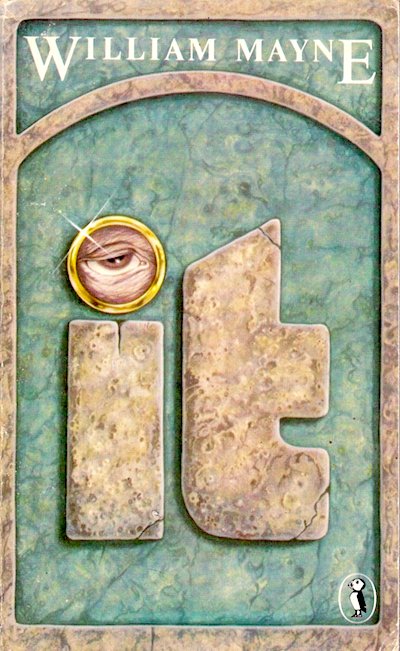
IT by William Mayne

IT by William Mayne (HB)I was intrigued to find that, aside from Stephen King’s, there’s another book called IT, this one by William Mayne, published in 1977. I was even more intrigued by the plot: Eleven-year-old Alice Dyson, looking at her home town from a distance, spies a hill she didn’t know existed, and resolves to explore it. At the top she finds an ancient, faintly-carved stone, similar in shape and design to three crosses that mark the boundaries of the town (and of which her grandfather, a vicar who has written a local history, believes there to have once been a fourth). Digging idly in the mud beneath it, Alice finds a dark hole. She puts her hand in — and feels another hand grasp it. When she withdraws her hand, she still feels the presence of that other hand; hers is “still haunted by what had held it”.

Alice gets on with her everyday life. She’s a bit of a trial to her family, the sort of child who’s always doing the wrong thing. Her grandfather, a bit of an authority-figure in the family, in particular finds her wanting (“she was always a miserable milk-and-water miss, with the milk curdled and the water tepid,” he says). But this is not as bleak a book as the Mayne novel I reviewed last time, A Game of Dark — Alice herself has a lightness and humour that prevent these family tensions from building up to anything like the awful alienation that exists between Donald and his parents in that book.

Alice learns of a possible explanation for the ghostly hand:

“…a witch, or sorceress… had taken refuge in the town and then come into the Market Place and made terrible frightening threats against the town. Before she had finished them a retribution had come upon her and she had fallen down dead, some said struck by God, and others by the Devil, stabbed with an invisible knife in full daylight in front of a crowd of people.”

Returning to the hill, Alice pokes about in the darkness with a piece of rusty metal she finds nearby. Suddenly, she feels she has stabbed something, and the ghostly hand leaves hers. She, then, is the cause of that “invisible knife”. But her troubles are not over. She has attracted another presence. This is not the witch, but the witch’s familiar, a poltergeist-like spirit keen to attach itself to Alice as it once did to the witch. It starts providing Alice with rings that are meant to bind them together — often as not lifted from other people. Alice, quite sensibly, hands them into the police. The spirit starts trying to follow what it assumes are Alice’s wishes — she wins a game of monopoly with every dice roll landing in her favour; a friend who throws a snowball at her gets showered in the snow from a nearby window ledge; when Alice gets angry, the spirit starts to break things.

What stops William Mayne’s IT from being a horror novel is that Alice isn’t isolated by her strange experiences. In fact, several adults, including her grandfather, a local bishop, and her mother, all accept what’s going on. As her mother says:

“Don’t forget that I was… in New Guinea… I was your age at the time, and I was older, and we’re both quite familiar with wandering spirits that attach themselves to people for a time, so at least we knew what was going on. Believe me, we met far worse ones than yours. But of course out there it was much easier to talk about things like that.”

IT by William Mayne (Puffin PB)Perhaps it was because I was expecting IT to be more of a horror novel that I found it slightly unsatisfying at the end. Although the effects of the ghostly hand and the later familiar spirit can be quite spooky (whenever Alice approaches a church, she’s enveloped in her own little storm, as “IT” tries to prevent her from entering the holy place, which it can’t follow her into), Alice herself isn’t overly spooked, and instead, feeling sorry for this childlike spirit that’s attached itself to her, tries to find a way to free it, and her, from an unwanted bondage. She realises a ritual has to be carried out involving the four crosses that once surrounded the town. Usefully, there’s an annual parade that, if Alice can persuade the committee, could have its route changed so as to provide the sort of magical act required. She does this in a series of quick-cut brief scenes that bring a comic feel to the story. But Mayne’s skill at characterisation, and Alice’s constant little difficulties with people, particularly her family, prevent it from being the sort of E Nesbit lark-with-magic that might make it sound like.

IT passes through spooky territory, then, but never becomes a horror novel. Nowhere near as bleak as A Game of Dark, neither is it as powerful, though it has its moments. What lingers, rather than the sort of trials Donald Jackson went through in that earlier book, is the light touch and resilience of Alice’s character, and the way her determination to see this strange experience through, in her own way, finally wins round her previously disapproving grandfather, and the town as a whole.

^TOP

A Game of Dark by William Mayne

William Mayne, A Game of DarkA Game of Dark (1971) opens with young Donald Jackson feeling dizzy and being led out of class to the empty school staffroom. There, he somehow slips between this world and another. In our world, he is Donald, the troubled teen son of a father left wheelchair-bound and in constant pain from an accident that occurred on the night Donald was born; in the other world, he is Jackson, a boy who wanders into a medieval town under siege from a gigantic worm, where he is picked by the new lord (Lord Breakbone — “The lord is supposed to protect us and to kill the worm, but it will not be killed, it kills them instead. So they send us another lord.”) to be his squire.

This slipping between worlds can occur at any moment, with no fanfare. At first it is only when Donald is alone — in the staffroom, or walking home at night — but later it can be while he’s in the presence of others, in mid-conversation, even. One moment he’s Donald in our world, the next he’s Jackson:

“He was being some other person, he found, in a crisp buzzing world of hard light and hard ground and hard people. Then, for a moment again he was Donald walking towards the bridge, and the boy who that morning, perhaps, had called himself Jackson to a girl on a hillside. For a moment he could choose again which he would be. One is real, he said to himself. Donald is real. The other is a game of darkness, and I can be either and step from one to the other as I like.”

At first, he teeters on the edge of full immersion. Hearing someone speak to him in that other world, he fights not to understand their language, because understanding will be a commitment to existing in that world; then he gives in. Returning to our world, he finds that time has passed, events have moved on:

“[His mother] was standing in the doorway of his room, and he was working at his homework, remembering what he had done since coming home without feeling he had experienced it.”

Neither world is an escape from the other. Donald cannot face his father, who has become strange, almost fearsome, and who can barely communicate through the often delirious pain, which he endures because of his beliefs. As Mrs Jackson tells her son:

“We were meant to bear pain in this world, and what’s sent to us we must submit to.”

Donald struggles to feel connected with either his father or his schoolteacher mother (who calls him by his surname at school, like any other pupil, and often slips into calling him the same at home). He wonders if he is truly their son. He finds a haven in a local church group — a Church of England one, disapproved of by his Methodist parents — and the (to my mind) rather touchy-feely friendship of the everyone’s-friend vicar, Mr Braxham, who encourages Donald to smoke and insists on being called “Berry”. In the other world, meanwhile, as if the everyday harshness of a bleak, medieval existence isn’t enough, there’s the worm, a great, unthinking, stinking thing that preys on the people of the town with nothing anyone can do to stop it.

A Game of DarkDonald/Jackson, then, has a whole series of father figures — Mr Jackson and Berry in this world, Lord Breakbone and the worm in the other. As his father in this world is taken into hospital, Donald can hardly find any feeling for him but a sort of panic fear; meanwhile, in the other world, the fight with the worm becomes unavoidable. At first it is pacified by animals left outside the town walls, but when the townspeople struggle to keep feeding it, it breaks through the wall and begins, once more, to eat human beings. (The worm in the book is particularly well-created. Its stink lingers for days; animals refuse to cross its slimy trail. In one fight, it suddenly produces a winged claw, seemingly as much to its own surprise as anyone else’s. The feeling is of a thing made stupid and complacent by being so powerful it has no serious opposition.)

Without its two worlds directly paralleling each other, A Game of Dark reaches its moving conclusion only when Donald brings his experience as Jackson in that other world — where he has faced and killed the worm, though not in the honourable, knightly way the town demands — to bear on the internal, emotional conflicts in this one. And not just on his own life. While, to him, the worm can be seen as standing for the darker and more difficult aspects of his relationship to his father, killing it throws light on just what his father must be facing — for his illness is a worm, too, something that humiliates and dehumanises.

Mayne’s style reminds me of Alan Garner’s in its spareness and occasional poetic density, its feeling of slight alienation from the world it describes, and its deft moments of character insight. But the matter-of-factness of slipping between one world and another, the way it is never explained, examined or excused, is something quite new to me in a fantasy novel, as is the very moving way the fantasy strand illuminates the equally-weighted real-world strand at the end.

^TOP