
The Moon Stallion

The Moon Stallion was first broadcast on the BBC at the end of 1978. I don’t remember seeing it, though I may have caught it when it was repeated in 1980, on the Sunday teatime slot I so associate with BBC kids’ fantasy (perhaps because of the Narnia adaptations they showed in the late 80s). Anyway, I may not have seen it at the time, but sitting down to watch it now, I certainly feel I know it: it’s archetypal kids’/young teen fantasy of the sort the 1970s did so well (see The Changes, King of the Castle, and Children of the Stones earlier on this blog). Perhaps the fact it’s set in Victwardian times — or BBC costume drama times, anyway — that helps to recall so much classic, E Nesbit-style magical mystery romps, but The Moon Stallion isn’t an adaptation, it was written for the TV by Brian Hayles, the creator of the Ice Warriors and the planet Peladon for Doctor Who, as well as the scriptwriter of Warlords of Atlantis (also on this blog).
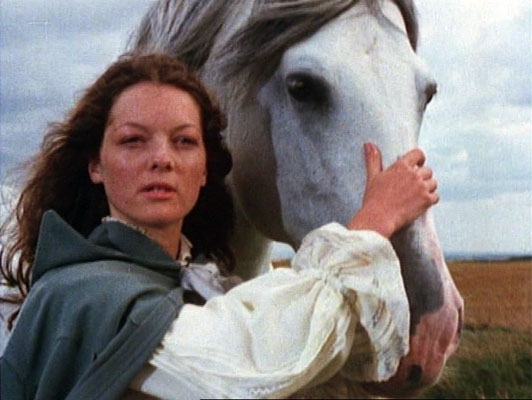
Sarah Sutton in The Moon Stallion

The other key Doctor Who connection, of course, is that it stars Sarah Sutton (later to play Nyssa of Traken) as the blind girl Diana. Visiting the home of Sir George Mortenhurze along with her younger brother and her father (an archaeologist brought in by Sir George to help prove a local King Arthur connection), Diana, though blind, sees the Moon Stallion, a wild horse of supernatural repute that, it turns out, Sir George and — even more — his groom and would-be “horse warlock” Todman have designs on capturing. Sir George wants the Moon Stallion because his wife died shortly after seeing it; Todman wants the Stallion so he can control the Moon Goddess, ride into Tir na Nog, and gain magical power. Dismissive at first of Diana’s link with the Moon Stallion, Todman later uses her to try and capture it. Throughout, Sutton plays Diana with a great deal of dignity, which really adds to her vulnerability at the key moments when she’s threatened.
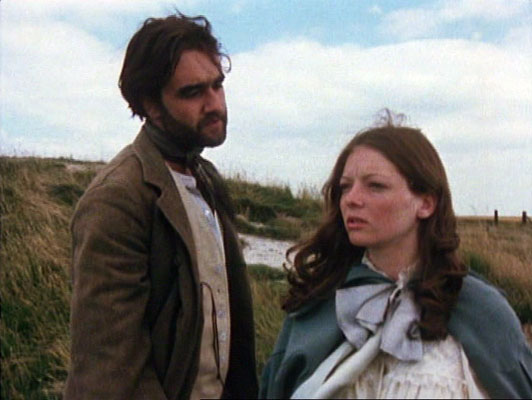
Diana and Todman, The Moon Stallion

In The Hill and Beyond, their encyclopedia of children’s TV drama, Alistair D McGown and Mark J Docherty say The Moon Stallion “in the final examination is no more than an entertaining hotchpotch of enticing legends and myths… a wonderful piece of light melodrama fit for any Sunday afternoon… a looker, then, but rather directionless as a story.” But David Pringle, in The Ultimate Encyclopedia of Fantasy, says “Hayles’s script was one of the most accomplished fantasies specially written for television.” I’d certainly say it was better than McGown and Docherty imply — The Moon Stallion may feel a little too made to seem like an adaptation of a classic kids’ book that never was, but I think it has a lot going for it. True, some of that may be nostalgia on my part. Recently, I’ve had a craving for that whole 1970s mystical-magic kids’ adventure thing, with its gleeful pick’n’mix of folk legends, King Arthur, standing stones (also, in this case, the White Horse of Uffington and the nearby Wayland’s Forge), magical moonlight, stately homes with family secrets and windswept moors by night, and The Moon Stallion was my latest fix. (I had to track it down on a German DVD, as it’s not available in the UK.) Like The Changes and Children of the Stones, The Moon Stallion (briefly) ties science up with magic, equating the two and implying that modern man’s loss of connection with the land, and his loss of respect for old beliefs, will lead to his undoing. As the Green King, a mystical figure who guards the way to Tir na Nog, tells Diana after giving her a future-vision of Concorde and a nuclear mushroom cloud:

“Your science is the magic of ancient times, forgotten, in darkness, now rediscovered and, not understanding its past, rushing into self-destruction, as so many times before…”
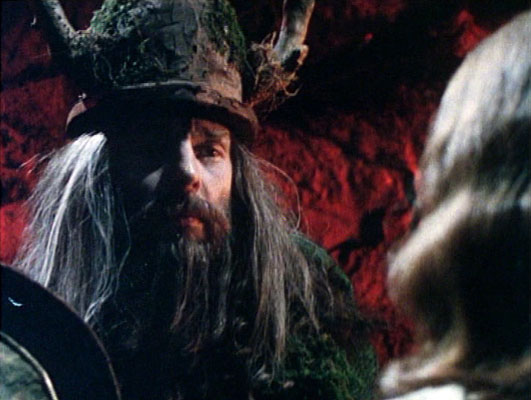
The Green King, from The Moon Stallion

And this, ultimately, is the substance to the tale that Docherty and McGown say it lacks. They say: “…the discovery of strange magic by a vulnerable and pretty young virgin is usually a metaphor for sexual awakening in the gothic novel but Hayles deploys Diana on a purely surface level.” But, although Diana does spend a lot of the tale at one remove from the action — necessarily, perhaps, because her visionary connection with the Moon Stallion, and the Green King, can short-cut the tension — the tale is ultimately not about her coming-of-age, but about a much wider confrontation with, and acceptance of, death. Sir George wants revenge on the Moon Stallion for his wife’s death; Todman wants power, and that includes power over death. As the Green King says, “the wolf in man’s” lust for power so often ends in his own destruction, and it is only once these greedy figures have been done away with that it can be set back to rights. At the end, it is Sir George’s daughter who inherits his home and lands; the whole story has a feeling that what’s needed is a little less male power-grabbing, and a little more of the Moon Goddess’s feminine influence, and respect for what cannot be controlled. (Even Sir George’s demand that local evidence for King Arthur be found and confirmed feels like him trying to dominate and control elements of myth and legend, rather than feel any reverence for them.)
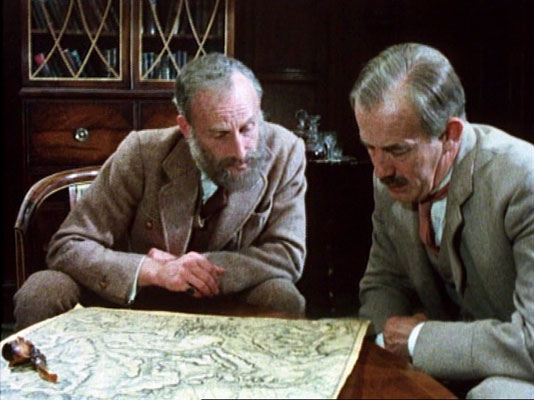
The Moon Stallion

It’s not the story that lingers in the mind, anyway, but the magical and visionary feel of a connection with things of the imagination — things of moonlight, and of the ancient past — along with a lot of shots of people riding horses over magnificent rolling countryside, and down hedgerowed lanes, in flowing gowns and cloaks. Perhaps it’s best watched as a welcome dose of nostalgia, but, then again, fantasy is all about magic from the past.
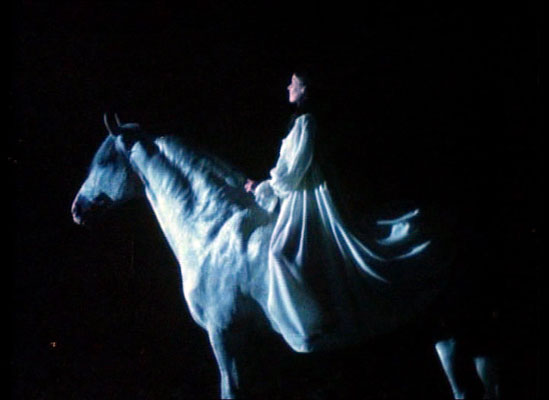
The Moon Stallion

(Full cast & credits at The Encyclopedia of Fantastic Film and Television here; also, details of a comic strip adaptation of The Moon Stallion from the girls’ comic Tammy.)
^TOP

Secret Gardens by Humphrey Carpenter, Inventing Wonderland by Jackie Wullschläger

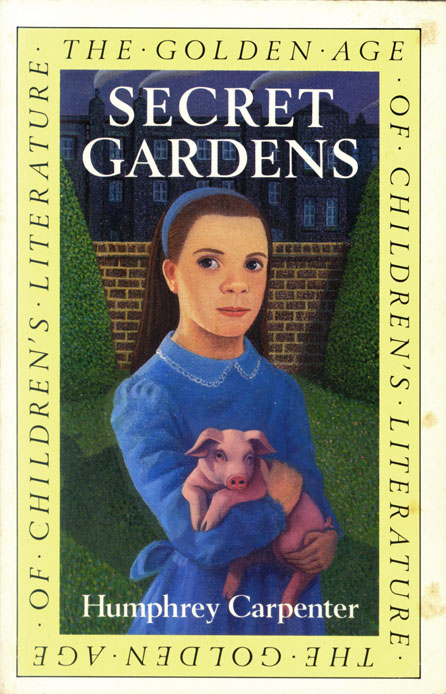
Secret Gardens by Humphrey Carpenter, cover by Mark EdwardsSecret Gardens is Humphrey Carpenter’s study of the writers who created a Golden Age of children’s fiction, from the mid-Victorians (Charles Kinglsey’s The Water Babies and Lewis Carroll’s Alice books) to the Edwardians (Kenneth Grahame’s The Wind in the Willows, J M Barrie’s Peter Pan), with one post-World War I stray in A A Milne. Prior to this, English Literature had only recently “discovered” childhood as a special state; children had previously been seen as little adults, their size making them particularly convenient to be set to work in places adults couldn’t reach — up chimneys and down mines, for instance. But suddenly, to the Victorians (the wealthier ones, at least), children were the embodiment of all that was innocent, like little Adams and Eves before the Fall, and were therefore something to be preserved, prettified and sentimentalised. Frances Hodgson Burnett’s Little Lord Fauntleroy (1886) was the ultimate statement of this approach, leading to a fashion for dressing children up as little English aristocrats and growing their hair in golden ringlets. (In the worst of this strain of children’s literature, whole books were written in mis-spelled baby-talk, surely a joke only adult readers would get, and quickly tire of.)

Then came what Carpenter calls the “Arcadians”, who took a different approach. They made the effort to see childhood from the inside, as a golden age of imagination, freedom and make-believe. Adults, from this point of view, were seen to have lost something as they grew up. Kenneth Grahame, Beatrix Potter and A A Milne were, in Carpenter’s view, the few who achieved perfection, with J M Barrie’s “terrible masterpiece” Peter Pan standing as a self-conflicted statement both in favour of not growing up, and the awful tragedy of not doing so.

The BorrowersIn the books for children that followed World War II, Carpenter detects a new theme, one in which children don’t just disappear into a golden, separated existence for the duration of their childhoods, but one in which they slowly discover their place in an “ongoing narrative”, and so learn to grow up. In The Borrowers (1952), “the first classic for children to emerge in England after the Second World War” (according to Carpenter), Arriety’s childhood world is less a “Secret Garden”, and more a prison from which she must learn to escape:

“The Borrowers’ domain beneath the floorboards, which is in many respects Arcadian… is characterised as above all stuffy, poky, and limiting. It is the precise opposite of Badger’s kitchen: it provides not womblike security but a choking constriction.”

It’s interesting to see how Carpenter focuses on how an “idea of childhood” was slowly developed, first being set aside and polished in its own special place (its secret garden) — necessarily so, to rescue it from pre-Victorian ideas of children being just little adults — then being reintroduced into the “main narrative”, reconnected with wider society and the idea of growing up, but only after that “special state” has had its properly special time.

Inventing Wonderland by Jackie WullschlagerWhere Carpenter traces the evolution of an idea, Jackie Wullschläger, in Inventing Wonderland, discerns a type. For her, the “Golden Age” of children’s writing belonged to “children’s writers who were also particular psychological types: boys who could not grow up”, and she singles out Lewis Carroll, Edward Lear, Kenneth Grahame, J M Barrie and A A Milne for particular finger-wagging.

And, sadly, finger-wagging it is. Whereas Carpenter’s Secret Gardens is the study of an idea and a developing literary movement, Wullschläger’s “collective biography”, having stated its theme (that the best books for children were written by “boys who could not grow up”), doesn’t really examine or test it, and so is ultimately unsatisfying. (What about, for instance, the female writers — E Nesbit, Frances Hodgson Burnett, Beatrix Potter — who contributed to the “Golden Age”? Were they “girls who could not grow up”?) Wullschläger has, it seems, an ideal of maturity against which these five male writers offend, but as she never defines it, you can only guess at it — and, sometimes, marvel at its stringency. At one point, she lists a group of children’s authors who, she says, “all lost parents when they were very young and then never fully accepted adult responsibilities”. In this list she includes J R R Tolkien: Tolkien, who served in the war, was a respected academic, had a successful marriage and a family life free of the horrors she describes in the lives of, for instance, Grahame and Barrie (each of whom had a child, adopted or otherwise, who committed suicide). Never fully accepted adult responsibilities? Just what is it that makes Tolkien fail the Wullschläger maturity test?

Lear - Complete Nonsense(The one author she shows some sympathy for is Edward Lear, though she misses the irony that it is exactly the sort of disapproval for human peculiarities she displays in Inventing Wonderland, that drove Lear in such despair from England to find a refuge on the continent.)

Wullschläger’s book, then, is interesting for its short biographies of a handful of writers, but draws no real conclusions as to what made their works successful — only on the fact that the writers themselves were immature. Of Tolkien and Lewis’s work, for instance, she says:

“Yet their work shows how fantasy continued to be shaped by the two forces which had driven Carroll and his contemporaries: nostalgia on the one hand, the need to find symbols and stories to reflect current anxieties, fears and doubts on the other.”

…implying that the only thing these extremely successful authors have going for them is a pair of negatives — nostalgia and fear. (If only she’d looked beyond her horror-word “nostalgia” to find, for instance, Tolkien’s deep, strong, and heartfelt connection with values in a past he both studied and admired.)

If it’s genuine insight into what made the “Golden Age” of children’s literature a golden age, then, you have to go to Carpenter’s book. The “Secret Gardens” so often located in children’s fiction are, at once, childhood itself, and an image of the imagination. A well-stocked imagination is one of the things that will, I think, see a child properly on his or her way towards a genuine, deep maturity — or at least arm them to withstand the jibes of the maturity police (those prey to what Ursula Le Guin has called “maturismo”: a swaggering, machismo-like version of grown-up-ness). This, I think, is more likely to be where these authors, so wounded in childhood that they could not, or would not, buy into the wider world’s maturity game, found their particular imaginative treasures, and thankfully passed them on to the rest of us.

^TOP

Ralph Bakshi’s The Lord of the Rings

It’s pointless to compare Ralph Bakshi’s 1978 animated film of The Lord of the Rings with Peter Jackson’s trilogy. They’re two completely different things. Jackson’s live-action film makes every effort to bring out the human drama of Tolkien’s story while presenting an exquisitely-crafted, seamlessly “real” version of Tolkien’s world. Bakshi’s, on the other hand, is a far pacier telling of the first half of the trilogy, and in style is more an illustrated thing, story-bookish and textured like a hand-made artefact — expressive and Romantic rather than dramatic and realistic. Jackson’s is convincing in every detail, but Bakshi’s works through the charm of its style.

Three rings for the Elven Kings...

Three rings for the Elven Kings…

Or perhaps I’m just saying this because Bakshi’s was the first version of The Lord of the Rings I was exposed to. I’d made attempts at reading LOTR before (the school library had a fat one-volume paperback of it, with a Pauline Baynes cover), but I always got stuck in the Shire. When I finally did get past that point and really enjoyed the books (those Barrow Wights!), I did so mostly with Bakshi’s version of the characters in mind — Aragorn had John Hurt’s voice (and, as in Bakshi’s movie, genuinely “looks foul and feels fair”, as compared to Viggo Mortensen’s much un-fouler look), while Gandalf, lean, aquiline, and hobbling around with his staff, was a far more authoritative and scary wizard than Ian McKellen’s (to my taste) rather too fond-and-friendly version. (I didn’t know it at the time, but there’s also Anthony Daniels, aka C3P0, as the voice of Legolas, and Mrs Victor Meldrew, Annette Crosbie, as Galadriel.)

Galadriel

Galadriel

Aragorn

Aragorn

Some people criticise the film for its uneven use of rotoscoping (where live footage is traced over by animators), but to me it’s just one of the many textures the film uses, and to great effect. Bakshi’s Lord of the Rings seems so wonderfully, hubristically 1970s, mixing animation styles like a prog-rock concept album mixes musical genres. (Apparently, he at one point wanted to use Led Zeppelin for the soundtrack.) For me, though, the rotoscoping adds a gritty, grainy quality to the action and battle sequences, recalling World War newsreel footage; and where it’s used to show the Nine Riders in their true form, in a sort of ivory-tinted black-and-white, it creates a genuinely creepy, otherworldly feel that to me is far more effective than the strangely windswept look Jackson used for the Ringwraiths’ true form in The Fellowship of the Ring.

BakshiLOTR-08 BakshiLOTR-07

The film does have its oddities. Saruman is sometimes referred to as Aruman — in one scene, he’s referred to by both names. In another scene, we see Merry and Pippin being carried along by a group of orcs after the pair have escaped into Fangorn Forest. But the greatest oddity, of course, is the fact that it ends halfway. There was going to be a sequel, but Bakshi found the process had taken more out of him than he’d expected. (In the end, there was a 1980 animation of The Return of the King by a different company. I saw it once, on US TV. The only thing I remember is my shock at finding it was a musical, with one song being called “Where There’s A Whip There’s A Way”.)

I still watch Bakshi’s Lord of the Rings occasionally. It has certainly not been out-dated by Jackson’s version (which I also like, but which had to first win out against my pro-Bakshi prejudice). The two are perfectly able to co-exist, being so different as they are.

BakshiLOTR-03 BakshiLOTR-04 BakshiLOTR-05 BakshiLOTR-09 BakshiLOTR-10 BakshiLOTR-12 BakshiLOTR-13

^TOP
