Two Films About Childhood

Not really meaning to, I seem to have given myself a themed, mini film festival these last two nights by watching a pair of films, both of which were about the secret, inner lives of children.

spiritofthebeehive

The first was The Spirit of the Beehive (1973), set in a rural nowhere in Civil War era Spain. I’d put it on my Amazon list after seeing it mentioned as a possible influence on Pan’s Labyrinth, but this was my second watching, because after getting it on rental, I liked it enough to buy it. In the film, six-year-old Ana is deeply affected by a showing of the old Universal Frankenstein at her village cinema (where the screen is a rectangle painted on the wall, and everyone brings their own chair), and when her sister tells her that Frankenstein’s monster wasn’t actually killed because he is a spirit that lives in a nearby abandoned house, Ana starts visiting, and talking to, this gentle, invisible monster. But, rather than characterising her as a child, this seems, in the film’s world, to be putting her on her first step to adulthood, individuality, and isolation: Ana’s father, spending all his time in his study with his glass beehive, seems to live in a world of his own; her mother cycles regularly into town to post letters to a man (a brother? a former boyfriend?) who never replies. One day a wounded soldier, fleeing the Civil War, turns up in the abandoned house, almost like a realisation of the spirit of Frankenstein’s monster, and Ana starts to take care of him.

The other film was Kes (1969), which I put on my Amazon list after hearing Mark Kermode praise it, and realising it was another one of those films I’d heard so much about but hadn’t seen. Set in a pretty grim Barnsley, Kes is about a fatherless boy, Billy, pretty much a loner, ignored by his teachers and bullied by his much older brother. Resigned to getting nothing out of life, he’s nevertheless passionate, almost poetic, about a young kestrel he trains to feed from his hand.

kes

Both films encase their young leads in private imaginative worlds, and both get remarkable performances in return. It’s amazing to think Ana in the first film is just six — in some of the later scenes her face seems ageless, almost ancient — while Billy in Kes looks already hardened against all that the adult world can throw at him. (Almost, but not quite.) In both films the kids find an intensely private focus for their burgeoning individuality and imagination, only to have it broken by the cruel harshness of an uncaring world. The difference is that, with Spirit of the Beehive, because Ana’s world was so much of the imagination to start with, even when events in the real world take it away from her, she’s still left with something. Kes is far more brutal and hopeless, but all the same I felt there was hope for Billy despite his obviously grim prospects, simply because he at least had something he felt strongly about, something that would always be there as a refuge against his unremittingly bleak world, which is more than can be said of his endlessly bickering, selfish, mother and brother.

^TOP

The Innocents

I love subtle, suggestive horror & weirdness in films, but really effective spookiness is quite hard to find. The industry itself — whether in the form of its producers, its studio executives, or its “audience” (someone’s idea of its audience, anyway, because they certainly don’t include me in that) — can’t help but give in to the urge to sensationalism, and even a little bit of sensationalism can ruin a perfectly good fright. For me, the more subtle and understated the horror, the more your imagination is teased and your rationality piqued, the better. That tense balance where your conscious mind can’t understand what it’s seeing but your subconscious can is what it’s all about. As soon as you add in other elements — a jump, a laugh, a gross-out — and you give your rationality enough excuse not to have to pay it any more attention. The effect is ruined. The Innocents, a 1961 adaptation of Henry James’s The Turn of the Screw, is a classic example of a horror film that really does work on this level, even if it does have flaws.

The flaws, to my mind, are almost all in the person of Deborah Kerr, who plays Miss Giddens, the inexperienced (and highly ineffectual) governess sent to look after a pair of orphaned children on a big, lonely estate. The previous governess, Miss Jessel, has died, and Miss Giddens soon learns there was another death shortly before, that of the sadistic manservant Peter Quint, and that the two deaths might have been linked. But the real tension in the story comes from what can and cannot be said about this mysterious history. Miss Giddens is forbidden from mentioning the tragic Miss Jessel to either of the children — supposedly because it might upset them too much — but, after witnessing two ghostly figures, one of a wicked-looking young man and the other of a mournful young woman, Miss Giddens starts to suspect that Jessel and Quint are present in a way the dead shouldn’t be — and, what’s more, that they’re still in touch with the children.

The real menace in the story is not in the existence of the ghosts, nor in the influence these “horrors” might have on the minds of the supposed innocents. The film becomes truly disturbing once we see how obsessed Miss Giddens becomes with getting the children to confess to seeing, and conversing with, their deceased former governess and her cruel lover. As she can’t mention the names of Quint or Jessel, the whole thing becomes a tortuous psychological game in which Miss Giddens, ever more insistently neurotic and entrenched in her belief, persecutes the children over what, the viewer knows, could well be nothing but hallucination on her part.

This is how it should work, anyway. To my mind Deborah Kerr doesn’t play Miss Giddens with anything like the subtlety or ambiguity required. Perhaps it’s just down to how the film has dated — the governess’ stilted upper-class accent (and the chirpy gosh-oh-golliness of the kids’ dialogue) masks any possible subtlety of emotion, and in the main the music seems to put forward the idea that this is a period melodrama rather than a spooky story.

But one way in which the film hasn’t dated — in fact, what seems to jolt it right into the 21st century, alongside the surreal suggestiveness of Ringu‘s haunted videotape — is in Miss Jessel’s ghostly appearances, which are so staunchly under-sensationalised, and often so brief and matter-of-fact, that they have an effect like a cold brick between the eyes. (The music stops dead each time, too, which helps.)

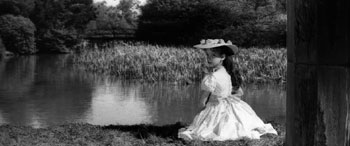
Take this example, which may be the best in the film. Miss Giddens and her young charge Flora are sitting by a lake. Flora is humming a tune which, we come to learn, is associated with the departed Miss Jessel, but doesn’t answer when quizzed about it. Miss Giddens starts to look disturbed. (The ghosts always appear after we have first focused on Miss Giddens’ look of growing horror. She always sees them before we do.)

innocents_1

Abruptly we see it: Miss Jessel, an out-of-focus, slumped figure in black, standing, quite bizarrely, among the reeds in the middle of the lake, just staring at us, not moving.

innocents_2

Then she’s gone.

innocents_3

It’s the almost surreal details which make it work, for me. The fact that Miss Jessel’s ghost is standing in the middle of a lake. The fact she’s not in any sort of frightening pose, but seems almost bored or tired. The fact she’s in broad daylight. Her being slightly out of focus and off-centre underplays the whole scene wonderfully, as if even the cameraman can’t see her, only we can, and that not too well. She’s beyond the clear, sharp grasp of the rational mind, and staring right into you out of some… other place.

^TOP

Fantastic Planet

I distinctly remember seeing this film in the old East Grinstead cinema, probably as the B-movie to some more major film. The trouble is, it was released in 1973, which would have made me about 2 years old at the time, so perhaps it was a re-release I saw, or it just took a while to reach these shores from France, where it was originally released as La Planète sauvage.

fantasticplanet02

The reason it stuck in my memory was that I wasn’t feeling too well at the time, having something of a stomach upset, and I had to leave the cinema when there was scene of two alien Draags sucking little particles of food from a big yellow cloud, which made me feel queasy! Since then, every so often I’ve wondered just what was that film with that scene in? (Also what was the B-movie which had no dialogue, just a long battle between two medieval knights, one all in black?) And then along came the answer, released on DVD.

Fantastic Planet is a French animation created by director René Laloux and French/Polish artist/writer Roland Topor (whose novel, The Tenant, has just been re-released with an intro by a favourite author of mine, Thomas Ligotti — funny how these things connect). It’s fantasy/SF with an obvious sixties psychedelic feel, not to mention an unintentional hint of Monty Python, as, at the start, we see a woman running in fear through a sparse forest before being toyed with and captured by an enormous blue hand. The blue hand proves to be that of a Draag, the native giant race of this planet, who imported human beings (called Oms — hommes in French, geddit?) as pets, only to find them escaping into the wild and breeding like rabbits. As a result, every three years there has to be a de-omming by a series of nightmare devices, like the sticky spheres in the pic below.

fantasticplanet01

The first half of the film follows a young Om as he grows up pet to a female Graak child, being dressed up in ridiculous clothes and subjected to various unintentional cruelties, till he escapes, taking with him one of the Draags’ automatic learning devices. He is found by a group of wild humans who use the learning device in their battle for freedom, culminating in a rocket journey to the “Savage Planet” which orbits the Draags’ home planet, and which the Draags visit regularly via meditation.

Along the way, there’s some pretty trippy visuals, including a scene of four Draags entering a meditative state where first their clothes change colours, then their bodies transmute into abstract shapes. The Draags’ planet is full of animate vegetation and creatures that prey on the Oms, lapping them up with sticky tongues like the ants they are, giving the setting a real Bosch-like feeling. The soundtrack (playable in isolation on the DVD) is rather typical of the era, aiming to transport you to another planet with its ethereal, oohy vocals and heavily chorused organs, but regularly dumping you firmly in the sixties when it brings in a funky wah-wah guitar or (worst of all) a rather clichéd sax solo for the moment when one of the Om females does a strip-tease as part of the wild humans’ religious rites.

Interesting to see it again after all this time, though.

^TOP