The Shape of… What? Er…

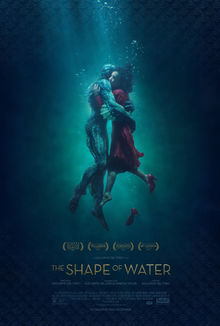
I was disappointed to read that Jean-Pierre Jeunet (director of Amelie, co-director of Delicatessen) was accusing Guillermo del Toro of plagiarism in his latest film, The Shape of Water. Partly, my disappointment is down to both directors having made favourite films of mine (Pan’s Labyrinth, Amelie, Delicatessen, and City of Lost Children all real favourites), and I’m always disappointed (though never too surprised) when creators I like criticise one another. But another reason is it seems somewhat ungenerous of Jeunet, considering how liberally he himself has borrowed from other films.

The main scene Jeunet singles out is where Sally Hawkins’s character and her neighbour (played by Richard Jenkins), sitting together on a sofa watching an old musical on TV, start tap-dancing along while sitting down. Jeunet said it was “cut and pasted from Delicatessen” (quote from The Telegraph) — no doubt meaning the scene where Dominique Pinon and Karin Viard, sitting on a bed and bouncing in order to locate a squeaky spring, fall into a sort of sitting-down dance. (You can see both at an article on The Playlist, which also reveals that the Jeunet quotes were Google Translated from the original French.)
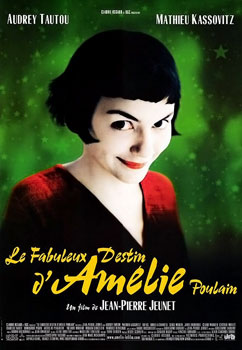
Jeunet also says Shape of Water’s having scenes featuring “the painter, the apartment, the girl who is a bit naive” must be inspired by Amelie, which strikes me as almost deliberately vague. I wouldn’t call Hawkins’s character “naive” — certainly not as Amelie is — she’s also clearly a woman rather than a girl, and the relationship between the characters Jeunet mentions is quite different. (In Amelie, the painter is very much a mentor figure; in Shape of Water, the relationship is of equals.) It’s far too vague for an accusation of plagiarism. (Hitchcock’s Blackmail also features a scene with a painter, an apartment, and a girl who is a bit naive, though of course it turns out far differently.)

Perhaps it’s more interesting to look at the scene Jeunet doesn’t mention. At one point in The Shape of Water, Sally Hawkins’s character shuts herself in a bathroom with the love of her life (who happens to be an aquatic humanoid more comfortable breathing through his gills than his lungs), blocking the bottom of the door with towels and turning on all the taps so they can flood the bathroom and enjoy a little underwater love. It’s reminiscent of the scene at the end of Delicatessen where Dominique Pinon’s Louison and Marie-Laure Dougnac’s Julie lock themselves in a bathroom, stop up all the gaps, turn on all the taps, and flood the bathroom, in this case to aid their escape from the other residents of the building, who want to eat at least one of them. Perhaps the reason Jeunet doesn’t point out this similarity is that this scene also occurs in a 1975 Paul Newman film, The Drowning Pool, in which Newman and a woman are locked in a large bathroom, block the drains, turn on all the taps, and flood the place to escape. In all three films, the central couple are carried out in the flood when the blocked door is finally opened.
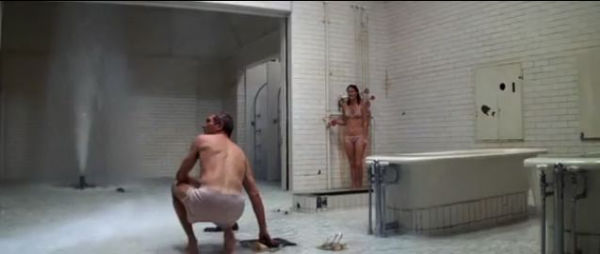
The Drowning Pool (1975) — they had a bigger bathroom

It’s just as easy to find borrowings — unconscious or not, accidental or not — in Jeunet’s films. The most obvious, to my eyes, is in Amelie. The scenes where Audrey Tautou’s character sneaks into the grocer’s apartment to play various sneaky little revenge-pranks on him are very similar to those in the 1994 film Chungking Express — not just in the idea of a young woman sneaking into a man’s apartment and playing little tricks, but down to some of the tricks themselves. In Chungking Express, Faye Wong’s character, among other things, swaps a pair of slippers and puts sleeping pills in a bottle of drink (if I remember right); in Amelie, Audrey Tautou’s character swaps a pair of slippers for those a size smaller and puts sugar in a bottle of some alcoholic drink.
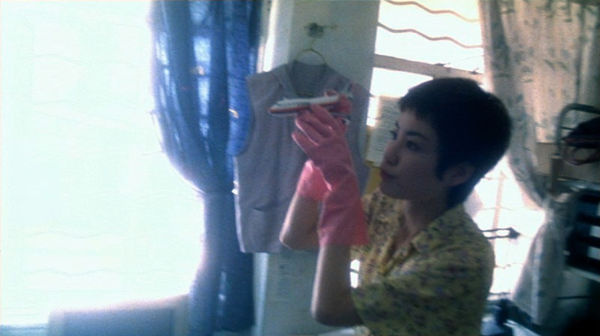
Chungking Express — this is not her apartment

To make all these accusations of plagiarism more complicated still, in an Empire magazine feature (Le fantastique M. Jeunet by Olly Richards) from January 2010, Jeunet says of the flooded bathroom sequence in Delicatessen:

“It’s funny, because maybe six or seven years later I saw a short film with Laurel & Hardy and it’s the same idea. Same bathroom with two cops outside. I understood that probably [co-director] Marc Caro or me saw that when we were kids and then forgot it. Then it sat in the back of the mind.”

It’s an old idea that good artists copy, great artists steal, but I can’t help feeling there’s a danger of a huge loss of subtlety as soon as the accusation of plagiarism comes up. There are, most certainly, cases of outright plagiarism, but there will also be cases of unconscious influence, parallel development of similar ideas, drawing from the same sources, and so on. How to tell the difference? Surely, in these sorts of cases, you ought to be able to judge by an artist’s, or director’s, creative integrity, as evident from their existing body of work, something I think del Toro and Jeunet have both demonstrated.
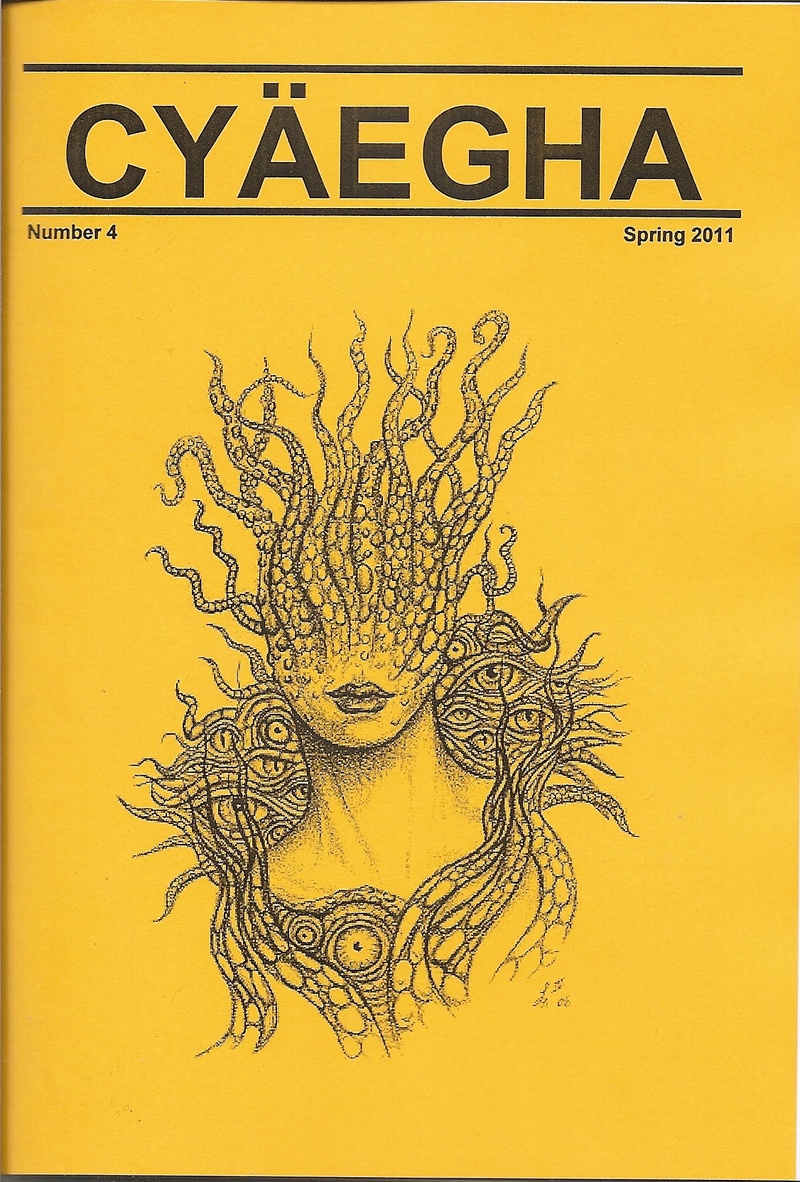
I’m certainly not putting myself on a par with Jeunet or del Toro, but, as it’s the one area where I have some chance of knowing a deeper level of the story, I’ll bring in a couple of examples from my own writing. Some time ago, I decided I wanted to write a Lovecraftian story, and worked hard on coming up with a plot that, to me, summed up the essence of what Lovecraft’s fiction meant to me, in terms of the implications of its world and worldview. This was eventually published (“Zathotha”, in Cyäegha #4 in 2011). I was completely unaware, till I was re-reading it some time after it was published, that I’d in fact reproduced the plot of my favourite Clark Ashton Smith story, “The Double Shadow” — both feature characters carrying out a magical ritual they don’t understand, that leads to the ineluctable approach of an entity that absorbs its victims, and nothing can be done to stop it.

To give another example, I used the idea of a phantom staircase that appears only at certain times, in The Fantasy Reader. I came up with the idea while playing about with the sort of thing that happens in dreams — I have loads of dreams where I find myself in a small house or apartment that, despite its limited size, has endless rooms with doors that open onto other rooms with more doors, and so on, with even the occasional staircase leading to yet more rooms and doors. It was only well after I’d started working with the idea that I remembered it was also in David Lindsay’s second novel, The Haunted Woman. It’s a book I’ve read loads of times, and I even run a website about Lindsay, so, no court of law would ever accept that I hadn’t taken the idea from him, and I’d certainly be happy to say that I had, and it may be I did, unconsciously, but my feeling is I took it from the same place where he, perhaps, found it.

Both del Toro and Jeunet are, even by directorial standards, outright cinephiles, and both not only talk about their influences, but include tributes and references to much-loved films in their work. (The Shape of Water and Amelie both contain scenes set in cinemas.) I have a feeling Jeunet’s reaction may be more emotional than rational — perhaps he saw someone doing the sort of thing he considers his territory, and getting a lot of plaudits, and felt left out. I can certainly understand that. As I say, I like both directors, and would like to see both in the best light.
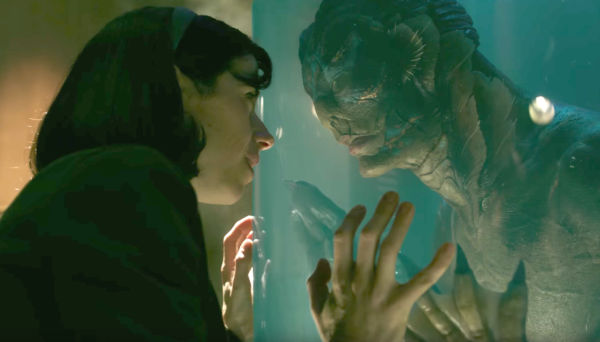
Anyway, The Shape of Water is a very nice film. I didn’t find it as intense as Pan’s Labyrinth, though it has a lot in common with that film. But it’s definitely the sort of film I’ll want to watch a few more times and really get to know — as I have, and will continue to do, with Pan’s Labyrinth, as well as Amelie, and Delicatessen.
^TOP

The Birds

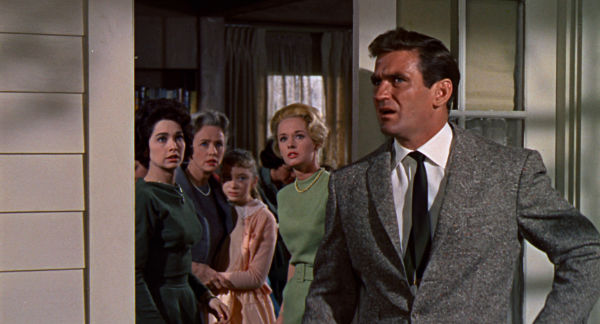
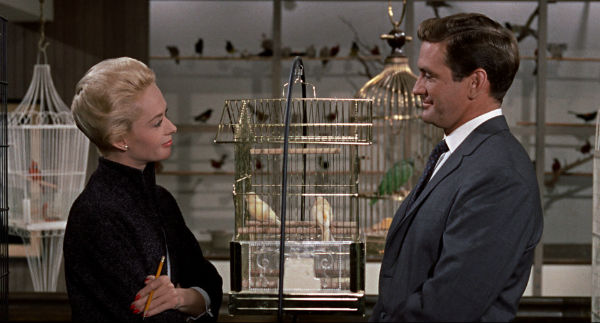
It starts with Mitch Brenner (played by Rod Taylor of George Pal’s The Time Machine) trying to buy a pair of love-birds for his kid sister. But, in a way, all the birds in Hitchcock’s 1963 film are love-birds. Most of them, though — the un-caged ones — are furies of the repressed, denied, and frustrated forces of love. On the one hand, The Birds is a horror film about the possible end of the human race in a war with a hundred billion birds; on the other, it’s about a mother and her new potential daughter-in-law learning to relate to one another. Seen in this way, it’s even got a happy ending.

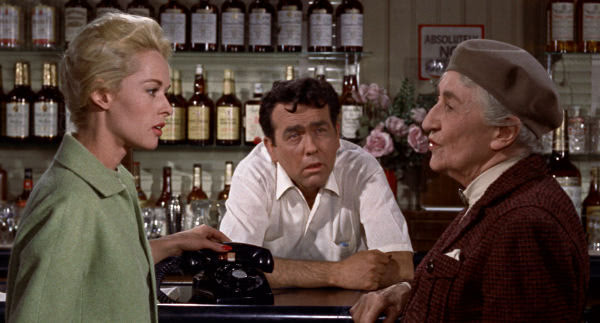
When Mitch goes to the pet-store to buy his kid sister a pair of precisely modulated love-birds (“I wouldn’t want a pair of birds that were too demonstrative… At the same time, I wouldn’t want them to be too aloof…”), the only thing that catches his eye is Melanie Daniels (Tippi Hedren), a bird of a slightly wilder variety. (She has a gossip-column reputation involving an incident in a fountain in Rome, where she was enjoying La Dolce Vita.) The two engage in a poker-faced battle of wits, ending with Melanie, determined to get the upper hand, buying the love-birds herself and delivering them by hand to Mitch’s city apartment. But Mitch has a carefully compartmentalised private life: he spends his bachelor weeks in San Francisco, and his weekends at Bodega Bay, where he lives with his mother and sister. This particular bird has flown, so Melanie sets out after him.

At the bay, the bird attacks come at emotionally significant moments. The first occurs after Melanie has boated across the bay to sneak the love-birds into the Brenner family home. Heading back, she sees Mitch find the birds and run out of the house. She lets herself be seen, and the two adopt the sort of expressions you’d expect from a duelling early-stage couple in a screwball-comedy, each trying loftily to pretend they’re not that interested in the other. Then the first of our furies swoops down to gouge into Melanie’s perfectly-coiffured head.

The next incident — not an attack, but significant all the same — comes when Melanie has taken a room for the night with local schoolteacher Annie Hayworth. Annie is a previous pretender to the title of Mrs Mitch, and knows what stands in the way: Mitch’s widowed mother, Lydia, who’s terrified of being left alone because she let her now-dead husband do all the emotional-warmth side of things, and now finds she has nothing but criticism and disapproval to keep the family together. Just then, there’s a knock at the door, and as both women are thinking of Mitch, they perhaps hope it might be him. But no, it’s a bird. It’s just killed itself slamming into Annie’s front-door.

The third attack is at a kids’ party. Mitch’s little sister Cathy (played by Veronica Cartwright, who’d survive all these killer birds only to fall prey to a xenomorph in Alien) and her friends are playing in the garden while Mitch and Melanie go off a little way to have their first unguarded conversation (in a scene written entirely by Hitchcock himself). Here, we learn that Melanie’s mother abandoned her when she was young, leaving her scornful of the very idea of mother-love. Which makes it doubly difficult if she’s going to try to fit into Mitch’s family: Melanie is a woman who does not want a new mother; Lydia, apparently incapable of love, does not want a new daughter; but both want Mitch, so who’s going to give way? The couple return to the party and, charged as they are with this stirring-up of old, difficult emotions, induce a bird attack. The birds swoop down on the kids, as though to underline the point that all of the coming violence and trauma is rooted in childhood vulnerabilities.

Mitch tries to convince Melanie to stay in Bodega Bay, and Lydia does her best, within civilised bounds, to encourage her to leave. A swarm of sparrows burst in through the fireplace (the hearth being the heart of the home), and wreck the living room. It’s like a poltergeist visitation — pent-up, unconscious forces lashing out with no control. The next day, Lydia goes to see a neighbour to discuss the fact that neither of their chickens are eating. She finds him dead, with his eyes pecked out. It’s a (literally) pointed reminder about her dead husband, and all the reasons she has to fear Melanie’s influence on her family.

Now the attacks become more frenzied and destructive, as though the forces let loose by Melanie’s arrival in Bodega Bay — the warring unconscious wraths of Melanie and Lydia — have given up trying to be specific and personal and are now just going to flail about, smashing everything in sight. Cars blow up, men catch fire, horses run wild, everybody’s screaming. A mother at the café skewers Melanie in an outburst that only makes sense if you think of her as somehow being possessed by Lydia’s dark half, giving vent to what that ultra-controlled, over-cool woman really wants to say to her new potential daughter-in-law:

“Why are they doing this? Why are they doing this? They said that when you got here the whole thing started. Who are you? What are you? Where did you come from? I think you’re the cause of all this. I think you’re evil! Evil!”

By now Melanie’s only rival Annie is dead and everyone’s in retreat. Holed up at the Brenner house, Melanie has that peculiar horror film urge to go upstairs, alone, to investigate the noises coming from a room (a child’s room?), whereupon she finds herself locked inside it with a tempest of birds, lashed and scratched and screeched at till she’s almost catatonic.

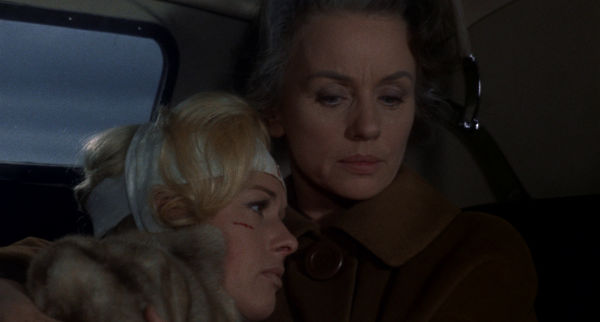
And it’s at this point, finally, that the new family starts to gel. As they leave the house and get into the car, Melanie squeezes Lydia’s wrist and Lydia responds with a smile. It’s only when they’ve both been terrorised to the point of trauma, and the house has been wrecked, that the two women can, at last, begin to relate to one another. Melanie, babyish with speechlessness, has gained a mother, and Lydia, forced to flee her wrecked and violated home, has found the ability to show this new daughter a hint of affection.

From one point of view, the world is on the verge of an apocalyptic war between birds and humans. From another, what we’re seeing is the Brenner family’s true inner landscape revealed — a world filled with small but fierce, barely quiescent furies of thwarted and frustrated love, which everyone must tiptoe around, like so many sharp-beaked family secrets. Cathy brings along the love-birds, and perhaps we can now understand Mitch’s wish to give his kid sister an example of love in its not-too-demonstrative, not-too-aloof form: just look at what repression, possessiveness and jealousy does to the place.

(Mrs Bundy, ornithologist:) “Birds are not aggressive creatures, miss. They bring beauty into the world. It is mankind—”
(Waitress, in the background:) “Sam—three southern-fried chicken!”
“—It is mankind, rather, who insists upon making it difficult for life to exist on this planet.”

^TOP

Walkabout

I said in my Mewsings about the 1988 film Paperhouse that I couldn’t think of many children’s books that, when adapted to the big screen, turned into films for adults, but Nicolas Roeg’s Walkabout from 1971 is another to add to the list, as it’s based on James Vance Marshall’s adventure novel for kids, first published in 1959 as The Children, and later retitled Walkabout.

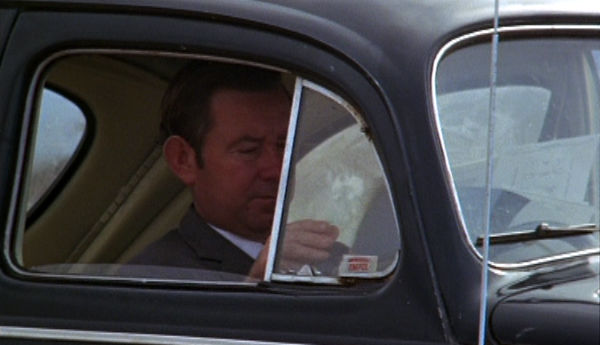
A key difference between the novel and the film is how the children (Americans in the book) find themselves alone in the outback. In the book, Peter and Mary are in a plane crash, whereas in the film (where they’re unnamed), they’re driven to the outback by their father who suddenly starts shooting at them, before setting his car on fire and killing himself — a major change, and certainly part of what takes the film away from being suitable for a young audience. (Though “Hansel and Gretel” starts in a similar way, with a father deliberately abandoning his son and daughter in the woods to starve.)

That infanticidal/suicidal beginning always makes me think of the 60s counterculture’s idea that you should never trust anyone over thirty; also its feeling that modern life was a stifling, dehumanising treadmill that could only end in this sort of psychotic breakdown. Walkabout is very much a film that belongs to the immediate aftermath of the 60s, being at once a product of it and a commentary on it. (As was Roeg’s co-directorial debut, Performance, but I’d also group it with Barbet Schroeder’s La Vallée, a.k.a. Obscured By Clouds, which, like Walkabout, features a small group of drop-outs from the West seeking a deeper connection to life through exposure to a tribal culture.)

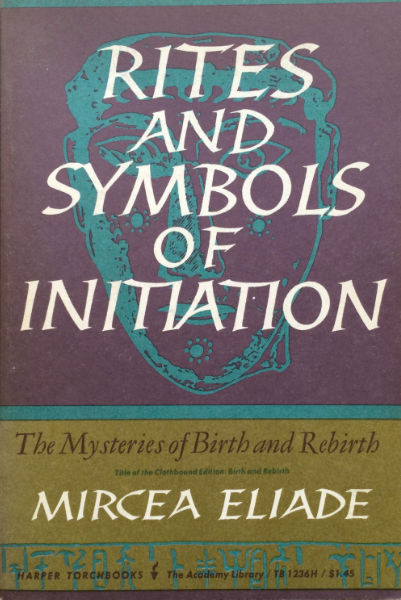
“It has often been said that one of the characteristics of the modern world,” wrote Mircea Eliade in his 1958 book on the subject, “is the disappearance of any meaningful rites of initiation.” Walkabout is about the rites of passage children undergo to become adults. The Aborigine who helps the schoolgirl and her brother is in the midst of his own initiatory trial, as explained by a title card at the start of the film:

“In Australia, when an Aborigine man-child reaches sixteen, he is sent out into the land. For months he must live from it. Sleep on it. Eat of its fruit and flesh. Stay alive. Even if it means killing his fellow creatures. The Aborigines call it the WALKABOUT.”

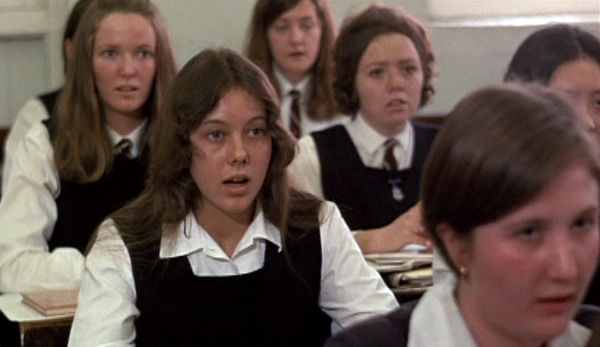
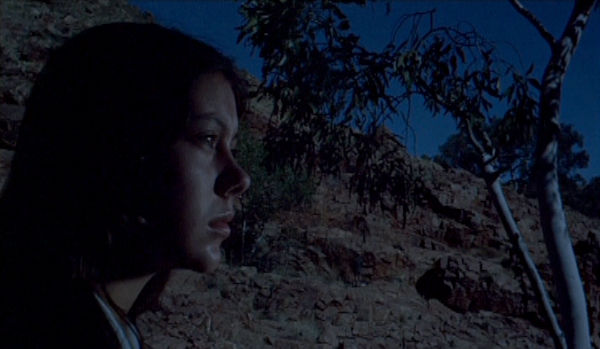
We first see Jenny Agutter’s character engaged in the West’s equivalent, school. She and the rest of her class, sitting in neatly ordered production-line rows, are practising their speech lessons, which seem remarkably like a sort of primitive rhythmic chant. Later, she tunes to a radio programme instructing her on her tribe’s complex eating rituals: which knife and fork to use when eating fish, and how to cover up if you inadvertently pick up the wrong ones.

By this time, we’ve already glimpsed her father sitting alone in the concrete desert between office blocks, and her mother at home preparing dinner, listening to a radio programme describing how a bird called the ortolan is kept in a box, force-fed grain, and drowned in cognac as a delicacy for gourmets. (In contrast to which, we later see the Aborigine youth hunt, kill, prepare and cook animals, as well as use, for instance, the fat of one of them to soothe the young boy’s sunburn.)

The father (played by John Meillon, who’d later play Crocodile Dundee’s duffer of a business partner, Wally, which makes it even worse that he’s about to start shooting at his children) drives his kids into the desert and, while the boy plays and the girl sets out picnic dishes, reads a report on Structural Geology, as though, even in the midst of the splendour of the outback, he can only relate to his environment as a tabulated business proposal. Spiritually, he’s running on empty, and the car’s almost out of petrol, too. The schoolgirl gives him a slightly worried look, as though she’s half expecting something to happen. Even when he starts shooting, she doesn’t seem entirely surprised — nor too traumatised after it’s happened. (I have to say that one of the things that makes the film slightly difficult, for me, is how she generally doesn’t show much emotion throughout, considering the peril and trauma she goes through. Perhaps it goes to prove how thoroughly initiated she already is in her own stiff-upper-lip culture.)

But even the father’s insane actions have a place in the children’s rites of passage. As Mircea Eliade says, in Rites and Symbols of Initiation:

“Now, suddenly, they are torn from their blissful childhood unconsciousness, and are told that they are to die, that they will be killed by the divinity. The very act of separation from their mothers fills them with forebodings of death—for they are seized by unknown, often masked men, [and] carried far from their familiar surroundings…”

“The universe that the novices now enter is that of the sacred world,” Eliade goes on to say, and the world the schoolgirl and her brother find themselves in is weird and alive, beautiful and deadly, as though supernaturally charged. It’s teeming with life: flies, ants, grubs, locusts, lizards, snakes, birds, kangaroos, camels, and even one desert-venturing wombat.

It’s harsh, too. A few days into their adventure, dehydrated and exhausted, the children find a waterhole, and immediately use up the precious water not just in drinking but in pointlessly washing themselves and their clothes. The next day, they wake to find the water all gone.

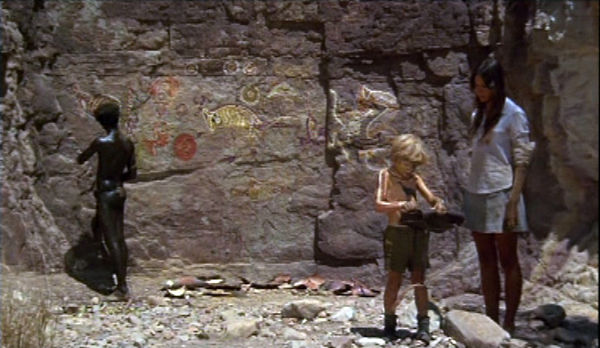
It’s at this point the Aborigine youth turns up, throwing spears at a lizard. (Later, while this young man makes more spears, the schoolboy boasts that he can multiply 84 by 84, his nearest equivalent skill.) The schoolgirl asks him, rather embarrassingly, “Where do they keep the water?”, as though this were a park with facilities, not a wilderness. And all she can do is ask — it’s up to her young brother, not yet entirely educated out of touch, to get the message through by acting it.

Whenever I watch Walkabout I expect it to be about two Western children gaining a deeper connection to the primal forces of life through sharing in an outback rite of passage, but that’s not what actually happens. The schoolgirl seems quite happy not to learn any of the skills she needs to survive in the outback, and clearly expects to be taken back to Western civilisation by the straightest route possible.

What of the Aborigine youth? At one point, walking atop a ridge, he passes right by a white woman, making no attempt to let the schoolgirl know she’s just yards away from her own folk. Instead, he takes her and her brother to an abandoned house. The girl, after her initial disappointment that there’s no one there to take her and her brother back to their own civilisation, immediately starts turning it into a home. She and the youth move about inside it, avoiding eye contact, suddenly distant in this confined space. At the slightest hint of her own world, she’s back to being a Western would-be housewife, and the youth seems a bit nonplussed.

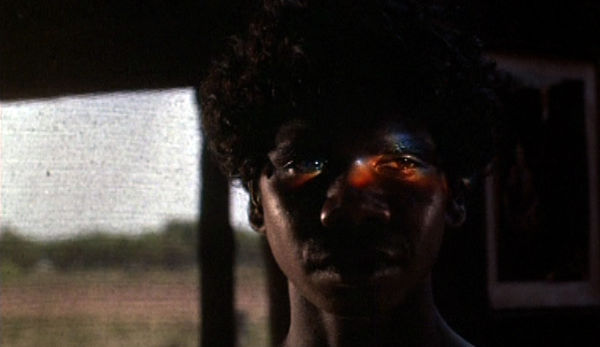
My interpretation of their parting is different from others I’ve read. The Wikipedia article on Walkabout, for instance, says that the Aborigine starts to perform a mating ritual to try to win the schoolgirl over, but my reaction (and this isn’t based on any knowledge whatsoever) was that it wasn’t a mating ritual but a farewell. Just beforehand, the youth goes hunting and sees some white men shooting their prey with rifles. Disgusted, he wanders off — ignoring the schoolgirl when he passes her — to lie among some animal bones. It’s as though he’s trying to come to terms with the idea that white men belong to a different, more savage and strange society, and the schoolgirl is one of them, so he’ll have to leave her. Returning to the house, daubed in white to make himself look like a skeleton, he starts a rather spooky dance which, to me, doesn’t have as much a suggestion of a mating ritual about it, as it does a sort of exorcism. Seeing the film for the first time, I assumed this meant he was saying goodbye to her — ‘dying’ to her metaphorically, while perhaps also trying to scare her from the house, to move her on her way. His jerky stares seem more alienating than inviting. Which isn’t to say his dance doesn’t have a sexual element, but that element may be to add to its magical potency.

When the schoolgirl and her brother find him the next day, suspended from the branches of a tree, I assumed he wasn’t literally dead, but was ‘dead to them’, and was going to stay like that till they left. But the general interpretation seems to be that he is actually dead, and that he died by — what? — dancing himself to exhaustion? Then hanging himself up in the tree?

Is he dead? His body’s in the same position as the father’s corpse was earlier in the film, arms outstretched amidst the limbs of a tree. But neither the schoolgirl nor her brother seem very shocked to see the youth like this. (Though this may be yet more ingrained impassivity from the schoolgirl.) They don’t bury him. The girl just brushes some ants from his body. Neither, though, do they tell him to snap out of it. (I’m sure his face twitches as they walk away, though.) Maybe I just don’t want him to be dead. (In the novel, after all, he catches flu from the children and, having no immunity, dies.)

Really dead or not, though, it’s the end of the trio’s time together. The schoolgirl and her brother walk to a nearby road, and head back to their own world. At the end of the film, we see the girl, now grown up (wearing make-up and smoking a cigarette), in exactly the same situation as her mother was in at the start of the film — a housewife in an apartment, preparing a meal for her husband, who comes home and tells her he’s up for a promotion. For a moment, it’s as though nothing has changed. And if the girl is in the same situation as her mother, does that mean her husband will one day take their children out to the desert and shoot them, too? But then we have a glimpse inside her head. Part of her is still in the outback, with her young brother and the Aborigine youth, swimming in a pool. Perhaps something in her was affected by her time in the outback, after all…

It seems to me Walkabout is doing its best to conjure some hope from the end of the 60s counterculture’s attempt at a revolution. It’s the 70s now, and the hippies and drop-outs have had to grow up and get jobs, and they’ve found that the only way to do that is to fit in with the existing system, become one with the never-to-be-trusted over-thirties. But, like Jenny Agutter’s character, who has a piece of her outback experience permanently (if deeply) lodged inside her, those hippies and drop-outs at least glimpsed an alternative, and even if they’re not living the revolutionary dream, at least something inside of them isn’t given wholly over to the Capitalist treadmill. Their revolution didn’t succeed, but it wasn’t entirely defeated, either.

^TOP