
Twin Peaks

Twin_Peaks_BluRayIf you plotted the quality of Twin Peaks, you’d come up with a twin-peaked graph: it started brilliantly, and ended well, but dipped somewhat in between. In an ideal world, it wouldn’t have been a parody soap opera about the town in which Laura Palmer was murdered, it would have been a weird crime series, following the adventures of David Lynch’s FBI, a bunch of borderline-shamanic all-American good boys investigating the dark forces behind the most terrible crimes. (Which sounds like a cue for The X-Files, a couple of years later.) Certainly, what drives the pilot and early episodes is following Special Agent Dale Cooper (who I like to imagine as Kyle McLachlan’s character from Blue Velvet, grown up) as he uses a combination of acute observation, sharp deduction, dream-clues, intuition and sortilege (naming possible suspects then throwing stones at a bottle, seeing which one hits) to solve the mystery of Laura Palmer’s murder. Most of the parallel plots that were unrelated to the murder — the whole tangle of insurance & blackmail surrounding the burning of the Packard Mill, the mostly unfunny comedy of super-strength Nadine’s regression to her teenage-years — I could have done without.

David-Lynch_MJEBut, I’m a David Lynch fan (though a rare one, in that I like Dune but don’t like Eraserhead), and what made me re-watch the show for the first time since it was on TV wasn’t a desire to revisit the characters or world of Twin Peaks, but a desire to revisit David Lynch and his world. For me, creative as the others can be, the episodes Lynch directed stand out. The question is why. There’s a scene in the final episode (directed by Lynch) that’s nothing but a slow advance down an empty corridor, yet somehow it’s full of brooding tension. Or take another scene, this time at the end of the pilot episode, when Laura’s mother has a vision of a hand retrieving a necklace that’s been buried in the woods. Her sudden panicked reaction makes it seem like some sort of horrendous psychic violation is taking place. What Lynch brings to these scenes isn’t just in the scenes themselves, but the world he creates around them, one in which there’s a constant potential for reality to rip open and reveal something behind it, something full of irrational terror. His world is beset by a constant note of anxiety that adds meaning, or the threat of it, to the most mundane moments. It’s one of Twin Peaks’ most notable characteristics that, though it’s mostly played as a quirky comedy, it contains moments of genuine horror. But it isn’t a horror-comedy as, say, Shaun of the Dead is. Rather, the horror is made all the more horrific by being couched in such light comedy. And what’s different in Lynch’s episodes is that, while others might contain the same quirkiness (Dale Cooper coming face to face with a llama) or directorial inventiveness (a long, slow zoom out of a hole in a wall-tile), none of them catch the uppermost peaks of outright terror or downright strangeness that Lynch does.
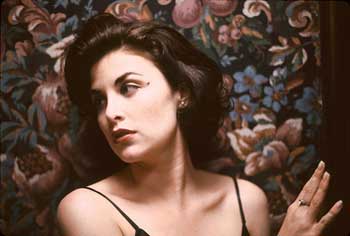
twin_peaks_audrey

Throughout Lynch’s work, innocence is always coming face-to-face with horror — and, in his best work, not just coming face-to-face with it, but being corrupted by it, and then, crucially, coming through that corruption to a new, more profound and hard-won innocence, a redemption or a rebirth. This type of story is only ever played out lightly, if at all, in the TV series (whose characters, in line with most comedy, don’t really change), but it’s the core of the 1992 film, Twin Peaks: Fire Walk With Me. In my view, the TV series is utterly blown away by the film, which is one my favourites, along with Blue Velvet, Lost Highway, and Mulholland Drive. (Having just watched it again, after watching the whole run of the TV show, I found I’d enjoyed it more when I watched it standalone, away from the TV series.)

twin_peaks_ring

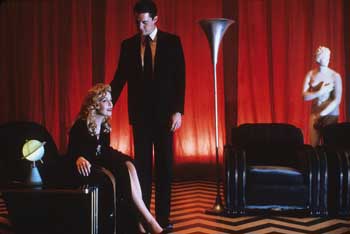
Lynch’s own view of the relationship between the TV series and the film is perhaps best expressed by the very first shot of Fire Walk With Me, in which a TV set, showing only static, is smashed by a baseball bat. Fire Walk With Me is Twin Peaks freed of its TV fetters. The opening half-hour — a further episode in the adventures of Lynch’s FBI boys, this time Chris Isaak as Special Agent Chester Desmond — is set in an out-of-the-way nowhere-place that’s all the town of Twin Peaks isn’t: its sheriff, unlike donut-noshing Harry S Truman, is utterly unhelpful and actively obstructive to the FBI (a deleted scene shows a fist-fight between him & Chester Desmond), the diner is manned not by former Miss Twin Peaks Norma Jennings, but fag-in-the-mouth cynic Irene, and the main residential area isn’t Twin Peaks’ upper middle-class suburbia but a rundown trailer park. The film still has the TV series’ surrealness and some moments of quirky comedy, but it has darkness in oodles — in nerve-jangling, nail-baiting, razor-laden dollops, until it’s almost too much to take. Twin Peaks: Fire Walk With Me is one of the most harrowing films I’ve ever seen, but one that nevertheless keeps me watching, and leaves me, at the end, feeling I’ve been through a genuine catharsis.
twinpeaks_fwwm

In it, Lynch raises Laura Palmer from being the clichéd beautiful murder victim of a serial killer to sort of a scapegoat, a victim of the disconnect between the town of Twin Peaks’ cosy surface and its dark underside. Caught between having to play the homecoming queen and dealing with the horror of abuse by the demonic Bob (whose supernatural nature can be taken as her own refusal to see who’s really abusing her — though this is a position undermined by the less ambiguous TV series), what sense of self she has grows thinner and thinner, till she has to say to her best friend: ‘Your Laura has disappeared. It’s just me now.’ It’s a drama that can only be resolved by switching from the normal reality of Twin Peaks (all cherry pie and damned fine coffee) to the weird, dreamlike otherworld of the Red Room, where the White Lodge and the Black Lodge are battling for her soul. Or are they working together for her redemption? It’s characteristic that Fire Walk With Me has less of the good-versus-evil, White Lodge-versus-Black Lodge feel to it: Red Room, White Lodge, Black Lodge — the alchemical significance of the colours Laura passes through is perhaps the key here, not the sort of duality the TV show was setting up.

^TOP

Neither the Sea nor the Sand by Gordon Honeycombe

Honeycombe_NTSNTSAnnie Robins, in her first venture away from an unloving mother and stroke-disabled father, travels on a whim to St Helier, Jersey, and there, despite her ‘unsociable, solitary nature’, falls deeply in love with Hugh Dabernon, seven years older but of a similarly solitary nature. They move in together, first into the house Hugh shares with his disapproving brother George, then into their own, more solitary home, above the island’s coast near the lighthouse at Corbière. Wanting, somehow, to get even further from human society, they take an unseasonal holiday in the far northwest of Scotland, and there, on a beach, Hugh drops dead. He gets up again some time later, but he’s still dead. Dumb (because breathless), blind to all but Annie (his gaze follows her even when she’s in another room), he does his limited best to obey the commands of the one and only love of his short life, though he can barely climb stairs. It’s all that Annie, in her distress, can do to get him home to Jersey, thinking there everything will be alright. When it isn’t, she calls George Dabernon, hoping he’ll know what to do with this dead-yet-not-dead brother, but she doesn’t get the response she hoped for:

‘It was the worst moment of George’s life, for it was unexpected, inexplicable, and tinged with blasphemy. Appalled at this resurrection, he gaped at the two of them…’

GordonHoneycombe

Gordon Honeycombe

This is a strange book, of just the sort of strangeness I like. It’s one, I can’t help feeling, that could only have been published before the Stephen King-led horror boom of the 1970s (Neither the Sea nor the Sand first came out in 1969), after which, commercial pressures would have skewed it more to outright horror than the ambiguous weird it is. Though it does feature a walking corpse, it’s not really horror; nor is it properly a love story, though love is the driving force. Whatever it is that binds Annie and Hugh together, the novel is more about Annie’s attempt to catch up with her always-just-out-of-reach Hugh, who is older, taller, more knowledgeable, more adventurous, and more robustly solitary than she is. The book opens with her trailing behind as he clambers up a steep hill in the Scottish wilds and she can barely keep up. Later, even when it’s he (now dead) who’s following her, the feeling is that he’s gone ahead, this time into death, though there’s a lingering part of him drawn back to her, as though she, or her love for him, were a lighthouse shining into the dark realm where he’s fallen. (The image of a lighthouse haunts the book, as does the sea.) The book is full of sequences of Annie following Hugh or Hugh following Annie, with one trailing behind, trying to catch up — right to the end, when we, as readers, follow a policeman, a doctor, a boy and a dog, who are following Annie, who’s following Hugh…

When we’re not following Annie or Hugh, we’re usually in the presence of some other character or (more often) pair of characters — a farmer and his wife, a GP and a neurologist, a policeman and his son — trying to understand what’s going on. They make no headway, whether they use common sense (the farmer and his wife), religious dogma (brother George), medical knowledge (the GP and the neurologist) or logical deduction (the policeman and his son). Annie, on the other hand, accepts Hugh’s return without the need to understand it, and it’s only when she has a moment of rational clarity, and sees him for what he is — a corpse, still walking — that she reacts with horror, and falls her furthest behind. Love, for these two, has to remain a shared irrationality, a thing that exists on the border between life and death, not at all a clearly-defined or explicable thing, which is perhaps why the pair need such solitude, as then there’s no need to explain. Annie comes through — after falling into her own death-like state, as though to experience this new way of being that Hugh has discovered — and finally finds a way of catching up with the man she loves.

NTSNTS_film02

Neither the Sea nor the Sand was the first novel of Gordon Honeycombe, best known as a newsreader for ITN in the 1970s, and for TV-AM in the 1980s, though a quick glance at his site’s biography reveals him to be a man of many accomplishments: an actor on stage (including with the RSC) and screen, a theatre director, adapter, writer, a TV and radio presenter. I can’t remember what brought me to this novel, but I was prompted into re-reading it when I recently found it had been filmed, in 1972. Honeycombe is credited with the screenplay (additional dialogue by Rosemary Davies). The main change is that Anna, played by Susan Hampshire, isn’t fleeing loveless parents but a collapsed marriage. This, for me, strikes the wrong note, as part of the reason the book works is that Anna is so young, vulnerable, innocent, and wilfully self-blinded to anything but the desperate fact of her one true experience of love, you can believe her unwillingness to accept Hugh’s death because she so needs it not to be true. The film’s Anna seems more down-to-earth, and the uniqueness of the bond between the two becomes that much less charged with whatever anguished power it is that draws Hugh back from the dead. Still, it’s an interesting film, part 60s in style, part 70s. Ex-Doctor Who companion Michael Craze is in it. It was retitled The Exorcism of Hugh in the US.

NTSNTS_film01

^TOP

Demons by Daylight by Ramsey Campbell

Cover to Demons by Daylight (Star)I’ve always been fascinated by the moments when artists and writers first find themselves, when they move out from the shadow of early, formative influences to speak with their own voice. Ramsey Campbell’s shift from taking Lovecraft as the defining mode & tone of horror fiction (as in his first collection, The Inhabitant of the Lake and Less Welcome Tenants) to something much more personal and of its time in his second collection, Demons by Daylight, is one of the better-documented, most notably by Campbell himself.

Demons by Daylight came out from Arkham House in 1973, though most of the stories were written by 1969. So different was the approach, Campbell felt that, though he might have been doing something entirely new in horror fiction, it could be that no one else was doing it because it wasn’t going to work. But some people got it, including T. E. D. Klein, who wrote an ‘extraordinary piece in Nyctalops, in which basically he identified everything I wanted to be in the book in the first place’ (as Campbell says in a lengthy interview in Necronomicon Press’s booklet, The Count of Thirty), and which proved ‘sufficiently encouraging to make me attempt to try to make my living from writing.’

What makes the shift between the Lovecraftian stories in The Inhabitant of the Lake to those in Demons by Daylight so pronounced is that it wasn’t just one thing that changed: it wasn’t only the style (from wordy mock-Lovecraft to something a lot more literary and impressionistic), or the storytelling approach (structured crescendoes of Gothic horror to jump-cut art-house snippets, more like the realistic cinema of the day in tone), or the themes (from cosmic horror to something rooted in human psychology, and human relationships), it was all three. It could seem that Campbell was deliberately going as far from Lovecraft in every direction possible, but I think what he was doing was making the very necessary shift from basing his writing on what he’d read, to his actual experience of life (the Inhabitant of the Lake stories were all written before he was 18). Also, by having a wider artistic palette to choose from. (Campbell mentions his discovery of Nabokov as being the second great revelation of his reading life, after Lovecraft.)

Cover to Demons by Daylight (Arkham House)Changing so much means a lot of experimentation, and Campbell talks of spending ‘the first couple of years basically getting it all wrong’, having to draft and re-draft stories till they worked. I still find some of the stories in Demons by Daylight don’t, quite, for me. This could be because many still use the Lovecraftian device of having the final sentence provide a sort of release or clarification of the horror — or seeming to do so. But whereas Lovecraft’s tales were structured to feed all their clues into a single, horrific revelation at the end, Campbell’s can be too impressionistic for this to work in the same way. (‘The Stocking’ is one that left me wondering what I’d missed. Is its final sentence a further twist, or just a cut-off point?) The real heft of Campbell’s stories isn’t in that final impact, but the overall impression: a whole psychological reality, not a single horrific fact.

It’s the themes, not the techniques, that make Demons by Daylight. These are not, in the main, tales of cosmic horror. Though ‘The Franklyn Paragraphs’ is still quite Lovecraftian — S T Joshi has called it ‘the summation of Campbell’s Lovecraftian work’ (in an essay in The Count of Thirty) — with its documentary style, its inhuman horrors, and it being based on the correspondence between two authors (recalling Lovecraft’s ‘The Whisperer in Darkness’), but it’s also the most stylistically varied of the Demons stories, with its narrator (Campbell himself) quoting Errol Undercliffe’s letters (one of which is written while drunk, and which ends with a parody of Lovecraft’s cut-off narrative, in this case not for the monster to come in and kill the writer, but for the inebriated Undercliffe to be sick), and quotes from Roland Franklyn’s book of supernatural revelations. It also has a highly Aickmanesque scene where the narrator meets Franklyn’s widow, who talks offhandedly about the supernatural events she’s witnessed, and which she’s fed up of having to live with. They’re more of a bother to her than a dark revelation.

cover to The Count Of ThirtyThe chief theme of Demons by Daylight is repression. Campbell’s characters are trying to grow, change, and find themselves, but are caught in stifling social and emotional nets. (A fitting theme for a book about Campbell writing himself out of his Lovecraft-shaped cocoon.) The horror emerges, all too often, as a bursting out of far-too-repressed emotional forces. So, in ‘Made in Goatswood’, the rather pagan-looking garden gnomes the narrator buys his Christian girlfriend end up dragging her off and assaulting her in a pagoda where she’d previously cut short his own advances. And ‘The Second Staircase’ has the protagonist vicariously — and helplessly — participating in a similar assault, an expression of his own repressed desire. The forces of repression themselves aren’t supernatural — they’re parents, parents-in-law, girlfriends, teachers. What’s repressed, though, emerges in supernatural ways. The source of the horror is inside the characters, not, as with Lovecraft, in the deepest abysses of space & time.

As well as being part of Campbell’s own writerly and personal journey, this bursting free of repression was part of the times. Here, Campbell engages directly with the Liverpool and London of the late 60s, and its changing social mores. There are references to films of the time, pop music, and the counter-culture. T. E. D. Klein’s review said that drugs were the key to Demons by Daylight, but Campbell says he’d ‘never gotten anywhere near drugs at that point’. The opening story, ‘Potential’, is about this very fact, about ‘being this sort of suited figure on the periphery’. (The story’s be-suited protagonist turns up at a rather disappointing ‘Be-in’, but gets invited to something far darker.)

For me, the best tale in the book is ‘The Guy’. It feels the most fully-formed as a story. Whereas the other Demons tales end on jarring eruptions of horror, this is about a man who’s lived with a single moment of horror all his life, and has even made it a positive part of his own purpose. ‘The Guy’ is about a friendship between two boys from different social classes, with the narrator learning to overcome his middle-class parents’ prejudices. It’s the sort of story, you can’t help feeling, that Lovecraft himself — hidebound by his own social prejudices — could never have written, but this aspect of it doesn’t feel at all like a reaction against Lovecraft; it emerges naturally from the story itself. Which is, I suppose, the surest sign of a writer having shrugged off the more artificial props of formative influence to be himself.

cover to Letters to ArkhamCampbell’s correspondence with Arkham House editor August Derleth, which covers the period of Campbell’s finding his own voice, has come out in hardback from PS Publishing this week, so it’ll be interesting to see what light that throws on Campbell’s formation as a writer.

^TOP
