
 If you plotted the quality of Twin Peaks, you’d come up with a twin-peaked graph: it started brilliantly, and ended well, but dipped somewhat in between. In an ideal world, it wouldn’t have been a parody soap opera about the town in which Laura Palmer was murdered, it would have been a weird crime series, following the adventures of David Lynch’s FBI, a bunch of borderline-shamanic all-American good boys investigating the dark forces behind the most terrible crimes. (Which sounds like a cue for The X-Files, a couple of years later.) Certainly, what drives the pilot and early episodes is following Special Agent Dale Cooper (who I like to imagine as Kyle McLachlan’s character from Blue Velvet, grown up) as he uses a combination of acute observation, sharp deduction, dream-clues, intuition and sortilege (naming possible suspects then throwing stones at a bottle, seeing which one hits) to solve the mystery of Laura Palmer’s murder. Most of the parallel plots that were unrelated to the murder — the whole tangle of insurance & blackmail surrounding the burning of the Packard Mill, the mostly unfunny comedy of super-strength Nadine’s regression to her teenage-years — I could have done without.
 But, I’m a David Lynch fan (though a rare one, in that I like Dune but don’t like Eraserhead), and what made me re-watch the show for the first time since it was on TV wasn’t a desire to revisit the characters or world of Twin Peaks, but a desire to revisit David Lynch and his world. For me, creative as the others can be, the episodes Lynch directed stand out. The question is why. There’s a scene in the final episode (directed by Lynch) that’s nothing but a slow advance down an empty corridor, yet somehow it’s full of brooding tension. Or take another scene, this time at the end of the pilot episode, when Laura’s mother has a vision of a hand retrieving a necklace that’s been buried in the woods. Her sudden panicked reaction makes it seem like some sort of horrendous psychic violation is taking place. What Lynch brings to these scenes isn’t just in the scenes themselves, but the world he creates around them, one in which there’s a constant potential for reality to rip open and reveal something behind it, something full of irrational terror. His world is beset by a constant note of anxiety that adds meaning, or the threat of it, to the most mundane moments. It’s one of Twin Peaks’ most notable characteristics that, though it’s mostly played as a quirky comedy, it contains moments of genuine horror. But it isn’t a horror-comedy as, say, Shaun of the Dead is. Rather, the horror is made all the more horrific by being couched in such light comedy. And what’s different in Lynch’s episodes is that, while others might contain the same quirkiness (Dale Cooper coming face to face with a llama) or directorial inventiveness (a long, slow zoom out of a hole in a wall-tile), none of them catch the uppermost peaks of outright terror or downright strangeness that Lynch does.
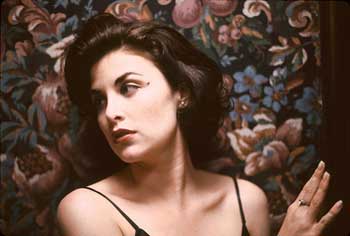
Throughout Lynch’s work, innocence is always coming face-to-face with horror — and, in his best work, not just coming face-to-face with it, but being corrupted by it, and then, crucially, coming through that corruption to a new, more profound and hard-won innocence, a redemption or a rebirth. This type of story is only ever played out lightly, if at all, in the TV series (whose characters, in line with most comedy, don’t really change), but it’s the core of the 1992 film, Twin Peaks: Fire Walk With Me. In my view, the TV series is utterly blown away by the film, which is one my favourites, along with Blue Velvet, Lost Highway, and Mulholland Drive. (Having just watched it again, after watching the whole run of the TV show, I found I’d enjoyed it more when I watched it standalone, away from the TV series.)

Lynch’s own view of the relationship between the TV series and the film is perhaps best expressed by the very first shot of Fire Walk With Me, in which a TV set, showing only static, is smashed by a baseball bat. Fire Walk With Me is Twin Peaks freed of its TV fetters. The opening half-hour — a further episode in the adventures of Lynch’s FBI boys, this time Chris Isaak as Special Agent Chester Desmond — is set in an out-of-the-way nowhere-place that’s all the town of Twin Peaks isn’t: its sheriff, unlike donut-noshing Harry S Truman, is utterly unhelpful and actively obstructive to the FBI (a deleted scene shows a fist-fight between him & Chester Desmond), the diner is manned not by former Miss Twin Peaks Norma Jennings, but fag-in-the-mouth cynic Irene, and the main residential area isn’t Twin Peaks’ upper middle-class suburbia but a rundown trailer park. The film still has the TV series’ surrealness and some moments of quirky comedy, but it has darkness in oodles — in nerve-jangling, nail-baiting, razor-laden dollops, until it’s almost too much to take. Twin Peaks: Fire Walk With Me is one of the most harrowing films I’ve ever seen, but one that nevertheless keeps me watching, and leaves me, at the end, feeling I’ve been through a genuine catharsis.
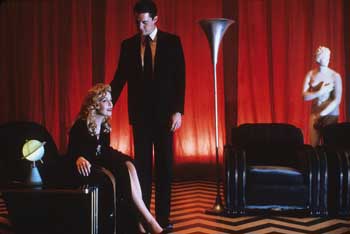
In it, Lynch raises Laura Palmer from being the clichéd beautiful murder victim of a serial killer to sort of a scapegoat, a victim of the disconnect between the town of Twin Peaks’ cosy surface and its dark underside. Caught between having to play the homecoming queen and dealing with the horror of abuse by the demonic Bob (whose supernatural nature can be taken as her own refusal to see who’s really abusing her — though this is a position undermined by the less ambiguous TV series), what sense of self she has grows thinner and thinner, till she has to say to her best friend: ‘Your Laura has disappeared. It’s just me now.’ It’s a drama that can only be resolved by switching from the normal reality of Twin Peaks (all cherry pie and damned fine coffee) to the weird, dreamlike otherworld of the Red Room, where the White Lodge and the Black Lodge are battling for her soul. Or are they working together for her redemption? It’s characteristic that Fire Walk With Me has less of the good-versus-evil, White Lodge-versus-Black Lodge feel to it: Red Room, White Lodge, Black Lodge — the alchemical significance of the colours Laura passes through is perhaps the key here, not the sort of duality the TV show was setting up.


