Salem’s Lot, the 1979 TV mini-series

I remember being terrified by this when I was a kid. Not the mini-series itself — I never saw it at the time — but the trailer. The trailer was all I needed. The thing that scared me most was a very brief glimpse of this ugly chap, Nosferatu in a blue mood:

He continued to scare me whenever I was home alone. I’d be about to move from one room to another when I’d suddenly think, “What if I opened the door and saw that standing there?” and instantly found myself making excuses to stay where I was till someone else came home. As a result, the first horror novel I read was King’s Salem’s Lot, perhaps in a (forlorn) attempt to quell the fear — forlorn because it immediately proceeded to scare me even more with its opening tale of Ben Mears’ childhood visit to the Marsten House, and what he saw there.

So, recently I decided to try and lay this particular ghost by getting the Salem’s Lot mini-series out on rental from LoveFILM. I expected to be disappointed, but wasn’t. The basic story (Dracula in small-town America) was handled well, the acting was good (a lot of competent character actors, including Kenneth McMillan as the town constable — who I mostly know as the pustulant Vladimir Harkonnen from David Lynch’s Dune — and of course David Soul and James Mason in the lead roles), but best of all it managed some nicely suspenseful, even spooky, moments. Perhaps because of the limitations of what was then allowed on TV, the gore count is low (to be measured in drops rather than modern-day bucketfuls), and there are very few of those tiresome false jumps every horror film or TV series feels duty bound to serve up at regular intervals (something which lost its appeal for me after a totally silly and irrelevant jump from an aggravated squirrel in Species, back in 1995). The Marsten House interior is an effective set (though it has its silly/surreal moment, when young Mark Petrie opens a drawer to find it full of glass eyes and a couple of live rats — why does he open the drawer in the first place? he’s looking for a vampire, not a pair of socks), and the ending has enough references to Psycho to assure you there’s someone who knows his horror films at the helm (Tobe Hooper, of The Texas Chainsaw Massacre and Poltergeist). A particularly good moment of the subtler sort of scare is when old schoolteacher Jason Burke hears an odd sound from upstairs, goes to investigate, and finds the corpse of recently-deceased Mike Ryerson gently rocking in a rocking chair. He stays like that for what seems an age before finally looking up with his scarily gleaming vampires eyes.

I wrote in an earlier post (“What’s the point of Renfield?”) that Renfield, in Dracula, is perhaps a necessary counterpart to the suave count. Where Count Dracula is cool, elegant, eloquent and scary, Renfield is disgusting, mad, pathetic and drivelling, and together the pair complete a portrait of a real vampire as both coldly reasoning and psychotic, cool on the exterior but wallowing in blood and filth in his mad moments. The TV mini-series of Salem’s Lot reverses the relationship. The mortal half of its villainous duo, Mr Straker (James Mason), is ultra-calm, drily witty, cultured, neatly dressed and surrounded by beautiful antiques; the vampire, Kurt Barlow, looks like a dead rat gone blue-skinned and hairless with rot, can’t speak, and is 100% monster.

But there are, as in Dracula, other vampires. In Stoker’s novel, these are women; in the mini-series of King’s novel, (at first, anyway, till the whole town goes vampirous) these are children. And this was the second most scary thing about the mini-series: those kids floating up to your bedroom window at night to scratch at the pane and ask to be let in, surrounded by reverse-motion smoke. Which is another way I used to spook myself when I was younger. If I woke up late at night, I’d find myself wondering what I’d do if I heard someone scratching at the window. Well, obviously not open it like these kids do. But simply seeing such a thing would have been bad enough.

It’s been a long time since I read King’s novel, so I can’t say how faithful to the book the mini-series is, but it was certainly faithful enough to remind me of reading the book a good 25-or-so years ago. Granted, it looks like a 70s TV mini-series, but I think that adds to its charm when seen nowadays — just like the HPLHS‘s old-style renderings of H P Lovecraft in their Call of Cthulhu and Whisperer in Darkness films, this is an authentically 70s-styled rendering of a 70s novel, and I’m glad I finally got to see it.

And, I have to admit, that though I started watching the first part (it’s in two hour-and-a-half parts) just before 9 o’clock at night, I had to watch an hour of normal TV afterwards before I felt unspooked enough for bed. And I watched the second part at 11 o’clock the next morning.

^TOP

Carmilla, and other spooky writings, by J S Le Fanu

“At the same time a light unexpectedly sprang up, and I saw Carmilla, standing, near the foot of my bed, in her white nightdress, bathed, from her chin to her feet, in one great stain of blood.”

Best Ghost Stories of J S Le FanuThis, from J S Le Fanu’s “Carmilla” (first published in 1872), is the image that launched a thousand horror films. It’s a characteristic moment for Le Fanu, whose scenes of supernatural horror often burst into view with the force of a jump-cut or a lightning flash, defying reason and rationality — as when, for instance, Justice Harbottle (in the 1872 tale of the same name) looks out from his coach window to see the sudden vision of a gigantic three-branched gallows complete with a hangman whose nose, lips and chin “were pendulous and loose”; or when Schalken the Painter (again, from the tale of the same name) is led into a crypt by the ghost of his former love, Rose Velderkaust, and suddenly shown “the livid and demoniac form” of her undead husband.

Although not his weirdest or most inventive, “Carmilla” is probably Le Fanu’s best-written and best-plotted tale, one of many of his in which a person is tied to a supernatural or fantastic double which they fear but cannot escape, and which becomes a baleful influence draining away their life (the leering monkey-thing in “Green Tea” has an almost Kafkaesque purity in this respect).

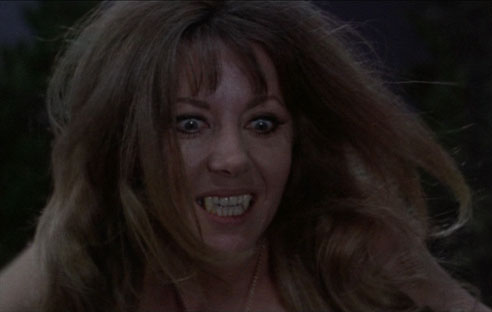
Ingrid Pitt as Carmilla in Hammer's The Vampire Lovers (1970)

Ingrid Pitt as Carmilla in Hammer’s The Vampire Lovers (1970)

“Carmilla” is a vampire story. Published a quarter of a century before Dracula, its suspense nevertheless relies on its reader understanding the nature of the villain well before the narrator does — knowing, for instance, just what Carmilla’s nighttime absence from her locked-from-the-inside bedroom must mean. But calling Carmilla a villain is wrong. In Le Fanu’s tale, Carmilla is not characterised as evil so much as of a different (and predatory) nature. When the father of her prime victim sits there self-satisfyingly saying that God will protect them from the “plague” of deaths currently affecting the local peasantry, Carmilla (unbeknownst to them the cause of it all) bursts out with:

“Creator! Nature! … And this disease that invades the country is natural. Nature. All things proceed from Nature—don’t they? All things in the heaven, in the earth, and under the earth…”

Later, one character wonders why “Heaven should tolerate so monstrous an indulgence of the lusts and malignity of hell.” But it’s because this is not a good-versus-evil world, and Carmilla is not “malignant” — she’s merely driven by the dictates of her own “nature”, as much prey to her own longings, both emotional and physical, as any human being:

“The vampire is prone to be fascinated with an engrossing vehemence, resembling the passion of love, by particular persons. In pursuit of these it will exercise inexhaustible patience and stratagem, for access to a particular object may be obstructed in a hundred ways. It will never desist until it has satiated its passion, and drained the very life of its coveted victim. But it will, in these cases, husband and protract its murderous enjoyment with the refinement of an epicure, and heighten it by the gradual approaches of an artful courtship. In these cases it seems to yearn for something like sympathy and consent. In ordinary ones it goes direct to its object, overpowers with violence, and strangles and exhausts often at a single feast.”

Le Fanu’s best moments are those where the supernatural makes itself suddenly known. He combines this with the casual delivery of strangely specific details, details which are not necessarily explicit or horrific, but which worry you, make you think, make you imagine, and ultimately convince you they must be real. It’s this two-pronged attack of surreal details delivered with a cool detachment that allows his spooky images to creep in through the back door of your mind, often by way of your spine’s tingle nerve. Another scene of Carmilla appearing by her victim’s bedside at night is just as cinematic as the one I quoted at the start, but this one makes me think of a different generation of horror films — the weird collage-like video of Sadako in the Japanese version of Ring:

“I saw a female figure standing at the foot of the bed, a little to the right side. It was in a dark loose dress, and its hair was down and covered its shoulders. A block of stone could not have been more still. There was not the slightest stir of respiration. As I stared at it, the figure appeared to have changed its place, and was now nearer the door; then, close to it, the door opened, and it passed out.”

The effect is weird, and so specific, yet unreasoned, as to command a great deal of confidence that what the author is describing is real, precisely because it seems so odd.

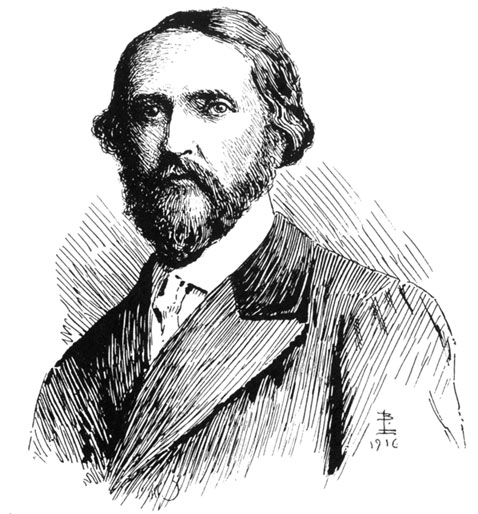
J S Le Fanu, drawn by his son Brinsley Lefanu, 1916

J S Le Fanu, drawn by his son Brinsley Lefanu

The best bit of spooky writing from Le Fanu, though, comes in his “Ghost Stories of the Tiled House” (1861), which mixes utterly believable human behaviour with a sudden flash of tersely-described horror:

“But the worst of all was poor Kitty Halpin, the young woman that died of what she seen. Her mother said it was how she was kept awake all the night with the walking about of someone in the next room, tumbling about boxes and pulling open drawers and talking and sighing to himself, and she, poor thing, wishing to go to sleep and wondering who it could be, when in he comes, a fine man, in a sort of loose silk morning-dress an’ no wig, but a velvet cap on, and to the windy with him quiet and aisy, and she makes a turn in the bed to let him know there was someone there, thinking he’d go away, but instead of that, over he comes to the side of the bed, looking very bad, and says something to her — but his speech was thick and queer, like a dummy’s that id be trying to spake — and she grew very frightened, and says she, ‘I ask your honour’s pardon, sir, but I can’t hear you right,’ and with that he stretches up his neck high out of his cravat, turning his face up towards the ceiling, and — grace between us and harm! — his throat was cut across like another mouth, wide open, laughing at her; she seen no more, but dropped in a dead faint in the bed…”

^TOP

Boy in Darkness by Mervyn Peake

As part of the celebrations for Titus’s 10th birthday in Gormenghast a sort of court masque is put on, featuring four giant puppets — the Lion, the Wolf, the Horse, and the Lamb:

“The Lamb, a little less in height than its companions, for all its towering stature, was a mass of pale golden curls. Its expression was one of unspeakable sanctity. However it moved its head — whatever the angle, whether it scanned the heavens in search of some beatific vision, or lowered its face as though to muse upon its own unspotted breast — there was no escape from its purity. Between its ears, and set upon the golden curls was a silver crown… It carried nothing in its hands for they were clasped upon its heart.”

Sometime, Never - coverThe figure of the Lamb, a somehow menacing mix of purity and unease, obviously stuck in Peake’s mind, because when he was asked to contribute to an anthology of three novellas, published in 1956 as Sometime, Never: Three Tales of Imagination (alongside “Consider Her Ways” by John Wyndham and “Envoy Extraordinary” by William Golding), the figure of the Lamb became the centrepiece in an encounter with one of the most insidious visions of evil in fantasy literature.

The Inner Landscape (cover)The resulting novella, “Boy in Darkness” (which was later included in another three-novella anthology, The Inner Landscape, in 1969, which swapped the Wyndham and Golding stories for “The Voices of Time” by JG Ballard and “Danger, Religion!” by Brian Aldiss) is a mini-masterpiece. Changing the puppet Lamb’s “golden curls” for the purest white, and blinding its eyes with blue-tinted cataracts, Peake does that thing again of creating a character that seems so familiar, so right in its every action and spoken word, I’m wondering where I could have encountered it before.

The first question to ask, though, is whether “Boy in Darkness” is part of Peake’s Titus series at all. From what I can gather, in the initial version, Peake only referred to the protagonist of his tale as “the Boy”, though this Boy is the fourteen-year-old “Lord of a tower’d tract”, and the opening paragraph makes it clear this is Gormenghast in all but name:

“The ceremonies were over for the day. The Boy was tired out. Ritual, like a senseless chariot, had rolled its wheels — and the natural life of the day was bruised and crushed.”

Apparently, after its first publication, Peake changed the manuscript to call the Boy “Titus” (twice, to my count), and it is in this form it’s currently published (in Boy In Darkness and Other Stories). But whether Peake had named him or not, the world he depicts — in its scenery and its concerns — is Gormenghast, and the young Boy is as much Titus as he can be.

Boy In Darkness and Other Stories coverThe plot is simple. Fed up with the castle and all its ritual, the Boy runs away, and finds himself lost in a desert land of industrial ruins. There, he falls into the hands of the Goat and the Hyena, a bickering pair of half-human half-animal creatures whose task it is to find victims for their “White Lord”, the Lamb, who dwells deep in an abandoned mine. With the inescapability of a nightmare (Peake at one point thought of subtitling the novella “A Dream”), the Boy is drawn closer and closer to the Lamb, and we, the readers, learn what the Lamb is planning. This creature, it seems, has the ability to change people, physically. He has done this countless times, but the Goat and the Hyena are the only two surviving examples. And the Lamb has not had a new victim, a new plaything, for a very long time.

The power of the tale resides entirely in Peake’s depiction of the Lamb. It is the very understatement of his bleating speech, the stillness of his body — all except his ever-weaving, self-fondling, whiter than white, softer than soft hands — that makes this apparently so innocent thing so unutterably evil. It is the hands of the Lamb that you will remember:

“There they were, folded one about the other as though they loved one another; neither gripping one another too passionately, for they were made to be bruised, nor touching one another too lightly, for fear of losing the sweet palpation.”

By the end of the novella, the hands are in a frenzy of anticipation:

“…they were moving so fast one about another, circling one another, separating, threading and weaving their ten fantastic fingers in such a delirium of movement…”

Peake’s writing is at its best when he writes of the Lamb, of “the quenchless vitality of his evil”, his “yielding, horrible mollience of endless wool”.

Yorke - My Eyes Mint Gold coverJohn Batchelor, in his 1974 book on Peake, calls the Lamb “the most blasphemous of Peake’s ideas”, saying it is clearly a “Christ in reverse”, but I think its power is simpler than that. The Lamb is a thing that is as evil within as it is seemingly innocent without. Batchelor goes on to say: “The story is too dark and pessimistic to have fitted the imaginative world even of Titus Alone.” And Malcolm Yorke, in his 2000 biography of Peake, My Eyes Mint Gold, says that “elements of fantasy are introduced that would have been intolerable in the world of Gormenghast”. He finds the style “irritating”, but most of all thinks the whole “a puzzling, unbalanced and very disquieting story and one wonders about the mental health of a person who could engender such a bleak world.”

I disagree on every count. I love the writing, and I think it fits in with Peake’s Gormenghast — as a nightmare episode — perfectly.

And the story isn’t puzzling at all. In fact, like the Lamb, it is almost overwhelming in its purity. Fantasy is so often about being careful what you wish for, and Peake’s protagonist, the Boy, starts off wanting to escape, but:

“…to be alone in a land where nothing can be recognised, that is what he feared, and that is what he longed for.”

And sure enough, the Boy, escaping, finds himself in the hands of a creature whose sole intent is to turn him into something he himself will no longer recognise, not just physically, but mentally and spiritually too:

“For it is the Lamb’s exquisite pleasure to debase.”

Yorke’s main criticism of the story is that “the evil is palpable enough, but where is it opposed by virtue?” But the virtue is as simple as the Lamb’s evil. It’s only the threat to the Boy’s individuality, his existence and his ability to be himself that is needed to justify his fighting back against the Lamb, whose evil is so like that of a child abuser, seeking, as it does, to corrupt others in order to both re-enact and in some way justify the corruption it, at some point, must have suffered. Fighting against the Lamb is simply a fight to retain one’s individuality, something that goes to the heart of Peake’s Gormenghast novels.

The story, then, is primal. It is about an encounter with a corrupting evil, but it is done so powerfully that it — particularly in the soft, white, quietness of the Lamb — will linger rather longer than you’d like.

^TOP