
 I’ve looked at cosmic horror before on this blog in the case of individual works—is Stephen King’s Revival cosmic horror? or Lem’s Solaris?—and certainly some of my all-time favourites, from Alien to HP Lovecraft, are, but I’ve never been sure I could properly define “cosmicism”, or say why the horror in cosmic horror is “cosmic”. Ellen Greenham, in this 2022 book from Hippocampus Press (full title: After Engulfment: Cosmicism and Neocosmicism in H. P. Lovecraft, Philip K. Dick, Robert A. Heinlein, and Frank Herbert), on the other hand, can:
“The principal tenets of cosmicism are that the universe operates as an indifferent mechanism, without purpose or direction, and the human creature is not only insignificant but exists as a biological mutation or accident of elemental and chemical stellar processes.”
I’d add—or at least, this is an aspect I’ve latched onto in my look at, say, Roadside Picnic—that cosmicism presents the universe as being vast, and far weirder than we could ever expect, to the point of being overwhelmingly incomprehensible. (Though this could be seen as a bleaker variant on the sense-of-wonder of science fiction.)
In my Mewsings on Stapledon’s Last and First Men I called cosmicism the religious aspect of atheism, but I might instead say it’s a worldview not just with no God, but with an oppressive God-shaped absence, to the point where the universe seems not merely indifferent but actively hostile. As Greenham says:
“The hallmark of cosmicism embodied within Lovecraft’s corpus is the apparent lack of anything even remotely like human emotion and morality being employed in the process of human eradication. Lovecraft’s others simply swat the human creature as that creature in turn swats flies.”
Why “cosmic”, then? To the Ancient Greeks, cosmos was opposed to chaos; it was order and certainty. The idea of the “cosmos”, then, relies on having a cosmological model—an ordered mental model of how the universe works. But, as Greenham points out, such models, however accurate they may seem, inevitably fail, for “a cosmological model, like a map, is only one particular view and not the territory itself”. For her, there is always an ineradicable degree of chaos that makes the universe ultimately resist any attempt to turn it into a tame and knowable cosmos.
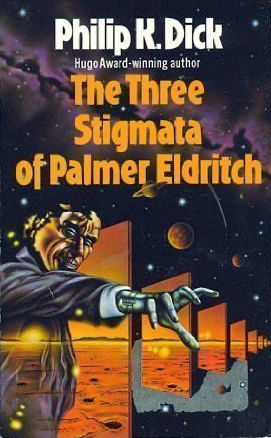
Philip K Dick’s Three Stigmata of Palmer Eldritch, cover art by Peter Gudynas
The horror of cosmic horror is all about incursions from the “outside”—the depths of space, other dimensions, other orders of being—but this “outside”, as Greenham says, “is simply the territory beyond the parameters of the cosmos”. “Outside” means outside one’s cosmological model. The thing that turns this into horror (as opposed to the sense-of-wonder of discovering something new), is that the outsideness is so extreme it doesn’t merely reveal flaws in the cosmological model, it shatters it so thoroughly that it destroys the protagonists’ very notion of themselves.
In cosmic horror there are usually two outcomes: madness or death. In this book, Greenham maps out an expansion of the ideas of cosmic horror into what she calls neocosmicism, and adds a third response, engulfment, a term that still captures something of the sense of fear and loss of self (as experienced by many a Lovecraft protagonist), but points to a way “the human creature” (as she refers to you and me) can move beyond a merely negative outcome:
“By choosing to be engulfed by the universe, rather than simply observe it from a distance, the human creature in neocosmicism can move beyond what stops and destroys it, to enter a vitalised engagement with the universe and with others.”
Being engulfed, one may drown, or one may (like the protagonist of Lovecraft’s “Shadow Over Innsmouth”) be transformed and take to the alien environment as one’s new home. But the transformation must be profound.

Heinlein, The Unpleasant Profession of Jonathan Hoag, cover art by Peter Gudynas
The primary Western cosmological model for centuries has been what Greenham calls “the Genesis model”, where humanity, God’s favoured creation, is “significant in its world”, and where there is a “moral code bestowed upon it by that God”. When this was assailed by the key ideas of the 19th and 20th centuries (the revolutions started by Darwin, Freud, Einstein, and others), it was replaced by “the Machine Universe”, one “without emotion or human morality”, ruled by “the cold equations” of the laws of physics. Caught between these two worldviews, you’re in what Greenham calls “the Schizophrenic Universe”, which is “no longer one stable thing or another”, “an alien and schizophrenic landscape that has become strangely separate from the human creature within it”. The way forward to a new understanding—or to a new way of relating to the universe without a full understanding—one must face the “gaping black hole between cosmos and universe” which Greenham calls the void. For, “the light,” she says, “can never be truly understood without knowledge of the darkness also”.
The void, of course, seems empty, meaningless, a frightening vacuum. But it has a useful purpose in this neocosmological process. Like Nietzsche’s abyss, its job is not so much to be stared into as to stare back: “The void is thus named because its function is to make void, to empty the full; to turn the human creature into a tabula rasa.” To accept a new notion of what the universe is, you must—painfully, if necessary—get rid of the old notions first, even if it means throwing everything out.

Dune by Frank Herbert, cover art by Bruce Pennington
At this point, the universe becomes “a proving ground”, where “the human creature enters a relationship of ‘lethal proximity’ with the universe”. A prime example is the planet Arrakis in Herbert’s Dune, whose harsh conditions have resulted in the super-tough Fremen, a people who’ve learned to live with the “cold equations” of their particular environment. The apparent hostility of the universe, then, becomes a spur: the successful entrant into the proving ground is “facing imminent threat so that… [it] might also engage its vitality”. Ultimately, though, the idea is not to just become a machine for survival, but a human being that survives, one that seeks to find “whether it is possible to survive in the cold equations with emotion and empathy intact”.
All this points to a new relationship with the vast, sometimes hostile-seeming universe. Against the apparent insignificance of humanity that’s a given in cosmic horror, Greenham’s neocosmicism points to how the very hostility of the “proving ground” can lead to a new sense of significance: the proving ground may weed out those who can’t survive its ultra-harsh conditions, but “Gardeners do not remove weeds for the sake of the removal”. There is, then, an ultimate aim: to turn oneself into a creature that fits this universe, perhaps even adds something to it. This can, Greenham says, even be a liberating view, for:
“…in remaining indifferent to whether the human creature succeeds or fails, the universe nullifies any sense that creature might have of striving for a final result, thereby releasing that creature from the requirement—real or illusory—to be bound by a sense of finitude.”
In the end, the idea is to no longer see the individual human being as a thing contained in, and oppressed by, a vast universe, like a pea rattling around in an enormous box, but as a part of it, and perhaps even (in John Wyndham’s phrase) “the crown of creation”—the human that triumphs against incredible odds, and retains their humanity, and not because a god deemed that it was always going to be so, but through their own efforts.

Olaf Stapledon
Reading Greenham’s book, I kept thinking of one author she doesn’t mention, Olaf Stapledon, in particular his Last and First Men. Stapledon has some of his future races of humankind actively engage with the sort of ideas Greenham writes about. They see their role as surviving in the universe as it is, not as they wish it to be, and being prepared to accept that the end must ultimately be a tragedy—the universe’s “cold equations” (literally cold: they face the dying of the sun) will win out, but in the meantime, their role is to seek the fulfilment of their particular nature within this universe: “man is a fair spirit, whom a star conceived and a star kills”. And Stapledon adds something I think Greenham doesn’t mention, as far as I recall, a willed returned to that science-fictional sense of wonder. Stapledon’s future humans “render the universe that intelligent worship which, they felt, it demanded”, and learn to “admire the Real as it is revealed to us, and salute its dark-bright form with joy”.
It’s an excellent study of an idea that could really be applied to so much I’ve previously written about on this blog. (Reading it didn’t require an extensive knowledge of the writers she covers—I’m certainly not very familiar with Heinlein, or with Herbert beyond the first Dune book. I’m tempted now to read some more in the Dune series; not so much with Heinlein.)
You can hear Greenham interviewed on episode 152 of the Udda Ting Podcast (don’t worry about the Swedish intro, the interview itself is in English), on most podcast apps or here at Soundcloud.


