I bought James Cawthorn & Michael Moorcock’s Fantasy: The 100 Best Books in a sale back in 1992, and have carried on a sort of book-by-book conversation with it ever since. I don’t know if I intend to read every one of its suggested hundred — I’ve just ticked off my 59th with John Buchan’s Witch Wood
 — but I’m often referring to it, wondering if this or that title has made the Cawthorn & Moorcock grade, or browsing it for reading suggestions. One thing I have come to learn is that their definition of fantasy is not necessarily mine (Moby Dick, for instance), nor is their definition of best (L Sprague de Camp’s Tritonian Ring, for instance), but that’s the fun of such lists. They’re only annoying if you forget they’re just one (or in this case two) person’s opinion and expect them to be in some way definitive.
Witch Wood (published in 1927) was Buchan’s favourite of his own novels (The Thirty-Nine Steps being everyone else’s). It’s set in the mid-seventeenth century, in rural Scotland, where a young minister, David Sempill, has just taken up a post in the kirk of Woodilee. There’s plenty of thick Scots dialogue (“Haste ye, sir, and help me off wi’ thae Babylonish garments, and that weskit o’ airn — what for sud folk gang to the smith for cleading and no to a wabster?”), and plenty of Scots Jacobean religio-politics. The edition I read had a three-page glossary at the back to help with some of the dialect, but as often as not it didn’t have the words I was looking up. (The second part of the above line, by the way, translates as: “why should folk go to a smith for their clothing, and not to a weaver?”) The politics, which I tried to skim past at first, eventually required a brief trip to Wikipedia to get through — Buchan was, after all, of that educated class that expected its readers to understand Latin, and have a far more detailed knowledge of the country’s history than modern readers (and I’m shamefully ignorant of everything Blue Peter never taught me). But the story itself was compelling, though it wasn’t till the penultimate chapter that it really clicked what type of story it was. And knowing what type of story is being told is key, really, to enjoying a book.
 So, what type of story is Witch Wood? It earned its place in Cawthorn & Moorcock’s list because of the new minister’s discovery that, as well as attending kirk every Sabbath, a good portion of his parishioners disappear into the wood (the wonderfully named Melanudrigill, or just “the Wud” to the locals, who fear to name it) to take part in Devil-worshipping rites around an old pagan altar. The new minister learns of this practice when, having got lost one night in an attempt to overcome his fear of a place that a man with God on his side ought not to fear, witnesses his flock, masked as animals, dancing round the altar and, in Buchan’s own delicate phrasing, kissing “some part of the leader’s body, nozzling him like dogs on the roadside”. Yes, we all know where witches are supposed to kiss the Devil, thank you very much.
Sempill sets about trying to uncover and denounce the coven, but soon finds himself set against both the superstitious fear of his parishioners, and the bigotry of his kirk elders. This may make it sound like a sort of proto-Wicker Man or historical Devil Rides Out, but although Witch Wood is definitely in the ancestry of both those stories, its emphasis is different. It’s not really a horror novel (though it contains some wonderfully atmospheric description of the Wud at night: “The clouds had thinned and the struggling moon showed Melanudrigill before them, rising and falling like an ocean of darkness.”), nor is it a fantasy novel (part of its denouement could be taken as an act of God, but it might just as well be the effect of conscience, or superstition, and there are no really fantastic occurrences). As well as the Devil-worship plot, there’s a pretty much separable love story, and a subplot involving David Sempill’s agonising over his political allegiances — all of which, for the bulk of the novel, are kept separate, meaning the Devil-worship subplot lies fallow for whole chapters at a time. It was only in the penultimate chapter, when the effect of these three strands come crashing down on the young David Sempill that the book clicked for me and I realised it was really the story of an idealistic young man learning to see the world’s hypocrisy, superstition, and sheer human pig-headedness in all its disillusioning glory. Not a vicar-versus-witches adventure story, then, but something more psychological.
And at this point, it became quite powerful. The previously ingenuous, and often slightly soft-spined Sempill gained a new, dark hardness, which allowed him at last to face up to his foes and deal with them in his own way. (But not, as in another devil-worship-in-rural-Britain story — Blood On Satan’s Claw — by wielding a huge sword. Sempill uses words alone.)
So, not a fantasy book, though certainly one that may appeal to fantasy or horror readers. I’m certainly glad I read it. One more to tick off my Cawthorn & Moorcock list.

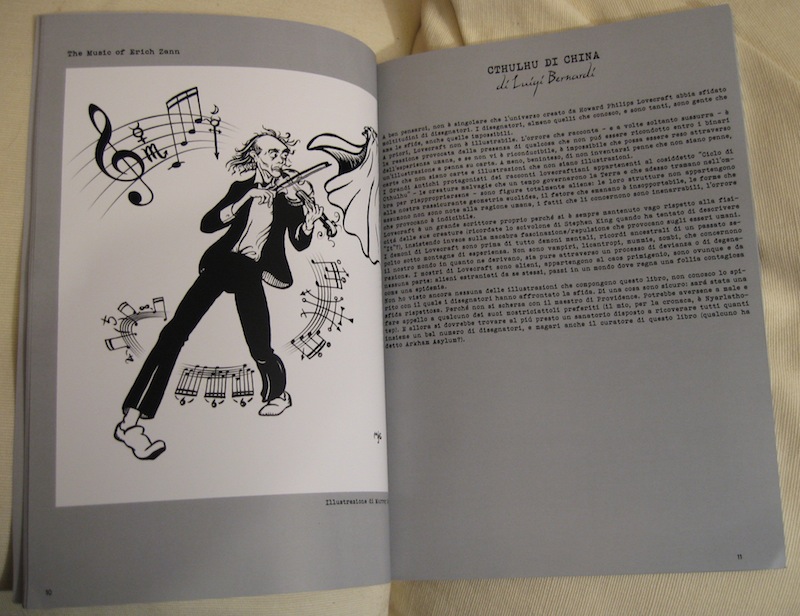
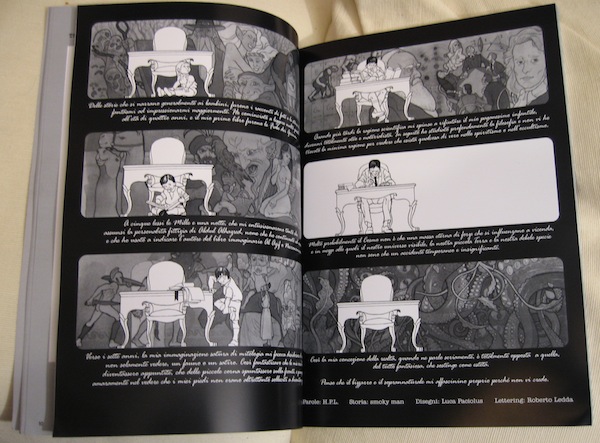
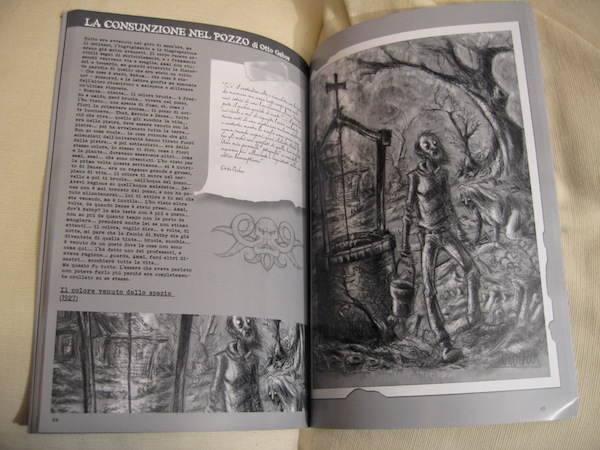
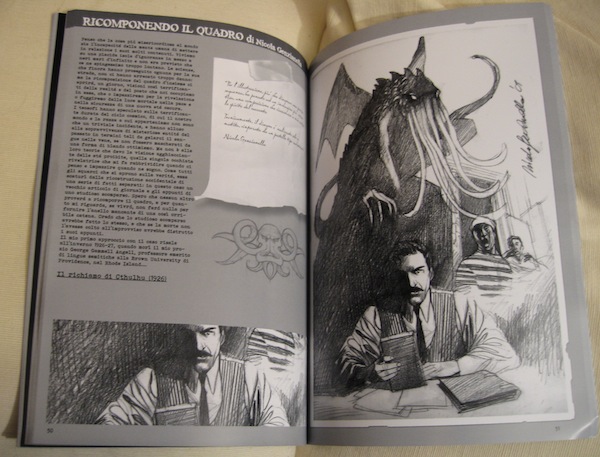
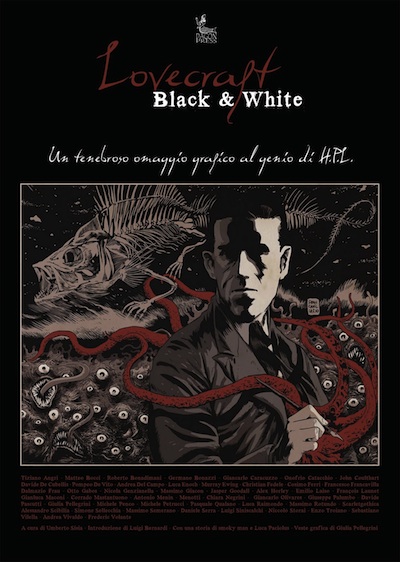 Earlier this year I was asked to contribute to Lovecraft Black & White, a volume of original illustrations inspired by the works of H P Lovecraft, published by Dagon Press in Italy, and today my contributor’s copy arrived! There’s a lot of high-quality work here, which puts my offering rather in the pale, I can’t help thinking. I was among three who chose to depict “The Music of Erich Zann” — or “La musica di Erich Zann”, I should say, as the book is in Italian, of course.