I really liked M Night Shyamalan’s The Sixth Sense. It was a genuinely spooky film that managed to be more than just spooky. Unbreakable seemed a bit too much like a short film idea spun out to feature film length. Signs was downright contrived, a major disappointment. The Village was good, but mainly because it worked as a drama, not because of the twist at the end which was surely obvious to anyone who’s read even a handful of science fiction stories. The Lady in the Water is his latest effort and, well, I was determined to give it a good go. I knew it had taken a critical mauling, but most of what I heard was, it seemed to me, simply down to embarrassment at the rather childish nomenclature the film uses — it’s about a man who discovers a narf (a sort of inspirational water nymph) living in the pool of the apartment block he caretakes. Narf is a naff word, as is scrunt, the monster out to get the narf, which seems to be a cross between a jackal and a patch of turf. But I thought I could overlook these rather clunky words — they were supposed to be from a child’s bedtime story, after all — because The Lady in the Water isn’t just about narfs and scrunts, it’s about the adults who find themselves caught up in this child’s bedtime story, and I thought that provided an opportunity for Shyamalan to say something interesting about the shape life takes.
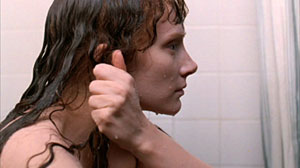
Only, (to kill the suspense), he didn’t.
The film had its good points — mostly thanks to the acting, with Paul Giamatti (playing the caretaker Cleveland Heep), managing to bring his personal story to a genuinely emotional climax, and Bob Balaban, as the film critic, whose deadpan humourlessness was absolutely hilarious. Things started to go wrong for me near the start, though, when Bryce Dallas Howard’s tendency to deliver all her lines by in-breath alone meant I had to turn on the subtitles to understand what she was saying. (Thankfully, she later resorted to sign language, though only for reasons of convoluting an already over-complicated plot.)
What I really didn’t like about the film, though, was that Shyamalan failed to say that interesting thing I was expecting him to say. The possibility was there, I thought, that by bringing adult characters into a child’s bedtime story, he might say something about the gap between the meaningful form we expect life to take (as embodied by children’s stories) and the actual result we find ourselves living as adults — something of a mess, with hints of meaningfulness every now and then, but so much superfluity and inconsequentiality that we quickly realise life isn’t anything so simplistic as a bedtime story. But instead of raising the idea of story to the level of his adult characters, Shyamalan instead lowered his supposedly adult characters to the level of a child’s bedtime story by imposing on them a tremendously naive idea of what it means to have “a purpose” in life. Rather as in Signs, Shyamalan seems to think that having “a purpose” means that, at some point in your life, all your personal peculiarities and foibles will come together to make you play some perfect (though most probably minor) role in a story. But this, to me, is a horrible idea — that all your life is a preparation for some tiny part in someone else’s story, after which — what, you retire to the coast and take up gardening? Surely human life is more meaningful than that!
All the way through the film I was hoping its characters would wake up to how simplistic (and imprisoning, even dehumanising) their idea of “purpose” was. Instead, whenever anything went wrong they’d reshuffle their roles like a pack of cards, then try the same approach till it worked. In other words, they learned nothing.
I’ll probably still go and see Shyamalan’s next film. He’s at least creatively individual enough to be interesting, even if he doesn’t always succeed. It at least feels as though he’s trying, which is something Hollywood rarely seems to do.
 I read Bret Easton Ellis’s American Psycho without being aware of any of the controversy surrounding its release. My reaction to it was similar to how I felt about J G Ballard’s Crash: an incredible writerly achievement, but not a book I was ever likely to re-read, not just because of the extreme subject matter, but because neither book had enough story to justify its length. (I think Ballard happily admits Crash was a short story extended to novel length, as a sort of balance to the novel-squashed-into-a-short-story approach of his “condensed novels” from The Atrocity Exhibition.) Of the two, I enjoyed American Psycho slightly more, as there were brief hints of real human despair in the isolation of its protagonist, despite the fact he was a monstrous serial killer. It also had its funny moments, which can’t exactly be said of Crash.