Alien: Earth

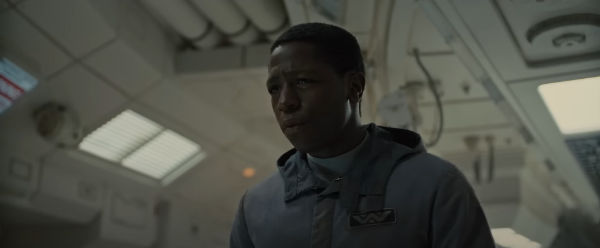
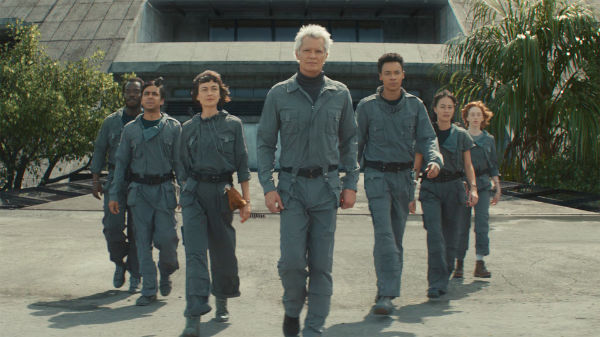
Set in the year 2120, Alien: Earth opens with the USCSS Maginot on its way back from a 65-year mission to gather alien specimens—and not just any alien specimens, but, seemingly, the most cunningly lethal it can find—when the inevitable happens and some of them get loose, causing the ship to crash into the city of New Siam. While the Maginot is owned by the Weyland-Yutani corporation, New Siam is owned by one of its rivals, Prodigy (the entire solar system, at this point, is divided up between five mega-corporations), so it’s Prodigy emergency teams who go into the wreckage. Prodigy, meanwhile, have been working on a new technology, the uploading of human consciousness into synthetic bodies. At the moment, only children’s minds are adaptable enough to make the change, so a handful of kids with terminal illnesses have been uploaded into new, adult-sized and super-resilient bodies. One of them, the group’s “big sister” Wendy, has been keeping an eye on her older brother in the outside world, and sees him entering the crash site in his role as a medic. She persuades Prodigy’s founder and CEO, the “boy genius” Kavalier, to send the kidroids (not what they’re called in the show) in, as a test of their abilities. Kavalier agrees, and soon sees an upside: they can get him the alien specimens before Weyland-Yutani reclaim them. It needs no degree in science fiction to know this is a bad idea.
Of course, one of the specimens loose on the Maginot is the Alien xenomorph. (There’s also a handy supply of its eggs, as well as the usual array of face-huggers in jars.) But, just as one swallow does not a summer make, neither does one xenomorph make this, necessarily, a real part of the Alien franchise. My take on the series is that, while it would have made an interesting, even quite original, SF show without the xenomorph, bringing one in, and calling the show Alien: Earth, sets up expectations it doesn’t deliver on. In short, it’s a good SF series, but it’s not an Alien series.

Some things are definitely Alien. The look and feel of the original film has been reproduced, particularly in the USCSS Maginot, which is pretty much identical to the first film’s Nostromo, complete with wildly outdated-looking computer equipment (green VDUs, chunky keyboards, and vast, room-sized arrays of winking lights). But the xenomorphs themselves aren’t really central to the plot. (I even began to suspect the show was written with one many-tentacled eye on easily removing the Alien elements, just in case it wasn’t green-lit for the franchise.)
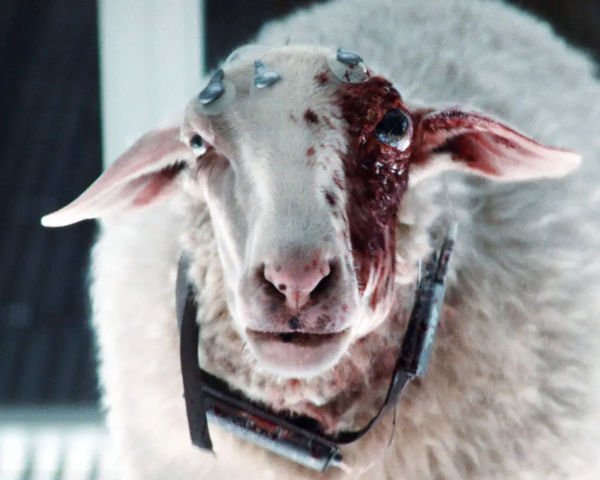
One thing that makes the xenomorphs themselves expendable is that there are a host of other, new alien lifeforms, all with icky and disturbing ways of infecting, consuming, or parasitising human beings. And one of them, the eyeball-thing that spends most of its time planted in the head of an eerily determined-looking sheep, is by far the most memorable. (And one that doesn’t get fully explored. The “boy genius” Kavalier at one point wonders what it might say if planted in the head of a human rather than a sheep, but never gets round to trying it out. This, to me, would clearly be the focus of a second series.)

But there’s another thing that spends the show elbowing the xenomorphs aside in their traditional role of apex predator. In Aliens, the Weyland-Yutani corporation want the xenomorphs because of their potential use as a weapons technology. But here, Prodigy have already developed something far superior in the bodies of its hybrids: they’re super-strong, super-resilient, and have super-sharp perceptions. They’re already the perfect killers (except that they’re currently inhabited by the consciousnesses of children, who of course don’t want to kill—but that changes as the show goes on). At one point, Wendy, who has developed a bond with the xenomorphs (to the extent that she can basically use them as attack dogs, thus removing the element of conscienceless chaos that made them so frightening in the first two movies), starts to explain what she sees in them. As she did so, I was so primed for her to echo Ash’s speech in the first film (about them being “a survivor, unclouded by conscience, remorse, or delusions of morality”), that when she merely said “They’re honest,” it felt like a missed opportunity—or, perhaps, an acknowledgement that, in this show, the xenomorphs don’t stand for much.
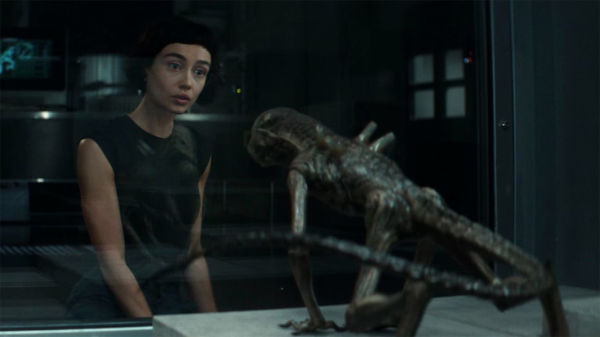
Ahh, they make sounds like dolphins, how cute.

The show doesn’t tie in with what, for me, is one of the key thematic strands of the Alien series, which is all about just how viscerally, weirdly biological our bodies are, and how vulnerable that makes us to all sorts of violation by infection, parasitism, or weird varieties of impregnation. But where Alien: Earth does tie into the Alien series is in its exploration of the extremes of capitalism. One way of viewing the original film is that it’s about the ultimate abuse of workers: they’re already having to work lightyears from home and sacrifice years of life they could have lived with their families, but now they’re being forced (under pain of receiving no shares at all—and presumably this is the only form of salary available in a corporate-dominated future) to put their lives in mortal danger. In Alien, workers are expendable. The ultimate corporate man in that film is Ash, the android, who will do anything the company wants, even if it means the deaths of his fellow crew-members. In Alien: Earth, we have all sorts of compromised beings, from the Ash-like synthetic Kirsh to the cyborg Morrow, who has become the perfect company man not because he’s had his humanity removed, but because he owes so much of his body to Weyland-Yutani that he has no choice but to act as it demands. (As he says to Wendy’s brother at one point: “There’s always a price when the corporation gives you something. Do you know what it is?” “Everything,” says the brother. “Everything,” Morrow rejoins, “doesn’t begin to cover it.”)
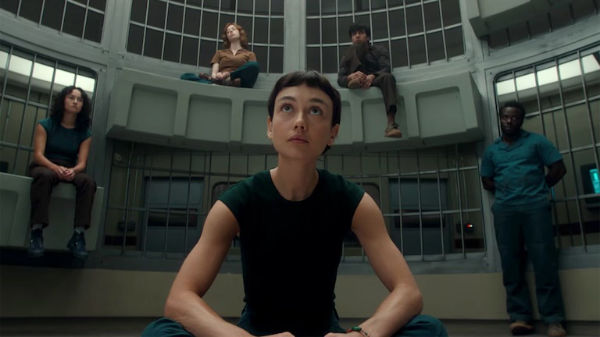
The only glimpse we get of ordinary workers along the lines of the “space-truckers” from Alien are the first-responder security guards/soldiers. One of them says: “We got a good thing going here. We’re alive. We get paid.” But in a tone that implies you can’t really ask much more than that. No freedom, self-expression, or security, just survival. In this ultra-corporate world, the only truly free people are the CEOs that sit atop those five mega-companies. Everyone else has to do what they’re told.

The child-robot hybrids are the essence of this clash between corporate beings and human beings. Their bodies are entirely owned by the Prodigy corporation. And after uploading their consciousnesses into these bodies, the company renames them, as though to underline its ownership. (Later, the “boy genius” Kavalier tells them straight that they’re not human beings or employees, but “show models”: company property.) But, because they’re kids, and not yet worn down by the corporate grind, they resist—and that, really, is the main story being told here, not the survival-by-the-skin-of-your-teeth narrative of all other Alien movies.
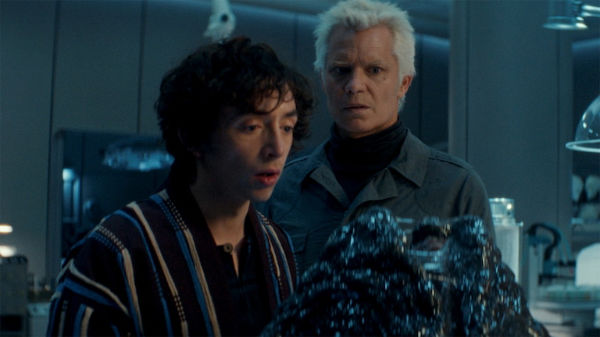
As a standalone SF series, I’d still, perhaps, be tempted to criticise the often over-mannered acting. It’s understandable for the kids to act like kids, and the synthetics to act a little strange (Kirsh’s constantly talking just a little too quietly, for instance), but elsewhere normal people act so mannered it started to become distracting. In a non-Alien series, I might think the show was making a point about how differently people might behave in the future, but the Alien franchise needs its people to act realistically to highlight the contrast between their ordinary humanity and the extreme survival situations they’re faced with. Here, I found myself feeling mostly irritated by the characters, so I didn’t care so much when they died. (There were exceptions. I think Adrian Edmondson was excellent, channeling the paternalistic menace of late-career Charles Dance.)

But also, I’m not sure the show really had something it was trying to say. Occasionally in the last episode, someone would say something that felt like it was one of those lines that sums up the theme of everything that had gone before. For instance, when the cyborg Morrow is fighting the synthetic Kirsh, he says “In the end, Man will always win. It’s a question of will.” Then he seems to win, but there’s a switch-around, so that obviously wasn’t the theme of this show. I was left feeling the show hadn’t really focussed on one particular theme or meaning. This, combined with the fact there were no major twists (you can predict the ending from the beginning, except for it being even more simplistic than you might expect), was one thing that made me feel that, even as a non-Alien show, it wasn’t entirely in the top notch of SF shows.
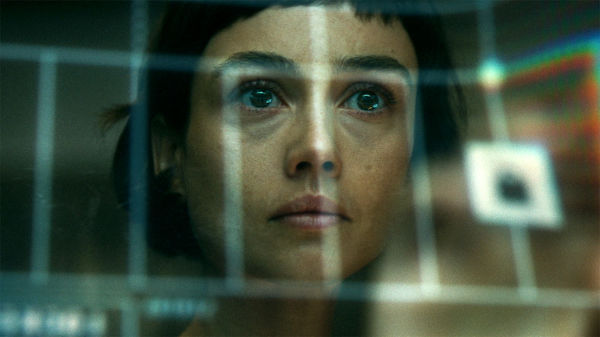
Still, it had some good ideas, and some relevance to our times (in its examination of a world ruled by a handful of over-indulged tech-trillionaires, for instance). I do think the Alien franchise needs to switch to this sort of long form TV series to really do more than merely attempt to reproduce the first movie. As I said in my review of Alien: Romulus, what I’d like is much more of a political thriller, focusing on the xenomorphs as the subject of industrial espionage, with plenty of corporate shenanigans and the occasional gruesome death, but I’m happy to watch something like Alien: Earth, which at least tried to do something new. Frankly, the first two movies of the Alien franchise are pretty much perfect, so it’s hard to imagine anything equalling them, but I’ll continue to watch (and no doubt criticise) anything that makes the attempt.

And I will watch the eyeball-thing when it gets its own series.
^TOP

Moonwind by Louise Lawrence

1987 Bodley Head paperback, cover art by Nick Bantock

Louise Lawrence’s 1986 YA Moonwind is something of a thematic sibling to her earlier novels Star Lord and Earth Witch, and though it’s ostensibly SF, it’s better read as a fable or fantasy that uses the backdrop of space and technology to heighten its themes. (Perhaps a better description might be New Age SF, considering its allusions to ancient Atlantis, humans being partly descended from aliens, and the idea that aliens are more like spiritual beings than bug-eyed monsters.)

It starts with a spaceship being forced to land on a barren moon for repairs. For some reason, only junior technician Bethkahn is left onboard to assess the damage (and to discover there’s one thing she can’t repair), while the rest of the crew take a secondary craft to the nearby blue planet. Landing on an island, that craft is destroyed when a volcano erupts, leaving Bethkahn isolated, alone, and unable to take off. The ship’s computer suggests she enter suspended animation, from which it will wake her when the situation changes. And it does, ten thousand years later, but with alarming news: the formerly primitive people of that nearby planet have developed technology, and are now visiting their moon. Bethkahn takes one look at these lumbering, space-suited creatures, and immediately dismisses them as “Cavorting imbecile monsters!” The ship fears that, when the creatures find it, they’ll take it apart to see how it works, and Bethkahn will be stranded in this primitive system forever. The pair watch for developments.

The story then switches to seventeen-year-old Gareth Johns from Aberdare (yes, that blue planet was Earth all along), co-winner of a World Educational Council essay-writing competition, for which he’s won a month-long visit to the US moonbase. His essay, titled “The Lunacy Syndrome” is about how there are dwindling congregations of church-goers on Earth, but “go to the Moon and you come back converted”. The Moon, he thinks, is “where science and religion finally meet”: “God is alive and well and living on the Moon.”

1986 US cover from Harper and Row

The other prize-winner is Californian Karen Angers, whose essay is on how the Moon has always been characterised, poetically and mythically, as female: Phoebe, Diana, and the White Goddess. Reading it, Gareth is unprepared for what he considers the “loud-mouthed and gawky” young woman who wrote it, who gets things off between them to a bad start by, first of all, referring to him as English—he’s the “first Welshman on the Moon”, after all!—and by constantly calling him Gary. But underlying this clash are differences of class (Gareth’s home town is poor, and he feels little hope about his own future, or that of the world, whereas Karen’s parents are obviously well-off), and of temperament. Gareth has come to the base expecting to “feel the Moon’s almighty desolation and catch the wonder”; sunny Karen seems to have just come to photograph everything, and Gareth feels she’s turned what ought be an awesome and even spiritual experience into a tourist trip.

Bethkahn, meanwhile, realises she has a chance of escape. If she can sneak into the moonbase, she can use their tools to fix her ship’s broken stabiliser and take off. But how to enter the base without being detected? She does have, it turns out, a means of doing so. Because Bethkahn, and the rest of her people, are non-corporeal; they are “spirit”, not flesh. But in order to do the work on the stabiliser she’s going to need to use a physical body, somehow, and the easiest way seems to be “spiritual possession”: she will enter a person’s body, take it over for a while, get the work done and leave. But her first attempt ends in disaster. She tries to enter a lunar buggy to possess the driver, but because the driver, lazily, left the internal airlock door open, all she succeeds in doing is killing him. Her next, more careful, attempt drives her intended possessee mad. She realises she needs, not a body to use, but an ally. And there’s only one person this can be: Gareth, who has discovered one of her ship’s spy modules but has kept quiet about it. He, she realises, might be someone she can trust. (And he already has a hint she exists. Just before the disaster with the moon buggy, he and some others saw a cloud of moon dust, driven by what, despite there being no atmosphere, seemed like a wind—a moonwind—and inside it, he thought he saw a young woman.)

US paperback cover

I’m sure the more hard-SF type of reader will already have noticed what appears to be a massive logical hole in this set-up. Bethkahn is non-corporeal, yet she had to open the moon buggy’s door to get in, which is why the driver was killed. It turns out she always has to open a door to get into anywhere. It also turns out she can carry physical objects—the damaged stabiliser is one such object—even though it seems she can’t handle the tools she’d need to use to fix it. (This despite being an engineer on a spaceship that surely at some point needs tools to fix its other components. And why does she need a physical spaceship at all if she’s non-corporeal?) In one scene, Gareth hands her a plastic bag containing the spy module he discovered, and she walks off with it; but when Gareth tries to touch her, his hand goes right through. Bethkahn’s non-corporeality, it seems, is there to first of all create a plot difficulty (how to fix the stabiliser), and secondly to underline the core theme of the book: loneliness.

Bethkahn has spent ten thousand years on the moon, and though she has her ship’s computer for company, “It was not enough that the starship cared for her. She needed a person… a voice, a smile, another living being beside herself.” Gareth, meanwhile, has already been warned that one of the main perils of this harsh environment isn’t its lack of atmosphere, but that “Solitude can be dangerous on the Moon”, because “here on the Moon was a loneliness that terrified, a monstrous isolation.” When he comes to know Bethkahn, he immediately grasps the poetic meaning of her nature:

“She’s non-corporeal, see? A ghost… stranded here… wandering. My God, there’s loneliness for you.”

Gareth is equally lonely, in a way. He’s hopeless about his life at home (“a decaying industrial nation, closed-down coal mines and acid rain and small chance of getting employment”), and doesn’t fit in with the mostly cheery Americans on the base. When Karen suggests he come to Santa Barbara where her dad can help get him a job, he bursts out:

“There’s nothing anywhere! No reason! No purpose! … There’s no memory on Earth. Here’s where the meaning began. Here! I want to go on, not back…”

Bethkahn, though, offers him an alternative: leave with her. Only, to do so, he has to become, like her, non-corporeal, which in human terms means dying. Moonwind is, at times, a stark narrative, about not just loneliness, but the way loneliness only increases the difficulties between people. Bethkahn’s inexperience in dealing with physical humans leads to one death and one madness; Gareth, on the other hand, is always getting in trouble with Karen and the other people on the base thanks to his oscillating between a spiky resentment of their generally happy dispositions, and his own rather disruptive sense of humour. In her essay on the moon goddess, Karen wrote that “loneliness makes her cruel”, and that certainly seems the unintentional effect of both Bethkahn’s and Gareth’s isolation.

Louise Lawrence

As with Lawrence’s Star Lord, the alien in Moonwind is a more advanced, more spiritual being, but one with a slight coldness to it. The closer parallel, though, is with Earth Witch, which is also about a troubled Welsh lad getting into a relationship with a woman who’s part human, part mythical entity. In all three, Lawrence takes her stories as close to tragedy as she can with a Young Adult audience, while leaving a little space at the end for something like a positive ending.

Moonwind was adapted for TV, though in mini-format. It was shown as part of ITV’s Book Tower magazine programme, in eight episodes from 8th January 1987 to 19th February (4:50p.m. on Thursdays). The Book Tower was itself only a half-hour (minus adverts) programme featuring book reviews and story readings as well as its drama serial, but even if each episode of the adaptation was only 10 minutes long, that could still make for a short feature-length film in total, which would be interesting to see. The only thing I’ve been able to find, though, is one picture of some of the cast:

Kevin Francis as Gareth, Andrea Milton as Karen, and Richard D Sharp as Drew

^TOP

Alien: Romulus

It’s been a while since the last Alien film (Alien: Covenant was 2017), surely long enough for something gestating in this hypersleeping franchise to burst forth and cause merry havoc. And now here it is, Alien: Romulus, which I went to see on a Saturday afternoon at my local cinema. (Two days after its UK premier. I assumed it was best to book in advance, but there were only two other people there. I don’t think this is any measure of the film’s success globally, just a combination of a small town and good weather. Really, I’m glad we have a cinema at all.)

The film opens on a mining colony on the sort of planet where you never see the sun rise, and are equally unlikely to die of old age. The female lead Rain and what I at first thought was her autistic brother Andy, but who turns out to be a slightly malfunctioning android (and I’ve only just got the joke, Andy: Android — but he of course prefers the term “artificial human”, so should have been called Art), are working for the faceless (and hug-less) Weyland-Yutani corporation. Rain, whose parents are both dead (the mother, at least, due to working down the mines), has just clocked up enough hours to be released from her contract and sent off to a proper colony world, only to be told, sorry, due to manpower shortages — mostly, it seems, due to illnesses and fatalities — the company has just extended the minimum contract term and she has to stay for another five or six years. It’s then that her ex-boyfriend Tyler turns up with a proposal. A large chunk of space-debris due to crash into the colony planet’s (spectacularly rendered) Saturn-like ring is an old Weyland-Yutani station, and bound to contain some cryonic stasis chambers. If a small group of them get into it, they can remove the chambers and use them to make their own trip to the colony world of Yvaga, where Rain will be able to see the sun rise at last. Of course, we know from the prologue that this chunk of space-debris is a research station that picked up a certain biomechanical-looking thing from the fragments of the Nostromo… (Which, to pick at a minor point, should in no way have been clumped so closely together. Alien ended with not one but three massive self-destruct explosions.)

I’ve developed my own sketchy thematic outline for the Alien series. The first film is about pregnancy; the second is about motherhood; the third, after struggling through a few rewatches, is, I have to say, about rape (which, despite it being a well-made film, is perhaps why I find it somewhat repugnant); the fourth I haven’t pinned down yet, but might be about hybridisation; Prometheus is about abortion; Alien: Covenant, again, I haven’t pinned down. Alien: Romulus is full of children (twenty-somethings, yes, but still feeling very much like children) who have lost their parents (and most specifically their mothers, as at least two characters mention how they’ve lost theirs — in both cases due to the Company). It might be subtitled, then, “Raised by Wolves”, only the wolf that does the raising isn’t the benevolent she-wolf who nurtured Romulus and Remus, it’s the Weyland-Yutani Corporation, and far from feeding these motherless children from its body’s milk, it sucks the life out of them.

The ultimate aim of the research station is to create a new “perfect” strain of humans, through extracting a certain icky black substance from that biomechanical egg it recovered from the Nostromo wreckage. (And this is this film’s only major connection with the — aptly aborted — Prometheus-direction the franchise had been going in, and I have to say it’s done with the sort of light touch I prefer.) So, you could say, by the end of the film we get to see what a real “Raised by the Weyland-Yutani Wolf” child would look like. And I’m sure it would never call in sick, but I also wouldn’t call it human.

My basic feeling about Alien: Romulus is similar to how I felt about the recent (2022) Hellraiser film. Both are returns to a franchise that had been going awry, if not downhill. Both bring a more 21st-century sensibility — to me, they very much feel like they’re made by the current generation — and both are aware that they’re bearing the responsibility to pay proper respect to their originating films and provide something sufficiently box-office-worthy to enable their franchises to survive. As a result, they’re basically well-made films which provide some nice minor surprises, lots of nods to their originating films (maybe too many, sometimes), and a satisfying watch, but never stray into the truly challenging, truly shocking, truly visceral or mind-blowing, as those originating films did. That might be unfair to ask — great films are rare — but every sequel will be judged against its original. And anyway it’s probably better, in both cases, to have a solid success so the franchise can continue, than the sort of big-idea-loaded messes that Ridley Scott’s last two contributions were (despite being well-directed, shot, plotted, and acted). But, at the same time, you come away missing that essential something from the franchise, and that essential something is, it has to be said, the sort of transgressive, shocking, visceral weirdness that made the originating films so original. The original Alien seemed to exist in a constant state of shock at how weird its alien was; by Alien: Romulus, even the gloopier moments are handled in an almost offhand way, without that element of reverence or awe — that sense of the dark sublime.

(There seemed to be, in Alien: Romulus, a lot of business with doors, multi-layered difficult doors, with obstructive locking systems. I can’t help wonder if that doesn’t reflect, in some way, the creative atmosphere around a film like this, with the weight of so many requirements — commercial and artistic — putting a constant series of checks, blocks, and dead-ends in the way of really free creativity.)

The stand-out in this film, as all the reviews I’ve read so far agree, is David Jonsson as Andy the android, particularly when he gets an upgrade and suddenly becomes a corporation man. The other notable android — sorry, artificial human — is what for a brief second seems like a nice tribute to Ian Holm, as we see another of the same model of android that was Ash in the first film. But then he talks. And the special effects technology is not up to giving us a mock-up of Ian Holm moving his mouth in anywhere near a convincing way. (Film-makers: lay off relying on this until it’s convincing! It’s just creepy, and not in a good way.)

What I’d really like to see, I think, is an Alien mini-series, long enough for a nice, slow build-up and deeper characterisation. Aliens worked so well by tying the SF-horror of the original with another genre — military SF, or the Vietnam War movie — and I’d love to see the series tied to something like a political thriller, full of the sort of commercial shenanigans we only get to glimpse in the films. (Which makes me realise that, in the Alien films, the political and the commercial are one and the same. I’m sure my motherhood/reproduction-based reading of the films can be completely replaced by one saying that the whole series is basically about capitalism. Certainly this film.)

Anyway, basically a good film, and if I expect too much of it, that’s only because the first two instalments in the franchise are so good. I can only hope there will be more — while also hoping there won’t be so much more it becomes like Disney’s over-ploughing of the Star Wars franchise. But then again, Disney owns 20th Century Studios, which makes this, basically, a Disney film, so I can’t be sure that won’t happen…

^TOP