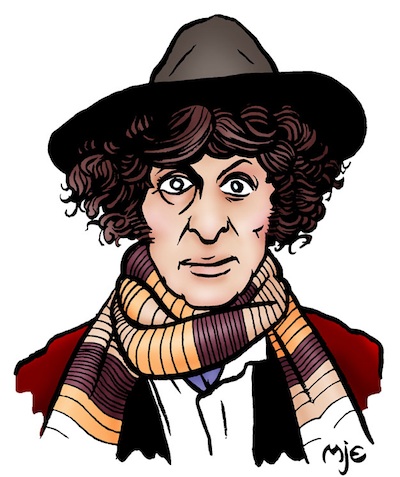
It struck me recently how Lovecraftian my favourite period of Doctor Who (the first half of Tom Baker’s reign) was. I don’t know if there was ever an explicit influence, but the fact it was a science fiction show being made during a British horror boom (the early seventies), probably led to a certain amount of natural crossover.
 Script editor Robert Holmes certainly brought in (or encouraged) all sorts of horror and sci-fi influences, mostly filmic ones — King Kong in “Robot”, The Thing from Another World in “The Seeds of Doom”, The Beast With Five Fingers in “The Hand of Fear”, Frankenstein in “The Brain of Morbius”, for instance. He wanted to “darken things up a little”, saying “I don’t think it would be unfair to accuse us of aiming towards a slightly ‘gothic’ area. Tom always called it ‘Who-noir’.” (quoted in Classic Who: The Hinchcliffe Years by Adrian Rigelsford)
Another thing that led to a Lovecraftian feel could have been Holmes’s attempt to shrug off good/evil dichotomies. According to producer Philip Hinchcliffe, Holmes “had a theory that there’s no such thing as good or evil in the universe; it’s all just part of a process, and the side you fall into simply depends on how you’re made. He was fascinated by the notion of an organic life-form which lands on earth and causes havoc because it’s neither intentionally bad or good, it’s just that its ‘process’ conflicts with ours and appears evil by comparison.” (from Classic Who, again.) This is pretty much spelled out by Sutekh: “Your evil is my good, Doctor. I am Sutekh the Destroyer. Where I tread I leave nothing but dust and darkness. That, I find good.”

Of course, Doctor Who could never have addressed the underlying cosmic horror outlook of Lovecraft. The Doctor is a heroic figure, and it’s one of the tenets of Lovecraftian horror that people can never be heroic — cannot, in fact, ever be anything other than gnats and flies before the terrible forces that rule our universe. (“In my presence, you are an ant, a termite — abase yourself, you grovelling insect!” — the ever-quotable Sutekh.) Doctor Who, on the other hand, had a fundamentally optimistic nature (necessarily so, perhaps, being a kid’s show). When the Doctor defeats Sutekh, it’s with the feeling of things being returned to their rightful balance, rather than a brief avoidance of an eventually inevitable human defeat (which is how “The Call of Cthulhu” ends). And just consider how Lovecraft would have viewed the story of one of the Doctor’s human companions — more as the sort of alien abduction perpetrated in “The Whisperer in Darkness” or “The Shadow Out of Time” than a romp through space & time, with the Doctor, perhaps, as a sort of charlatan Nyarlathotep figure.

But it’s surprising how much of a similar feel the alien creatures had during these few seasons to Lovecraft’s creations:
insect-like creatures who can fly through the vacuum of space — the Mi-Go (Lovecraft), and the Wirrn (Doctor Who)…
a man transformed into a giant, lumbering, tentacled monster intent on wiping out all human life — the creature at the end of “The Dunwich Horror” (Lovecraft), and Keller transformed into a Krynoid at the end of “The Seeds of Doom” (Doctor Who)…
an alien entity who wants nothing more than to destroy all life in the universe, but who has been imprisoned in a tomb on Earth — Cthulhu (Lovecraft) and Sutekh (“The Pyramids of Mars”)…
a created lifeform, intended as a servant/soldier, destroys the race that created it — Shoggoths (At the Mountains of Madness) and the nascent Daleks (“Genesis of the Daleks”) who, in their naked form, are rather Lovecraftian sea-slug-like slimy blobs…
an ancient alien lifeform, buried for millions of years, is uncovered and comes to life again — At the Mountains of Madness, “The Hand of Fear”.
 To me, the most Lovecraftian creatures are the Fendahleen — perhaps just because they spring from the same impulse to try and create a monster that doesn’t simply look like a man in a suit (in the case of Doctor Who) or which isn’t just a slight alteration of the human form, but is designed to be totally alien to everything we ever think of as human (in the case of Lovecraft’s monsters).
Of course, a more direct source of influence on “The Image of the Fendahl”, with its ancient, alien powers being released by scientists examining a 12 million year old skull, is Nigel Kneale’s Quatermass and the Pit. But the Lovecraftianism of Nigel Kneale’s output is a whole nother subject (the meteorites of Quatermass II — nicked virtually wholesale by Doctor Who in “Spearhead from Space” (another Robert Holmes story) — to me recalls Lovecraft’s “The Colour Out Of Space”, for instance.)
So, to recap: Sutekh is Nyarlathotep, Zygons are Deep Ones, and the Doctor ought to faint more often.