The Night-Watchmen by Helen Cresswell

The Night-Watchmen by Helen Cresswell, illustration by Gareth Floyd

cover illustration by Gareth Floyd

Like Catherine Storr’s Marianne Dreams, The Night-Watchmen starts with its young protagonist, Henry, confined to bed after a month-long illness. But within pages he’s given the OK to get up for a few hours a day — a limit that’s promptly forgotten as he spends the rest of this short book tramping around town, at all hours, at one point even engaging in some heavy labour, helping dig a hole in the street. Unlike in Marianne Dreams, then, the illness isn’t an essential part of the plot, just an excuse to get young Henry on his own and out of school for a bit of adventure.

Pretty soon, he falls in with a pair of brothers, Josh and Caleb, who call themselves ‘Do-as-you-pleasers’ (i.e., tramps). Josh is writing a long, perhaps never-ending book on all the places they visit, while Caleb concentrates on rustling up gourmet-level meals three times a day. (For tramps, the two have a lot of possessions, including a gas stove, a portable hut, picks and shovels, a small library, and a good deal of cooking equipment, all carried about in a pair of wooden hand-carts.) There’s something else about the pair that’s different, though: they’re from ‘There’. ‘There’ is only defined as different from ‘Here’ (our world) by the fact that it can only be reached by the Night-Train: a steam locomotive that can appear on any rail-track as soon as it’s whistled for, though only, of course, at night. (It feels a bit like the Knight Bus from the Harry Potter books — a magical go-anywhere-in-next-to-no-time transport system.)

illustration by Gareth Floyd

Josh and Henry, illustration by Gareth Floyd

Henry spends as much time as possible with the pair, helping them dig a hole in an out-of-the-way street just so they can erect their workman’s hut:

‘You see, if we was to go putting up huts all over the place, there’d be questions asked. There’d be police and Authority on us before we’d so much as got the stove lit. But a hut with a hole, ah, that’s a different matter!’

The only trouble in Josh and Caleb’s lives is ‘Them’, the Greeneyes: human-like creatures who are trying to get to the tramps’ home-place of ‘There’, and need the Night-Train to do so. And to get the Night-Train, they need Josh and Caleb, so the two have to keep an eye out for these creatures. The one thing they’ve got on their side is the fact that the Greeneyes can’t see in daylight — night is their day, and light blinds them.

illustration by Gareth Floyd

illustration by Gareth Floyd

It’s a light book, almost all taken up with Henry getting to know the tramps and having a glimpse at their (mostly) carefree way of life. The fantasy and world-building are entirely done by suggestion: we don’t know anything more about ‘There’ than that it’s not ‘Here’, and the only thing we know about the Greeneyes is they’ve got green eyes and are the enemy. But it works. Henry has his little holiday from real life, his glimpse of something other than a untroubled child’s view of an otherwise comfortable and ordered life, one of those self-defining moments you feel, by the end, has set him up to be something other than a dull do-as-you’re-told-to, or a do-as-others-do.

Published in 1969, The Night-Watchmen was in the running for the Carnegie Medal, as was Cresswell’s 1967 book, The Piemakers, and her later Up the Pier (1971) and Bongleweed (1973). Cresswell has written scripts for TV, adapting her own novel, The Moondial, and Gillian Cross’s The Demon Headmaster. (The Night-Watchmen, I think, is more radio-play material.) It’s hard to imagine such a quietly-paced, gentle sort of adventure being published today, but I hope they are.

^TOP

A High Wind in Jamaica by Richard Hughes

A High Wind in JamaicaPublished in 1929, A High Wind in Jamaica has that Gorey-esque quality of seeming like it might be a genuine old-time classic children’s book — in Humphrey Carpenter’s terms, it could be of the ‘Arcadian’ type of idealised childhood, its ‘secret garden’ a stint the Bas-Thorntons spend on a pirate ship — but beneath its light, storytelling air, it’s far darker than those old-time children’s classics ever were. Dickensian in tone, with Dickens’s love of the comic grotesque, both in over-the-top characterisation and the theatrical set-piece, there’s a subtle but powerful undercurrent building around the only rarely-explored inner life of its key character, ten-year-old Emily, and how she’s affected both by what happens to her and (perhaps more crucially) what she does, during her time with Captain Jonsen and his men.

The novel starts with the Bas-Thornton children living semi-wild on a rundown estate in Jamaica. It is the mid-1800s, after the emancipation of the slaves, and the sugar plantations are mostly abandoned and derelict. Then along comes a hurricane, taking the top off the Bas-Thorntons’ house. Their parents decide the children would be safer at school in England, and ship them off, only for them to be taken by pirates en route. The pirates at first don’t know what to do with the children. Captain Jonsen is hardly vicious enough to simply kill or maroon them, even when they take over his deck, and adopt some vital ship’s gear for use in various games (young Rachel keeps claiming things to be her baby-dolls); they may even be useful in his particular form of piracy, as a distraction to make a potential target ship think his is just a harmless passenger vessel, so he can get close enough to board. For a while, the children aren’t even aware they’re on a pirate ship. Totally lost in their own little worlds, they think this is simply another stage on their journey to England:

‘Margaret said,’ went on Rachel, ‘that time we were shut up on the other ship she heard one of the sailors calling out pirates had come on board.’

Emily had an inspiration. ‘No, you silly, he must have said pilots.’

‘What are pilots?’ asked Laura.

‘They Come On Board,’ explained Emily, lamely. ‘Don’t you remember that picture in the dining-room at home, called The Pilot Comes On Board?’

Hughes takes pains to present the children as anything but the clichéd little angels of most Victorian fiction: these are utterly self-involved, given to bursts of fondness or indifference, brushing against the adult world only briefly, like whales surfacing to breathe:

‘How then can one begin to describe the inside of Laura, where the child-mind lived in the midst of the familiar relics of the baby-mind, like a Fascist in Rome?’

Signet_HighWindThe children and the pirates co-exist mostly (at first) by ignoring one another. The pirates seem, at times, to look fondly on the children in their innocence and playfulness; the children try to ignore all clues that the pirates may be pirates — apart from thirteen year old Margaret, the eldest, who instantly knows what’s in store for her from these male criminals. The other, younger, children don’t understand her terror and think she’s being silly. But into this seemingly comic, meandering narrative, hints of a real darkness come through: accidents (one fatal, one near-fatal), then, one drunken night, the pirates come for Margaret — they may even be coming for ten-year-old Emily, too, but she bites Captain Jonsen’s thumb, and this seems to remind him she’s still a child, or perhaps makes him realise she’s too wild to risk, so she doesn’t suffer the more fatalistic Margaret’s (un-mentioned) fate. The journey continues, just as light in tone, just as twisted in implied detail.

It’s only at the end, with the children returned to civilisation, when the adults in London try to prise the truth from the children’s mix of outright fantasy and downright silence, that you get a sense of the trauma they may be suffering beneath their outward normalcy. As the lawyer Mathias says near the end:

‘It’s bad enough having a child in the [witness] box anyway… You can never count on them. They say what they think you want them to say. And then they say what they think the opposing counsel wants them to say too…’

At the end, we’re left with a sense that this adventure is a formative one for the children, but not in any clearly-defined way. The children have brushed against terrors and adventures, yes, but have also spent a lot of time just being themselves — undoubtedly in strange circumstances, but to a child, as Hughes points out, all circumstances are strange, it’s all new. Emily, stocking up on experiences, thinks, at first, it’s enough to have experienced a genuine earthquake right at the start of the novel; her time with Captain Jonsen, with whom she even begins to develop the sort of relationship she never had with her rather distant parents, is too much an undigestible and contradictory mass for her to call it any one thing (as Hughes says, ‘Children have little faculty of distinguishing between disaster and the ordinary course of their lives’); and the one deed she does which nobody guesses (its one witness, Margaret, is too traumatised by her own experiences to talk about it, or anything else), all go towards the making of her as a person, in ways too complex to be simply stated: Hughes’s very silence on the matter speaks far more eloquently.

HighWind_filmcoverThroughout, A High Wind in Jamaica has been subtly undermining its own slightly distant tone, building this sense of an unspeakable tension, a hidden trauma, that is only to be dealt with by not speaking of it, except near the end, when the image of Emily, self-contained once more after a single, brief outburst of emotion in court (easily overlooked by all the adults present), is what lingers with me now the book’s read.

A High Wind in Jamaica was made into a surprisingly faithful film in 1965, with Anthony Quinn as the pirate captain (not Jonsen here, but Chavez, as no-one would believe Quinn was Danish). Somehow, the Hollywood sheen (though it’s a UK film) works just as well as Hughes’s light, Dickensian prose style to take the edge off the awful events, and the impassivity of Deborah Baxter as Emily perfectly captures her child-like impenetrability right up to that tell-tale break-down in court.

^TOP

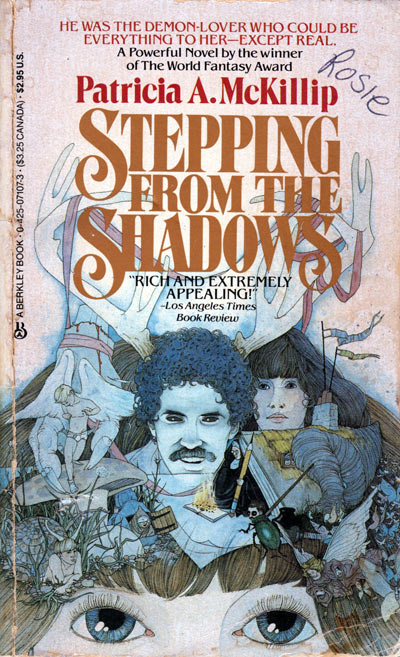
Stepping from the Shadows by Patricia McKillip

The Encyclopedia of Fantasy calls Stepping from the Shadows (published 1982) ‘an interesting naturalistic novel about the making of a fantasy writer’, which immediately piqued my interest. It is, then, a Bildungsroman — a novel about the formation of an individual. And, though it’s not a fantasy novel (certainly not in the sense that McKillip’s earlier books, like The Forgotten Beasts of Eld and The Riddle-Master of Hed trilogy), it’s very much about imagination, and not just idle daydreamery: its young narrator has a strong imaginative life, one that threatens, at times, to unbalance her.

The book starts with an interesting narrative approach that won me over immediately. The first person narrator (a young girl, seven years old in the first chapter) is constantly accompanied by ‘Frances’, a dreamy soul apt to be lost in stories, reveries and idle distractions, often at the most inconvenient times, like when Sister Thomas Augustine is asking her a question in class. It’s obvious Frances and the narrating ‘I’ are the same person, but one is the inner self, the dreamer, the storyteller, while the other, the narrating ‘I’, is the one who has to deal with the moment-by-moment realities of life. Frances is annoying but rewarding. It’s she who decides the cacti they pass on the way to primary school in this small America town are in fact the fingers of Hell-Giants, poking out of the ground; it’s she who provides the magic, imagination, and deeper meaning in the narrator’s life.

Each chapter is a leap forward in age. In chapter two, Frances-and-I are in Germany, and in chapter three they’re in England, following her military father’s various postings. The England chapter is my favourite, a wonderfully evoked autumn and winter in which Frances’s sensitive nature blooms into at first poetry, then full-blown imaginative vision, as a stag she sees transforms into something both magical and startlingly real, a man with antlers:

‘I wanted to cry or yell at Frances for waking something like that out of the past around us, putting it into my mind. Now that you’ve got him, I wanted to shout, what am I going to do with him? Most of all, I wanted to run. But I couldn’t take my eyes off him. After a while, I stopped wanting to run.’

As in Alan Garner and Susan Cooper’s books, the stag-horned man represents something deep and true coming from the primal realms of the imagination — but also something troubling and potentially dangerous. Here, it represents the true awakening of Frances’s creative life. Having seen it, she’s compelled to follow this striking vision (in the secret, private stories she writes) to try and solve this ‘unsolvable problem in quest of an answer’. The narrator, though, struggles with the sheer peculiarity of her suddenly over-alive inner life:

“God damn it!” I yelled at Frances. “Nobody else has a Stagman — why should I have one? I’m trying to lead a normal, ordinary, mediocre existence!”

But, impossible as it is to live with this constant, impossible companion, it’s worse trying to live without the vital inner link he represents:

‘…the Stagman was part of my own shadow, or my dreams, to be endlessly pursued, endlessly challenging, forcing the best of strength, creativity, passion from me.’

Even when Frances seems to have understood the Stagman creatively (it passes almost unmentioned, but in the later chapters, she has written about him, and got published, giving her the money she needs to drop out and find herself) he changes, as all such tricksy figures do: suddenly, he takes on a new aspect, representing Frances’s sexuality, as she starts seeing the Stagman all around, in the young men she’s both attracted to and terrified of.

Stepping from the Shadows is set mostly in the 1960s. While Frances is at school, President Kennedy is assassinated (she also overhears a conversation two fellow pupils are having: ‘What’s a hobbit?’, one says). Later, at high school, she’s involved in various political demonstrations. The novel reminded me of Hermann Hesse’s Demian, another Bildungsroman about a divided protagonist on a creative quest, and both books, I have to say, have slightly disappointing endings. But the thing is, how can you end the story of someone’s quest for what is, in essence, a beginning — both McKillip’s Frances and Hesse’s Demian are in search of themselves so they can start on their proper lives. Their ‘happily ever after’ is an inner event, a moment of certainty, of commitment, a moment of finding oneself, a moment when things begin. In a film, you’d end with them walking off down a road towards some hopeful future, and the camera would lift up, leaving them to find new adventures; neither McKillip nor Hesse find the literary equivalent of that lifting camera, so both peter out a bit (though in different ways). But it’s the journey to reach that point that counts, not the actual moment of ending, so that’s what these books should be judged upon.

A poetic book about the formative years of a sensitive, imaginative soul, Stepping from the Shadows is more engaging than The Forgotten Beasts of Eld, whose main character I found a bit aloof. Frances, here — or her narrator-I self — is so much more directly engaged in the very difficult task of being and becoming a whole human being (as Eld’s super-cool, powerful Sybel wasn’t) that the novel feels, moment by moment, so much more alive.

^TOP