Weaveworld by Clive Barker

Tim White cover for Clive Barker’s Weaveworld

Weaveworld, published in 1987, was Clive Barker’s breakthrough novel. It was also his breakout novel, as it saw him transform himself from being the hottest new horror writer in town (with The Books of Blood and The Damnation Game), to being a hot new fantasy writer, or perhaps just a hot new writer full-stop. And of course, with the movie Hellraiser out the same year, Barker seemed to be announcing himself as an impressive creative force whatever the medium. He painted and illustrated, he wrote and produced plays; what was more, he was eloquent and outspoken in his views on the importance of imagination and the fantastic in art. I’d read some of his Books of Blood stories, but Weaveworld was much more my thing. After it, I read pretty much every novel he wrote as they came out (in paperback, anyway), faltering briefly at The Thief of Always, perhaps out of post-Imajica exhaustion (825 pages!). That ended with 2001’s Coldheart Canyon. I bought Coldheart Canyon, and it sat on my to-read shelf for about a year before I admitted to myself I wasn’t going to read it. I’ve never even looked at his Abarat books (perhaps feeling a bit cheated that he never got round to finishing his Books of the Art series). I read (and reviewed) Mister B Gone when it came out, as a toe-dip back in Barker’s world, but aside from the angels at the end, I mostly wished I hadn’t. I’m not sure, really, what happened. Perhaps it was simply Barker exhaustion (he does write long novels, and perhaps even marvels and wonders can wear you out). Whatever it was, I recently re-read Weaveworld, to see if I could sample a little of what it was that made him so exciting back then. Would it still be there?

It was. It is.

Weaveworld is about a magical land hidden in a carpet. But really, this magical land is made up of fragments of our world — nooks of wonder and beauty we came to ignore, or never discovered, and which the Seerkind (the people of the Weaveworld — or the Fugue as they call it when not in its woven state) took as their own. The Seerkind are mostly human in appearance, but have “raptures” — crafts such as weaving, singing & dancing, that work like magic spells. To the Seerkind, we ordinary humans are Cuckoos, and our non-magical world is the Kingdom of the Cuckoo. And although we Cuckoos have, in the past, pursued and persecuted the Seerkind, it was a far worse enemy that forced them into hiding, an awful power known as the Scourge, which of course threatens them again as soon as they wake. The novel follows two ordinary-ish people from our world, Cal Mooney and Suzanna Parish, who come into contact with the Weaveworld, only to find themselves inextricable parts of the struggle of the Seerkind to wake, find a safe place to unpack the wonders of the Fugue, and survive the onslaughts of their many enemies.

Two things make Barker an outstanding writer of the fantastic. The first is the wildness and freedom of his imagination. Before him, the defining style of supernatural horror was that of Stephen King, who made his horrors all the more believable by placing them in settings designed to feel as familiar as possible, and written in a voice that assured you the writer was an average Joe like you, speaking down-to-earth, yeah, you-know-the-kind-of-thing speak. Barker blew that approach away by writing horror and fantasy like an Old Testament prophet. Where, with King, one subtly-built up supernatural element was enough to fuel a blockbuster novel, Barker has monsters and magical beings by the dozen before we’re a quarter of the way through. If King is the fireside storyteller, making you gather round while he whispers his tales towards their slow climax, Barker takes the Barnum and Bailey approach, full of fireworks, cymbal crashes, dancing girls and lion tamers. (And there’s a lot of the performer in his works — his Seerkind are, mostly, performers, Bohemians; perhaps naturally, considering Barker’s first career as a playwright & actor.)

That comparison to the Bible links to the other thing that made Barker such a notable new voice — the conviction with which he wrote, his belief in the transforming power of the imagination. In Weaveworld, when humans encounter the magic of the Fugue, it often has a near-religious effect on them. It changes their world, it opens them up to new possibilities, new beliefs. (Of Suzanna: “All she knew was that she was suddenly alive to a space inside herself where the haste and habit of her adult life had no dominion.”) Because, ultimately, Weaveworld isn’t about a magical world and a real one, it’s about one world which is both magical and real, it’s about the healing, the weaving together, of what can be imagined and what is accepted as real, between the mundane and the magical. The Seerkind aren’t ethereal beings, they’re “flesh and blood like you”; the Fugue is a place in which you can meet with wondrous experiences, but that is true of the real world, too, because the true place those wondrous experiences occur is in the mind:

“Magic might be bestowed upon the physical, but it didn’t reside there. It resided in the word, which was mind spoken, and in motion, which was mind made manifest;… all mind.”

“Imagination,” Barker writes, “was true power: it worked transformations wealth and influence never could.”

Two of the most interesting characters in Weaveworld are the villains, Shadwell the Salesman (whose name unfortunately reminded me of Siadwell, the comic Welsh poet from Naked Video in the 80s) and Immacolata the Incantatrix, who has a cold hatred for her fellow Seerkind. These, like so many Barker villains, aren’t merely evil; they are led to evil ends by understandable (if unordinary) motivations. Something to note about Barker’s monsters — they’re not just killers and beasts, they’re philosophers. They like to explain themselves. They have an aesthetic. (Just not the sort you’d expect to be expounded by the local art society.) In a sense, like the Seerkind, they’re performers, too, artists of a brutal kind, Bohemians gone bad. One of the things Barker seems to be saying is that all experience, potentially, can be transcendent experience, and that includes the painful experiences, the dark experiences, and the dark drives and motivations, too. At the end, the Scourge is not defeated, it is healed. The “Old Science” of the Seerkind (which perhaps could better be called Art) is used to “seduce it into confessing its profoundest desire: simply to see its own true face, and seeing it know how it had been before loneliness had corrupted it.”

Which reminds me of Barker’s own words about himself in the 1994 South Bank Show episode about him:

“My life has absolutely been transformed by the imaginative possibilities offered to me by artists. Isn’t that one of the reasons we go to books and paintings and theatre and movies? We go because we want our lives enriched. And that enrichment is a kind of change. We want our pain illuminated, and if it’s illuminated, maybe it isn’t quite so terrible… I think my kind of fiction, and I get this in conversations with people and in letters, is to some extent about saying these journeys are journeys which we’re all taking. And it’s okay to take them. And it doesn’t mean you’re crazy. It doesn’t mean you’re marginalised. Just because you’re bringing your dreamscape into your daily life, into your conscious life, doesn’t make you fit for the madhouse. It makes you very healthy.”

Barker’s art is working the Seerkind’s sort of magic. He’s not merely peddling wonders to make a sale, to get a wow and a round of applause. He very much has a belief in what he’s doing, in its power to affect people, and for their ultimate good. Even if it takes them into some pretty dark places on the way.

^TOP

The Moon of Gomrath by Alan Garner

The Moon of Gomrath is Alan Garner’s second novel, and his sequel to The Weirdstone of Brisingamen. Like the first, I read it when I was 8 or 9 but, of the two, it’s the one that lingered most in my memory. It’s also the book where Garner’s authentic imagination begins to show through the influence of Tolkien, like outcrops of ancient rock, dark, slaty and sharp, poking through the otherwise green Middle Earth-ish meadows.

On the surface, The Moon of Gomrath is very much a continuation of Weirdstone. The child protagonists of the first book, Colin and Susan, find themselves tangled once more in the world of magic that exists like a ghost layer, or a nighttime fog, on the otherwise real world of Alderley Edge. With the Weirdstone of the first book secure, there may seem less urgency to this novel, but the background story matters less in the Alderley Edge books than the rush of nightmare chases, encounters with goblins and other semi-mythic folk, and the welter of magical-sounding ancient names. The focus of this book is the Mark of Fohla, the silver bracelet given to Susan by Angharad Goldenhand in the first book. This, it turns out, is not of the wizard Cadellin’s type of magic, but belongs to an Old Magic, a deeper mythic magic, weirder and wilder by far than the Tolkienesque world of goblins and warlocks that made up the first book. The Old Magic is the magic of folklore, of olden times; not of elves and wizards, but of half-wild men and half-gods. It’s this part that I remembered most from the book on my first reading: the image of an ancient pathway that appears only in the light of the moon, and of riders summoned by lighting a fire on a certain hill on a certain night. These riders are part of the Wild Hunt, and don’t come to help or to hinder, but are a chaotic force who do what their wild hearts lead them to do. Their leader is a man with stag’s horns:

“Susan looked at him, and was not afraid. Her mind could not accept him, but something deeper could. She knew what made the horses kneel. Here was the heart of all wild things. Here were thunder, lightning, storm; the slow beat of tides and seasons, birth and death, the need to kill and the need to make…”

The Old Magic is linked with all the primal forces:

“For the Old Magic is sun magic and moon magic, and it is blood magic… it is woman’s magic, too…”

Although much of the book is a series of close-packed chases and encounters with the evil forces led by the Morrigan from the previous novel, there’s a secondary story which begins to emerge, and which could well have become the central plot strand, had this been one of Garner’s later books. At first it may sound a bit like an echo of yet another part of The Lord of the Rings, as we learn that the silver bracelet given to Susan is a mixed blessing:

“She was saved, and is protected, only by the Mark of Fohla — her blessing and her curse. For it guards her against the evil that would crush her, and it leads her ever further from the ways of human life. The more she wears it, the more need there is to do so. And it is too late now to take it off.”

It sounds a bit like Tolkien’s One Ring — a minor magical artefact from a previous book suddenly revealing hidden powers, and hidden dangers. Only, here, the Mark of Fohla isn’t an evil thing (as the One Ring was), but belongs, as it were, to a world outside good and evil — the world of the Old Magic. The danger is that, by wearing it, and using it, Susan will become separated from the human world, and be lost in that other world, as she almost is at one point, after falling into a coma. Woken, she initially calls out to the nine maidens of that other world (which has all the danger of Tolkien’s Faerie, as well as something of the realm of death), not wanting to leave them. So, it may sound like an element of Tolkien’s work repurposed & reimagined as in the first book , but I think it’s when Garner starts to write about this double-edged aspect of contact with the world of magic that he connects with a vital seam in his own imagination, something which will drive the stories of later novels (in particular The Owl Service), about how contact with the world of Old Magic, of myth, is dangerous, and can make you lose yourself, be subsumed by it.

So, although its story isn’t about saving the world (as The Weirdstone of Brisingamen was), I find The Moon of Gomrath a more powerful, and more memorable, book. It still suffers somewhat from having to live in the same world as the heavily Tolkienesque Weirdstone, but the connection Garner makes with “the Old Magic” — and with, I think, his own more authentic imagination — makes it somehow more vital, more dark, more truly a part of the folkish-magic tradition I love so much in fantasy (Holdstock’s Mythago Wood, being a prime example, Jo Walton’s Among Others, too).

Now I’m really looking forward to what Garner’s going to do in his forthcoming third Alderley Edge book, Boneland.

^TOP

The Weirdstone of Brisingamen by Alan Garner

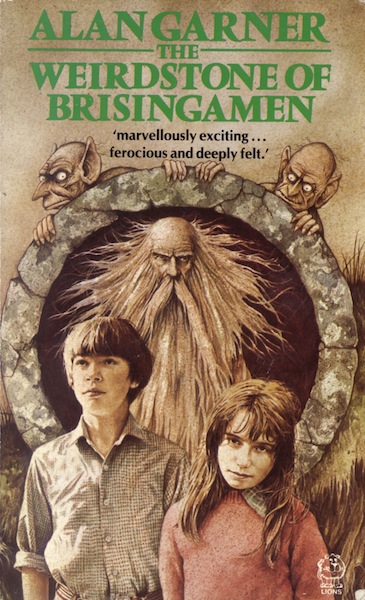
The Weirdstone of Brisingamen was Garner’s first book, published in 1960, and is the first of a trilogy, to be completed later this year. I first read it at the age of 8 or 9, and was totally caught up in its delirious, nightmare chase sequences (a good half of the book, if not more, is given to two long chases, one aboveground, one below); it also either introduced me to, or connected me with, a primal, archaic layer of my imagination, something I can best describe as “English mythic” — a folkloristic mix of fairy lore, Norse myth and Tolkienesque fantasy laid upon the English countryside, something which has, ever since, been one of those deep-running veins of imaginative meaning for me, and that excites me whenever I encounter hints or glimpses of it in such things as classic Doctor Who, 70s UK horror films, Robert Holdstock’s Mythago Wood, Susan Cooper’s Dark is Rising, etc., etc.

I re-read the book in my twenties, and was a bit disappointed. While no way near as derivative of Tolkien as, say, the regurgitative Sword of Shanarra, Weirdstone is certainly strongly influenced by The Lord of the Rings. It’s silly to complain that Cadellin, the white-bearded, monk-robed wizard, is like Gandalf, because Gandalf is like Odin, and all such wizards have their roots in a similar primal archetype. But other aspects of the book are surely too Tolkienesque to be anything but influence. There’s the Galadriel-like Angharad Goldenhand, for instance, a beautiful female elf-like noble who protects the travellers in her realm, giving them food and gifts to help them when they return to the fray. There are dwarfs — Tolkienesque dwarfs, not Norse myth ones. There’s a magical object (the Weirdstone of the title), which in this case needs to be recovered, not destroyed. Most Tolkienesque of all is the nightmare journey through the mines of the goblin svart-alfar, whose “Eyes! Eyes looking at me! Down there in the darkness!” made me think of Tolkien’s “Drums! Drums in the deep!”, occurring as it does at a similar moment. The best way to describe LOTR‘s impact on Weirdstone (I don’t know if Garner acknowledges this or not) is to think of it as a sort of fever dream fuelled by the late-night reading of Tolkien, with certain major events and figures emerging re-purposed, alongside a host of Norse-mythic figures bursting out as the imaginative floodgates are opened.

A recent, third read changed my mind again. Yes, Weirdstone is heavily influenced by Tolkien, but two things save it from being a derivative work. One, Garner is a powerful writer, and perhaps the only reason he relied so much on Tolkien is he responded to him (or the archetypes he employed) so powerfully. The most Tolkienesque passage — that journey through the Moria-like goblin-infested mines — is one of the most compelling sequences in the book, with the “Earldelving” chapter, in which the travellers have to squeeze through miles of narrow, often flooded passages, being genuinely claustrophobic. I found myself desperate to finish that chapter just so I could breathe again. Some of the descriptions of the underground caves have a beauty that can only have come from firsthand experience:

“Now and again they would come upon a stretch of rock over which the water had washed a delicate curtain. This was to be found where a vein of ore lay just above the roof: the water, trickling through the copper, over the years had spread a film of colours down the wall, ranging from the palest turquoise to the deepest sea-green.”

The other saving grace is evident in the above passage, too. Garner’s main purpose in writing Weirdstone seems not so much to tell a story — as I said, story-wise, Weirdstone is pretty much all chase — as to enchant a landscape he knows and loves (that of Alderley Edge) with a thick layer of myth and imagination. The second half of the book, in which the children, their dwarf companions, and the down-to-earth rustic Gowther Mossock, have to cross several miles of countryside while avoiding the thickly-ranked forces of evil, seems almost like a game children would play — “How would you get from here to there without being seen?” One thing fantasy all too often suffers from is generic landscapes — forests full of nothing but evenly-spaced trees on flat land, mountains that are bluish, rocky and snow-capped, swampy marshes, sandy deserts, etc. etc. — but Garner’s is a real landscape, tangled with all the quirks and stops and ditches and brambles of the actual English countryside, as well as being shot through with folklore, like it has a vein of imaginative silver running through it. (In fact, it is often the landscape, with all its obfuscating thickets and exposed, open spaces, that provides the real hazards and difficulties in the journey in Weirdstone, despite the hordes of evil human and inhuman creatures loose in it.)

The feel I get from Weirdstone is of a young writer, fired up with the creative freedom granted him by reading Tolkien (and a lot of the same source myths & folklore too), and connecting that with a deep, highly imaginative love of a real landscape. When I first read this book, the thing that most excited me was the feeling that the everyday world could be infused with a barely-hidden magic, in which a bothersome local woman could turn out to be the evil witch Morrigan, an ancient rock could be a hidden gateway to an underground chamber, and a family heirloom could be an ancient stone of power. And I think the reason I loved this so much about Weirdstone, and other books like it, is not that it provides an escape from “real” life, but that it captures an essence of human experience, that we not only live in a real world of mud and stones, roads and houses, but in a world of imagination, too, where the “real” things have potentially powerful connections with realms of inner meaning & magic that are just as real, even if they are only in our heads.

^TOP