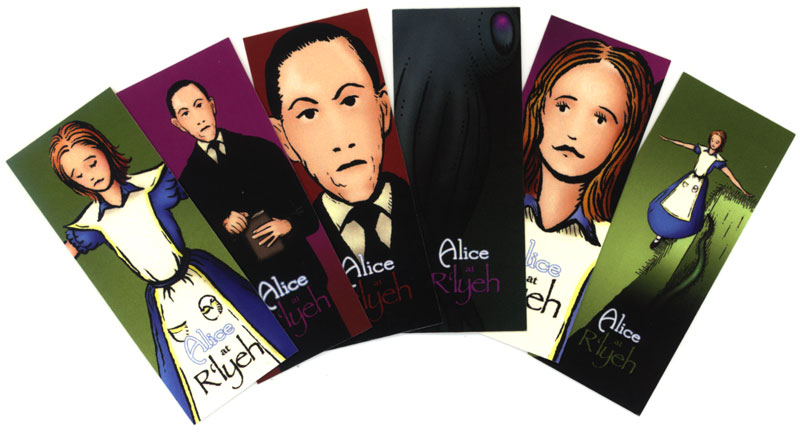
(Part 1 of this report, about creating the Alice at R’lyeh booklet, can be read here.)
 Now I’d spent actual money getting the Alice at R’lyeh booklet printed, I had to promote and sell it. Not my favourite thing. Some artists & writers are happy to shout about what they’ve done, and frankly, I envy them. Self-promotion is a talent that is, I can’t help thinking, as valuable as being able to produce promotion-worthy content in the first place. I’m sure there’s a part of every writer/artist that wants to crow about what they’ve done, but for some (me included) tapping into it can be difficult. I tend to feel, whenever I produce something I like, that what makes it likeable to me is some rare, personal quality, that, if I’m lucky, might be shared by at most a scattering of oddballs and misfits classifiable by no known marketing category. So I’m the last person to want to convince anyone to buy something I’ve produced. But, if you’re self-publishing, that’s what you’ve got to do.
I have to admit I never exactly shouted at the top of my voice that Alice at R’lyeh was available to buy. But here’s a summary of what I did do.
Website. Old-fashioned, perhaps, in these endlessly new-fashioning times, but you’ve got to have a website. I stopped short of buying a domain name for the project, mostly for reasons of expense, but also because I think, increasingly, unique and meaningful domain names are only of use if you’re promoting something through non-internet media. If you’re being interviewed on the radio, for instance, I guess you have to be able to provide an easily memorable way of accessing more information about your project. But even then, with a sufficiently unique name (or some memorable tags), a Google search is just as good. Search for “Alice at R’lyeh” on Google, and you get my site — so, job done, there.

The major website-related decision I took was to put the text of the poem online, and to provide a freely downloadable PDF of the booklet (with graphics at web-level dpi, both for size reasons, and to encourage people to buy the booklet if they wanted a printed version). Why do this? I could have just put up a teaser so people had to buy the booklet for the whole thing. I’d like to say I was influenced by Cory Doctorow‘s ideas on giving away what he writes as both a free ebook and a paid-for printed book — as I was to a certain extent — but the decision really came down to the fact that I didn’t want anyone being disappointed with the booklet when they finally got it. I have no idea if not having the whole thing readable on the website would have led to more sales, but my main aim, in the end, wasn’t sales, it was just to have what I’d written read by people. To that end, the website was the primary tool.
Of course, what I really wanted to know was that people were reading the thing — either by spending time on the poem’s page, or downloading the PDF. I’d already set up Google Analytics to provide me with stats on my whole website, but now wish I’d put something a bit more basic and specific in place. For two reasons. (1) Google Analytics offers so much data, and so many options, that I can’t find a simple access count for either of the key pages. (2) I tried setting up a filter to provide me with data specific to the Alice at R’lyeh section of my website, but for some reason it resulted in a filter that displayed data relevant to everything but the Alice at R’lyeh section of my site. Plus, there’s an old bit of my site (Getting More Out of GarageBand, about Apple’s GarageBand, and not updated since 2005!) which annoyingly gets so many more hits than any other part, however new. So, I’ve no idea how many people have read Alice at R’lyeh online or downloaded the PDF.
Reviews. There are two sorts of reviews. Those you solicit, and those that pop up spontaneously. I solicited one review for Alice at R’lyeh (at Grim Reviews). But discovering the odd spontaneous review that people put up — however brief — was a real joy. I’m still quite nervous of following links to any mention of Alice at R’lyeh, but am so glad when I do and someone has something nice to say. This one from Homo Sum, for instance — brief, but above all, it’s obvious the guy gets it. And knowing you’ve been “got” is, really, the best reward self-publishing can lead to.
 Conventions & shows. I didn’t go to any conventions and shows myself, but thanks to the extremely lucky coincidence that I have a brother with a newly (and professionally
 ) published book out, who very generously offered to put a bouquet of Alice at R’lyehs among the Rainbow Orchids on his table, I learned about the power of selling at conventions and shows. They are obviously the route to go. I don’t know if it’s just because people can see the product, or because the sort of people who go to conventions have curious minds and quirkily individualistic tastes, but Garen got through virtually all the copies I gave him, at a much faster rate than my internet sales.
The odd thing, to me, was that those shows were comics shows. I felt at first I ought to put a sticker on the booklets — “Warning: Poem! Not a Comic!” — but it didn’t seem to matter. Garen told me people were quite okay with it being a poem. And this is one thing I came to learn as part of the self-publishing experience, that different subcultures have very different attitudes to self-publishing. In the UK comics scene, there is a thriving self-publishing community, which sees the fact that something is self-published as a genuine plus-point. It actively welcomes the diversity of the sort of things people produce when they’re let loose on their own. Other areas, though, see self-publishing as an active minus-point, if not an outright automatic rejection. Searching for places to send a review copy of Alice at R’lyeh to, I often came across “no self-published work” notices, which started to annoy me as much as the “no fantasy, science fiction or children’s fiction” notices you find in The Writers & Artist’s Yearbook list of literary agents.
It’s sort of understandable, I suppose, given the context. A self-published comic is a very different thing from a self-published novel. A comic, for instance, has to be drawn, so takes a bit more effort and ability to produce. Also, as you, the punter, can take in the drawing at a glance, you can know instantly if it’s likely to be your sort of thing. (It doesn’t lead to an instant judgment on the story, of course. But if you don’t like the story, you’ve still got the artwork.) A self-published novel is more difficult to judge, and because it takes less skill to write a bad novel than to produce a bad comic, it’s statistically more likely that a self-published novel won’t be as good as a self-published comic. Still, I think there have always been various areas of culture more open to people doing their own thing. When I used to listen to Jazz FM (not being into jazz much, but my stepfather was), I was struck by how all jazz musicians accepted and complimented what each other did, however at odds it was to their own approach. It was a world in which everything was valid. Compare that with pop music, say, where you often get people dissing each other left, right, and centre. (I can’t believe I actually wrote “dissing”, but now I’ve written it, I can’t find a substitute. It may sound like I’m pathetically and outdatedly trying to be hip, but the word stays!) Anyway, there’s room for a whole blog post on that topic. Suffice it to say, I’m extremely grateful for the reception Alice at R’lyeh got from the UK comics community, considering it’s not a comic at all, but a poem.
Google AdWords. Google kept sending me these promotional offers to use £75 worth of free AdWords advertising. If you haven’t come across this, AdWords ads are those brief text ads that appear on the righthand side of Google searches, and also pop up in other places, like eBay. I thought, “Why not use it for Alice? It’s free!” So, keeping a careful eye on the amount I was spending (you can’t automatically cap the expense with AdWords, and in the end I actually went £5 over my free £75 because I realised I was looking at the wrong page on the AdWords control panel), I engaged in a fortnight’s Google AdWords campaign. It’s difficult to judge how effective this was, as I was also, at the time, listing on eBay. But I’d say, if it hadn’t been free, AdWords would certainly not have justified its cost for a small, self-published project like mine. Plus, I got annoyed every time I saw my own ad on eBay or Google — it was costing me!
 eBay. After the conventions, eBay was my big seller. I’ve had more sales via eBay than via my website. The main factor here, of course, is that Alice at R’lyeh is a Lovecraftian project, and I suspect a lot of the sales were to people who look out for and collect Lovecraftiana. “Lovecraft” is one of my few regular eBay searches, so I just hoped there would be other people who did the same. Turns out I was right. Of course, the unfortunate thing here is that this doesn’t generalise to other projects. People bought Alice at R’lyeh because of its Lovecraft associations. They certainly didn’t, for instance, search eBay using my name (I didn’t even bother to put it in the headline description). So, I’m not sure how useful eBay would be for a more original project.
Those, then, were my approaches to promoting and selling Alice at R’lyeh. The main lesson, I think, is that each project will have individual quirks (in this case, the Lovecraft connection, and the illustrations giving it something of a comics overlap) which will help sell it, so each project has to be considered on its own merits. One thing you’ll notice missing from the above is any mention of Facebook or Twitter — I’m still getting to grips with social networking, so, obviously, those are pretty much untapped resources, for me.
The main thing about self-publishing is something that should be true about creativity in general. It should be fun. It isn’t always, and you can easily forget to enjoy it, but I think if you keep reminding yourself that it should be enjoyable, and use that as a guide to what to do next, then at least you know, at the end of it, that you made a profit in that sense, even if you didn’t financially.
(And I certainly didn’t make a profit financially. First off, I forgot to factor in PayPal and eBay fees, which wiped out the small margin I’d allowed for in my costings. Then the price of postage went up. Oh, and I indulged in a few “promotional items”, just for the hell of it, such as these mini-cards from Moo.com:

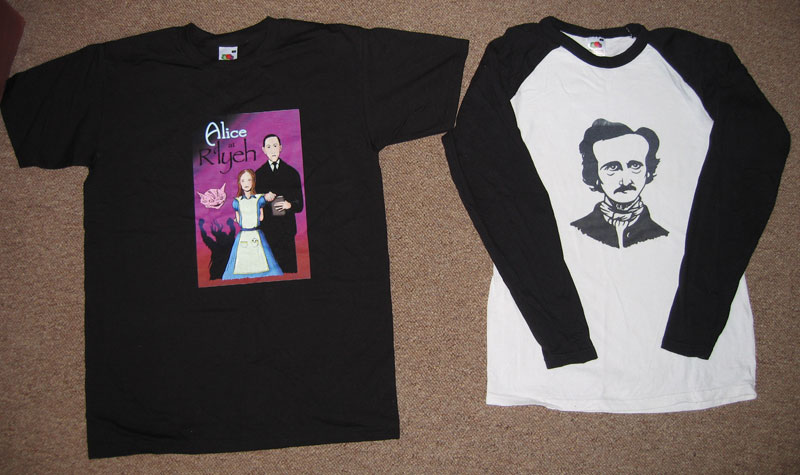
…And a t-shirt from yourdesign.co.uk, which didn’t really work. So I did an Edgar Allan Poe baseball shirt as well:

…which did!)
I’ll finish off by mentioning the two best moments of the whole project. One was each time I got an order from a new country. I ended up selling, as well as to the UK, to the USA, Australia, Finland, the Netherlands, and Japan! (A real surprise, that last one.) I don’t know why, but there’s something inherently satisfying about putting those little mental flags around the globe. (I didn’t actually put Alice at R’lyeh flags on my World Domination Globe. Honestly I didn’t.)
The other great moment was when MorganScorpion contacted me, out of the blue, and offered to record a reading of the poem. Apart from the thrill of hearing the poem read so well, it was the fact that this was, as it were, an artistic/creative response to what I’d done, and it certainly capped the whole experience. (If you haven’t heard the reading, you can do so via the Alice at R’lyeh site, or to Archive.org, which also has other readings by MorganScorpion.)
Anyway, that’s the report. Thanks to everyone who’s bought or read the booklet, and I hope you enjoyed reading it as much as I enjoyed the process of getting it out there.
(If anyone has written similar reports about self-published projects, please put links in the comments section, as I’d love to read them.)

 “Happy families are all alike; every unhappy family is unhappy in its own way.” Yes, but what about mad families? What about psychotic serial killer families? Tolstoy didn’t think of that one, did he? Ever since reading about Mumsy, Nanny, Sonny & Girly

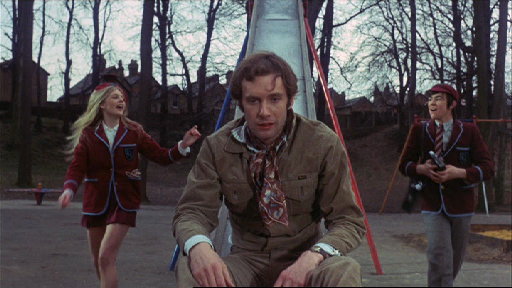
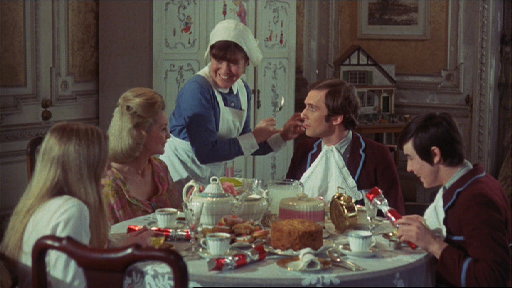
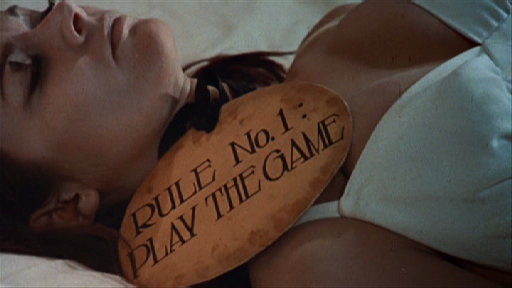
 …does miss the point a bit about this being, after all, a family film. Though not, obviously, a film for all the family.