
The Sun (or Solntse, 2005) is the third in a series of films by Aleksandr Sokurov, each of which focuses on a 20th century political leader from the darker end of the spectrum: Moloch was about Hitler, Taurus was about Lenin (neither of which I’ve seen), while The Sun is about the Japanese Emperor Hirohito in the days up to and immediately after the country’s capitulation to the US in World War II.
In his production notes on the DVD, Sokurov says that Hirohito is a far more human figure than either Hitler or Lenin, thus making The Sun a more optimistic film than his others about the evils of totalitarianism.
I didn’t read the production notes till after I’d watched the film, but turned to them in the hope of finding out what the film was trying to say. If it is just that Hirohito was a far more human figure than the dictators Hitler and Lenin, then Sokurov’s hardly making much of a point. As the film presents him, Hirohito was a much more human figure simply because he wasn’t really in charge or even connected with what was going on in the war at all. (The Wikipedia article on Hirohito has a brief discussion of the Emperor’s actual involvement). In fact, for a large part of the film, I was wondering if The Sun wasn’t meant as a comedy. Hirohito’s peculiar facial tics and his childlike manner as he distracts himself with dictating notes about the Hermit Crab, and loses himself in a dead end of the war-bunker, made me wonder if there was some mental illness I was supposed to know about. When Hirohito sits down to talk to the incredibly-foreheaded General MacArthur, we get ridiculously inconsequential dialogue which only at one point actually touches on the war — and when it does, it shows Hirohito to be perceptive enough to understand what went wrong, thus raising the question of why he didn’t do anything to stop the war. There’s then a sequence in which Hirohito tries to light a cigar, ending in a peculiar shot of the Emperor lighting the cigar from MacArthur’s. At first it’s as if the two men are kissing, then it’s as if MacArthur was prolonging the event simply to humiliate the Emperor by puffing smoke in his face. But neither of these interpretations has any relevance to the two men’s relationship in later scenes. The film is full of such moments that seem to be saying something, but which don’t build on anything that occurred before, leaving me wondering what it was all leading up to. The Emperor finally animates and starts to talk about his one enthusiasm in life — marine biology — but MacArthur immediately interrupts him to say, bizarrely, he has to leave on an important errand. He goes out of the room and watches Hirohito, who, alone, proceeds to perform a little dance before playfully extinguishing all the candles on the table. MacArthur looks on, smiling as at a child’s antics. Earlier on, US war photographers had called the Emperor “Charlie”, likening him to Charlie Chaplin, underlining this air of childlike innocence.
The only dark moment in the film comes right at the end, when Hirohito has recorded a speech renouncing his divine status. He asks what happened to the engineer present at the recording, and is told the man committed hara-kiri. The Emperor pauses, surprised and upset. Then we get an outside view of a city — perhaps Hiroshima — that is totally devastated and still smoking, a place where thousands have died. It seems to indicate, to me, that an Emperor who can feel the loss of one man he met only briefly obviously didn’t understand the reality of what was happening around him during the war, where such tragedies were occurring every second.
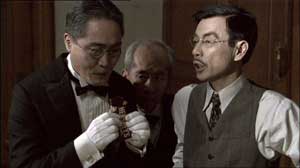
(The film’s best moment is also its funniest, when the Emperor receives a gift from General MacArthur of Hershey bars. Everyone seems slightly awed by the presence of real, cocoa-made chocolate. The Emperor’s butler warns they might be poisoned. The Emperor tells him to try some. The butler nibbles a bit, then says with a shrug, “I prefer rice candy.”)
 Sophie Scholl is the dramatisation of a true story set in the latter days of World War II Germany. Sophie, her brother, and a few friends, distribute pamphlets criticising Hitler’s government and pleading for the war’s inevitable end to be brought about sooner rather than later, if nothing else for the sake of soldiers’ lives. Unfortunately, in Hitler’s Germany publicising such political beliefs was punishable by death.