The Innocents (2021)

Not the 1961 adaptation of Henry James’s Turn of the Screw, but a 2021 Norwegian film (De uskyldige), which I was drawn to for its bleakly realistic take on a theme I’ve written about in Mewsings before: psychic kids.

The Innocents focuses on Ida, a girl of about eight or nine, whose parents move to a new flat in the sort of complex of apartments I last saw on film in Let the Right One In (which would make an excellent Nordic-supernatural-kids double-bill with this film). Ida’s older sister Anna is profoundly autistic, so cut off from the world that she doesn’t respond when Ida viciously (and casually) pinches her leg. Ida befriends another loner at the apartment complex, Ben, a boy of her own age who shows off a skill he’s been practising: if Ida drops a bottle cap in front on him, he can fling it to the side with his mind. Ida’s impressed; Ben is equally impressed by Ida’s ability to bend her arms slightly backwards. He then shows her a cat he’s befriended, and suggests they take it up several flights of steps and drop it, to see what happens.

Superpowers!

Amazingly enough, there’s another child with a mild psychic ability in the same apartment complex. The slightly-younger Aisha can hear some people’s thoughts and talk back to them with her mind. She can’t hear Ida (Ida has, it seems, no psychic ability), but can hear the autistic Anna. More crucially, Anna can hear her, even when they’re apart, and it’s through Aisha that Anna is encouraged to say her first words.

The kids realise their powers get stronger when they’re together. They of course use them to play games, with Ida whispering a word into Anna’s ear and Aisha or Ben “hearing” it the next floor up. But things start to take a darker turn with the already-troubled Ben. Bullied not just by the local older lads but also his own mother, Ben discovers he can make people do things. He gets revenge on a teenage boy who taunted him by controlling a much older man. Then he plays with getting his own back on his mother (who has clearly beaten him — we see unexplained bruises on his body), and, childlike, goes way too far, but perhaps doesn’t care, or can’t admit he does. The children’s powers are all meshed together, though, and an injury to one — or caused by one — can be felt or perceived by the others. Aisha doesn’t like what Ben’s doing, but Ben doesn’t like being told what to do. A confrontation is brewing.

The Innocents is clearly a world apart from that archetypal “psychic kids” film, Disney’s Escape to Witch Mountain (1975). There, apart from some mild peril at the end, the film is mostly about what fun it would be to have psychic powers. Here, it’s about how dangerous psychic powers might be in kids who are neglected or ignored or mistreated enough that they can take a childish pleasure in inflicting pain, or in taking an instant and over-the-top retribution just because they can.

But The Innocents does have a more positive side. Though I’ve seen it described (bizarrely, I think) as a superhero film — presumably, just because there are “super powers” involved — what it most reminded me of was Theodore Sturgeon’s classic novel More Than Human (1953), in which a group of misfits who, individually, would be regarded as physically or mentally disabled, together meld into a super-powered example of the next step in human evolution, “homo gestalt”. In The Innocents, it’s through coming together that these kids’ powers develop.

Their powers aren’t explained at all. Ben’s having worked on the ability to fling bottle tops with his mind just seems to be the product of a lonely boy’s application, driven perhaps by a determination borne of a clearly unhappy home life. It’s the coming together of Ben, Aisha and Anna that flips things from flinging bottle tops to mind control and murder. But The Innocents gets past any accusation that this is a major coincidence — three kids with psychic powers, however mild, happening to come together in the same apartment complex — by a hint, at the end, that psychic abilities aren’t all that rare, they’re just usually too mild (or left un-amplified by isolation) to get noticed. (And presumably such abilities either die out in adulthood, or these kids are that tiny step forward in evolution, in the manner of mutants and Tomorrow People everywhere).

The Innocents does have some scenes which are really hard to watch (particularly involving the poor cat), but overall it’s a low-key, even muted film, with a lot of quiet but meaningful moments that build the tension — which is as much emotional as supernatural, particularly when it comes to seeing how far Ida will side with the increasingly vindictive Ben. Not a casual watch at all, nor perhaps as affecting as Let the Right One In, but a worthwhile slice of subtle Nordic supernatural.

^TOP

Seaward by Susan Cooper

1985 Puffin PB, art by Steve Braund

Published in 1983, this was Susan Cooper’s first novel since finishing her Dark is Rising sequence with Silver on the Tree in 1977. Like those books, Seaward is a fantasy for young adults, though in this case a standalone one.

Two youngsters, separately, find their way into another world. The boy Westerley, whose home nation isn’t identified, though it’s evidently on the totalitarian spectrum, is told by his mother how to escape to this other world the moment before she’s shot by a political branch of the country’s police. He knows his father is by the sea and, thinking himself pursued even in this other world, heads towards it. The girl Cally (full name Calliope) has recently found herself alone after first her father then her mother are taken away to some place by the sea for a cure for a muscular disease — or, more likely, care before they die. Drawn by a music she vaguely recognises, Cally enters a mirror in her parents’ room and finds herself in this strange land. Like Westerley, she decides to head for the coast, where she believes she can reunite with her parents.

The world they’re now in is ruled by two beings — or, perhaps, ruled by one, who’s tempered by the other. There’s the blue-robed, white-blonde Lady Taranis, kind one moment, cruel the next, and the gold-cloaked, owl-eyed Lugan, who is much more of a helper to the two kids, though only at times:

“Sometimes I may intervene. Not always. There are perils in this country, but there are also laws—and while you journey here, I watch that neither you nor anyone else break those laws.”

1983 Bodley Head HB, art by Joseph A Smith

There’s something of an Alice in Wonderland feel to the fantasy in this book. Not only does Cally enter the world through a mirror, but Westerley’s first adventure is to find himself part of a chess game, played by unwitting squares of soldiers on a wide, flat plain. But this isn’t a nonsense fantasy, nor is it meant to be taken lightly. The whole point is that the perils Cally and Westerley face — at first alone, but soon together — are life-threatening, or at least potential prisons. This book is closer to, say, Ursula Le Guin’s Threshold or Catherine Storr’s Marianne Dreams, in that it’s about a lonely boy and a lonely girl meeting in another world and, through facing its perils together, forging a relationship that allows them to return to our world and face it with a renewed hope and strength. (Though I wouldn’t say it’s quite as good as either of those.)

And that theme, I think, would have been the thing I’d have responded to had I read it first as an adolescent, but as I’m reading it for the first time now, many years later, I was more bothered by the lack of solidity to the story. Lugan may mention laws, but his use of the passive voice (“there are also laws”) means we’re not going to told what they are, and his pronouncement that he “may intervene” sounds more like a writer letting the reader know that random interventions may occur, but they’re not going to tell you when. Cally and Westerley’s adventures are full of invention, but have none of the sort of logic that can allow the reader to really take part in the tale (anticipating what will happen, working out what they would do in the characters’ place). Most of the time, the pair are rescued from peril by some magic helper or gift that just works at the right moment: a magical wind to take them away, the help of birds, a friendly giant snake, a friendly giant insect. As Colin Manlove says of Seaward in From Alice to Harry Potter: Children’s Fantasy in England:

“Though the book’s settings are finely imagined, they are not suggestive of meaning, but are there simply as fantastic inventions to give an exotic and exciting air to the plot.”

1987 PB, art by David Wiesner

In a sense, to use Tolkien’s word, the book is a series of eucatastrophes — last-minute miraculous rescues from certain peril — but used so often they soon lose their fairy tale element of genuine magic and just become frustrating. But the point of the book, I’d say, isn’t the story, but the way these perils bind the boy and girl together, teach them to trust one another and form a new bond of a type they’d only previously had with their parents.

Manlove’s other criticism of the book, I don’t quite agree with:

“Part of the trouble is that the book is non-moral: enjoyment of life is the only notion of good, hating it the bad.”

But I think this is to be too harsh on a novel that’s basically about overcoming grief and loss, and the fear of growing up in a world which can so easily take away what is most valuable, in human terms. As Charles Butler says in Four British Fantasists (a study of Alan Garner, Penelope Lively, Susan Cooper and Dianne Wynne Jones — four writers who happened to be at Oxford when Tolkien was lecturing there):

“One of the book’s main themes is that the two rulers of the secondary world, Lugan and Taranis, are not moral opposites, even though they at first appear to be so, with Lugan protecting the children and Taranis attempting to bar their escape. Ultimately, they are brother and sister, life and death: each of them has both a kindly and a cruel aspect.”

2013 PB cover, which makes use of a single (very brief) appearance of a dragon to sell this as the sort of fantasy it isn’t

“Nothing is black and white, Westerly, in this long game we play,” Lugan says at an early point, which isn’t, I don’t think, a moral point, but one about learning to accept the apparently bad things as part of a life that will inevitably contain both the bad and the good, as well as many things in between. It’s a novel about learning to balance the threat of/fear of death and loss, and the other negative aspects of life, with at least the possibility of the positive (here, the promise of love as a balance to loss).

Ultimately, Seaward is a coming of age tale, taking both characters to the point where they must decide to return to the real world, with all its losses, perils, and difficulties, in order to either mature into a full life, or escape from harsh reality and remain children forever. As I say, it’s not, I don’t think, the sort of YA book that can be read for the first time as an adult — something I’d say is also true of Cooper’s Dark is Rising books, which also have too much passive-voice fantasy (“this must be”, and so on) for my full enjoyment. But, they’re not written for me, at least not the non-adolescent me I am now.

^TOP

Star Maker by Olaf Stapledon

First HB dustjacket, from Methuen, art by Ethel “Bip” Pares

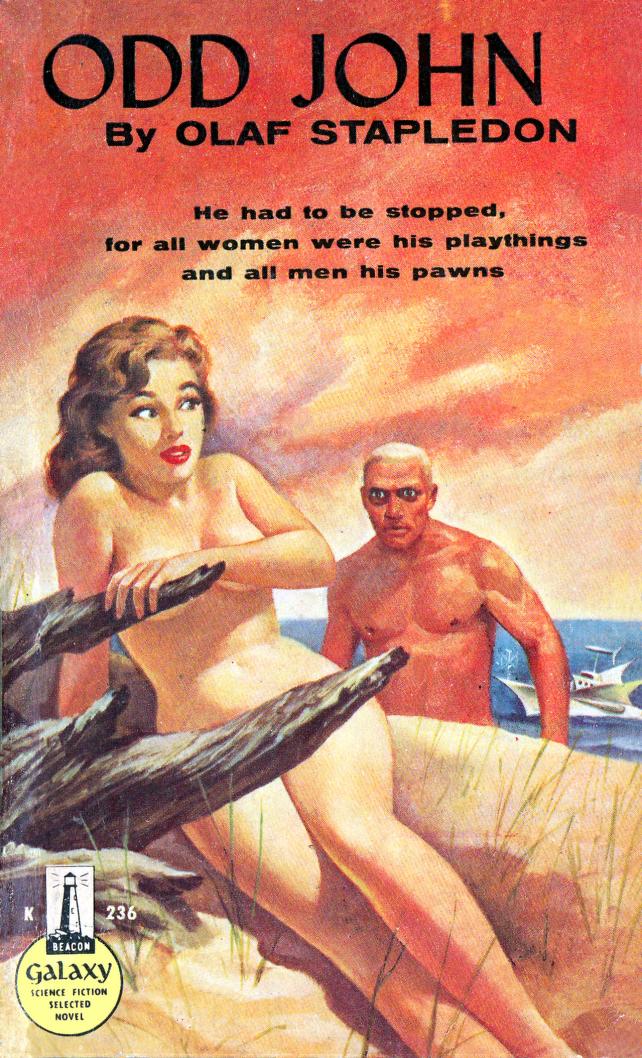
After his first novel, Last and First Men, Stapledon published Last Men in London (1932) and Odd John (1935), but it was 1937’s Star Maker that was the true successor to his first book.

Like that debut, Star Maker isn’t so much a story as a trip through time (and, in this case, the entirety of space as well, before moving outside both space and time in the final chapters). It starts with its narrator leaving his family home one night in a state of bitterness, to sit on a hill and regard “our own house, our islet in the tumultuous and bitter currents of the world”. Soon, it is not his own little house he’s regarding from the outside, but his world, Earth, as some force takes him up on the start of this novel’s journey:

“The Earth appeared now as a great bright orb hundreds of times larger than the full moon. In its centre a dazzling patch of light was the sun’s image reflected in the ocean. The planet’s circumference was an indefinite breadth of luminous haze, fading into the surrounding blackness of space… The spectacle before me was strangely moving. Personal anxiety was blotted out by wonder and admiration; for the sheer beauty of our planet surprised me. It was a huge pearl, set in spangled ebony.”

This makes me think of the famous “Blue Marble” photograph of the Earth seen from space, taken in 1972, and how it and other Earth photos (Wikipedia has a timeline of them) brought out the preciousness of this speck of rock that we call home, thinly coated with a life-preserving environment, an island in a vast, harsh vacuum — just as Stapledon describes it — and how that fed into the burgeoning environmental movement. (And this makes me wonder who was the first writer to properly see the Earth as such a “Blue Marble” in fiction.)

David Pelham art for 1972 Penguin PB

The narrator becomes “a disembodied, wandering view-point”, capable of inhabiting the minds he encounters, and sharing their experiences. He finds he can enter into dialogue with these beings, and that they can even become fellow travellers. Soon, the narrator is at once the Earthman experiencing all the wonders and mysteries of the cosmos, and a conglomerate of disparate beings, all journeying, like him, by mind, experiencing the many worlds they encounter, learning their stories. In their quest, this narrator becomes aware that he and his fellow travellers can move through both time and space, the only limit to their travels being that they can’t connect with — even become aware of — planets whose inhabitants have evolved to a level of consciousness too far beyond their own. They have to advance their own awareness and understanding before they can experience these more realised beings, or even perceive them as more advanced. There is, for Stapledon, no way to be a purely passive viewpoint and genuinely perceive the truth; you have to be altered by what you see.

As he/they range on this cosmological quest, the narrator becomes aware that “every world that we entered turned out to be in the throes of the same spiritual crisis as that which we knew so well on our native planets”:

“…in which the ideals of the masses are without the guidance of any well-established tradition, and in which natural science is enslaved to individualistic industry…”

This, to me, sounds so much like the modernist crisis of the early 20th century, as found in the likes of T S Eliot and Virginia Woolf: an existential crisis of meaning, driven in part by the First and Second World Wars (themselves perfect metaphors for “natural science… enslaved to individualistic industry” and taken to mass-murderous extremes), but also by the destabilisation of so many ideas and ideals thanks to the revolutions in thought brought about by Darwin, Einstein, and others. As Stapledon’s narrator sums it up at the start: “horror at our futility, at our own unreality, and not only at the world’s delirium”. But whereas the emphasis in the literary moderns, who were often staunchly elitist, is on the sensitive individual suffering from angst and despair, Stapledon sees this as a worldwide crisis, whose roots lie in the clash between the lone individual and the community:

“This crisis I came to regard as having two aspects. It was at once a moment in the spirit’s struggle to become capable of true community on a world-wide scale; and it was a stage in the age-long task of achieving the right, the finally appropriate, the spiritual attitude toward the universe.”

Les Edwards art from 1999

Star Maker, then, is an attempt to understand this early 20th century moment by stepping outside it and asking: “What if this weren’t just our own dark moment, but a stage that all intelligent races in the universe go through — what if it has a million variations throughout the cosmos? Why might it be necessary?” The answers, for Stapledon, lie in the reason for all of this — life, the universe, everything — and so in the nature of its creator, the Star Maker.

First, though, he has to confront the fundamental question of whether there is a Star Maker. There are certainly moments of cosmic despair as the narrator ranges through the universe:

“The appalling desert of darkness and barren fire, the huge emptiness so sparsely pricked with scintillations, the colossal futility of the whole universe, hideously oppressed me.”

I fully expected Stapledon to leave the question of whether there was a Star Maker hanging till the end — in the classic Lovecraftian style of ending with the moment of overwhelming confrontation — or perhaps to never answer it at all. But no, Stapledon wants to examine what such a Star Maker would be like, so he has to have one and bring it on stage. At first, his narrator becomes aware of the Star Maker through its many aspects. One moment it’s “sheer Power”, another it’s “pure Reason”, or “Love”, or “unreasoning Creativity”. But these are just the trunk, tusks, tail and legs of an elephant too vast for him to perceive as a whole. All the time:

“The felt presence of the Star Maker remained unintelligible, even though it increasingly illuminated the cosmos, like the splendour of the unseen sun at dawn.”

Peter Goodfellow art, from 1979

Even at the end the Star Maker remains — has to remain, if Stapledon is to be intellectually honest — “a dread mystery”. It’s interesting that one of the books that influenced Stapledon in his writing of Star Maker was Rudolf Otto’s The Idea of the Holy (1934), which was about the essentially incomprehensible, alien, or inhuman aspects of divinity, and how the holy is so often associated with darkness — interesting because Otto’s book was also a key influence on C S Lewis, and fed into the shadowy aspect of the primitive goddess Ungit and the not-to-be-looked-on Mountain God in Till We Have Faces. Both Star Maker and Till We Have Faces are about how we cannot even begin to perceive the nature of the divine (or of that level of reality we might call divine) until we ourselves have changed. (Lewis, though admiring Stapledon’s book, thought it “ends in sheer devil worship”.)

Stapledon’s approach (or his narrator’s), in this novel, has been to try to understand the crisis early 20th century Earth is going through by rising above it and putting it into a new and wider perspective. At first, that perspective is to learn that other worlds are going through the same crisis — in fact, have to go through it. Then, rising above that level, he discovers that not only species go through this crisis, but stars too — stars, in Star Maker, are conscious entities, and one of Stapledon’s most inventive moments is to reveal that what we think of as the universal laws of gravitation that dictate how the stars must move in their galactic orbits are, to the stars themselves, closer to social rules or aesthetics. They have no need to obey them — they are, then, not laws — but the stars do obey them, because not to do so would bring them shame and a kind of aesthetic pain.

The ultimate end of this rising-above approach is to see humankind — and the many created races that inhabit our universe with us — from the viewpoint of their creator. What, then, are we, to the Star Maker?

“And at once I knew that the Star Maker had made me not to be his bride, nor yet his treasured child, but for some other end… It seemed to me that he gazed down on me from the height of his divinity with the aloof though passionate attention of an artist judging his finished work; calmly rejoicing in its achievement, but recognising at last the irrevocable flaws in its initial conception, and already lusting for fresh creation.”

The Star Maker, it turns out, has a dual nature. It is at once outside and (when engaged in creation) inside time, evolving in response to what it has created. Stapledon’s cosmos is not an entirely top-down hierarchy. Humankind, and the other races, are not just there to be the playthings of their creator, but to teach that creator how to better create. Which could be a harsh sort of idea — our purpose, it seems, is to be flawed, and to try but fail, so the next iteration of creation might be less flawed — but it comes, for Stapledon’s narrator, as a kind of consolation:

“The incalculable potency of the cosmos mysteriously enhanced the brightness of our brief spark of community, and of mankind’s brief, uncertain venture. And these in turn quickened the cosmos.”

Jean-Michel Nicollet art from a 1979 French translation

What, for me, sets Stapledon’s cosmicism apart from, say, Lovecraft’s (who reveals what I take to be his own longing to be a “disembodied, wandering view-point” in the universe in The Whisperer in Darkness), is that Stapledon is always aware of — insists on — there being both a plus and a minus. At every stage in his narrative, an intelligent race of beings triumphs only to realise its limits, or to find there is more striving to be done; or it fails and learns and starts again. Ultimately, even the tragedies have a purpose. This can make reading Stapledon, particularly as a piece of sense-of-wonder science fiction rather than of philosophy, a mite frustrating, as every payoff is tempered, every revelation is not quite the last. (Another comparison is with Clark Ashton Smith’s The Hashish Eater, whose narrator indulges in a superficially similar experiential tour of the universe, though unlike Stapledon’s narrator he tries very much not to become involved or changed by the wonders he sees — until the final confrontation with that “huge white eyeless Face”, which is where Smith leaves it. Stapledon pushes on, still asking questions.)

Spine of the first edition

Is there a final answer, then, to the modernist crisis that kicked this novel off, and those questions the narrator asked at the start:

“Had we, perhaps, misconceived our whole existence? Were we, as it were, living from false premises?”

The response Stapledon gives is a typically Stapledonian one, in that it isn’t any sort of final answer, but is, rather, an opening up of new questions. Returning to Earth, at the end, the narrator is struck by “The littleness, but the intensity, of earthly events!” He sees his own situation, then, from not a new perspective, but from two perspectives: not just that of the human being caught up in his own troubles and all the intensity of a contingent, mortal life, but also from the cosmic viewpoint, from which his suffering is really quite a minor thing, but nevertheless part of a much larger, ultimately hopeful, project of creating something better.

This is perhaps the key thing that prevents Stapledon from writing Lovecraftian cosmic horror. He does see and acknowledge the horror, but also acknowledges that it is, however true to the one perceiving it, only one perspective among others. The point is not to be caught in one viewpoint — not that of the suffering mortal, nor that of the vastly removed Star Maker — but to move between them, to step outside or inside as required.

(Which is what I’ve always thought is one of the main benefits of “escapist”and imaginative fiction: the ability to step outside of it all, get a new and expanded, or at least refreshed, perspective, then return.)

Is Star Maker fiction or philosophy? Reviewing it in The Sketch when it first came out, L P Hartley called it “the most ambitious novel, if novel it can be called, that I ever read”. It’s certainly not a story, as most novels are. It uses the techniques of fiction to present a philosophical idea of how the cosmos might be ordered, of how the crisis of 1937 might be faced. If Stapledon had written about the nature of his Star Maker as philosophy, he’d have been dismissed as a fantasist; but by writing it as fantasy, he can say something that feels like a sort of truth, even if it doesn’t have to be taken as literally true.

At the same time, it’s a difficult read — far more abstract, and (literally) disembodied, than his Last and First Men. One of those monuments of imaginative literature, Star Maker is a book that, for me, has grown the more I’ve thought about it.

^TOP