
Harry Potter and the Order of the Phoenix by J K Rowling

Jonny Duddle cover

For this re-read of J K Rowling’s Harry Potter books, I bought the series as a single Kindle book (all the better to quote you with, my dear), a side-effect of which was I could see how far, percentage-wise, I was through the series as a whole. And it’s only with this, the fifth (and longest) book of seven, that I passed the halfway point. Halfway points are often major turning points in stories, and I’d say Harry Potter and the Order of the Phoenix (first published in 2003) is no exception.

You wouldn’t think so immediately, though. For a large part of The Order of the Phoenix, the presiding feeling is one of frustration. Harry being so isolated at the Dursleys and getting no news of what’s going on in the Wizarding World; none of the kids being told what Dumbledore’s Order of the Phoenix is up to; nobody knowing what Voldemort’s up to; Harry being disbelieved by everyone at school; Dumbledore avoiding not only speaking to, but even looking at Harry; Hagrid’s unexplained absence; Ron and Hermione’s being prefects, leaving Harry on his own and feeling left out; Ron and Hermione’s constant bickering; the increased homework and revision the trio have to put up with as well as (for Harry) detentions, on top of the burden of their usual extracurricular school project of defeating the forces of evil; Harry’s inability to talk to Cho, or to understand her emotional state (plus the frustrations of early adolescence generally); Umbridge teaching only the theory, not the practice, of Defence Against the Dark Arts; her increasing stranglehold on communications in and out of Hogwarts, and her limiting of everyone’s freedoms, until “It seemed to Harry that Umbridge was steadily depriving him of everything that made his life at Hogwarts worth living: visits to Hagrid’s house, letters from Sirius, his Firebolt and Quidditch.” On top of all this, there’s Harry’s frustrating dreams, which are, he soon realises, only echoes of Voldemort’s frustration. The first half of the book starts to feel like a powder keg waiting for a match.

The first UK cover, art by Jason Cockroft

Another part of the frustration is that Harry is denied the usual sense of coming to his true home that has, so far, begun every book in the series, whether that home is Hogwarts or the Weasleys’. Instead, we get number 12 Grimmauld Place, current headquarters of the Order of the Phoenix, but still dominated by the character of the morally dark, pure-blood-elitist Black family who once lived there. Now it’s a sort of prison for the last scion of that family, Harry’s godfather Sirius, who turned his back on his parents’ elitism but now finds himself swamped once more in their prejudicial gloom, as though the house were a living symbol of a repressive childhood lingering into adulthood. (And the family’s house-elf, Kreacher, wandering around muttering darkly, is like the sort of inner voice instilled by such a childhood, and just as hard to get rid of.)

Talking of elitism, this book — and how could it be otherwise with a title such as The Order of the Phoenix? — is full of elites. There’s the Order itself, there’s “Dumbledore’s Army”, there’s being a Hogwarts prefect, and Umbridge’s Inquisitorial Squad that replaces them. People who see Thestrals (those who have witnessed death) form a sort of unnamed elite. There’s Death Eaters, the upper echelons of the Ministry of Magic, Aurors, the Wizengamot, the Order of Merlin, and the Griffindor Quidditch team (the last three being highlighted because major characters are ejected from them — leading to more frustration). All this serves as a reminder that Harry’s adult initiation into the Wizarding World, which ought to have been sealed by his winning the Triwizard Cup in the last book, is still somehow incomplete. The admission, in that book, by both Voldemort and Dumbledore, that young Harry had faced tasks even an adult might fail at, hasn’t taken hold — in large part because the Wizarding World doesn’t want to believe Voldemort is back, so ceases to trust Dumbledore. But even Dumbledore isn’t treating Harry as fully initiated. He’s still protecting him, both from danger and from the truth.

Brian Selznick cover

The frustration finally loosens its grip when this new generation starts to take action for itself. Denied proper Defence Against the Dark Arts instruction, they form Dumbledore’s Army to learn it for themselves; at Hermione’s suggestion, Harry gives an interview to The Quibbler (the wizarding version of The National Enquirer) about what really happened to him at the Triwizard Tournament; and then, at the end, the kids launch their own rescue mission into the bowels of the Ministry of Magic, like a full-on assault on the adult establishment.

In previous books, Harry being likened to his father — even mistaking himself for his father at one point — could be taken as a sign of his growing up, but here it’s his starting to notice how he’s unlike his father that reads like a sign of maturity — certainly, of individuation. And this book has an increasing moral complexity throughout, with almost all of the main characters revealing vulnerabilities and weaknesses, or having them highlighted to a greater degree than before: the fact that Sirius is trying to relive, through Harry, his lost youthful friendship with James Potter; Molly Weasley’s “mollycoddling”; Harry’s “weakness for heroics”, and his “saving-people thing”; his father being revealed as an arrogant bully; Ron’s klutziness being put on display before the whole school in Quidditch; Neville’s secret about his parents being finally admitted. I like to think another pair of weaknesses revealed in the final fight section is that not-so-clever Ron is trapped in the tentacles of a living brain, while too-clever Hermione is felled by a wordless spell. Even Professor McGonagall gets Stunned. We glimpse something of the weakness behind Voldemort’s power — his belief that “There is nothing worse than death” — and Dumbledore admits, at the end, his own weakness: the fact that he cared too much for Harry’s happiness to carry out the plan he’d initially conceived.
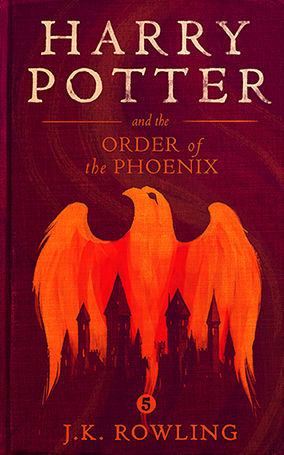
Olly Moss’s ebook cover

And that leads to the final part of Harry’s “initiation” I spoke of in my mewsings on the previous book. As well as tests and trials, and a public recognition, initiation requires education. In a traditional society, this means teaching a child, in its passage to adulthood, the myths of the tribe. (And of course this is the book where Harry & co. sit their exams, which is our modern-day version of this stage.) Here, Harry gets told the full truth about himself and Voldemort — or, the full truth as Dumbledore knows it, anyway:

“It is time,” he said, “for me to tell you what I should have told you five years ago, Harry. Please sit down. I am going to tell you everything…”

The link between Harry and Voldemort is, I think, one of the most satisfying aspects of the series. It’s not just that Harry is “good” and Voldemort “evil”, and that there’s some sort of prophecy that says one will defeat the other (as there is in my childhood’s equivalent of the Harry Potter series, David Eddings’ Belgariad) — though there is, in this book, a prophecy, it turns out — it’s that Voldemort’s evil actions by themselves created Harry as he is, so evil planted the seed of its own downfall. This becomes clearer as the series moves on, but on this re-read I can’t help wondering at how restrained Rowling has been in revealing just a little at a time to what is, by The Deathly Hallows, a thoroughly well-thought-out reasoning for why Harry is who he is.

Kazu Kibuishi’s cover, whose colour scheme reminds me of the 70s paintings of Bruce Pennington

Another thing that stands out about The Order of the Phoenix is that Rowling really starts bringing on the interesting female characters. We’ve had teachers (McGonagall), parent-figures (Mrs Weasley), and two minor villains (Aunts Marge and Petunia), as female characters before, but in this book we get a wider range and deeper characterisation. We get two new female “hero” characters, in the shape of punky Auror Tonks (who “never quite got the hang of these householdy sort of spells”, though her mum could “even [get] the socks to fold themselves”, making me think her mother may have been Mary Poppins), and Luna Lovegood (a sort of antithesis to Harry in his truth-seeker capacity, in that “she’ll only believe in things as long as there’s no proof at all”, which means she believes in all the Wizarding World’s versions of conspiracy theories). Even better, though, are the female villains, Dolores Umbridge — passive aggression personified, a living version of the “smiling no” by which you can spot a psychopath — and deliriously unstable Bellatrix Lestrange. Both of these female villains are so much more emotionally provoking than the series’ main male villain, Voldemort. Voldemort is coldly arrogant, but both Umbridge and Bellatrix have a way of needling their victims’ (and the reader’s) most emotionally vulnerable points. Perhaps that’s because we expect Voldemort, a sort of “Dark Father” archetype, to be remote, but the viciously nasty “Dark Mother” behind both Umbridge and Lestrange can’t help hurting that much more.

Despite its air of frustration — no, because of its extended initial frustration — Order of the Phoenix is the most satisfying piece of Rowling storytelling yet, particularly when that frustration breaks and the action’s unleashed. My favourite part of this book (and perhaps of the series) is the scene of that final unfolding, the Department of Mysteries. Harry & co.’s wandering through the dark, surrealistic bowels of the Ministry of Magic’s strangest division remains one of my favourite fantasy sequences, both in the book and the film. The rooms they pass through (in the book, anyway) are a sort of gallery of Symbolist scenes (reminiscent of the sort of non-commercial painting Michael Whelan does). This department of the Ministry is looking into the fundamentals of human existence, at such abstracts as Time, Death, Love, and Dreams, but Rowling captures them with a moody weirdness I’d really love to see more of — or perhaps it’s there throughout, it’s just so easy to miss amongst all the wizard-school-romp stuff.

Inside the Department of Mysteries

Some of Michael Whelan’s Symbolist-feeling works. More at Michael Whelan.com

From Order of the Phoenix on, the series is about the now-publicly-acknowledged war with Voldemort. The gloves (and the blinkers) are off… Or are they? We’re not at the final book yet, so we’re not at the final confrontation. What can possibly hold that final moment off? We’ll find out in the next book, Harry Potter and the Half Blood Prince.

^TOP

Red Pill by Hari Kunzru

UK cover to Red Pill, featuring Heinrich von Kleist, whom Kunzru identifies as a Romantic-era incel

There’s something of a war of genres going on in Hari Kunzru’s 2020 novel Red Pill. On the one hand, the tone (somewhat distanced and ironic) is very much that of a literary novel, as is the protagonist (a middle-aged writer finding it difficult to get going on his latest book). You can even narrow down “literary novel” to “midlife-crisis novel”, if you want to get specific. But I was drawn to the book by the other genre it suggested, that of psychopolitical thriller. For, whilst the (unnamed, I think) narrator unsuccessfully ensconces himself as a writer-in-residence at the Deuter Centre in Berlin, he becomes obsessed with Blue Lives, an ultra-violent, ultra-nihilistic TV cop show. When he later meets the creator of that show, Gary Bridgeman, a.k.a. “Anton”, he learns that the man is utterly invested in the conspiratorial, right-wing-extremist views of his lead character. Shocked by his own inability to immediately refute Anton — even, finding himself mocked by the man and his cronies as a caricature of a liberal, left-leaning “Social Justice Warrior” — our narrator’s incipient midlife crisis turns into a full-on breakdown, leading to his following Anton to a Paris film premiere to try and get the last word, and then tracking down Anton’s secret hideaway cabin off the coast of Scotland.

And this is the point at which the war of genres is decided. In a thriller, you’d get a showdown between Anton and the narrator, mixing idealistic back-and-forth with bouts of fisticuffs. Our hero would vanquish both Anton the man and his extremist views in one four-knuckled blow. But we don’t get that ending. I won’t give it away, but the ending we do get is much more muted and internalised, of exactly the sort you’d expect from a literary novel, and a literary midlife-crisis novel at that.

What made me want to write about Red Pill, though, was the feeling that Kunzru was presenting a sort of allegory of the moral battle going on in Western culture at the moment. Both the writer-narrator and the literary novel genre he belongs to are, in a way, hitting something of a crisis. Their distanced, ironic tone has become a worldview, a slightly too-knowing one in which realism is best achieved by everything being that little bit disappointing — every relationship just that little bit distanced, every experience that little bit as-expected, every interaction just a little bit humiliating, every self-revelation one of inadequacy. And, like the narrator’s attempts to start a new book, this lacklustre worldview (only exacerbated by the way his success as a writer cushions him from the harsher realities of life) soon gives way to the base pleasures of something a little more stimulating: violent-but-moreish TV. It at least has some life to it.

French nihilist philosopher Emil Cioran

(Blue Lives, though fictional, reminded me in some ways of True Detective, in that its creator puts nihilistic literary quotes into the mouths of its lead characters. With True Detective it was Thomas Ligotti; with Blue Lives it’s the Comte de Maistre, Schopenhauer, and Emil Cioran. But there’s also an element of Game of Thrones there too, in the violence and moreish storytelling. And later, we learn that Anton has started up a fantasy TV series, called Spear of Destiny.)

To underline what’s going on with the narrator, we get the story-within-a-story of Monika, born in Communist East Berlin, whose youthful rebelliousness found a brief burst of expression in her days as a drummer in a (non-state-approved) punk rock band. But the Stasi put a stop to that, effortlessly taking all that made her life worth living away from her, till she’s left isolated and cynical in a world she no longer cares about. Even the fall of the Berlin Wall doesn’t end it for her. (I’m tempted to add this as part of the allegory, as the constant surveillance under the Stasi, and the way everything you say in Communist Berlin is immediately misunderstood, politically, in the worst possible way, can’t help coming across as a reminder of certain tendencies on those platforms of self-surveillance, social media.)

Monika’s life gets crushed by the Stasi; the narrator’s life gets crushed by, frankly, his lack of any really vital connection to anything. (Despite having a family he supposedly cares about.) It may seem odd to equate the Stasi with the distanced, ironic tone of the literary novel, but, given enough time and exposure, both seem to have the same deadening effect.

And then along comes Anton — dark-souled, outspokenly racist, despicably self-centred and utterly privileged by his success — and, rancid though he and his beliefs are, there’s something living about him the narrator lacks. Why else is the narrator so drawn to him? Like the Jungian Shadow he surely is, Anton effortlessly takes up residence in the narrator’s mind (who has to, at one point, explicitly point out that this isn’t to be taken as literally as it occurs in Fight Club, after which Red Pill can’t help but feel as though it’s under that other book’s shadow).

When it comes down to it, our narrator just doesn’t have the energy, the life, the conviction, to defeat Anton. However much better his morals are, it’s the livingness he lacks. (This all reminds me of what I wrote about the late-60s films Blow-Up and Performance, in both of which artists find a new lease of creativity after a brush with the world of violent crime. Here, the narrator fails to find that new lease — but the big changes like redemption and rebirth are, in a way, precluded by this being a literary novel, which can’t allow itself to believe in such things.)

All this makes me think that a literary novel like Red Pill will never be able to provide an answer to this particular malaise of our times. The literary novel used to be a thing of danger and intellectual acuity — just think of Joyce’s Ulysses or Ballard’s Crash — but this sort of book doesn’t have the oomph in it for the fight, and that lack of energy feels almost built in to the genre. Would a thriller have done better? It might have, but simplistically, without the necessary intellectual arguments. A comedy might work, though it would have to be both blunt and acidic in equal measures. I’d like to say, perhaps something like Armando Iannucci’s film The Death of Stalin — but, just look at how little of an effect The Thick of It had on politics. (If anything, it just got thicker.)

Red Pill was enjoyable enough, but I think ultimately proved itself inadequate for the task at hand. The literary part of culture is, I can’t help thinking, too mired in irony, distance, and the need to avoid any sort of real conviction, to be able to face something as darkly-vitalistic, darkly-mythic and darkly-powered by wilful ignorance as Anton and his real-life equivalents.

^TOP

Harry Potter and the Goblet of Fire by J K Rowling

Giles Greenfield’s cover for the UK hardback

The word “fire” in the title of the fourth Harry Potter book (published in 2000) immediately makes me think of tests and trials, the idea of something passing through flames and emerging proved and tempered. Books about youngsters who learn they have magical powers are often stories of initiation, as with The Dark is Rising, A Wizard of Earthsea, and Jenny Nimmo’s The Snow Spider (recently dramatised on CBBC). But Harry learned he had magical powers in book one, and this is book four, so why is this theme of initiation being highlighted now?

In a way, this is a point conceded by Goblet of Fire as, instead of providing a new task of initiation, it gives us a summary of the previous three books. Harry’s name is, unbeknownst to him, put in for the Triwizard Championship, and he finds himself thrust into the limelight — just as he was when he first arrived at Hogwarts, and found everyone knew his name because of his role in the downfall of Voldemort. As a result, he’s put through three tasks, which could be reminders of the three previous books, and so of tasks he’s already faced. First, he has to get a golden egg guarded by a dragon — just as, in the first book, he had to acquire the Philosopher’s Stone before Voldemort could use it. Second, he has to rescue “what you’ll sorely miss” from the depths — in this case, his best friend Ron Weasley from the depths of Hogwarts Lake, but in the second book it was his future wife Ginny Weasley from the depths of the Chamber of Secrets. In the third task he has to get through a dangerous maze — and a maze being a sort of prison, this recalls the third book, The Prisoner of Azkaban, not just metaphorically, but also because the maze contains, for Harry, a Dementor, or a Boggart-appearing-as-a-Dementor, both of which featured in that third book.

Art by Kazu Kibuishi

So what does The Goblet of Fire add to the mix, rather than just being a reminder of how far Harry has come? An important part of initiations isn’t just the trials you go through, but the fact that they’re acknowledged by the community as a whole. Initiation in whatever form — into adulthood, into an organisation — is a public announcement as much as it’s an inner transformation, and here we get a couple of acknowledgements (aside from his very publicly winning the Triwizard Championship) that Harry has made the grade. Dumbledore says to Harry:

“You have shouldered a grown wizard’s burden and found yourself equal to it…”

And this comes after, earlier in the book, Harry allowed himself his most open admission of his child-state so far:

“What he really wanted (and it felt almost shameful to admit it to himself) was someone like – someone like a parent: an adult wizard whose advice he could ask without feeling stupid, someone who cared about him, who had had experience of Dark Magic…”

The second acknowledgement comes from Dumbledore’s opposite, Voldemort, when he and Harry square off in a graveyard:

“And now you face me, like a man… straight backed and proud, the way your father died…”

Art by Brian Selznick

Tales of initiation often have a presiding Magus figure to lead the protagonist through the process and arrange the tests and trials. There’s Prospero testing Ferdinand in The Tempest, and Sarastro in a similar role in The Magic Flute; the “Valerie” section in Alan Moore’s V for Vendetta is one of the most powerful examples, for me, with V himself as the puppetmaster; and later, we get a more ambiguous version in John Fowles’s The Magus. Who is the figure presiding over Harry’s initiation? It ought to be Dumbledore, but it isn’t, because one point about Harry’s initiation in this book is that it comes too early. He’s too young to enter the Triwizard Championship, and he’s too young to face the very real dangers his initiation leads him into — but so much of the series is about Harry being thrust into situations too dangerous or testing for one so young, first of which is Harry’s parents being killed by Voldemort when he was still a baby. No, the presiding figure for Harry’s initiation is Voldemort, and if there’s a dark figure presiding over an initiation, any actual initiation that occurs is a by-product of the process, not an intention. Voldemort, after all, doesn’t want Harry to come into his powers; he wants to kill him. Harry’s successful initiation is a side-effect of Voldemort’s failure.

(And anyway, there’s another necessary element that makes for a full initiation, so it’s still not complete. That’s left for the next book, The Order of the Phoenix.)

It’s an interesting theme of the series, how evil and good can’t help being intertwined. The link between Harry and Voldemort — in the way Harry’s scar hurts when He-Who-Should-Not-Be-Named is doing, or thinking about doing, something particularly evil, and the way Harry dreams about what is actually happening to Voldemort — recalls, for me, Mina Murray’s link with Dracula in the second half of Bram Stoker’s novel. Both Mina and Harry are unfinished victims, and this unfinishedness has unintended consequences, giving them insights into their victimisers that leave their enemies just slightly vulnerable. Evil, which thinks only about itself, discovers its weakness in the fact that it can’t help being linked to others.

Art by Jonny Duddle

But, with all this talk about initiation, does Harry “come into his powers” at all? Is Harry any good as a wizard? It’s clear that Hermione is the most capable wizard. Ron is the most klutzy. Harry generally tends towards the Ron end of the scale, except in two ways. One is that, when faced with the darker extremes of magic, he tends to come through. He might not be able to levitate a pillow to its intended location, but when he’s in desperate straits — and when his anger, determination, or sense of what is right is activated — he can pull off some pretty advanced magic. He might not be able to mend his own glasses, but he can repel a horde of Dementors.

The other factor in Harry’s ability as a wizard comes not from his own powers, but the power of others. Time and time again Harry gets through a task or solves a problem by getting help from others. And this might seem, if you’re viewing him as the traditional type of man-alone hero like James Bond or Conan, as a weakness, but it’s quite obviously a tremendous strength. Voldemort is the loner, the one who’d rather kill other people than have to rely on them; Harry is constantly winning loyalties and friendships, all of which pay off. And at the end of this book, it’s precisely because Voldemort has killed so many people and Harry has killed none that Harry escapes with his life.

eBook cover art, by Olly Moss.

The theme of memory magic which I mentioned in my Mewsings on the second book as being important in the series is less so here — even though this is the book that introduces the most important aspect of memory magic, Dumbledore’s pensieve, with its ability to store and share memories — but the wider theme of how a community’s “memory”, its history, and even the way it interprets the present, can be skewed, starts to become a lot more prevalent in The Goblet of Fire. First we have Rita Skeeter, who wilfully twists everything that’s going on into a tabloidese version so removed from the truth it sounds unbelievable, only people do believe it (even Mrs Weasley gets turned against Hermione because of it). And then we have Cornelius Fudge, head of the Ministry of Magic, who we see actively recasting the rebirth of Voldemort into something more acceptable: the actions of a single madman, and therefore nothing to worry about.

Previously in the series I’ve highlighted dangerously neutral characters like Ollivander the Wand Vendor who seem to revere power over goodness. (And here we get Crouch Senior, who despite being vehemently opposed to Voldemort, is “as ruthless and cruel as many on the Dark side”, and who allowed the use of Unforgivable Curses on those merely suspected of being Death Eaters.) With Cornelius Fudge, though, we see someone with power (he’s Minister for Magic, after all), who’s unwilling to use it, as doing so would upset the status quo. He’s the archetypal “good man who does nothing”, a passive neutral whose passivity empowers those who are prepared to actually use their power.

Art by Jim Kay

Goblet of Fire, despite being the longest book in the series so far, is also the most tightly and satisfyingly plotted. And it features the darkest turn yet, with the moment Harry and Cedric appear in the graveyard feeling like a real switch into bleakness and evil. The book’s big revelation — that all of this was plotted by Voldemort — feels like it’s saying that, despite Harry’s getting through the previous three books and defeating Voldemort each time, it was all for nothing, because Voldemort won this time. All of Harry’s previous victories, then, can seem to have been falsified in this book, as can all the time we’ve spent with the wonderfully battered and cranky “Mad Eye” Moody, who would be my favourite character in the book, if only it hadn’t turned out not to have been “Mad Eye” Moody at all.

What happens after an initiation, a passage through fire? After initiation, one is a member of a group; after passing through fire, one is reborn. Both aspects are acknowledged, I like to think, in the title of the next book, The Order of the Phoenix.

^TOP
